The Future of Geopolitics: What Business and Government Will Actually Look Like
Eric Garland is a geopolitics keynote speaker who explains to business and government audiences how the post-Cold War global order is ending and what is replacing it. “The Future of Geopolitics” shows where power now moves (through sanctions, licenses, court orders, export controls, and tariffs) and how global organizations can protect value while the rules change quickly.
At a glance
- Full title: The Future of Geopolitics: What Business and Government Will Actually Look Like in the Decade Ahead (also offered by bureaus as “The Future of Globalization”)
- Length: 45 to 60 minutes, including Q&A
- Audiences: financial services, multinational executive teams, government leadership programs, law and professional-services firms, and major associations
- Delivery: in person or virtual, in English or French
- Kept current: rebuilt each quarter from the research behind our Systemics Quarterly Brief
The old order is ending
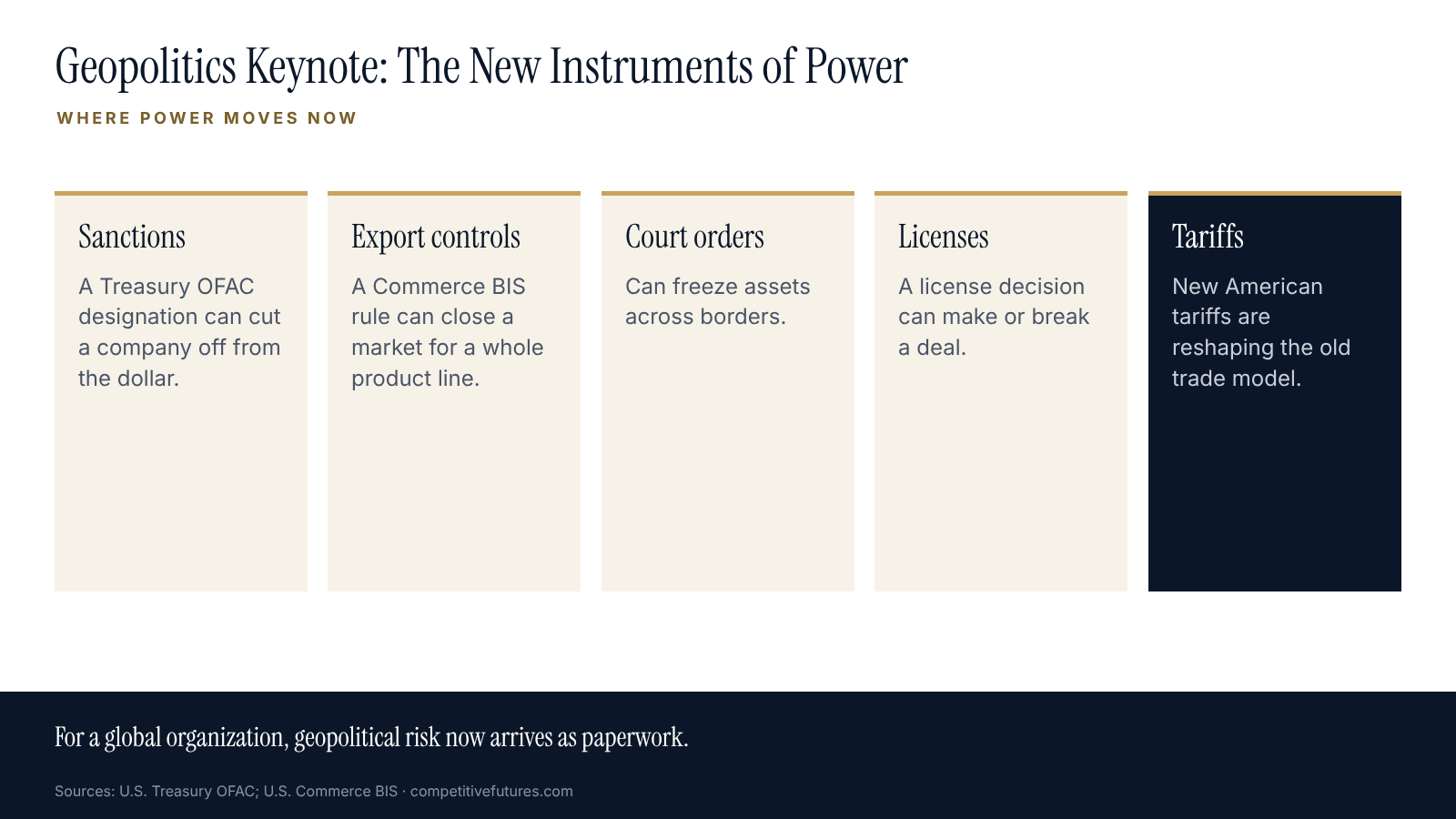
For thirty years after the Cold War, the global economy ran on a familiar model: offshore finance, heavy consumer spending, manufacturing moved abroad, and, in the shadows, the growth of transnational organized crime. The keynote argues that this model is coming apart, and that a new one is taking shape now.
The forces reshaping it are visible in the news every week: new American tariffs, a NATO rearming to counter Russia, reduced economic dependence on China, a more modern and more central Mexico, and pressure on the criminal networks that the old model let flourish. The keynote argues that these trends point to a decline in transnational organized crime, and explains why.
Power now moves through paperwork
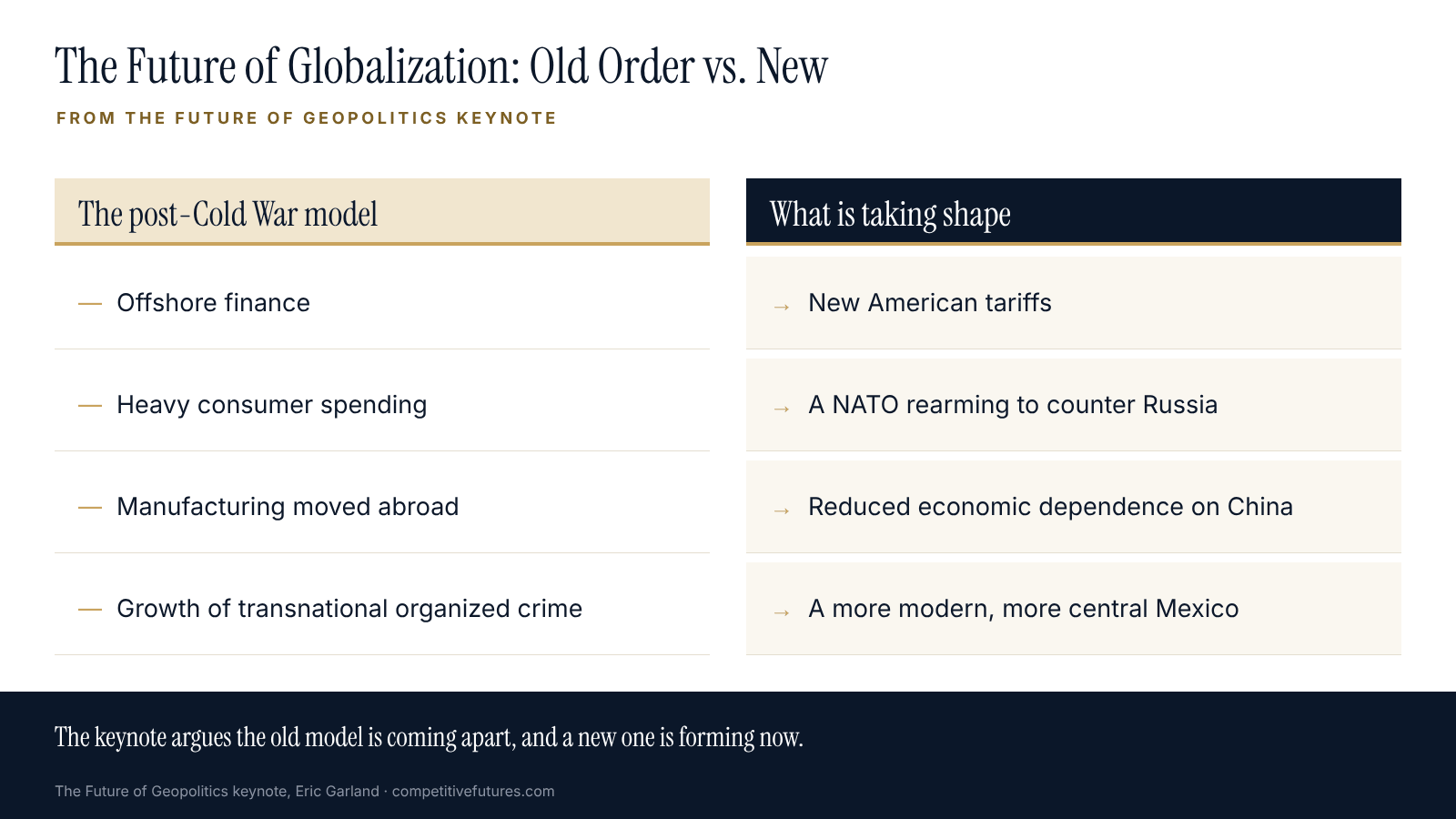
The most important instruments of national power today are often legal and administrative. A sanctions designation from the Treasury’s Office of Foreign Assets Control can cut a company off from the dollar. An export-control rule from the Commerce Department’s Bureau of Industry and Security can close a market for an entire product line. A court order can freeze assets across borders, and a license decision can make or break a deal. We cover each of these regimes in our enforcement risk series.
For a global organization, this changes the questions that matter. Which of our counterparties could be designated? Which of our products depend on controlled technology? Which jurisdictions could turn a routine contract into a legal problem? The keynote gives leaders a way to think about those questions before they arrive as a crisis.
What audiences take away
- A clear picture of what is replacing the post-Cold War order, and why it won’t simply revert.
- How sanctions, export controls, licenses, court orders, and tariffs shape markets, supply chains, and counterparty risk.
- The regions and relationships most likely to change in the decade ahead, including North America, Europe, and China.
- Practical steps to protect value while the rules keep moving.
From the stage to the organization
Geopolitical risk used to be something a company read about. Now it arrives as a compliance notice, a frozen payment, or a lost export license. Organizations that track enforcement as closely as they track competitors see these moves early. That is the core of an intelligence function for a global company, and it is the work behind our enforcement risk practice and our quarterly brief.
Frequently asked questions
What is The Future of Geopolitics keynote about?
It explains how the post-Cold War global order is ending, what is replacing it, and how sanctions, export controls, licenses, court orders, and tariffs now shape business and government.
Is this the same talk as The Future of Globalization?
Yes. Some speakers bureaus list it as “The Future of Globalization: What Business and Government Will Really Look Like in the 21st Century.”
Who should book a geopolitics keynote speaker?
Financial services firms, multinationals, law and professional-services firms, government leadership programs, and associations whose members trade, invest, or operate across borders.
Is the content up to date?
Yes. The keynote is rebuilt each quarter from the research behind the Systemics Quarterly Brief and tailored to each audience’s sector and regions.
Is the keynote partisan?
No. It looks at what governments and courts are actually doing and what it means for organizations, whoever is in office.
How long is it, and can it be delivered virtually?
45 to 60 minutes with Q&A, in person or virtually, in English or French.
Work with Competitive Futures
To check dates, contact us with your event date, location, and audience. We will be in touch within one business day with availability, fees, and a proposed angle. Speakers bureaus are welcome to inquire on a client’s behalf.
Related from Competitive Futures
- Enforcement Risk: How U.S. Law Became an Instrument of Geopolitics
- U.S. Sanctions and OFAC
- U.S. Export Controls
- 7 Questions to Ask a Geopolitics Speaker Before the Event
- The Chaos Advantage keynote
References
- U.S. Department of the Treasury, Office of Foreign Assets Control. https://ofac.treasury.gov/
- U.S. Department of Commerce, Bureau of Industry and Security. Export Administration Regulations, 15 C.F.R. Parts 730–774. https://www.bis.gov/regulations