Competitor Analysis: What It Is, Where the Classic Frameworks Came From, and Why Most of It Misses the Next Move
Every company does competitor analysis, whether it calls it that or not. The sales team swaps notes on a rival’s pricing, the product team tears down a competing release, and the strategy group builds a slide comparing market shares. The question is never whether a company studies its rivals. It is whether that study tells leaders anything they can act on before the rival acts first.
This page explains what competitor analysis is and how it differs from competitive intelligence, where the standard frameworks came from, why so many analyses fail in predictable ways, and what a few famous misreadings teach. It is written for executives who want to judge the analysis in front of them.
Competitor analysis at a glance
- What it is: the structured study of specific, known rivals: what they want, what they are doing, what they believe, and what they are able to do, in order to anticipate how they will act and react.
- How it differs from competitive intelligence: competitor analysis is one product within competitive intelligence, which also covers markets, technologies, regulators, suppliers, and rivals that do not exist yet.
- The founding framework: Michael Porter’s four-component model, published in chapter 3 of Competitive Strategy (Free Press, 1980), examines a rival’s future goals, assumptions, current strategy, and capabilities.
- The most common tools: Porter’s Five Forces (1979) and SWOT analysis, both of which describe the field more than they predict any one rival.
- Why it fails: analyses tend to be static, backward-looking, fixed on today’s incumbents, and shaped by the analyst’s own assumptions.
- The real goal: not a profile of the rival but a forecast of its next move and of how it will respond to yours.
- The boundaries: good competitor analysis rests on lawful, ethical collection; trade secret law and professional codes draw the lines.
What competitor analysis is, and what it isn’t
Competitor analysis is the part of strategy that takes a single rival, or a small set of them, and asks how they will behave. In Competitive Strategy, Porter built his framework toward a “competitor response profile,” a synthesis meant to predict a rival’s offensive moves and its defensive reactions (chapter summary; HBS). That is a forecasting problem, not a filing problem.
It is not a feature comparison table, which describes products rather than the decisions behind them, or a market share chart, which records past moves. Nor is it the whole of competitive intelligence. Competitive intelligence is the broader discipline of collecting and analyzing information about the entire external environment (customers, technologies, regulation, capital flows, and geopolitics as well as rivals) to support decisions. Competitor analysis is the slice aimed at named, known opponents. A company can be excellent at it and still be blindsided, because the most dangerous rival is often one that does not yet appear on the list, the subject of our page on identifying future competitors. For how competitive intelligence sits alongside market research and business intelligence, see competitive intelligence vs. market research.
Academic research has sharpened the concept since Porter. Ming-Jer Chen, writing in the Academy of Management Review in 1996, proposed judging each rival on two dimensions, how much its markets overlap with yours (“market commonality”) and how alike its strategic resources are (“resource similarity”), and introduced the idea of competitive asymmetry: two firms do not necessarily threaten each other equally (Chen, 1996). A company may see a rival as a minor nuisance while that rival sees the company as its primary target.
Where competitor analysis fits on the path to foresight
Competitor analysis is not the top of the ladder. Organizations build foresight in stages, and each stage rests on the one below it. They start with their own numbers: sales, profit margins, costs, and R&D (Level 0). Next they learn why they win and why they lose against rivals (Level 1). Competitor analysis is Level 2: sales battle cards, maps of competing products and services, and industry forecasts.
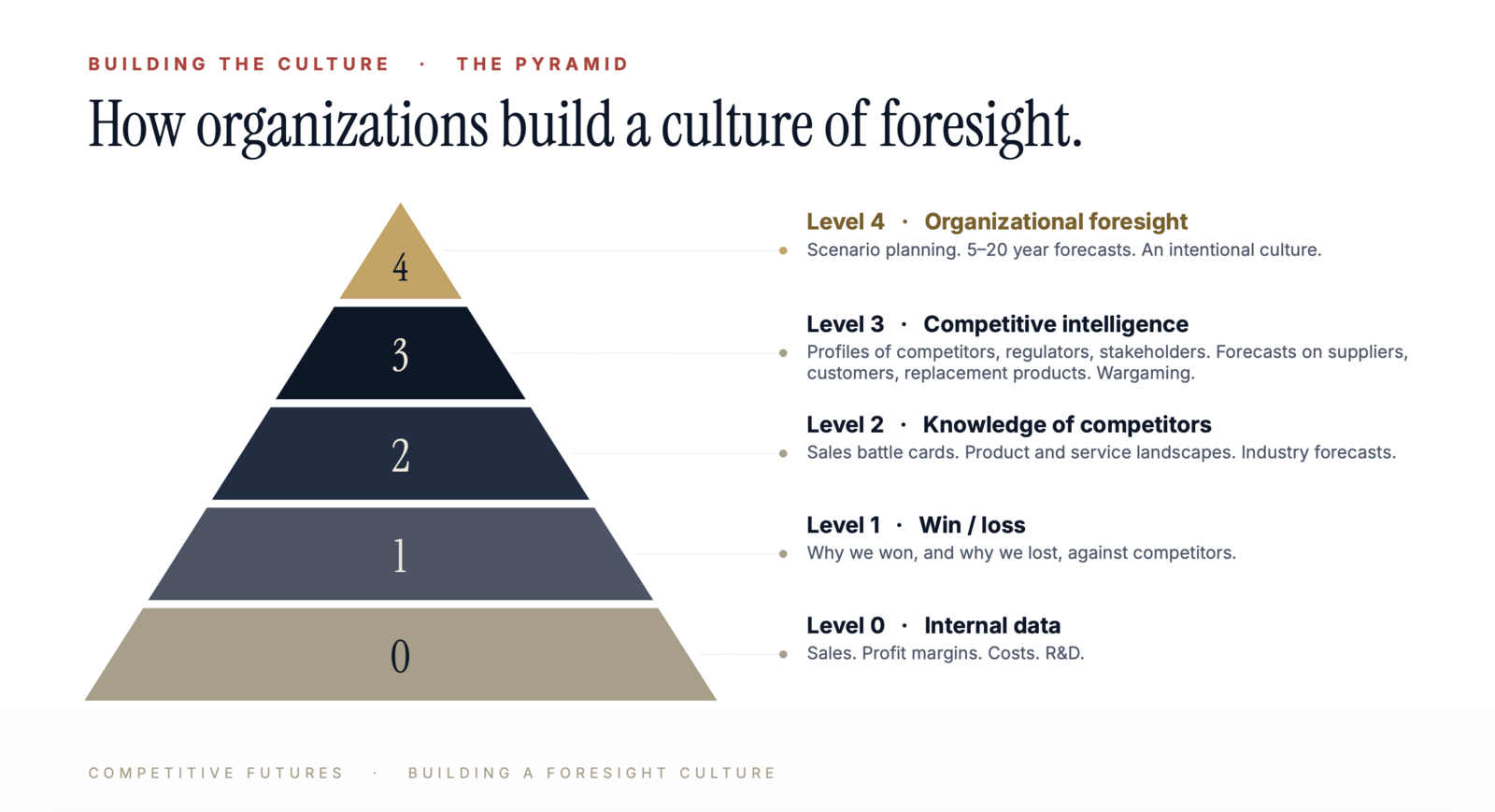
The levels above it are where the questions get harder. Competitive intelligence (Level 3) extends the profiles beyond rivals to regulators and other stakeholders, forecasts what suppliers, customers, and replacement products will do, and uses wargaming to test how rivals will respond. Organizational foresight (Level 4) adds scenario planning, forecasts that run five to twenty years out, and a culture that looks ahead on purpose; see strategic foresight.
Many of the failures described below come from stopping at Level 2 and treating it as the whole job. A company can have excellent battle cards and still miss the substitute product, the regulator, or the entrant that changes the market.
The public frameworks and their authors
Porter’s four components (1980)
Porter’s framework, often called “four corners” analysis, remains the most cited model built specifically for studying a rival. It looks at four things: the competitor’s future goals, at the business-unit and corporate-parent level; its assumptions about itself and the industry; its current strategy; and its capabilities, including its staying power and its ability to respond quickly and adapt (chapter summary). Porter combined these into a “competitor response profile” meant to predict offensive and defensive moves.
The insight most readers skip is the second component. Porter argued that examining a rival’s assumptions can reveal its “biases or blind spots,” and that a firm can win by picking the battleground where the competitor is least prepared to defend (chapter summary). Goals and capabilities can be estimated from public data. Assumptions are harder to see, and they are where the leverage is.
Five Forces (1979 and 2008)
Porter’s Five Forces, introduced in the Harvard Business Review in 1979, maps the structure of an industry through the threat of new entrants, the bargaining power of buyers and suppliers, the threat of substitutes, and rivalry among existing competitors (HBR, 1979). It is an industry tool rather than a competitor tool, but it carries a warning that every competitor analysis should heed. In his 2008 update, Porter wrote that “managers define competition too narrowly, as if it occurred only among today’s direct competitors” (HBR, 2008). Four of the five forces are about players other than direct rivals. Our longer explainer is Michael Porter’s Five Forces of Competition.
SWOT and its limits
SWOT (strengths, weaknesses, opportunities, threats) is the most widely used and least examined tool in the strategy kit. Its origins were long murky; a 2023 study in Long Range Planning traced it, through archival research and interviews, to a planning scheme called SOFT associated with Robert F. Stewart, later relabeled SWOT (Puyt, Lie, and Wilderom, 2023). Its weaknesses have been documented for decades. A 1997 study of 20 UK manufacturing companies by Terry Hill and Roy Westbrook, titled “SWOT Analysis: It’s Time for a Product Recall,” concluded that it was ineffective as a means of analysis or as part of a corporate strategy review, citing long, unprioritized lists and claims that were never verified (Hill and Westbrook, 1997).
Applied to a competitor, SWOT is a snapshot of what the analyst believes today, in the analyst’s own categories; it says nothing about what the rival intends. We make the full case in Why SWOT Analysis Sucks.
Why most competitor analyses fail

The failures are consistent across industries, and few come from a lack of data. They come from framing.
It is static. Many competitor analyses are annual documents built for a planning cycle, but rivals do not move on a planning calendar. A profile accurate in January can be wrong by June, which is why the discipline treats competitor understanding as continuous rather than periodic, the theme of our page on competitive early warning.
It looks in the rearview mirror. Market share, revenue, and product catalogs are lagging indicators of what a competitor has already done. The useful questions concern intent and capability: what the rival is building toward and what it would do if conditions changed.
It watches the incumbents. Clayton Christensen and Joseph Bower documented in 1995 “the failure of leading companies to stay at the top of their industries when technologies or markets change,” often because the threat came from products that the leaders’ best customers did not yet want (HBR, 1995). A competitor analysis that lists the five firms everyone already knows will miss the entrant, the substitute, and the adjacent player crossing over. Porter’s own warning about defining competition too narrowly applies here (HBR, 2008).
It confirms what leadership already believes. Confirmation bias, the tendency to seek and interpret evidence in ways that support existing beliefs, is one of the best documented findings in psychology (Nickerson, 1998). In competitor analysis it shows up when a team gathers evidence that a rival is weak because leadership has already decided it is. Edward Zajac and Max Bazerman argued in the Academy of Management Review that decision makers have systematic “blind spots” about competitors’ contingent decisions, and that these blind spots help explain recurring patterns such as industry overcapacity, failed entries into new businesses, and acquisition premiums (Zajac and Bazerman, 1991).
It mirror-images. Intelligence analysts use the term mirror imaging for the habit of assuming an opponent thinks the way you do: shares your goals, weighs costs as you would, and reads the market through your eyes. In business it sounds like “they would never cut prices that far.” Porter built assumptions into his framework because a rival’s logic often differs from your own. The broader set of traps is covered on our cognitive bias page.
The common thread is that competitor analysis is a judgment about the future made under uncertainty. It will sometimes be wrong; the aim is to be wrong less often, and in less costly ways, a point developed in Intelligence Is Always Wrong. Decide Anyway.
How competitor analysis relates to adjacent disciplines
Competitor analysis borrows from, and feeds, several neighboring practices. It sits inside the intelligence cycle, which begins with the decision a leader needs to make and works back to the information required. It overlaps with strategic foresight and scenario planning, which ask how the field itself might change, and with trend analysis, which tracks the forces that will reshape what rivals can do. Business war games, which use role-play to make a team argue from a rival’s point of view, exist largely as a countermeasure to mirror imaging. Our list of competitive intelligence books covers the field’s wider literature.
It also has limits set by law and ethics. Studying rivals through public and lawfully obtained information is standard practice. Taking trade secrets is not: the Economic Espionage Act makes theft of trade secrets a federal crime (18 U.S.C. § 1832), and the profession’s association, now the Strategic Consortium of Intelligence Professionals (SCIP), maintains a code of ethics for practitioners. See our pages on ethical collection in competitive intelligence, the SCIP Code of Ethics, and the Economic Espionage Act. Where a collection question is close, talk to counsel.
Cases where companies misread their rivals
Blockbuster and Netflix (2000)
In 2000, Netflix co-founders Reed Hastings and Marc Randolph offered to sell the company to Blockbuster for $50 million and run its online business. Former Netflix CFO Barry McCarthy later said Blockbuster “laughed us out of their office.” Blockbuster eventually launched a strong online counterattack, Total Access, in 2006, which cost Netflix subscribers, but the effort was pulled back after a change in leadership, and Blockbuster filed for bankruptcy in 2010 (CNBC). Lesson: a small rival’s size says little about its trajectory, and a correct read abandoned is as costly as a wrong one.
Kodak and Fujifilm (1975 to 2012)
Kodak engineer Steven Sasson built the first digital camera in Kodak’s Rochester lab in 1975 and received a patent in 1978, but executives did not see a market for it (IEEE Spectrum). Kodak filed for Chapter 11 protection in January 2012; analysts pointed to its reluctance to cannibalize film and its half-hearted diversification, while its longtime film rival Fujifilm moved into medical imaging, flat-panel display film, and cosmetics (Marketplace). Lesson: watching your familiar rival is not the same as watching the forces that can make both of you obsolete.
Frequently asked questions
What is competitor analysis?
Competitor analysis is the structured study of specific rivals, including their goals, assumptions, current strategy, and capabilities, in order to anticipate their moves and their likely responses to yours. It is one part of the broader discipline of competitive intelligence.
What is the difference between competitor analysis and competitive intelligence?
Competitor analysis focuses on known, named rivals. Competitive intelligence is the wider practice of collecting and analyzing information about the whole external environment, including customers, technologies, regulators, suppliers, and potential entrants, to support decisions. Competitor analysis is one of its outputs.
Who created the competitor analysis framework?
The best-known framework comes from Michael Porter’s 1980 book Competitive Strategy: Techniques for Analyzing Industries and Competitors, which analyzes a rival’s future goals, assumptions, current strategy, and capabilities. Later academic work, such as Ming-Jer Chen’s 1996 research on market commonality and resource similarity, extended it.
Is SWOT analysis good enough for competitor analysis?
Usually not on its own. SWOT is a snapshot in the analyst’s own categories and says little about a rival’s intentions. It can start a discussion, but it rarely predicts a competitor’s next move.
Is competitor analysis legal?
Studying rivals through public and lawfully obtained information is legal and routine. Misappropriating trade secrets, misrepresenting who you are to obtain information, or inducing someone to breach a confidentiality obligation can create civil and criminal liability. The lines depend on the facts and the jurisdiction, so questions about specific methods belong with counsel.
Related reading
- What Is Competitive Intelligence?
- Identifying Future Competitors
- Competitive Early Warning
- Competitive Intelligence vs. Market Research vs. Business Intelligence
- Michael Porter’s Five Forces of Competition
- Why SWOT Analysis Sucks
- Cognitive Bias: A Field Guide for Leaders Who Must Decide Under Uncertainty
- How to Build a Competitive Intelligence Function
- Ethical Collection in Competitive Intelligence
Competitive Futures builds and runs competitive intelligence for companies that need to see their rivals clearly; details are on the competitive intelligence page.
This piece is part of our guide to Competitive Intelligence: The Complete Guide.