Michael Porter: The Strategist Who Gave Competitive Intelligence Its Mandate

Michael E. Porter (born 1947) is a Harvard Business School professor and the most influential thinker in modern business strategy. His 1980 book Competitive Strategy gave executives the vocabulary still used in boardrooms: industry structure, the Five Forces, generic strategies, and competitor analysis. It also contained a short section, “The Need for a Competitor Intelligence System,” that a generation of practitioners took as a mandate. Within six years of the book’s publication, competitive intelligence had its first bestselling handbook, its first corporate units, and its own professional society.
Porter didn’t invent competitive intelligence, and he never claimed to. What he did was more important: he made a rigorous economic case that strategy depends on understanding competitors and the forces around them, and then pointed out that almost no company was organized to gather that understanding systematically. The CI profession grew up to fill the gap he described.
At a glance
- Born: 1947, Ann Arbor, Michigan.
- Education: B.S.E. in aerospace and mechanical engineering, Princeton (1969); MBA (1971) and Ph.D. in business economics (1973), Harvard.
- Career: Harvard Business School faculty from 1973; named a Harvard University Professor in 2000, the university’s highest faculty honor; Bishop William Lawrence University Professor, now emeritus.
- Key works: “How Competitive Forces Shape Strategy” (HBR, 1979), Competitive Strategy (1980), Competitive Advantage (1985), The Competitive Advantage of Nations (1990), “What Is Strategy?” (HBR, 1996).
- Institutions: co-founder of the Monitor Group consultancy (1983) and FSG; the Institute for Strategy and Competitiveness at Harvard was created in 2001 to carry on his work.
- Legacy for intelligence: the four-component competitor analysis framework, the case for a formal competitor intelligence system, and the idea that competition extends well beyond today’s direct rivals.
From aerospace engineer to strategist
Porter trained as an engineer at Princeton before taking his MBA and doctorate at Harvard, where he joined the faculty in 1973 (Princeton; FSG). His doctoral field was industrial organization, the branch of economics that studies how the structure of an industry shapes the behavior and profits of the companies in it.
That background shaped his career. Industrial-organization economists had long studied industries from the point of view of regulators, asking whether markets were competitive enough. Porter flipped the question around and asked it from the company’s point of view: given the structure of my industry, where can I make money, and how do I defend it? That shift is the foundation of modern strategy.
The Five Forces (1979)
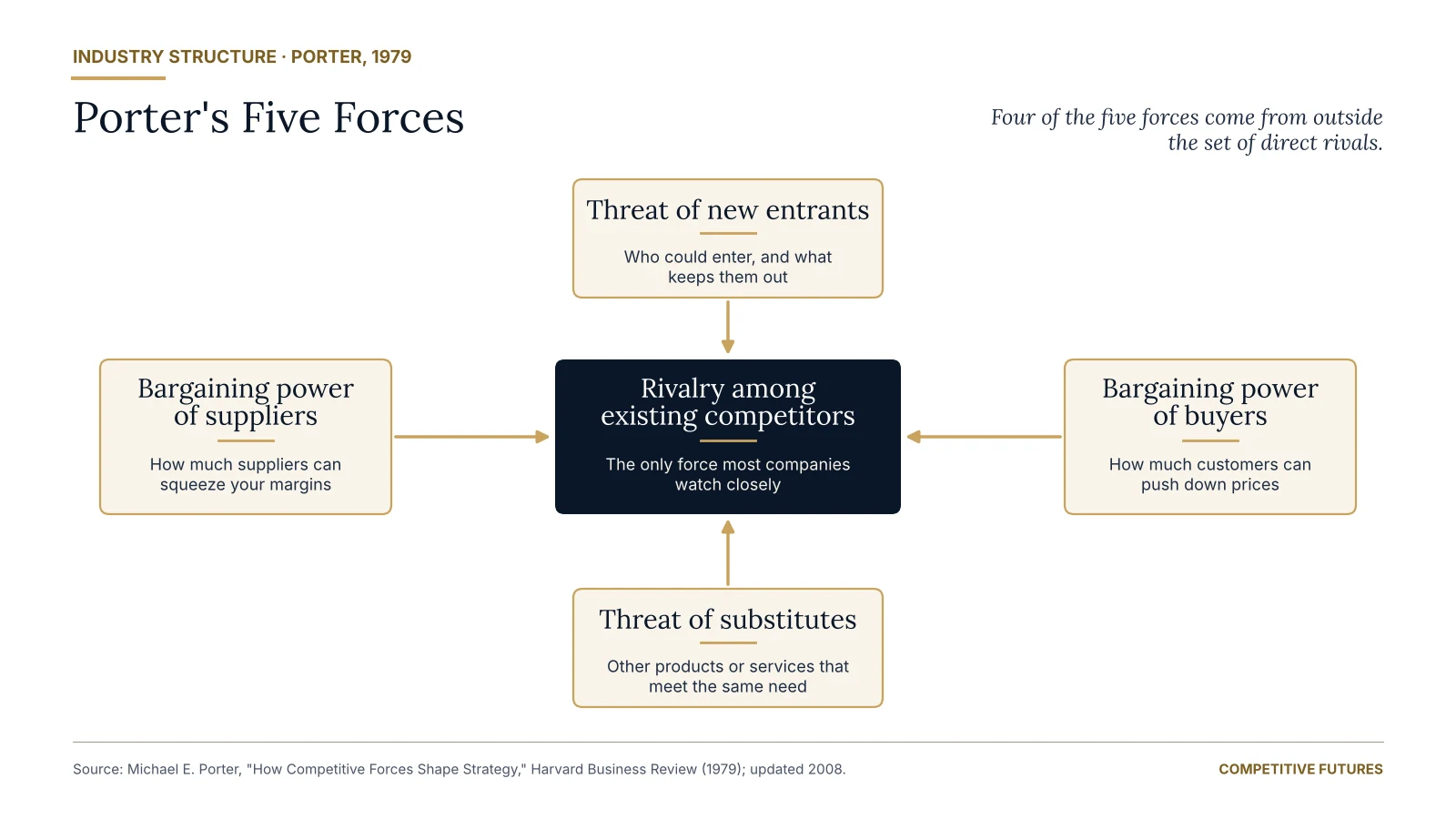
Porter’s first Harvard Business Review article, “How Competitive Forces Shape Strategy,” appeared in 1979 when he was a young associate professor (HBR). It argued that an industry’s long-run profitability is set by five forces: rivalry among existing competitors, the threat of new entrants, the threat of substitutes, and the bargaining power of buyers and of suppliers.
The intelligence lesson was in the framing. In his 2008 update, Porter wrote that managers often define competition too narrowly, as though it happened only among today’s direct rivals (Chief Executive, reprinting HBR). Four of the five forces are about players who aren’t direct competitors at all. Any intelligence function that watches only rivals is watching one-fifth of the problem.
Our longer explainer is Michael Porter’s Five Forces and Competitive Intelligence.
Competitive Strategy (1980): the book that started a profession
A year later Porter expanded those ideas into Competitive Strategy: Techniques for Analyzing Industries and Competitors (Free Press, 1980) (Harvard Business School). It is one of the most widely read business books ever written, and it has been reprinted dozens of times and translated into many languages.
The book did three things that matter for intelligence work.
It set out the generic strategies. Porter argued that companies succeed through overall cost leadership, differentiation, or focus on a narrow segment, and that a company trying to do all three risks getting “stuck in the middle” (SSRN abstract). To know which position you can hold, you have to know which positions your rivals already hold.
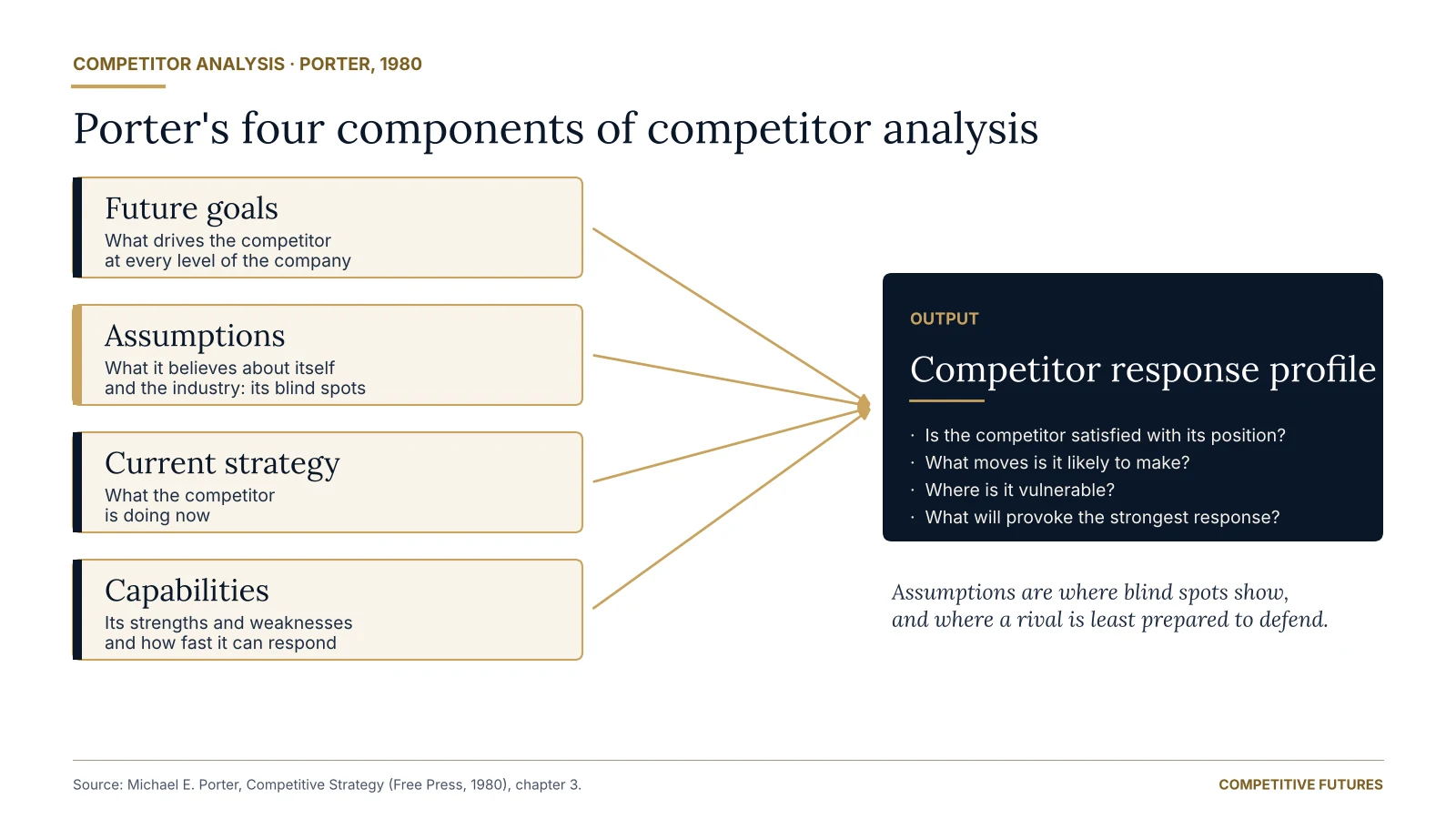
It made competitor analysis a formal discipline. Chapter 3, “A Framework for Competitor Analysis,” broke a rival down into four diagnostic components: its future goals, its assumptions about itself and the industry, its current strategy, and its capabilities (MAAW chapter summary). Together they produce a “competitor response profile” that estimates how a rival will move and how it will react to yours. Practitioners still call it “four corners” analysis.
The most valuable corner is the one most often skipped. Porter pointed out that a competitor’s assumptions can reveal its blind spots, and that a company can win by choosing the battleground where a rival is least prepared to defend (MAAW). Goals and capabilities can be estimated from public data. Assumptions are a matter of how the other side thinks, and reading them takes the same discipline intelligence analysts use against cognitive bias (see our guide to cognitive bias in intelligence analysis).
It called for an intelligence system. At the end of that chapter, Porter acknowledged a practical problem. The data needed to answer his questions is hard to get, arrives in fragments from many sources over time, and is useless unless someone collects it, catalogs it, digests it and gets it to decision-makers. Hence the section title: “The Need for a Competitor Intelligence System” (MAAW). Chapters 4 and 5 went further, covering how to read rivals’ market signals and including a note on information and secrecy in competitive moves.
That one section turned out to be a founding document. John McGonagle’s history of the field identifies Porter’s call for creating a competitor analysis system as the profession’s point of origin (AFIO), and the book is widely treated as the founding text of modern competitive intelligence.
How Porter inspired the creation of competitive intelligence
Porter described what companies needed. A group of practitioners, many with backgrounds in government intelligence, built it. The sequence happened quickly:
- 1979: Leonard Fuld founds Fuld & Company, an early specialist in business intelligence (Encyclopedia of Management). Today it is the Strategic Consortium of Intelligence Professionals.
- 1980: Porter publishes Competitive Strategy.
- 1983: Jan Herring, a career government intelligence analyst, joins Motorola, which builds one of the first full-time corporate CI units. CEO Robert Galvin wanted a capability like the government programs he had seen (AFIO).
- 1985: Fuld publishes Competitor Intelligence: How to Get It, How to Use It (Wiley), the field’s first bestselling handbook (AbeBooks author record).
- 1986: The Society of Competitor Intelligence Professionals (SCIP) is founded. It later became the Society of Competitive Intelligence Professionals, reflecting a scope beyond rivals (Encyclopedia of Management).
- 1988: Ben and Tamar Gilad publish The Business Intelligence System (AMACOM), an early model for organizing a corporate CI function.
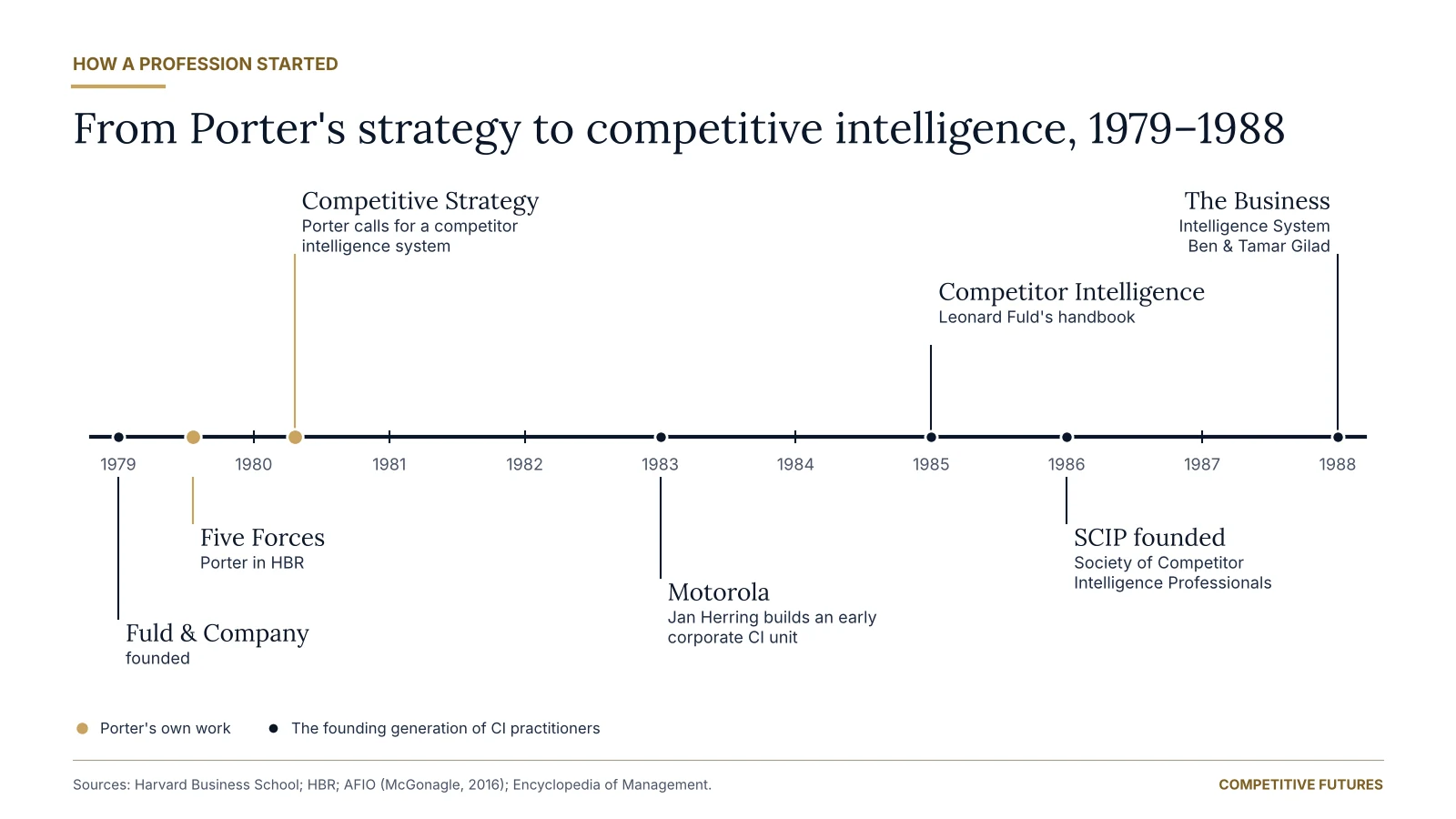
The early name tells the story. The founders called it competitor intelligence because Porter’s framework was about studying rivals. The shift to competitive intelligence, covering customers, suppliers, regulators, technologies and new entrants, followed the logic of his Five Forces: competition is bigger than the company across the street.
Porter supplied the “why” and much of the “what.” The founding generation supplied the “how”: collection, ethics, analysis and delivery. That division still defines the profession. For the full history, see What Is Competitive Intelligence?
Competitive advantage, the value chain and clusters
Porter’s later work extended the toolkit in directions intelligence analysts still use.
The value chain (1985). Competitive Advantage: Creating and Sustaining Superior Performance broke a company into the activities it performs, from inbound logistics and operations to marketing and service, and argued that advantage comes from how those activities are configured. For an analyst, the value chain is a map of where a rival’s costs and strengths come from, and therefore where it’s exposed.
Nations and clusters (1990). The Competitive Advantage of Nations asked why particular countries and regions dominate particular industries. Porter’s answer, the “diamond” of factor conditions, demand conditions, related and supporting industries, and firm strategy and rivalry, introduced the idea of industry clusters. It is the bridge between corporate strategy and the economic-security questions governments now ask about supply chains and state-backed competitors.
“What Is Strategy?” (1996). In this HBR essay Porter drew a sharp line between operational effectiveness (doing the same things better) and strategy (choosing to do different things, and accepting trade-offs). It remains the best short answer to executives who confuse benchmarking with strategy.
Later, through the Institute for Strategy and Competitiveness, which Harvard created in 2001 to further his work (Princeton), Porter applied the same thinking to health care delivery, economic development and the relationship between business and society.
Critiques and limits
Porter’s work has drawn serious criticism, and a good analyst should know it.
Too much industry, not enough company. Scholars of the resource-based view argued that Porter’s early work explained profits mainly through industry structure and underweighted what makes individual firms different: their resources, capabilities and knowledge (Organizations and Markets). Porter’s later value-chain work answered part of this, but the debate continues.
Too static for fast markets. Critics have argued that the Five Forces describe an industry at a moment in time and struggle with markets where boundaries shift quickly, platforms blur industries and advantages erode fast. That’s a fair limit on the framework, though it’s also a reason to pair structural analysis with early warning and scenario work rather than abandon it.
The Monitor episode. Monitor Group, the consultancy Porter co-founded in 1983, filed for bankruptcy in November 2012 and sold its assets to Deloitte (Consulting magazine). Critics used it to question his frameworks. The fairer lesson is narrower: a framework for analyzing an industry is not a guarantee of execution, and no analytical method survives a company that stops using it on itself.
What Porter means for intelligence work today
Four of Porter’s ideas remain at the core of competitive intelligence:
- Competition is wider than your rivals. Entrants, substitutes, buyers and suppliers can do more damage than the competitor you watch every day.
- Study how competitors think, not just what they do. Assumptions and blind spots are where the leverage is.
- Intelligence has to be a system. Fragments of information are worthless until someone collects, analyzes and delivers them on purpose.
- Strategy means choosing. Intelligence earns its keep when it helps leaders decide what not to do.
Porter wrote that a competitor intelligence system was needed. Four decades later, most companies still don’t have one that works. That gap is what we were built to close; see how to build a competitive intelligence function.
Frequently asked questions
Who is Michael Porter?
Michael E. Porter is a Harvard Business School professor, born in 1947, widely regarded as the father of modern business strategy. He is best known for the Five Forces framework, generic competitive strategies, the value chain and The Competitive Advantage of Nations.
How did Michael Porter influence competitive intelligence?
Porter’s 1980 book Competitive Strategy set out a formal framework for analyzing competitors and argued that companies needed a “competitor intelligence system” to collect and analyze the information it required. Practitioners built that system over the following decade, and the book is widely treated as the founding text of the field.
What are Porter’s four components of competitor analysis?
A competitor’s future goals, its assumptions about itself and the industry, its current strategy, and its capabilities. Combined, they produce a competitor response profile that estimates how a rival will act and react. The framework is often called “four corners” analysis.
What are Porter’s Five Forces?
Rivalry among existing competitors, the threat of new entrants, the threat of substitutes, the bargaining power of buyers, and the bargaining power of suppliers. Together they determine an industry’s long-run profitability.
When was the Society of Competitive Intelligence Professionals founded?
In 1986, six years after Competitive Strategy was published. It began as the Society of Competitor Intelligence Professionals and has since been renamed, and today it is the Strategic Consortium of Intelligence Professionals.
Work with Competitive Futures
We build and run the kind of intelligence system Porter said every company needed: competitor analysis, early warning and strategic foresight for companies and governments. Request a 20-minute conversation, or see how we help organizations build a competitive intelligence function.
Related analysis from Competitive Futures
- What Is Competitive Intelligence?
- Michael Porter’s Five Forces and Competitive Intelligence
- Herman Kahn: The Father of Scenario Planning
- Clayton Christensen: How Disruption Theory Made Competitive Intelligence Smarter
References
- Fuld, L. M. (1985). Competitor Intelligence: How to Get It, How to Use It. Wiley.
- Gilad, B., & Gilad, T. (1988). The Business Intelligence System. AMACOM.
- McGonagle, J. J. (2016). Competitive intelligence. The Intelligencer: Journal of U.S. Intelligence Studies, 22(2). Association of Former Intelligence Officers.
- Porter, M. E. (1979). How competitive forces shape strategy. Harvard Business Review, 57(2), 137–145.
- Porter, M. E. (1980). Competitive Strategy: Techniques for Analyzing Industries and Competitors. Free Press.
- Porter, M. E. (1985). Competitive Advantage: Creating and Sustaining Superior Performance. Free Press.
- Porter, M. E. (1990). The Competitive Advantage of Nations. Free Press.
- Porter, M. E. (1996). What is strategy? Harvard Business Review, 74(6), 61–78.
- Porter, M. E. (2008). The five competitive forces that shape strategy. Harvard Business Review, 86(1), 78–93.
This piece is part of our guide to Pioneers of Strategy, Intelligence, and Foresight.