Iran War and the Midterms: The Numbers Don’t Fit
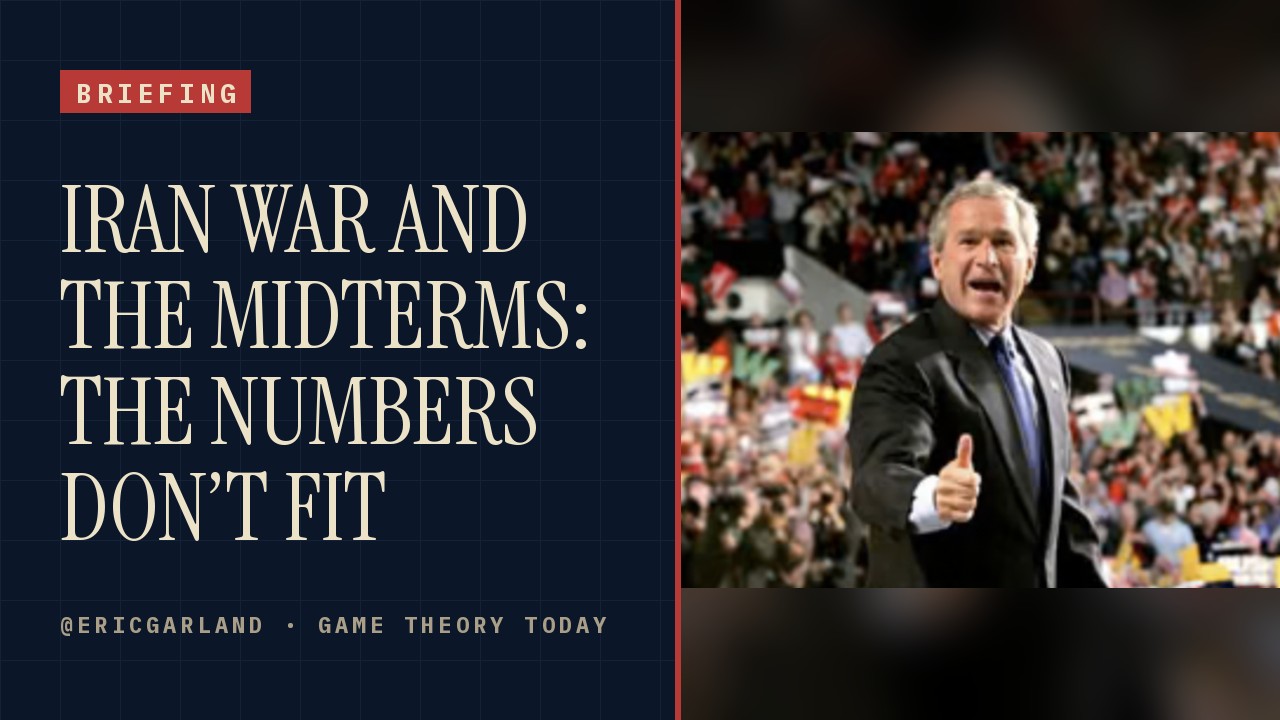
The Iran War and the 2026 Midterms, by the Numbers
Did the Iran war decide the 2026 midterms? Democrats won control of the House and the Senate in the November 3, 2026 midterm elections. NBC News projects Democrats will hold at least 258 House seats, and seven Senate seats have flipped so far. The most common explanation is the war with Iran. Compare it with the last election held during a major American war. By November 2004, the Iraq War had cost 1,120 American lives and about 8,300 wounded, with 140,000 troops on the ground and about $94 billion spent through fiscal 2004, according to the Congressional Budget Office. On October 6, 2004, four weeks before the vote, the Iraq Survey Group’s Duelfer report confirmed that Iraq held no stockpiles of weapons of mass destruction. Operation Epic Fury had cost 21 American lives and 865 wounded as of October 9, 2026, with about 50,000 troops in the region and $43.6 billion spent through September 3, according to U.S. Central Command; the Congressional Budget Office estimated $38 billion through August 1. Adjusted for inflation, gasoline costs about 19 percent more than it did in election week 2004. In 2004, George W. Bush was re-elected, and Republicans gained three House seats and four Senate seats.
Why the Iran War Explanation Doesn’t Fit
The obvious objections are real. 2004 was a presidential election held three years after September 11, and most Americans still tied Iraq to the war on terror. 2026 was a midterm, and midterms usually punish the party in power. But on nearly every measure, Iran costs a fraction of what Iraq did: in 2004 there were more than fifty times the deaths, nearly ten times the wounded and more than twice the money. If casualties, spending and a discredited intelligence case did not decide 2004, it is not obvious how a smaller war decided 2026. The question is what actually moved voters this year, and whether the Iran war is the cause of the result or only the most convenient explanation for it.
For how the Iraq intelligence case failed, see Deep Dive: The Iraq War Intelligence Fraud and Operation Iraqi Freedom, cognitive bias, and intelligence. For the Iran side, see The Real Iran Threat and Iranian Intelligence: History, Structure, and the Headlines.
Eric Garland is an intelligence analyst personally sanctioned by the Russian Federation in May 2022 for his work on Russian intelligence operations. He is the author of the 2016 “Game Theory” thread, named by The New York Times as one of the 25 most important tweets in history.
🔔 Subscribe for daily geopolitical intelligence analysis. 📝 Substack: ericgarland.substack.com 🎤 Book Eric to speak: Leading Authorities — https://www.leadingauthorities.com/speakers/eric-garland
SOURCES
U.S. Department of Defense, Defense Casualty Analysis System, Operation Epic Fury casualties, updated October 9, 2026
U.S. Department of Defense, Operation Iraqi Freedom casualty reports, through October 2004
U.S. Central Command, Operation Epic Fury cost estimate, September 3, 2026
Congressional Budget Office, “Estimating the Cost of Combat Operations Against Iran,” September 15, 2026
Congressional Budget Office, cost of military operations in Iraq through fiscal year 2004
Central Intelligence Agency, Comprehensive Report of the Special Advisor to the DCI on Iraq’s WMD (Duelfer Report), released October 6, 2004
Office of the Director of National Intelligence, declassified Iran assessment, 2026
Clerk of the U.S. House of Representatives, Statistics of the Presidential and Congressional Election of November 2, 2004
U.S. Bureau of Labor Statistics, Consumer Price Index (CPI-U), 2004–2026
AAA, national average gasoline prices, October–November 2004 and November 1, 2026
CBS News poll, April 2004
CNN/SSRS poll, 2026
NBC News, 2026 midterm election projections, November 5, 2026
Task & Purpose, “Pentagon raises Iran war death toll to 21,” October 10, 2026
About Competitive Futures
Competitive Futures has provided strategic intelligence and foresight to corporate and government clients since 2002. Its principal, Eric Garland, publishes analysis here, on Game Theory Today, and in the Systemics Quarterly Brief.
Read next
- Seventy Countries, Six Cities: The Global Network Behind Iran
- The Systemics Quarterly Brief: 2026 Prospectus
- Strategic intelligence services for executives and governments
- All analysis from Competitive Futures
Stay in touch
Leave your email and a note about the Brief, a briefing for your team, or this piece, and we will be in touch.