The Twenty Committee: How Britain Ran Germany’s Spies in the Second World War
For most of the Second World War, German military intelligence believed it had a working espionage network inside Britain. It did. Every member of it was under British control. The body that decided what those agents could tell Germany was a small inter-service committee that met once a week in London from January 1941 until the war in Europe ended. It was called the Twenty Committee, and it was the policy arm of what MI5 still calls the Double Cross System. This page is part of our series on the history of intelligence services and sits alongside our page on British intelligence and our history of MI5 and MI6.
At a glance
- What it was: the inter-service committee that approved what Britain’s double agents told German intelligence, and the policy arm of the Double Cross System.
- When: weekly meetings from January 1941 to May 1945, chaired by J. C. Masterman.
- Who ran the agents: Section B1a of MI5 under T. A. Robertson. The committee answered to the W. Board of service intelligence directors.
- Scale: MI5 counts about 120 wartime German agents turned into double agents.
- The payoff: the D-Day deception of 1944, which kept two armored and nineteen infantry divisions at the Pas de Calais through July and August.
- The record: the committee’s minutes are files KV 4/63 to KV 4/69 at The National Archives.
The name was a joke about the Roman numeral for twenty
Written in Roman numerals, twenty is XX, a double cross. MI5’s official history notes the committee was “so called because the Roman numeral for twenty, XX, is a double cross,” and J. C. Masterman, who chaired it, wrote that it was “so called from the moment of its first meeting.” The files at The National Archives carry the name without ceremony: seven volumes catalogued as “Formation and minutes of the Twenty Committee in connection with Double Cross agents,” references KV 4/63 to KV 4/69, running from 27 December 1940 to 10 May 1945.
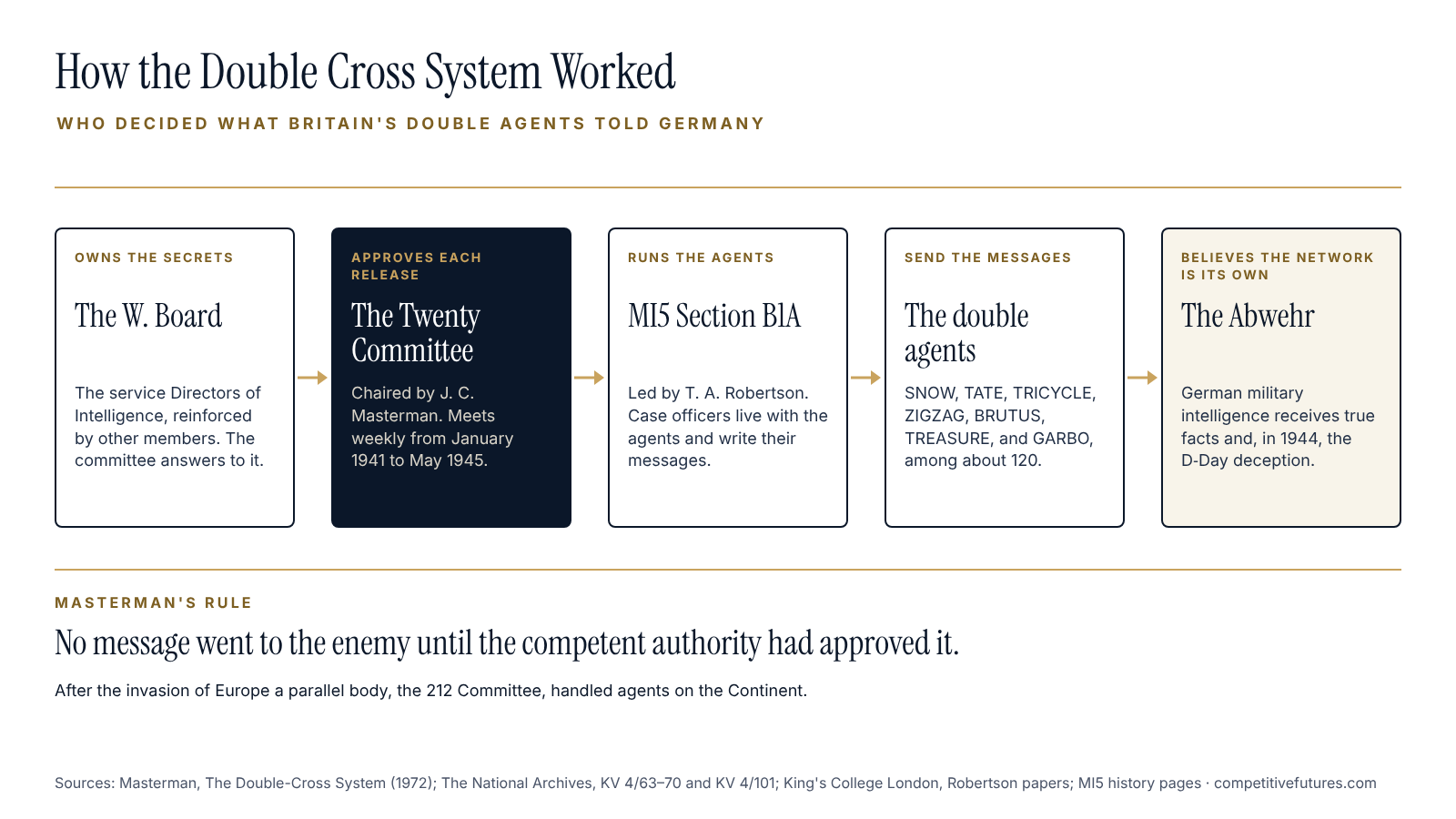
The committee was not the operation; MI5 ran the agents day to day. It existed because what those agents sent to Germany touched the secrets of every fighting service, and someone had to approve what was given away. Masterman put the rule plainly: no message should ever go to the enemy that had not been approved by the competent authority.
The pieces: B1a, the W. Board, and a weekly meeting
Three parts made the system work. The first was Section B1a of MI5, which Masterman described as the section “which dealt with the double agents.” It was built and led by Thomas Argyll Robertson, known as “Tar,” a Seaforth Highlanders officer who joined MI5 around 1931 and was seconded back to it in 1939. The catalogue of his papers at King’s College London records that he “built up and controlled double agent network through Section B1A” and “masterminded Operation FORTITUDE, 1944.” His case officers lived with their agents, wrote their messages, and kept the files that made consistency possible.
The second was the W. Board, to which the committee answered. Masterman describes the Twenty Committee as “technically a subcommittee of the W. Board,” and the W. Board as the service Directors of Intelligence “reinforced by other members.” Its papers survive as KV 4/70. When the committee released a genuine fact to the enemy, it did so on behalf of the men who owned the secret.
The third was the committee itself. Masterman, an Oxford historian and international sportsman, was seconded from the Intelligence Corps to MI5 and, in the words of the Imperial War Museums’ record of his life, “appointed by the director-general to chair the new Twenty (XX) Committee set up in January 1941 to funnel the flow of information through double agents to the enemy.” He records “the creation, in January 1941, of the Twenty Committee,” which “held weekly meetings from then until May 1945,” well over two hundred sittings, a total often given as 226.
The Twenty Committee’s membership drew on MI5, which owned the agents, on MI6, which handled the overseas side of their traffic, and on the service intelligence departments whose directors sat on the W. Board. B1a prepared case summaries for the committee; one set from October 1941 survives as KV 4/92. After the invasion of Europe a parallel body, the 212 Committee, handled agents on the Continent; its minutes (KV 4/101) call it “the SHAEF equivalent of the Twenty Committee.”
The system worked by giving the enemy a network he thought was his
MI5’s history states the achievement in Masterman’s words: “we actively ran and controlled the German espionage system in this country.” The service’s count is that about 120 wartime German agents were turned into double agents, and that almost all of the roughly 115 further agents sent against Britain were caught, the sole exception being one who took his own life before capture.
The mechanics were simple to describe and hard to do. A captured or volunteer agent kept transmitting to his German controllers under the hand of a case officer. To stay credible he had to send true information, which the trade called “chicken feed”: facts the enemy could verify or would soon learn anyway, released in quantities that kept the agent valuable without damaging the war effort. The committee weighed each release. Masterman’s list of the system’s aims began with controlling the enemy’s system “or as much of it as we could get our hands on,” ran through catching fresh spies when they appeared, and ended with the ambition to “deceive the enemy about our plans and intentions.”
Everything depended on the Germans believing the network was theirs, and on the British resisting the urge to use the channel too early. The payoff came not from any single message but from years of accumulated credibility.
The agents were an odd collection of volunteers, prisoners, and adventurers
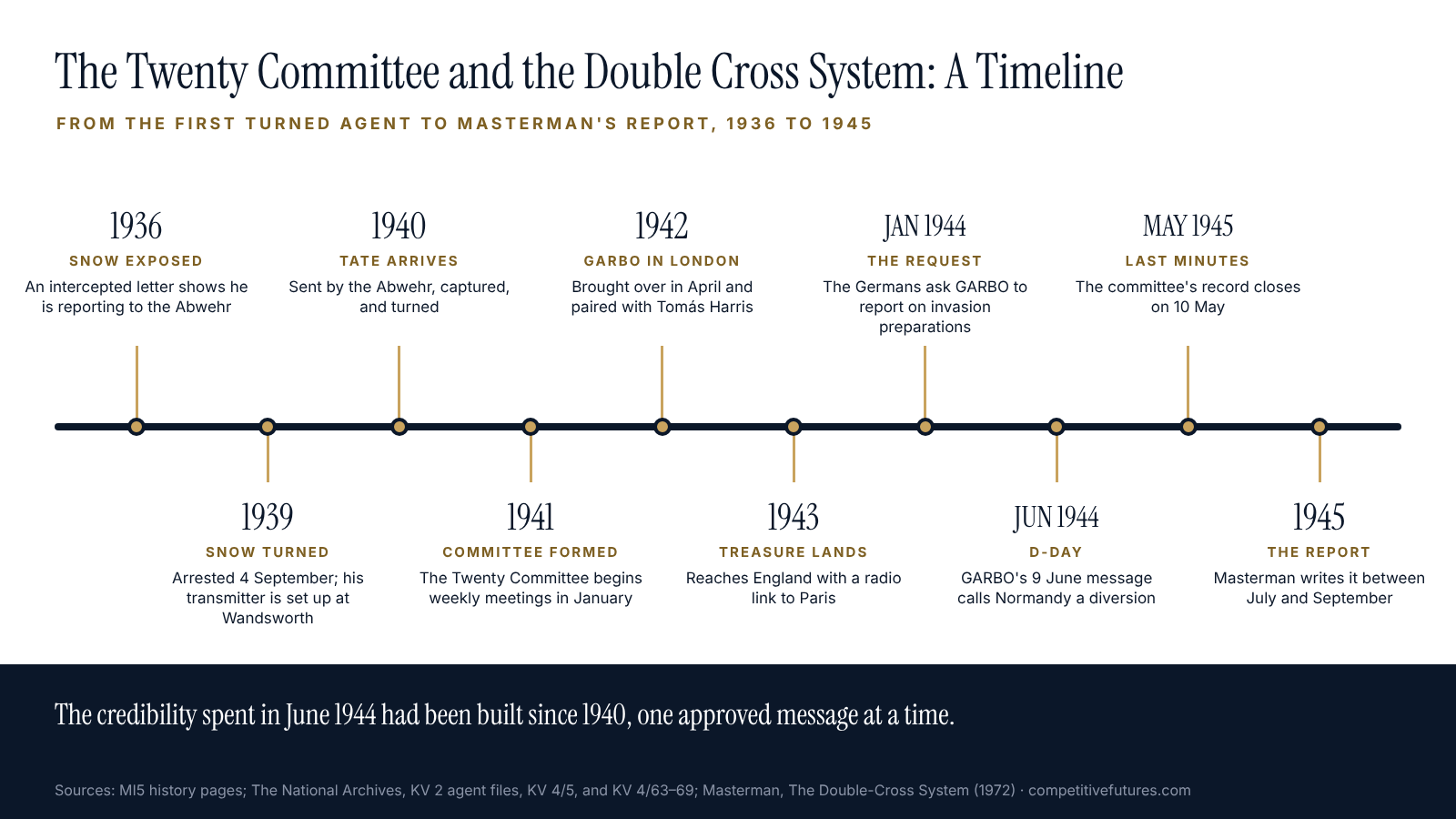
SNOW. The system began before the war. SNOW, a Welsh-born electrical engineer, was already reporting to the Abwehr when an intercepted letter exposed him in 1936. On 4 September 1939 he was arrested and held at Wandsworth Prison, where his German transmitter was installed. Masterman called him the “fons et origo” of the system; MI5 calls him “the first in a series of 120 wartime German agents who were turned by MI5.” Files: KV 2/444 to KV 2/453.
TATE. One of the agents the Abwehr trained and dispatched to Britain in 1940, TATE was captured, turned, and kept transmitting until the war’s end. His files are KV 2/61 and KV 2/62, “TATE: selected historical papers,” covering July 1940 to August 1945. Later accounts identify him as Wulf Schmidt; the catalogue uses only the code name.
TRICYCLE. Dusko Popov, a Yugoslav, was recruited by the Abwehr in 1940 and promptly reported the approach to the British. His files, KV 2/845 to KV 2/866, describe a man run by MI5 in London who communicated with the Abwehr in Lisbon, fed misinformation about the Normandy landings, and whose 1941 attempt to build an Abwehr network in the United States failed. He later received the OBE.
ZIGZAG. Edward Chapman was, in the words of his MI5 file, “a burglar and expert safe-blower before the Second World War.” Imprisoned in Jersey when the Germans occupied it in 1940, he offered them his services, was trained as a saboteur, and was parachuted into England, where he went straight to MI5. His controllers staged a fake sabotage of the de Havilland works at Hatfield and sent him back to his handlers in 1943; he returned with the Iron Cross. MI5 closed the case after learning he had told friends what he was doing. Files: KV 2/455 to KV 2/463.
BRUTUS. Roman Czerniawski, a Polish Air Force officer, founded the Interallié resistance network in occupied France. Arrested by German security in 1941, he agreed to work for the Germans, reached Britain, and was taken on by MI5 as BRUTUS. Files: KV 2/4351 to KV 2/4356, with further papers at KV 2/72 and KV 2/73.
TREASURE. Nathalie Sergueiew, a pre-war Paris journalist, “offered her services to an acquaintance working for German Intelligence” intending to double-cross them. After Abwehr training she went to Spain, contacted British intelligence, and reached England in 1943. Her radio link to her controller in Paris carried misleading reports on troop concentrations in southern England before D-Day, and MI5 used it until Paris was liberated. Files: KV 2/464 to KV 2/466.
GARBO. Juan Pujol García was never a captured German agent; he had, as The National Archives puts it, “set himself up on his own.” Rebuffed by British officials in 1941, he offered himself to German intelligence and invented a network of sub-agents in Britain from Lisbon using a travel guide and reference books. Brought to London in April 1942 and paired with case officer Tomás Harris, he grew the fiction into a network the Germans believed numbered more than two dozen sub-agents. Berlin awarded him the Iron Cross in July 1944; MI5 gave him the MBE that December. Files: KV 2/4190 to KV 2/4214, with earlier material at KV 2/40.
Fortitude was the payoff, and it took years to earn
The deception that protected the Normandy landings is why the Double Cross System is remembered. Fortitude aimed to convince the German high command that the main invasion would come at the Pas de Calais and that Normandy was a diversion. The notional threat was the First United States Army Group, a fictitious formation under General Patton supposedly holding eleven divisions in Kent and Essex.
The controlled agents were the channel, and the Twenty Committee approved what they carried. MI5 records that between January 1944, when the Germans asked GARBO to report on invasion preparations, and D-Day, more than 500 radio messages passed between GARBO and Madrid. On 9 June GARBO sent a long message arguing that Normandy was a diversion and the real blow would fall on the Pas de Calais. BRUTUS and TREASURE reinforced the picture. MI5 records that through July and August the Germans kept two armored and nineteen infantry divisions at the Pas de Calais, and that Field Marshal von Rundstedt overruled Rommel’s proposal to move them to Normandy.
None of this would have worked with a network built in 1944. GARBO had been writing to his German controllers since 1941; TATE had been transmitting since 1940. The credibility spent in June 1944 had been banked over years, one approved message at a time.
Masterman wrote the official report in 1945 and fought to publish it
Between July and September 1945 Masterman wrote a report on B1a and the double agents for internal use. The original survives as KV 4/5, “Mr J C Masterman’s report on the operation of B1A in connection with special agents during the Second World War, the Double Cross system.” He later wrote that “there was in 1945 no thought of publication at all.”
The report became The Double-Cross System in the War of 1939 to 1945, published by Yale University Press in 1972 (224 pages, with a foreword by Norman Holmes Pearson) and the same year by Australian National University Press. Masterman’s preface records that his earlier proposals to publish were judged “premature” and that, in the end, “the permission of Her Majesty’s Government has been given.” How hard that permission was won is disputed. Hugh Trevor-Roper wrote in The New York Review of Books that Masterman had published “undeterred by the bumble of bureaucracy.” Ronald Mansbridge, for the publisher, replied that although Masterman “was sorely tempted” to go ahead without consent, “the book was not published until official permission had been obtained.” Trevor-Roper accepted the correction but held that “when Sir John Masterman stood firm, it ultimately yielded on terms.” Both agree the government did not want the book and ended up permitting it.
The Popov questionnaire is the one genuinely contested episode
In 1941 the Abwehr sent TRICYCLE to the United States carrying a questionnaire concealed, in Masterman’s phrase, “under a series of full stops,” part of which asked about defenses at Pearl Harbor. Masterman’s account, quoted by Graham Greene in a 1982 letter to The New York Review of Books, says the questionnaire “contained a sombre but unregarded warning of the subsequent attack on Pearl Harbour,” that the FBI “were therefore in possession of all the information contained in the questionnaire,” but also that the British “ought to have stressed its importance more than we did.” Popov later claimed that “American red tape stopped the information going through.”
The contrary view, held by a number of historians and defenders of the Bureau, is that the Pearl Harbor items were a fraction of a long questionnaire, that the material was handled through normal channels, and that nothing in it specified a date or method of attack. Masterman himself placed part of the responsibility on the British side.
The record lives in the KV series at Kew
MI5 periodically releases files to The National Archives under the department reference KV. KV 2 holds personal files on individuals, where the agent files above are found; KV 4 holds policy files, including the Twenty Committee minutes, the W. Board papers, Masterman’s report, and the report on Camp 020 (KV 4/8), the interrogation center through which captured agents passed before they could be turned. The archive’s research guide cautions that access to MI5 and MI6 records “is restricted and many are not available publicly,” and that Freedom of Information legislation does not apply to them. Even so, the GARBO case alone generated some twenty-one files, and many agent files have been digitized. The authorized history, Christopher Andrew’s The Defence of the Realm (Penguin, 2009), was written with what MI5 describes as “virtually unrestricted access to the Security Service’s archives.”
What the Double Cross System teaches
Three lessons travel well beyond 1945. First, the most valuable thing to control is not your own information but what the adversary believes he has learned. The Germans were not blinded; they were fed, and the feeding worked better than any blackout. Organizations that think only about preventing leaks miss the other half of the problem: shaping what the other side concludes from what it does see.
Second, a single coordinating body with authority over sensitive information is worth its weight, and that is what the Twenty Committee was. The agents belonged to MI5, but the secrets belonged to the services and the planners. Without a committee empowered to approve every release, each department would have protected its own interests and the network would have starved or been blown.
Third, patience. SNOW began in 1936. GARBO wrote his first letters in 1941. The dividend came in June 1944. Source operations judged on quarterly results do not survive long enough to matter. These are the questions we work through in corporate counterintelligence, where the adversaries differ but the logic of controlled information is the same. The other side of this story is on our page on German intelligence, and the American dimension on our page on American intelligence.
Frequently asked questions
Why was it called the Twenty Committee?
Twenty written in Roman numerals is XX, which looks like a double cross. MI5’s official history says the committee was so called because the Roman numeral for twenty is a double cross, and its chairman J. C. Masterman wrote that the name was adopted from the moment of its first meeting in January 1941. The National Archives catalogues its minutes under exactly that name in KV 4/63 to KV 4/69.
What did the Twenty Committee actually do?
It approved the information that MI5’s controlled double agents sent to German intelligence. The agents were run day to day by Section B1a of MI5 under T. A. Robertson; the committee, meeting weekly from January 1941 to May 1945 as a subcommittee of the W. Board of service intelligence directors, decided what true information could be released to keep the agents credible and what deceptions could be fed through them.
Who were the most important Double Cross agents?
SNOW, the pre-war electrical engineer whose case began the system; TATE, a German agent turned in 1940 who transmitted until 1945; TRICYCLE (Dusko Popov); ZIGZAG (Eddie Chapman); BRUTUS (Roman Czerniawski); TREASURE (Nathalie Sergueiew); and GARBO (Juan Pujol García), whose invented network of sub-agents carried the main D-Day deception. Their files are in the KV 2 series at The National Archives.
How did the Double Cross System help D-Day?
Through Operation Fortitude, the controlled agents persuaded German commanders that the main Allied landing would come at the Pas de Calais and that Normandy was a diversion. MI5 records that GARBO exchanged more than 500 radio messages with Madrid between January 1944 and D-Day, sent a key message on 9 June 1944, and that the Germans kept two armored and nineteen infantry divisions at the Pas de Calais through July and August.
Where can I read the original records?
At The National Archives in Kew. The Twenty Committee minutes are KV 4/63 to KV 4/69, the W. Board papers are KV 4/70, and Masterman’s 1945 report is KV 4/5. Agent files sit in KV 2, for example GARBO at KV 2/4190 to 4214 and TRICYCLE at KV 2/845 to 866. Masterman’s report was published as The Double-Cross System in 1972 and is available open access from the Australian National University.
Who chaired the Twenty Committee?
J. C. Masterman, an Oxford historian seconded from the Intelligence Corps to MI5, chaired the Twenty Committee from its creation in January 1941 until May 1945. Between July and September 1945 he wrote the internal report on the double agents, which Yale University Press published in 1972 as The Double-Cross System in the War of 1939 to 1945.
Work with Competitive Futures
We help companies and governments build intelligence functions that decide what can be shared, what must be protected, and who has the authority to say so. Contact the company to talk about yours.
Related analysis
- The History of MI5 and MI6
- The Office of Strategic Services: Donovan, the CIA, and the 2026 Revival
- J. Edgar Hoover: Building American Counterintelligence
- British Intelligence
- German Intelligence
Sources
- MI5, “World War II” (official history: Double Cross System, Twenty Committee, SNOW, GARBO)
- MI5, “World War II” (wartime figures, Camp 020, agents caught)
- MI5, “Agent GARBO”
- MI5, “MI5 at The National Archives” (KV series guide)
- MI5, “Centenary History” (Christopher Andrew, The Defence of the Realm)
- The National Archives, KV 4/63–69, “Formation and minutes of the Twenty Committee in connection with Double Cross agents,” 1940–1945
- The National Archives, KV 4/5, Masterman’s 1945 report on the operation of B1A
- The National Archives, KV 4/101, Minutes of the 212 Committee
- The National Archives, KV 4/8, Report on the operations of Camp 020
- The National Archives, KV 2/864, Dusko Popov, codenamed TRICYCLE
- The National Archives, KV 2/72, Armand Walenty, codename BRUTUS
- The National Archives, KV 2/466, Nathalie Sergueiew, codename TREASURE
- The National Archives, KV 2/460, Edward Chapman, codename ZIGZAG
- The National Archives, “Double Agent Operations” (release of GARBO files KV 2/4190–4214)
- The National Archives blog, “Garbo: the story behind Britain’s greatest Double Cross agent”
- The National Archives blog, “We fought them in the filing cabinets”
- The National Archives, research guide: Intelligence and security services
- J. C. Masterman, The Double-Cross System in the War of 1939 to 1945 (1972), open-access edition
- J. C. Masterman, The Double-Cross System, preface and opening chapters (PDF)
- Robin W. Winks, review of The Double-Cross System (Yale University Press), Worldview, September 1972
- Ronald Mansbridge and H. R. Trevor-Roper, exchange on the book’s publication, The New York Review of Books, 1 April 1976
- Graham Greene, “The FBI and Pearl Harbor,” The New York Review of Books, 12 August 1982
- King’s College London, Liddell Hart Centre, papers of Lt Col T. A. Robertson
- Imperial War Museums, Lives of the First World War: John Cecil Masterman
- Military Intelligence Museum, J. C. Masterman
We study how intelligence services actually operate, from the Twenty Committee to the present, because the same questions of controlled information and patient source work shape corporate security today.
This piece is part of our guide to The Pioneers of Strategy, Intelligence, and Foresight.