Elicitation: How Information Leaves a Company One Conversation at a Time
Many corporate secrets do not leave the building on a thumb drive. They leave in conversation. A friendly question at a trade show booth, a flattering remark about a paper you presented, a stranger on a flight who knows your industry a little too well: these are the ordinary settings in which a practiced collector draws out details no one meant to share. The technique has a name. Intelligence professionals call it elicitation, and the FBI describes it as “the strategic use of conversation to extract information from people” without making them feel interrogated.
This page explains what elicitation techniques are, why they work on intelligent people, where they are used in business life, where law and professional ethics draw the line between open conversation and theft, and what the public U.S. government guidance says about recognizing it. It is part of our corporate counterintelligence series and builds on an earlier note we published on the subject.
At a glance
- What it is: the strategic use of ordinary-seeming conversation to draw out specific information without the other person realizing it.
- Why it works: it relies on normal habits, such as politeness, pride in one’s work, and the urge to correct a mistake. It does not depend on carelessness.
- Where it happens: conferences, trade shows, academic exchanges, business travel, vendor meetings, and professional networking sites.
- The legal line: asking questions is lawful. Obtaining a trade secret by fraud, artifice, or deception is a federal crime under the Economic Espionage Act.
- The professional line: the SCIP Code of Ethics requires practitioners to disclose their identity and organization before an interview.
- What to do: know what you are not authorized to share, redirect or decline the question, and report the contact.
Elicitation Is Collection Disguised as Conversation
The defining feature of elicitation is that the target does not experience it as questioning. The Defense Counterintelligence and Security Agency (DCSA) defines it as “a structured method of communication used to extract predetermined information from people,” and notes that the person being collected from usually does not realize it is happening. The exchange can be spoken or written, in person, by phone, or online; it can be spread over months; and the collector may work under a cover story.
The National Counterintelligence and Security Center (NCSC), part of the Office of the Director of National Intelligence, frames the purpose in two parts. Elicitation can confirm or expand what a foreign service already knows about a program, and it can help assess a person being considered for recruitment. DCSA puts it in business terms: the goal is to learn about a sensitive project, or to evaluate someone’s “placement and access” before a more direct approach. What separates it from professional networking, which it is designed to resemble, is concealed intent, and often a concealed identity.
It Works Because It Exploits Normal Human Decency
Elicitation does not depend on the target being careless. It depends on the target being normal. The FBI brochure lists the tendencies a trained elicitor relies on: the wish to be polite and helpful, even to strangers; the wish to appear well informed about one’s profession; the habit of expanding on a subject when praised; the urge to gossip, correct others, and show off; the tendency to underestimate the value of information, particularly when one cannot see how it might be combined with other pieces; the assumption that other people are honest and a reluctance to seem suspicious; and the reflex to answer an apparently honest question truthfully. The DCSA pamphlet adds a tendency to complain, and indiscretion when emotions run high. Both agencies observe that elicitation often succeeds away from the workplace, where the usual security habits fall away, and DCSA notes plainly that alcohol makes the job easier.
Almost every item on that list describes a good colleague. The person who answers questions patiently, defends the team, and shares knowledge generously is exactly the person a collector hopes to meet. People do not need to become unfriendly. They need to recognize the pattern.
The FBI Has Published the Common Elicitation Techniques
The FBI’s public brochure names roughly two dozen techniques, and the methods recur across every setting. Among them: flattery, where praise invites the target to elaborate; feigned ignorance, where the collector plays the novice so the target will teach; criticism of the target’s company, which provokes a detailed defense; deliberate false statements, which the target corrects; bracketing, where a high and a low estimate prompt the real number; confidential bait and quid pro quo, where the collector offers something “off the record” to invite a disclosure in return.
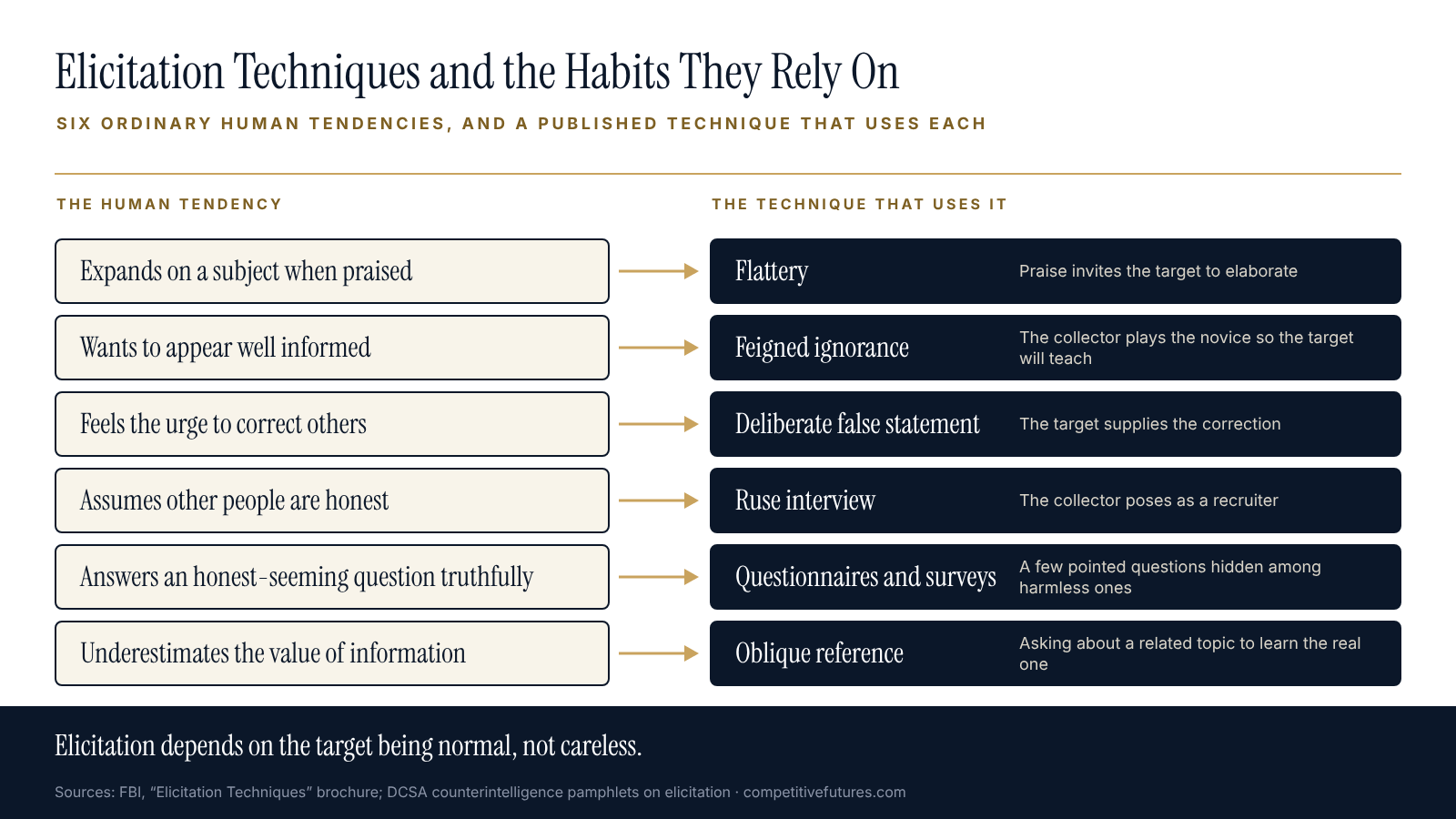
Other elicitation techniques in the brochure include the provocative statement, which gets the target asking the questions; macro to micro, moving from industry talk to a specific project; oblique reference, asking about a related topic (the brochure’s example is asking about catering to learn about vendor access); questionnaires and surveys that hide a few pointed questions among harmless ones; ruse interviews, in which the collector poses as a recruiter; and targeting the outsider, which means asking a vendor, subsidiary, or competitor who may not know what to withhold.
The DCSA pamphlet for cleared contractors adds paper review: requests to peer-review a thesis or paper that are really aimed at sensitive technical knowledge. It also stresses that elicitation “requires patience and persistence.” A single encounter rarely yields much. A series of them, each apparently trivial, can yield a great deal.
It Happens Where Business Happens
The public guidance describes a consistent geography. DCSA’s personal-contact material names the people most often targeted: developers, technicians, production and IT staff, business development personnel, business travelers, and human resources staff. Among the indicators it flags are an offer of paid attendance at an overseas conference or a keynote invitation, a business contact who asks for information outside the scope of a contract after a gradual progression from legitimate discussion, a request to move communications onto a commercial chat platform, and a casual acquaintance who seems to know more about your work than they should.
Conferences and trade shows concentrate exactly the conditions elicitation needs: experts, a culture of open exchange, alcohol, and a reason to talk shop with strangers. Academic exchanges and invited lectures add the prestige of being asked to present. The NCSC brochure’s own illustration is an airline seatmate who asks which agency you work for and then claims to have guessed from the pen in your hand; business travel removes the cues of the office and puts people in a hospitable mood among new acquaintances.
Online, the same techniques run through professional networking sites. An FBI awareness document on social networking risks, republished by NCSC, warns that “predators, hackers, business competitors, and foreign state actors troll social networking sites looking for information,” and that “it is easy for people to fake identities over the Internet.” A profile listing one’s employer, projects, and conference schedule is a targeting package assembled by the target, and the ruse interview is far easier to run when the “recruiter” never has to appear in person.
Vendor meetings matter too. The FBI’s “target the outsider” technique works because a supplier’s engineer often holds pieces of a client’s picture without knowing which are sensitive, one reason insider risk programs increasingly extend to third parties.
The Law Draws the Line at Deception and Theft, Not at Conversation
Asking questions is lawful. Learning things in open conversation is lawful. The line is crossed when information is obtained through deception, breach of a duty of confidence, or theft, and when the information meets the statutory definition of a trade secret.
The Economic Espionage Act of 1996 created two federal crimes. Under 18 U.S.C. § 1831, anyone who, intending or knowing that the offense will benefit a foreign government, instrumentality, or agent, steals a trade secret or obtains it by fraud, artifice, or deception faces up to 15 years in prison and a fine of up to $5 million; an organization faces a fine of up to $10 million or three times the value of the secret, whichever is greater. Under 18 U.S.C. § 1832, the same conduct for private economic benefit carries up to 10 years for an individual and, for an organization, the greater of $5 million or three times the value of the secret, including the research costs the thief avoided. Both sections reach attempts and conspiracies, so a defendant can be convicted without ever receiving a genuine secret. The words “fraud, artifice, or deception” matter for anyone who collects information for a living: a false identity, a fake survey, or a ruse interview aimed at a trade secret is an enumerated means of committing the offense.
The definitions in 18 U.S.C. § 1839 do the rest. A trade secret is information whose owner “has taken reasonable measures to keep such information secret” and which derives economic value from not being generally known. “Improper means” includes “theft, bribery, misrepresentation, breach or inducement of a breach of a duty to maintain secrecy, or espionage through electronic or other means,” and expressly “does not include reverse engineering, independent derivation, or any other lawful means of acquisition.” That carve-out is the legal foundation of legitimate competitive intelligence.
The Defend Trade Secrets Act of 2016 added a federal civil remedy. Under 18 U.S.C. § 1836(b), the owner of a misappropriated trade secret may sue in federal court for an injunction, damages or a reasonable royalty, up to double damages for willful and malicious misappropriation, and attorney’s fees, within three years of discovery. A secret that was never treated as one is hard to defend in court, a point explored on our pages on protecting trade secrets and competitive intelligence in court.
Professional Ethics Draw the Line Earlier
The law sets the floor. The professional standard sits above it. The Code of Ethics of the Strategic Consortium of Intelligence Professionals (SCIP) requires members to “comply with all applicable laws, domestic and international” and to “accurately disclose all relevant information, including one’s identity and organization,” before all interviews, and to promote the code within their own companies and among third-party contractors.
That transparency rule is the practical difference between competitive intelligence and elicitation as a hostile service practices it. A professional who tells you who they are and whom they work for, and then asks good questions, is doing legitimate work; you can decline, and you know what you are declining. A collector who hides those facts has taken the choice away from you. The company operates under its real name and affiliation in every conversation, the only way to run a practice that can stand up in a courtroom or in front of a client’s general counsel.
A Case Shows the Full Arc
The clearest public example of elicitation as the opening move in an economic espionage operation is the case of Yanjun Xu, a career officer of China’s Ministry of State Security. According to the Department of Justice press release announcing his sentence, Xu began targeting aviation companies in the United States and abroad no later than December 2013. He used aliases, front companies, and universities, identified employees at the companies he was interested in, and recruited them to travel to China, often under cover of an invitation to present at a university, with expenses and a stipend paid.
In March 2017 an engineer at GE Aviation in Cincinnati was invited to deliver a report at a Chinese university. About two months later the engineer traveled, presented, met Xu, and was paid. After the trip the FBI took over the engineer’s communications with Xu. In January 2018, Xu asked for “system specification, design process” information, and with GE Aviation’s cooperation the engineer sent a two-page document bearing a proprietary-information label. In February 2018, Xu proposed a meeting in Europe and asked for the file directory of the engineer’s company laptop. On April 1, 2018, he traveled to Belgium carrying cash and photographs of the engineer and was arrested at the planned meeting. The release adds that Xu and colleagues had, in other instances, copied or hacked invited employees’ computers in their hotel rooms while taking them to dinner. A federal jury convicted Xu on November 5, 2021, on all counts, including attempted economic espionage and attempted trade secret theft. On November 16, 2022, he was sentenced to 20 years in prison.
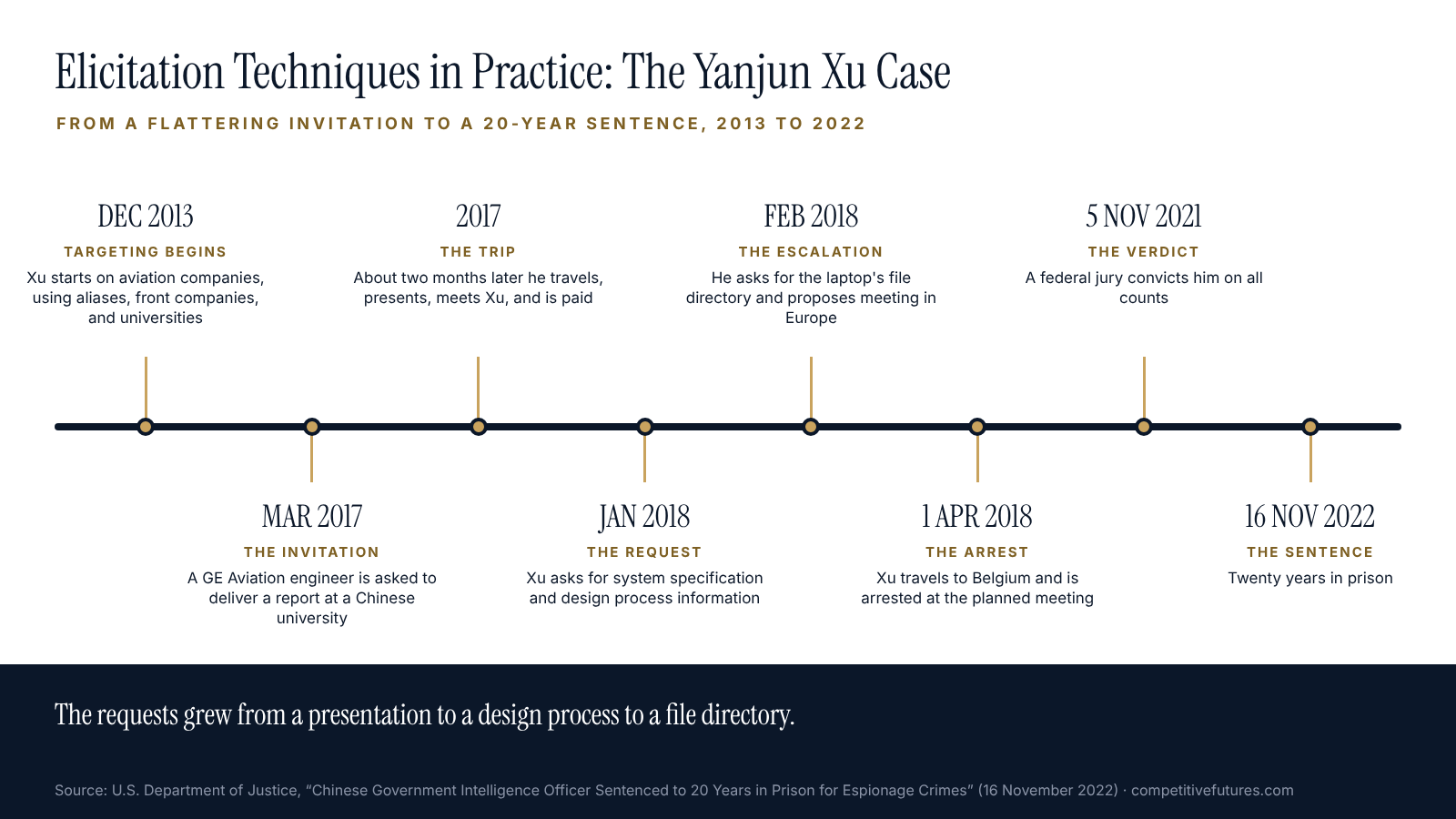
Every stage of that arc is in the public guidance: the flattering invitation, the paid travel, the escalation from a presentation to a “design process” request to a file directory, and the university as cover. The GE Aviation engineer was not naive. He was doing what engineers are encouraged to do: share expertise with peers abroad.
The Public Guidance Is Simple and Worth Repeating
The FBI, NCSC, and DCSA give consistent advice about elicitation techniques, and it is modest in scope. Know what information you are not authorized to share, including personal details about yourself, your family, and your colleagues, and be wary of anyone who seeks it. Refer the questioner to public sources. Change the subject. Answer a question with a question, or simply ask “Why do you ask?” DCSA adds that if the person persists, treat the exchange as suspicious. Give a vague answer, or say you cannot discuss the matter. The NCSC brochure recommends preparing simple answers to basic questions about your job in advance, because guarded or clumsy responses draw more attention than a smooth one. And in its words, “Never feel compelled to answer any question that makes you feel uncomfortable.”
All three agencies end with reporting. Cleared contractors must report suspicious contacts under the NISPOM. Private companies have no such duty, but the logic is the same: a single odd conversation means little, and several, reported and compared, can reveal a campaign. The FBI invites companies to contact it for information or training.
That guidance is aimed at employees. For executives and security officers, the lesson sits a level higher. Elicitation techniques succeed against organizations that have never decided what is actually sensitive, never told their people, and never built a place for an uneasy feeling to be reported. The U.S. agencies and allied services that watch this for a living have put the warning in plain language.
Frequently asked questions
What is elicitation in intelligence?
Elicitation is the strategic use of ordinary-seeming conversation to draw out specific information without the other person realizing it. The FBI defines it as “the strategic use of conversation to extract information from people.” It can be spoken or written, in person or online, and it often unfolds over several encounters rather than a single one.
What are the most common elicitation techniques?
The FBI’s public brochure names roughly two dozen. Among them are flattery, feigned ignorance, criticism that provokes a defense, deliberate false statements, bracketing, confidential bait, quid pro quo, questionnaires and surveys, and the ruse interview. DCSA adds paper review, a request to review a thesis or paper that is really aimed at sensitive technical knowledge.
Is elicitation illegal?
Asking questions and learning things in open conversation is lawful. The line is crossed when information is obtained through fraud, deception, or breach of a duty of confidence and the information qualifies as a trade secret under 18 U.S.C. § 1839. The Economic Espionage Act makes obtaining a trade secret “by fraud, artifice, or deception” a federal crime.
Where does elicitation most often happen?
Public guidance from the FBI, NCSC, and DCSA points to conferences, trade shows, academic exchanges and invited lectures, business travel, vendor meetings, and professional networking sites. Collectors prefer settings away from the workplace, where people relax and ordinary security habits fall away, and they often approach through flattering invitations or recruiter-style contacts.
How is competitive intelligence different from elicitation?
Professional competitive intelligence is conducted under the practitioner’s real name and affiliation. The SCIP Code of Ethics requires members to comply with all applicable laws and to “accurately disclose all relevant information, including one’s identity and organization,” before interviews. Hostile elicitation depends on concealing exactly those facts, which removes the source’s ability to make an informed choice.
What should an employee do if they suspect elicitation?
The agencies’ advice is consistent: know what you are not authorized to share, refer the questioner to public sources, change the subject, ask “Why do you ask?”, or say you cannot discuss the matter. Never feel obliged to answer an uncomfortable question. Report the contact to your security officer so that isolated odd conversations can be compared.
Work with Competitive Futures
We help companies decide what is sensitive, tell their people, and build a place where an uneasy conversation can be reported. Contact the company to talk about yours.
Related analysis
- Corporate Counterintelligence: How Companies Protect Their Secrets From Competitors and Foreign Services
- Insider Risk Programs: How Companies Protect Their Secrets From the People Who Already Have the Keys
- Business Travel Security and Trade-Show Counterintelligence
- Protecting Trade Secrets: What “Reasonable Measures” Means and Why Courts Decide Cases on It
- The Economic Espionage Act: History, Case Law, and Controlling Precedent
- The Twenty Committee: How Britain Ran Germany’s Spies in the Second World War
- MICE: Why People Spy, and What the Acronym Leaves Out
Sources
- FBI, “Elicitation Techniques” (counterintelligence awareness brochure)
- FBI, Counterintelligence (awareness brochure listing and economic espionage overview)
- NCSC, “Elicitation” awareness brochure
- NCSC, Know the Risk, Raise Your Shield: Awareness Materials
- FBI, “Internet Social Networking Risks” (republished by NCSC)
- DCSA, Counterintelligence Outreach Pamphlet: Elicitation (2024)
- DCSA, Counterintelligence: Elicitation (2021)
- DCSA, Counterintelligence Outreach Pamphlet: Personal Contact (2024)
- Strategic Consortium of Intelligence Professionals (SCIP), Code of Ethics
- 18 U.S.C. § 1831, Economic espionage
- 18 U.S.C. § 1832, Theft of trade secrets
- 18 U.S.C. § 1836, Civil proceedings (Defend Trade Secrets Act)
- 18 U.S.C. § 1839, Definitions
- Defend Trade Secrets Act of 2016, Public Law 114-153
- U.S. Department of Justice, “Chinese Government Intelligence Officer Sentenced to 20 Years in Prison for Espionage Crimes” (Nov. 16, 2022)
We help companies see how their people and their information are approached, and how to talk openly with the world without giving away what matters.
This piece is part of our guide to Intelligence Collection and OSINT.