Protecting Trade Secrets: What “Reasonable Measures” Means and Why Courts Decide Cases on It

There’s a classic case in competitive counterintelligence. An executive is on a flight with his laptop open. He begins editing a PowerPoint deck from which he plans to brief his board of directors. He does not have a privacy screen on his computer, and the man seated to his right, who works for a rival firm, can read everything. The other passenger discreetly makes notes on his phone about the strategy documents he’s able to read over the executive’s shoulder. Not only does the passenger send those notes to his employer, he also makes stock trades based on the information he’s just learned.
The key question: Did the passenger commit a legal or ethical violation, and does the executive’s company have a claim that its trade secrets were stolen? The answer comes down to whether the company took reasonable steps to protect the information. Here, it probably did not. A federal court has held that trading on information overheard by chance from an insider is not insider trading (SEC v. Switzer), and reading a screen left open in a public seat would be hard to call “improper means” of acquiring a trade secret. The executive, in effect, gave it away.
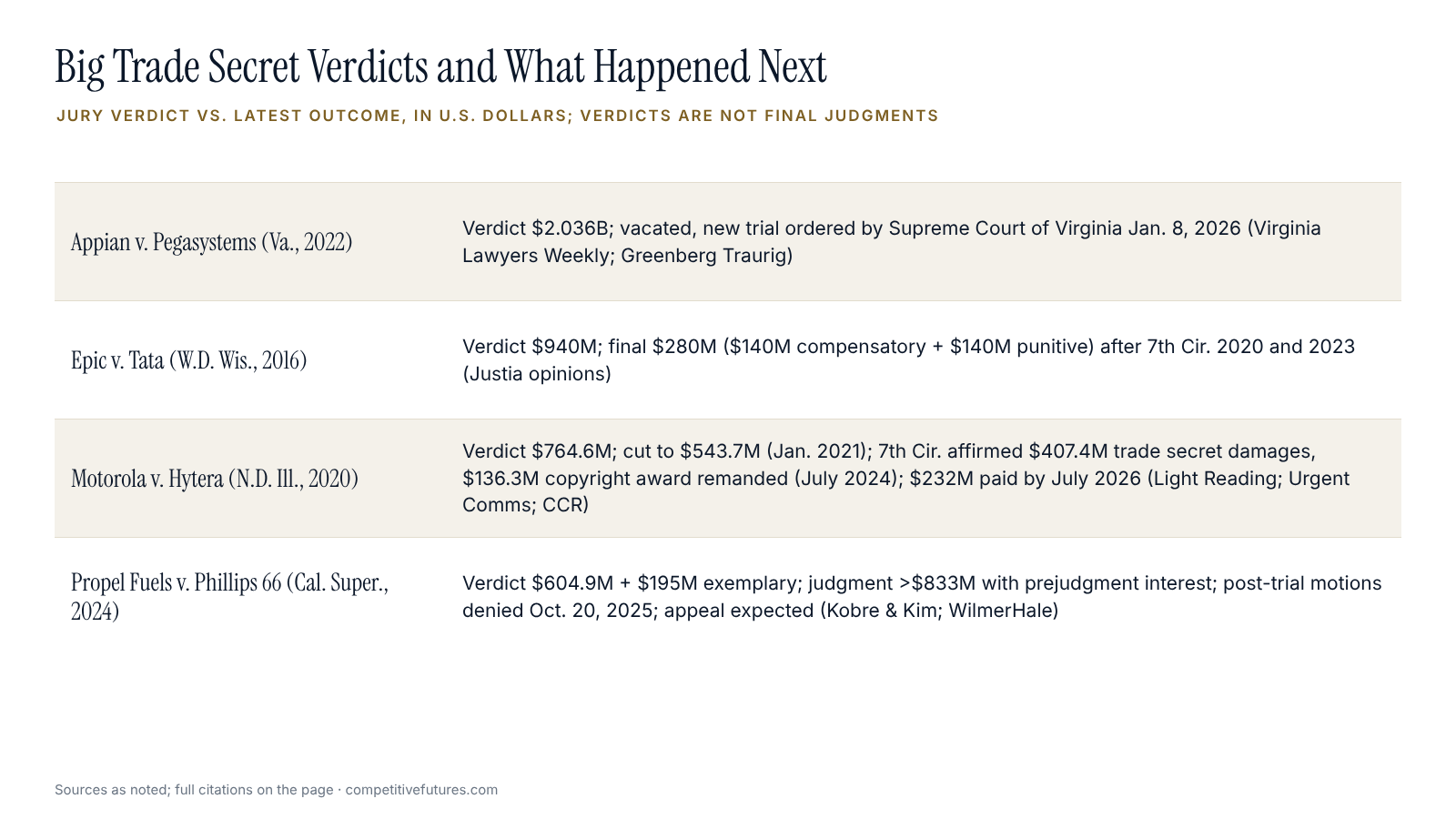
Many trade secret lawsuits are decided before anyone argues about theft: the first question is whether the owner took “reasonable measures” to keep the information secret, and owners who cannot prove it lose, however clearly the information was taken. When owners can prove secrecy and misappropriation, juries have returned verdicts from about $600 million to more than $2 billion, though several were later cut or thrown out.
This page covers the legal definition of a trade secret in the United States and abroad, what courts have accepted as reasonable protection and where it failed, the contract rules that affect remedies, the state of noncompete law, and the cases that show what is at stake. It belongs to our corporate counterintelligence series; the criminal side of the law has its own page on the Economic Espionage Act. This is general information from statutes, court opinions, and public guidance, not legal or security advice for a specific situation. Anyone facing a real dispute or drafting real agreements should talk to counsel.
Trade secret protection at a glance
- Federal definition: under 18 U.S.C. § 1839(3), a trade secret covers “all forms and types of financial, business, scientific, technical, economic, or engineering information” if “the owner thereof has taken reasonable measures to keep such information secret” and the information “derives independent economic value, actual or potential, from not being generally known” or readily ascertainable through proper means.
- Civil remedy: the Defend Trade Secrets Act of 2016 (Pub. L. 114-153) created a federal civil claim, with exemplary damages of up to twice actual damages, plus attorney fees, for willful and malicious misappropriation (§ 1836(b)(3)).
- State law: nearly every state has a version of the Uniform Trade Secrets Act, which requires “efforts that are reasonable under the circumstances to maintain its secrecy” (for example, Cal. Civ. Code § 3426.1(d)); New York relies on common law (Pierce Atwood).
- Whistleblower notice: agreements with employees, contractors, and consultants must disclose a statutory reporting immunity, or the employer loses exemplary damages and fees against them (§ 1833(b)).
- Noncompetes: the FTC’s 2024 nationwide ban was set aside in August 2024 and abandoned in September 2025 (FTC); state law governs.
- Abroad: the EU Trade Secrets Directive and China’s Anti-Unfair Competition Law also require the holder to take confidentiality measures.
Why “reasonable measures” is something you must prove
The Defend Trade Secrets Act makes reasonable measures part of the definition: without them there is no trade secret, so nothing was misappropriated. As the Ninth Circuit put it, “a required element of a trade secret is that the owner ‘has taken reasonable measures to keep such information secret’” (InteliClear, LLC v. ETC Global Holdings, 978 F.3d 653 (9th Cir. 2020)). State law works the same way. The Tenth Circuit said in 2025 that what is reasonable “is fact-dependent, but in all cases it requires a higher level of diligence than ‘normal business precautions’” (Snyder v. Beam Technologies (10th Cir. Aug. 5, 2025)).
Three features of the standard matter. It is reasonable, not perfect: courts have upheld criminal convictions where protections were imperfect but real, as our Economic Espionage Act page explains. It depends on context: the Fourth Circuit said in November 2025 that “what may be reasonable measures in one context may not necessarily be so in another,” and held that a confidentiality provision in employment agreements was enough to plead the element (Samuel Sherbrooke Corporate Ltd. v. Mayer; IPWatchdog). Pleading is not proof, and a jury may want more. And it is ongoing: disclosure “to others who are under no obligation to protect the confidentiality of the information” can extinguish the right (Snyder).
Owners must also say what the secret is “with sufficient particularity.” The Tenth Circuit affirmed summary judgment in April 2025 against a company that could not, had posted some specifications on its own website, and shared prices with customers without limiting further sharing (Double Eagle Alloys v. Hooper, via Littler).
What courts have accepted as reasonable, and what failed
No statute lists the required measures. Court opinions and public guidance such as the World Intellectual Property Organization’s Guide to Trade Secrets and Innovation point to familiar categories: confidentiality agreements, which the Ninth Circuit held “constitute reasonable steps to maintain secrecy” (InteliClear); limits on who can see what; marking; technical controls; training; and care when people leave.
The failures share a theme. Courts do not punish companies for lacking an elaborate program; they rule against owners whose own conduct contradicted the claim of secrecy, such as sharing openly, leaving unmarked files on personal devices, relying on verbal warnings alone, or posting part of the secret in public. In Yellowfin, the court stressed that the company “never asked Barker to delete the information from his personal devices after he left the company” (Eleventh Circuit).
Employment agreements: the whistleblower notice and noncompetes
The whistleblower notice. The Defend Trade Secrets Act protects individuals who disclose a trade secret in confidence to a government official or attorney to report a suspected violation of law. Employers must give notice of that immunity in agreements with employees, contractors, and consultants that govern confidential information; without it, the employer “may not be awarded exemplary damages or attorney fees” against that person (18 U.S.C. § 1833(b)). Older templates deserve a review with counsel.

Noncompetes. A federal court set aside the FTC’s rule banning most noncompetes in August 2024 (Faegre Drinker), and in September 2025 the Commission dropped its appeals and turned to case-by-case enforcement (FTC). States are moving in different directions, some restricting noncompetes and others, such as Florida, easing enforcement (Mayer Brown). Where noncompetes are limited, confidentiality agreements and other secrecy measures carry more of the load.
Knowing what you have, and the patent choice
Courts want secrets identified precisely, and a company can only protect information it knows it holds. WIPO notes that “It is generally helpful to record trade secrets in some way” (WIPO).
The same exercise raises the patent question. A U.S. patent generally lasts 20 years from filing (35 U.S.C. § 154) and requires public disclosure. A trade secret has no fixed term while its requirements are met (USPTO), but it offers no protection against independent discovery or lawful reverse engineering. Many companies use both.
Incoming hires and other people’s secrets
Risk runs both ways: a company can become a defendant when a new hire brings a former employer’s files. Misappropriation includes acquiring a secret while knowing or having reason to know it came through improper means (§ 1839(5)), so a hiring company cannot look away. Waymo’s case against Uber and Starwood’s against Hilton are covered on the competitive intelligence in court page.
International angles
European Union. The EU Trade Secrets Directive protects information only if it “has been subject to reasonable steps under the circumstances” to keep it secret (Directive (EU) 2016/943, Article 2(1)(c)). Reverse engineering remains lawful.
China. China protects trade secrets mainly through its Anti-Unfair Competition Law, which since 2019 has allowed damages of up to five times for willful, serious misappropriation; a revised law took effect October 15, 2025 (China IP Law Update).
Cases that show the risk
Epic Systems v. Tata Consultancy Services (2016–2023)
A Wisconsin federal jury found that Tata Consultancy Services misappropriated Epic’s confidential information and awarded $940 million, including $700 million in punitive damages. The district court vacated $100 million of the compensatory award and cut punitive damages to $280 million under Wisconsin’s cap. In 2020 the Seventh Circuit held that “the maximum permissible award of punitive damages in this case is $140 million” (Seventh Circuit, 2020), and in 2023 it affirmed that amount on remand (Seventh Circuit, 2023), leaving $280 million before interest. The Supreme Court declined review (Healthcare IT News).
Lesson: the headline verdict is rarely the final number.
Yellowfin Yachts v. Barker Boatworks (2018)
Yellowfin restricted access to its customer information and password-protected it, but encouraged a senior employee to keep it on his personal phone and laptop, had no confidentiality agreement with him, did not mark it, and never asked him to delete it after he left. The Eleventh Circuit affirmed summary judgment, finding that Yellowfin “effectively abandoned all oversight in the security of the Customer Information” (Eleventh Circuit).
Lesson: good controls fail if everyday practice undercuts them.
Motorola Solutions v. Hytera Communications (2020–2026)
The Seventh Circuit found that Hytera recruited three Motorola engineers in Malaysia who, “acting at Hytera’s direction,” downloaded thousands of files containing trade secrets and source code (Motorola Solutions v. Hytera, 108 F.4th 458 (7th Cir. 2024), summarized by Faegre Drinker). A Chicago jury awarded $764.6 million in February 2020 (Light Reading); the judge cut it to $543.7 million in January 2021 to avoid double recovery (Urgent Communications). In July 2024 the Seventh Circuit held that the Defend Trade Secrets Act reached Hytera’s foreign sales, affirmed $407.4 million in trade secret damages, and sent the $136.3 million copyright award back for recalculation (Faegre Drinker). By mid-2026 Hytera had paid $232 million, and the copyright remand was pending (Critical Communications Review).
Lesson: U.S. law can reach a foreign rival’s worldwide sales, but collecting takes years.
Appian v. Pegasystems (2022–2026)
A Fairfax County, Virginia jury awarded Appian $2.036 billion in 2022, finding that Pegasystems misappropriated trade secrets about Appian’s platform, in part through a contractor with access and later through trial accounts opened under aliases (Proskauer). The Court of Appeals of Virginia reversed in 2024, and on January 8, 2026, the Supreme Court of Virginia unanimously agreed and ordered a new trial, holding that Appian must prove causation of its damages and that evidence of how many people had access to the claimed secrets was wrongly excluded (Virginia Lawyers Weekly; Greenberg Traurig).
Lesson: how widely a secret was shared can decide whether it was a secret.
Propel Fuels v. Phillips 66 (2024–2025)
Propel shared confidential information with Phillips 66 under a nondisclosure agreement during 2018 acquisition talks; after the deal ended, Phillips 66 built its own renewable fuels retail business. In October 2024 an Alameda County, California jury awarded $604.9 million and found the misappropriation willful and malicious. In July 2025 Judge Michael Markman added $195 million in exemplary damages, citing the failure to return or destroy Propel’s information, for a judgment above $833 million with prejudgment interest (Kobre & Kim). The court denied Phillips 66’s post-trial motions on October 20, 2025 (WilmerHale); the company indicated it would appeal, with interest accruing at 10 percent a year (Propel release).
Lesson: diligence data from a failed deal is a liability until it is returned or destroyed.
Snyder v. Beam Technologies (2025)
The plaintiff claimed a broker list as a trade secret but had emailed it to ten of the defendant’s employees without marking it, restricting it, password-protecting it, or requiring confidentiality, and testified that he shared it on purpose. The Tenth Circuit affirmed summary judgment: “no reasonable jury could conclude” his actions met “the minimum definition of reasonable measures” (Tenth Circuit).
Lesson: one unrestricted email can end a trade secret.
What it means for companies
The court record suggests a simple test: could the company show a judge what its secrets are, who could see them, and what it did to keep them secret, with documents made before any dispute? Companies that pass tend to have current agreements, protections applied in practice rather than on paper, and people who knew what was confidential. Counsel should set the details for each company’s facts.
How intelligence and foresight help
Reasonable measures concern how you protect information; the strategic question is who wants it. Hytera’s case began with a competitor that had struggled for years to build a product and recruited the people who knew how. Appian’s and Propel’s arose from ordinary commercial contact. Knowing which competitors are behind in a technology, which are under pressure to catch up, and which state-backed programs prioritize your sector shows where pressure will come from and which relationships deserve attention. That is a strategic intelligence question, and it links this page to the rest of the corporate counterintelligence series.
Frequently asked questions
What are “reasonable measures” to protect a trade secret?
No statute lists them. Courts have accepted confidentiality agreements, restricted access, passwords and encryption, marking, training, and exit procedures, judged together and in context. Claims fail where owners shared information without restrictions or relied on informal understandings.
Is a confidentiality agreement enough on its own?
Sometimes. The Ninth Circuit called confidentiality provisions reasonable steps, and the Fourth Circuit held in 2025 that one sufficed to plead the element. Conduct that contradicts the agreement, such as broad unrestricted sharing, can still defeat it. Ask counsel what your situation requires.
What happens if an employment agreement leaves out the DTSA whistleblower notice?
The employer can still sue, but under § 1833(b)(3)(C) it cannot recover exemplary damages or attorney fees under the Defend Trade Secrets Act against anyone who did not receive the notice.
Is the FTC’s noncompete ban in effect?
No. A federal court set it aside on August 20, 2024, before it took effect, and the FTC dropped its appeals in September 2025. The FTC still pursues individual cases, and state laws, which vary widely, govern enforceability.
Should we patent an invention or keep it secret?
It depends on whether the invention can stay secret once products are sold, how long its value will last, and how easily others could find it independently. A patent gives about 20 years of exclusivity in exchange for disclosure; a trade secret can last indefinitely but does not stop reverse engineering or independent discovery. Decide with patent and trade secret counsel.
Related reading
- Corporate Counterintelligence: How Companies Protect Their Secrets From Competitors and Foreign Services
- Insider Risk Programs: How Companies Protect Their Secrets From the People Who Already Have the Keys
- Business Travel Security and Trade-Show Counterintelligence: Why Trips and Conferences Are Prime Collection Opportunities
- The Economic Espionage Act: History, Case Law, and Controlling Precedent
- Competitive Intelligence in Court: Civil and Criminal Cases
- Enforcement Risk: How U.S. Law Became an Instrument of Geopolitics
- Intelligence Services Around the World: Structure, History, and the Headlines
- Cognitive Bias: A Field Guide for Leaders Who Must Decide Under Uncertainty
Competitive Futures helps companies understand who is targeting them and why; details are on the services page.