Why Smart Organizations Still Can’t See Obvious Disasters

My 2011 satire How to Predict the Future…and WIN! offered 25 tips for failing at foresight. Reading them again fifteen years later, I notice that a surprising number are about the same thing. They are not really about predicting the future. They are about how organizations make it unsafe to see what is already in front of them.
Tip 2: Put internal politics above external data. Tip 6: Focus uniquely on positive information; punish those who are negative. Tip 7: Ridicule, ridicule, ridicule! Tip 8: Value the probability of forecasts by the charisma of the person delivering them.
Smart organizations rarely miss a disaster because nobody saw it coming. They miss it because the people who saw it could not get anyone to listen.
“The sky is falling”
In the book I told a story from a client retreat I facilitated, a meeting specifically reserved for scenario thinking about the future. After about an hour, a senior vice president reached his limit:
“You know, in my 35 years experience I have learned that there will always be people who worry about the sky falling, and there will be those who worry about getting things done. And you people had better be worrying about getting your numbers up, and soon.”
“The rest of the people in the room lowered their eyes,” I wrote, “chastened for daring to think about the future during a retreat about the future.” The rest of the day was spent on how to push more product through more channels before the end of the quarter.
He did not challenge the data. He did not argue with the scenarios. He made thinking about them embarrassing. That is how it usually works. Ridicule is cheaper than rebuttal, and in a hierarchy it is far more effective.
Why good news wins
The deeper problem, as I described it in 2011, is that bad news about the outside world gets confused with criticism of the people inside:
“If you’re telling me that this decision won’t result in success forever, you’re saying I’m stupid for having made the decision in the first place.”
Once a warning feels like an accusation, the warning loses. The analyst who raised it learns to soften the next one. The executive learns that the people around him agree. Everyone is behaving rationally, and the organization goes blind.
The fallacy underneath, I wrote, is “that changing your mind is a sign of having been wrong to begin with.” In a world that changes slowly, maybe. In a world where business models can vanish in a few years and markets can melt down in an afternoon, changing your mind is just keeping up.
Three disasters that were seen in advance
The official investigations of three very different failures read like variations on the same tips.
Columbia
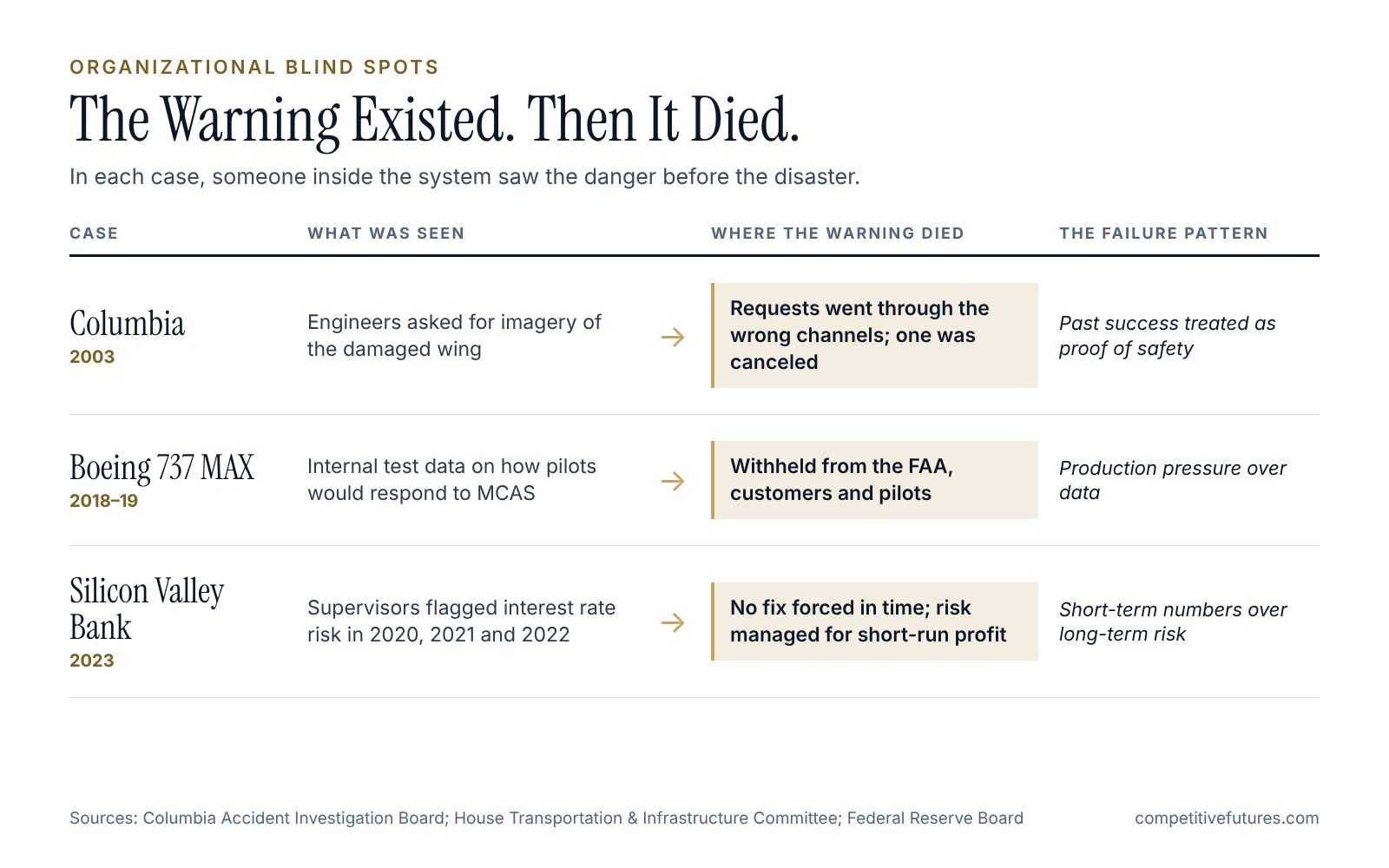
The space shuttle Columbia broke apart on reentry on February 1, 2003, after foam debris struck its wing during launch. NASA engineers had asked for imagery of the damage during the flight; the requests went through the wrong channels, and one that reached the Department of Defense was canceled. The Columbia Accident Investigation Board found a “broken safety culture” and a “reliance on past success as a substitute for sound engineering practices.” It concluded that Columbia and Challenger were both “failures of foresight” (Congressional Research Service synopsis of the CAIB report).
Foam had come off on earlier flights, and those flights came home. Past success became the argument against present worry. That is the senior vice president’s “35 years experience,” written into an engineering process.
The Boeing 737 MAX
Two 737 MAX crashes killed 346 people. After an 18-month investigation, the House Transportation and Infrastructure Committee identified five themes, including “production pressures that jeopardized the safety of the flying public” and a “culture of concealment,” finding that Boeing “withheld crucial information from the FAA, its customers, and 737 MAX pilots” (House Transportation and Infrastructure Committee).
Production pressure is Tip 2 in its purest form: the schedule outranked the data, and the information that would have alarmed outsiders stayed inside.
Silicon Valley Bank
Silicon Valley Bank failed in March 2023 after rising interest rates eroded the value of its bond portfolio. The Federal Reserve’s own review found that the bank “managed interest rate risks with a focus on short-run profits,” and that “supervisors identified interest rate risk deficiencies in the 2020, 2021, and 2022” supervisory cycles without forcing a fix in time (Federal Reserve Board).
The risk was written down, three years running, by the people paid to find it. Seeing it was never the problem.
The typo defense
There is one more move worth naming, because every analyst has seen it. In 2011 I described a client who had commissioned a study expecting it to confirm his views. It showed instead that his sales team was heading in the wrong direction, and that the fix was easy. He went through the report hunting for typographical errors, found that we had misspelled the name of an industry expert, and decided that this was reason enough to dismiss the “shoddy” report and its “insane” conclusions.
My lesson then still stands: “if your findings are at all negative, charisma usually counts for nothing.” When people do not like a conclusion, they will search for the smallest flaw that lets them keep ignoring it. Do your homework anyway, and do not expect polish to save you.
How to see what is in front of you
- Separate the warning from the verdict. Say it out loud in the meeting: a new threat in the outside world is not a judgment on decisions made when that threat did not exist. As I wrote in 2011, recognizing that the world is changing “does not mean that somehow you were running your peanut butter company the wrong way.”
- Start five years out. Next year’s forecast is about people’s current jobs, so it gets defended. In the book I argued that five years is “the minimum amount of time into the future it takes to get people to relax a bit.” Begin there and walk back toward today.
- Run a premortem. Before committing to a plan, have the team assume it has already failed and explain why. Gary Klein’s technique gives people with doubts a safe, expected way to voice them (Harvard Business Review).
- Ban ridicule as a debating tactic. Leaders set the tone. If a senior person mocks a scenario instead of arguing with it, the room learns what is allowed. Thank the person who brings bad news, especially when they turn out to be wrong.
- Give warnings a path to the top. Columbia’s imagery requests died in the wrong channels. Make sure a serious concern can reach a decision-maker without passing through every manager whose project it threatens.
- Judge the analysis, not the messenger. Ask what would have to be true for the warning to be right, and check that, before you check the spelling. Studying cognitive bias helps a team catch itself doing the opposite.
Be a little more Vermont
In the book I noted that some cultures, the Finns, the Estonians, the Taiwanese, do not punish the person who warns management about pitfalls, because history has taught them that bad news is often true. I counted my own people among them: as a seventh-generation Vermonter, I come from a tribe that “distrust[s] optimism and love[s] bad news,” since every winter we expect Mother Nature to finally make good on her attempts to kill us.
You do not have to move to Vermont. But the organizations that see disasters in time tend to share that temperament. They treat bad news as information, not insubordination. They listen to the person worrying about the sky, at least long enough to check.
Frequently asked questions
Why do organizations ignore warning signs?
Usually not because nobody saw the danger. Warnings about the outside world get mistaken for criticism of past decisions, ridicule makes raising them embarrassing, and short-term pressures outrank long-term risks. The information exists; the organization filters it out.
What is an example of an organization ignoring warnings?
The Columbia Accident Investigation Board found that NASA engineers asked for imagery of the shuttle’s damaged wing during the flight, but the requests went through the wrong channels. The board called both Columbia and Challenger “failures of foresight.”
How can leaders encourage people to raise bad news?
Separate warnings from judgments about past decisions, start discussions five or more years out, run premortems, ban ridicule as a debating tactic, give serious concerns a direct path to decision-makers, and judge the analysis rather than the messenger.
What is a premortem?
A technique developed by psychologist Gary Klein in which a team assumes its plan has already failed and explains why. It gives people with doubts an expected, safe way to raise them before the decision is final.
How to Predict the Future…and WIN! is still available in paperback and on Kindle.
Related analysis from Competitive Futures
- Intelligence Is Always Wrong. Decide Anyway.
- I Wrote a Book About Predicting the Future in 2011. Here’s My Scorecard.
- Every New Information Technology Promises World Peace
- Cognitive Bias: A Field Guide for Leaders Who Must Decide Under Uncertainty
Want this kind of analysis for your organization? Contact Competitive Futures or learn more about Eric Garland.
About Competitive Futures
Competitive Futures has provided strategic intelligence and foresight to corporate and government clients since 2002. Its principal, Eric Garland, publishes analysis here, on Game Theory Today, and in the Systemics Quarterly Brief.
Read next
- Seventy Countries, Six Cities: The Global Network Behind Iran
- The Systemics Quarterly Brief: 2026 Prospectus
- Strategic intelligence services for executives and governments
- All analysis from Competitive Futures
Stay in touch
Leave your email and a note about the Brief, a briefing for your team, or this piece, and we will be in touch.