The Chaos Advantage: How Great Leaders Win in Uncertain Times
The Chaos Advantage is a leadership in uncertain times keynote built on a simple observation from three decades of intelligence work: the best organizations often gain the most ground during disruption, not during calm. Eric Garland shows how great leaders have read chaotic environments, found the opening, and made decisions that held up, and how today’s leaders can do the same.
At a glance
- Full title: The Chaos Advantage: How Great Leaders Win in Uncertain Times
- Length: 45 to 60 minutes, including Q&A
- Audiences: association general sessions, leadership summits, C-suite retreats, and strategic offsites
- Delivery: in person or virtual, in English or French
- Built from: historical cases and three decades of strategic intelligence casework for corporations and governments
Disruption is where leaders are made
Most planning assumes the next five years will look like the last five, with some adjustments. When that assumption breaks, many organizations freeze. A few move. The keynote draws on periods when the rules changed overnight, including world wars, the end of communism, and sudden market shocks, and looks at the organizations that came out of them stronger.
Three cases from the keynote
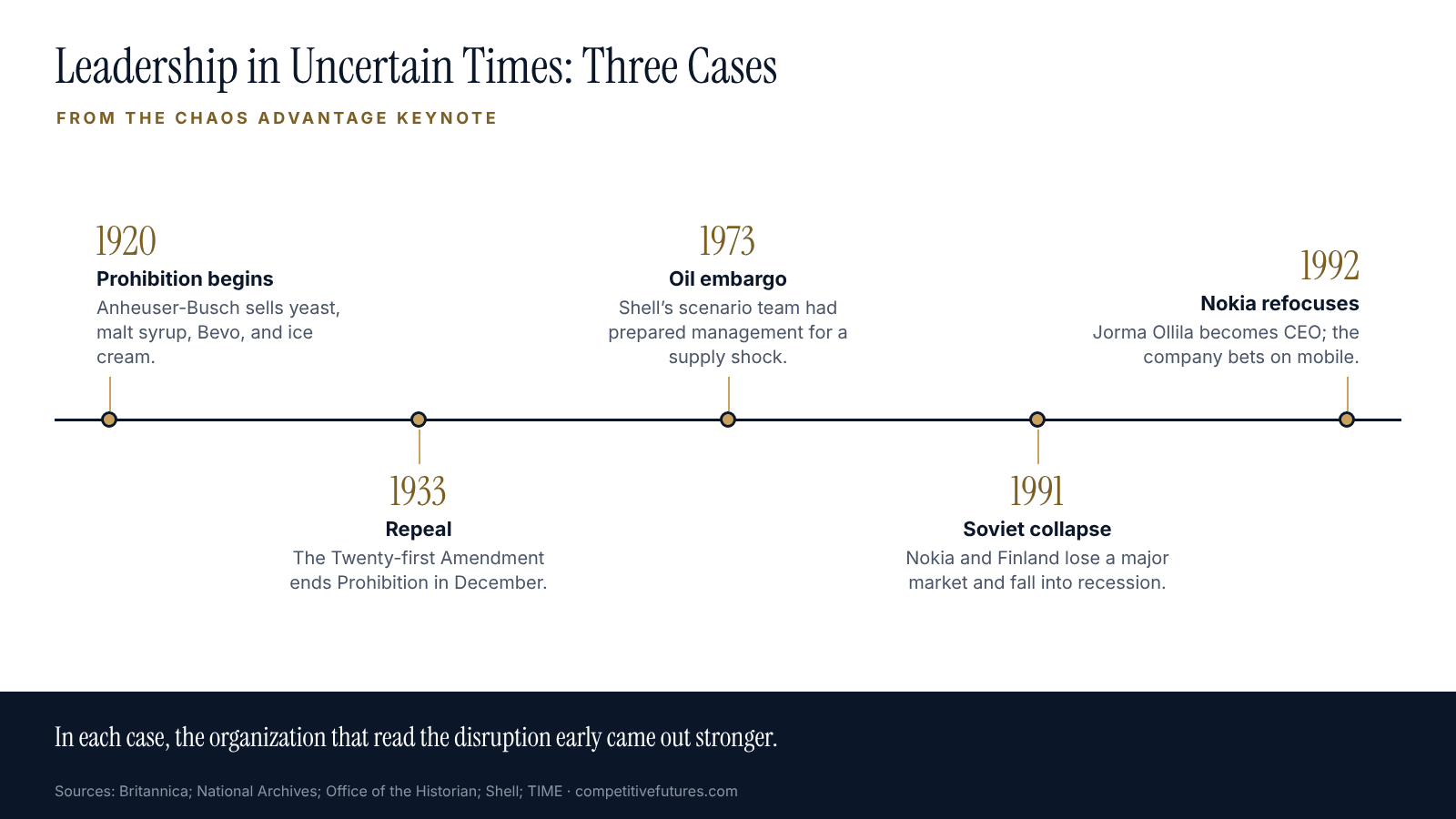
Anheuser-Busch and Prohibition (1920–1933). National Prohibition took effect in January 1920 and lasted until the Twenty-first Amendment was ratified in December 1933. The brewer stayed in business by selling what it could legally make, including yeast, malt syrup, a near beer called Bevo, ice cream, and refrigerated truck bodies.
Royal Dutch Shell and the 1973 oil crisis. Shell’s planning group under Pierre Wack had built scenarios that included a sudden break in oil supply and shared them with management before the October 1973 embargo. When the shock came, the company was better prepared than its rivals.
Nokia and the Soviet collapse (1991–1993). The Soviet Union had been a major market for Nokia and for Finland. Its collapse in 1991 helped push both into a deep recession. Under Jorma Ollila, who became chief executive in 1992, the conglomerate decided to concentrate on mobile communications and became the world’s leading phone maker by the end of the decade.
The keynote uses these cases to ask what the leaders saw, what they did differently, and what the same posture looks like in the current environment.
What audiences take away
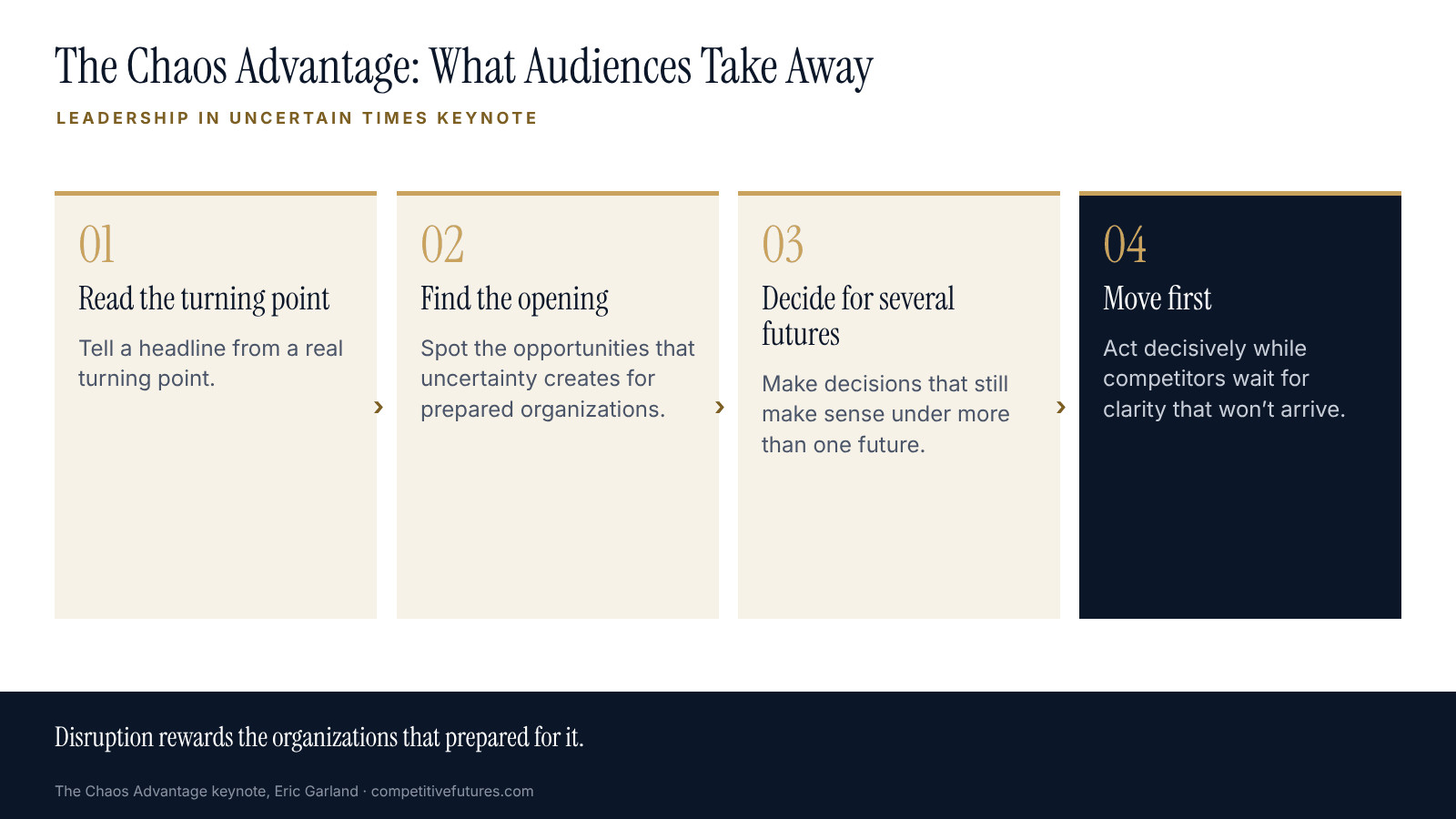
- How to tell a headline from a real turning point.
- How to find the opportunities that uncertainty creates for organizations that prepare for them.
- How to make decisions that still make sense under more than one version of the future.
- How to act decisively while competitors are waiting for clarity that won’t arrive.
From the stage to the organization
None of the three companies above was lucky in the ordinary sense. Each had people watching the environment and leaders willing to act on what they reported. That is the work of an intelligence function: collect the signals early, test them against several futures, and get the conclusions in front of decision-makers before the moment passes. We help organizations build that capability, and our guides to strategic surprise and competitive early warning explain how it works.
Frequently asked questions
What is The Chaos Advantage keynote about?
It shows how great organizations have gained ground during periods of disruption, and how leaders can read uncertain conditions, find the opportunity, and make decisions that hold up.
Which historical examples does the keynote use?
Cases include Anheuser-Busch during Prohibition, Royal Dutch Shell during the 1970s oil crisis, and Nokia after the fall of the Soviet Union, alongside current examples chosen for each audience.
Who is The Chaos Advantage for?
Leadership conferences, association general sessions, C-suite retreats, and strategic offsites. It is non-partisan and built for general business audiences.
How long is the keynote?
45 to 60 minutes, including Q&A.
Can it be delivered virtually or in French?
Yes. It is available in person or virtually, in English or French.
How is it different from Building a Foresight Culture?
The Chaos Advantage is about the leader’s posture when disruption arrives. Building a Foresight Culture is about the organizational habits that let a team see it coming.
Work with Competitive Futures
To check dates, contact us with your event date, location, and audience. We will be in touch within one business day with availability, fees, and a proposed angle. Speakers bureaus are welcome to inquire on a client’s behalf.
Related from Competitive Futures
References
- Encyclopaedia Britannica. Anheuser-Busch Companies, LLC. https://www.britannica.com/money/Anheuser-Busch-Companies-Inc
- National Archives. 18th and 21st Amendments to the U.S. Constitution. https://www.archives.gov/founding-docs/amendments-11-27
- Office of the Historian, U.S. Department of State. Oil Embargo, 1973–1974. https://history.state.gov/milestones/1969-1976/oil-embargo
- Shell International (2013). 40 Years of Shell Scenarios.
- Wack, P. (1985). Scenarios: Uncharted waters ahead. Harvard Business Review, 63(5), 72–89.
- Ollila, J. Interview, TIME, 2010. https://content.time.com/time/specials/packages/article/0,28804,2024035_2024499_2025043,00.html