Building a Foresight Culture: Keynote by Eric Garland
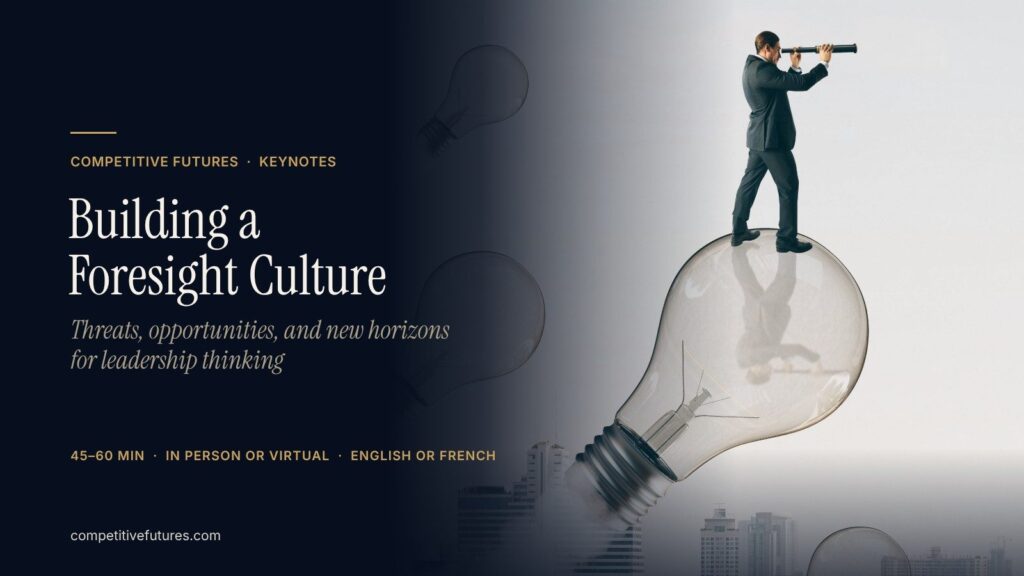
The foresight culture keynote teaches leadership teams how to make thinking about multiple futures a shared habit instead of one person’s job. “Building a Foresight Culture: Threats, Opportunities, and New Horizons for Leadership Thinking” draws on 30 years of foresight and intelligence work for corporations and governments, and it is the lead program in Eric Garland’s keynote lineup.
At a glance
- Full title: Building a Foresight Culture: Threats, Opportunities, and New Horizons for Leadership Thinking
- Length: 45 to 60 minutes, including Q&A. Extended versions run as a half-day or full-day workshop.
- Audiences: executive teams, partner meetings, associations, professional-services firms, and any organization planning past the next fiscal year.
- Delivery: in person or virtual, in English or French.
- Debut: November 2026, at a global professional services firm’s leadership conference in New York.
Why this keynote, and why now
The organizations most surprised by change are rarely short of data or smart people. They usually saw the signal. What they lacked was a habit of taking it seriously before the quarter forced them to. We explain what that habit looks like in our guide to building a foresight culture; this keynote is how leadership teams start building it.
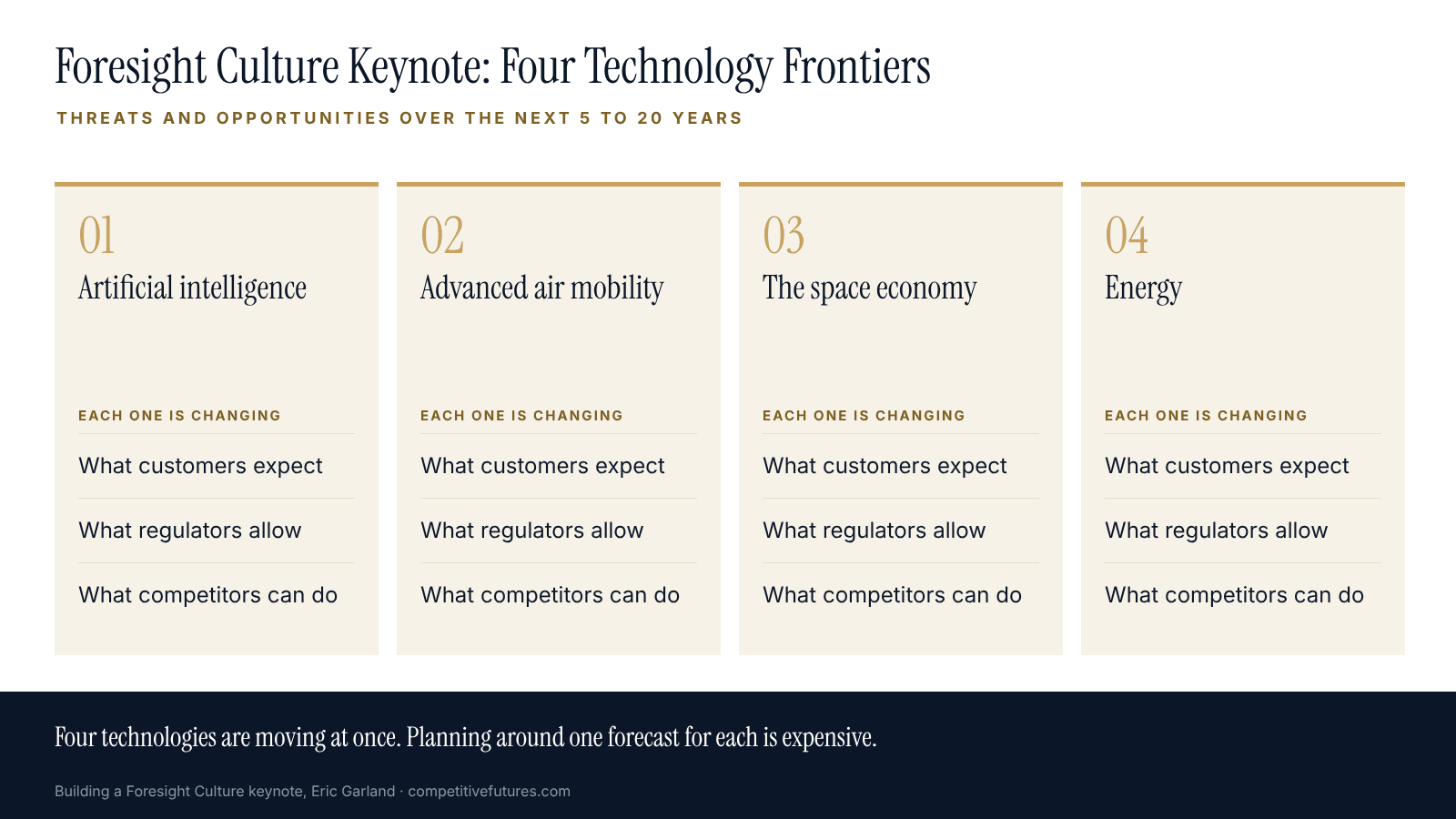
The timing matters. Several technologies are moving at the same time: artificial intelligence, advanced air mobility, the space economy, and energy. Each one is changing what customers expect, what regulators allow, and what competitors can do. Leaders who plan around a single forecast for each of them will be wrong in ways that are expensive.
What the keynote covers
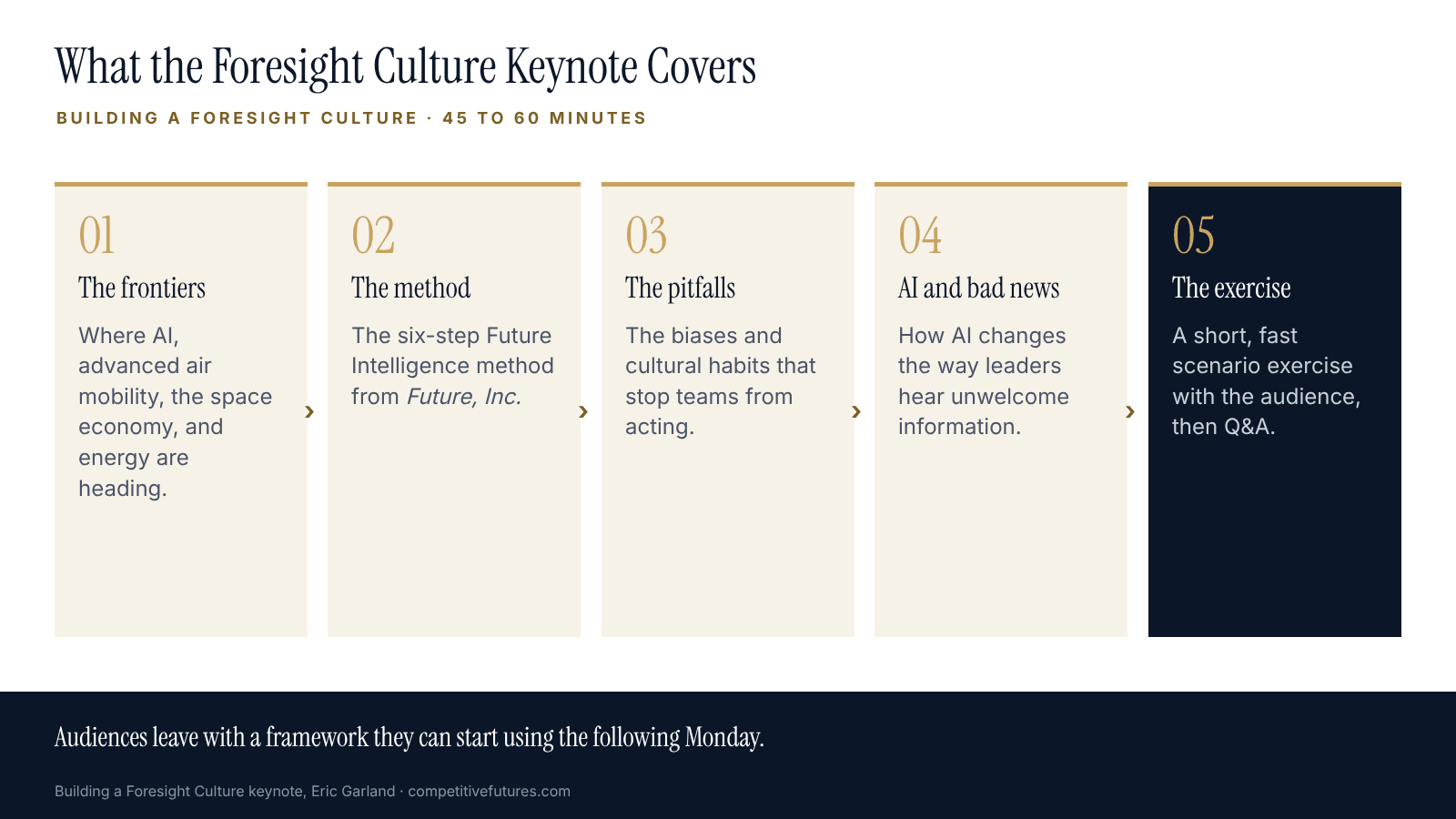
- The frontiers. Where AI, advanced air mobility, the space economy, and energy are heading over the next 5 to 20 years, and the threats and opportunities each one creates.
- The method. The six-step Future Intelligence method from Garland’s book Future, Inc. (AMACOM, 2007), and why a real strategic choice needs more than one scenario.
- The pitfalls. The cognitive biases and cultural habits that stop smart teams from acting on what they already know.
- AI and bad news. How AI changes the way organizations take in uncomfortable information, and what leaders have to do so that the tools are allowed to deliver it.
- The exercise. A short, fast scenario exercise with the audience.
What audiences take away
- Why being right isn’t enough, and what makes a forecast useful to the people who decide.
- A practical framework for looking 5 to 20 years ahead that a team can start using the following Monday.
- A shared vocabulary for raising unwelcome possibilities without being treated as a pessimist.
- A clear view of which technology frontiers matter most to their own sector.
From the stage to the organization
A keynote can change how a room talks about the future for an afternoon. A culture changes when the habit has an owner, a schedule, and a place in decisions. That is the same problem as building any intelligence function: someone has to collect the signals, someone has to turn them into options, and leadership has to reward the people who bring bad news early. Many clients follow the keynote with a scenario workshop or an executive education session, and some ask us to help design the foresight function itself. Our guide to building a competitive intelligence function covers the structure.
Frequently asked questions
What is the Building a Foresight Culture keynote about?
It shows leadership teams how to make foresight a shared organizational habit. It covers four technology frontiers, a six-step foresight method, the biases that block action, and how AI changes the way leaders hear bad news.
Who is this keynote for?
Executive teams, partner and board meetings, associations, professional-services firms, and any organization that plans further ahead than the next fiscal year.
How long is the foresight culture keynote?
45 to 60 minutes, including Q&A. It can also be extended into a half-day or full-day working session.
Can the keynote be tailored to our industry?
Yes. Every delivery is adapted to the audience’s sector, and the frontier section is weighted toward the technologies that matter most to that audience.
Is it available virtually or in French?
Yes. It is delivered in person or virtually, in English or French.
How much does it cost to book?
Fees depend on format, travel, and customization. Our guide to what a futurist keynote speaker costs explains the market, and we will send a quote with availability.
Work with Competitive Futures
To check dates, contact us with your event date, location, and audience. We will be in touch within one business day with availability, fees, and a proposed angle for your audience. Speakers bureaus are welcome to inquire on a client’s behalf.
Related from Competitive Futures
- How to Build a Foresight Culture
- Strategic Foresight: A Practitioner’s Guide
- Scenario Planning
- Cognitive Bias: A Field Guide for Leaders
- Strategic Mind Traps keynote
References
- Garland, E. (2007). Future, Inc.: How Businesses Can Anticipate and Profit from What’s Next. AMACOM.
- Rohrbeck, R., & Kum, M. E. (2018). Corporate foresight and its impact on firm performance: A longitudinal analysis. Technological Forecasting and Social Change, 129, 105–116. https://doi.org/10.1016/j.techfore.2017.12.013