MICE: Why People Spy, and What the Acronym Leaves Out
MICE recruitment is the Cold War shorthand for why people agree to spy: Money, Ideology, Compromise, and Ego. Ask why someone betrays their country or their employer and you will probably get those four letters. The acronym is useful. It is also badly incomplete. Read the public record and three things stand out: most spies volunteer, coercion makes poor agents, and motives are usually built over time rather than simply found.
This is nation-state tradecraft. It is not competitive intelligence. No legitimate firm can bribe, blackmail, or deceive its way to information, and Competitive Futures does not. We describe how state services recruit so that companies can recognize it when it is aimed at their own people. This page goes through the four letters with a case for each, the U.S. data on who actually spies and why, the main critique of the acronym, and what all of it means for a company protecting its own information. It is part of our corporate counterintelligence series.

At a glance
- What MICE is: Cold War shorthand for four motives behind espionage: Money, Ideology, Compromise, and Ego.
- Whose tradecraft it is: state intelligence services. It is not competitive intelligence, which cannot bribe, blackmail, or deceive anyone.
- Why that is no handicap: a lawful program that draws a few pieces of information from many open conversations is often more accurate than a single recruited insider, and it has no single point of failure.
- The cases: Aldrich Ames (money), Ana Montes (ideology), Clayton Lonetree (compromise), and Robert Hanssen (ego).
- What the data show: about 60% of American offenders since 1990 volunteered, and money was a motive for 28% of them.
- What the acronym misses: motives are usually built over time, and coercion makes poor agents.
- Why companies should care: the same motives drive insiders who sell trade secrets. The defense is knowing what matters and giving people a way to report an approach.
This Is Nation-State Tradecraft, Not Competitive Intelligence
Everything on this page describes how state intelligence services recruit people to betray a trust. It does not describe competitive intelligence, and it is not a method any legitimate firm can use.
The two differ in kind. A state service works behind a cover story, recruits agents who hand over what they were trusted to protect, and uses money, leverage, and flattery to keep them producing. The work is a crime in the country where it happens. Competitive intelligence is done by companies and the analysts they hire, under a real name and a disclosed affiliation, from public records, open sources, and interviews with people who know who is asking and are free to decline. It offers no payment for secrets and applies no pressure.
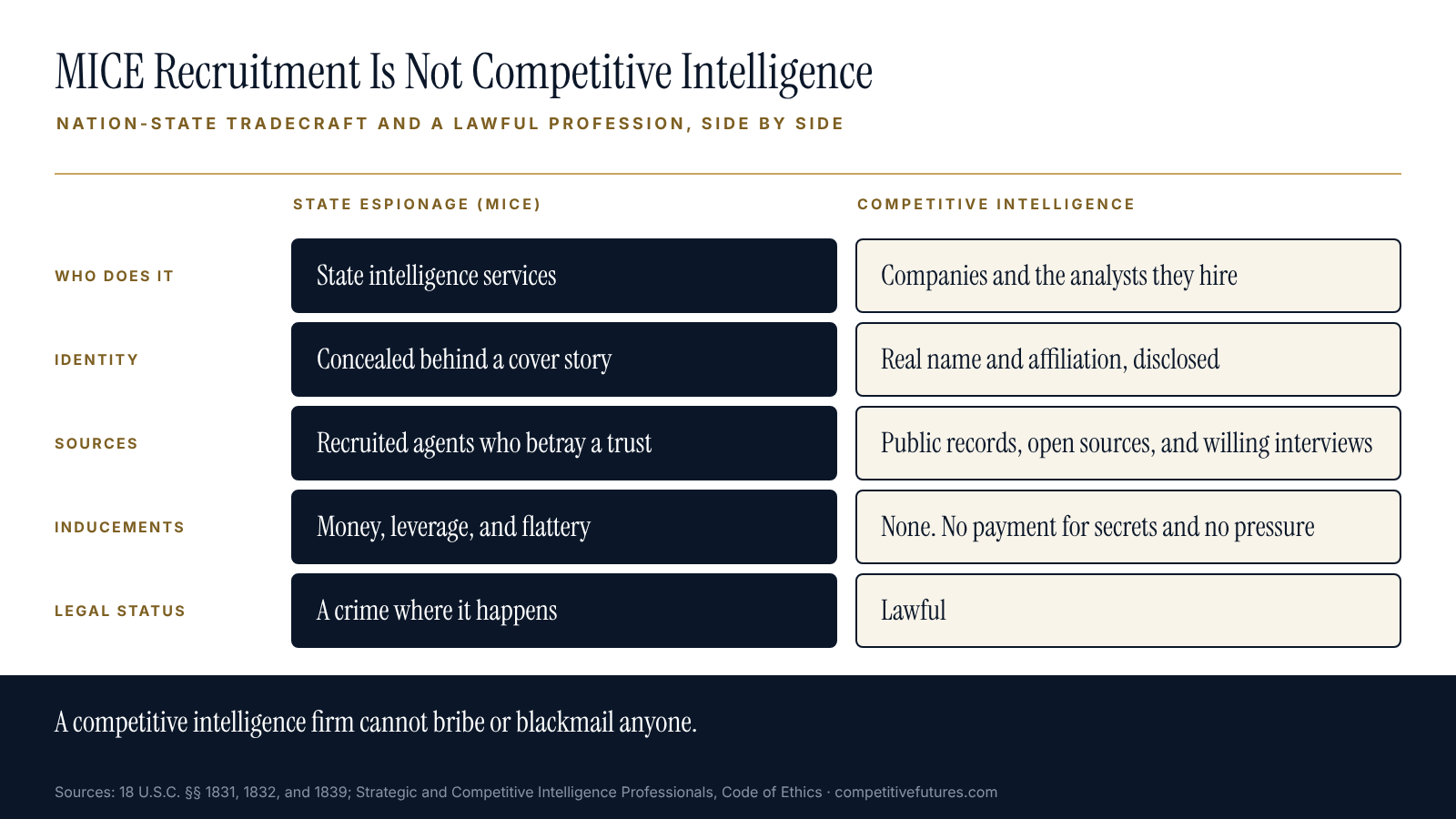
The law draws the same line. Under 18 U.S.C. § 1839, the “improper means” of acquiring a trade secret include theft, bribery, misrepresentation, and inducing someone to breach a duty of secrecy. Paying an employee for an employer’s confidential information is bribery, and threatening someone to get it is extortion. Either can end in a prosecution under the Economic Espionage Act. The code of ethics of Strategic and Competitive Intelligence Professionals (SCIP) sets the professional standard above that floor: obey the law everywhere you work, and tell the people you interview who you are and whom you represent.
Competitive Futures cannot bribe or blackmail anyone, and it does not. The company does not recruit insiders, pay for confidential information, or use leverage against a source. A firm that did would be committing crimes and exposing its clients to them.
Lawful Collection Works Better Than a Recruited Source
None of this leaves a legitimate firm at a disadvantage. In our experience, lawful human intelligence produces better results than a recruited insider would, and the difference comes from how the program is designed.
A well-designed program does not depend on one person with access to everything. It draws on many people around an organization and its market, each of whom can speak openly about what they know. Picture fifty conversations, each yielding two to five pieces of information. Assembled, those pieces form a constellation that is often more accurate than anything a single well-placed source could provide, because each piece can be checked against the others and no one person’s error or bias decides the result.
Breadth also protects the work. Each conversation asks for little, so none of them stands out, and the program keeps going if one contact moves on or declines to talk.
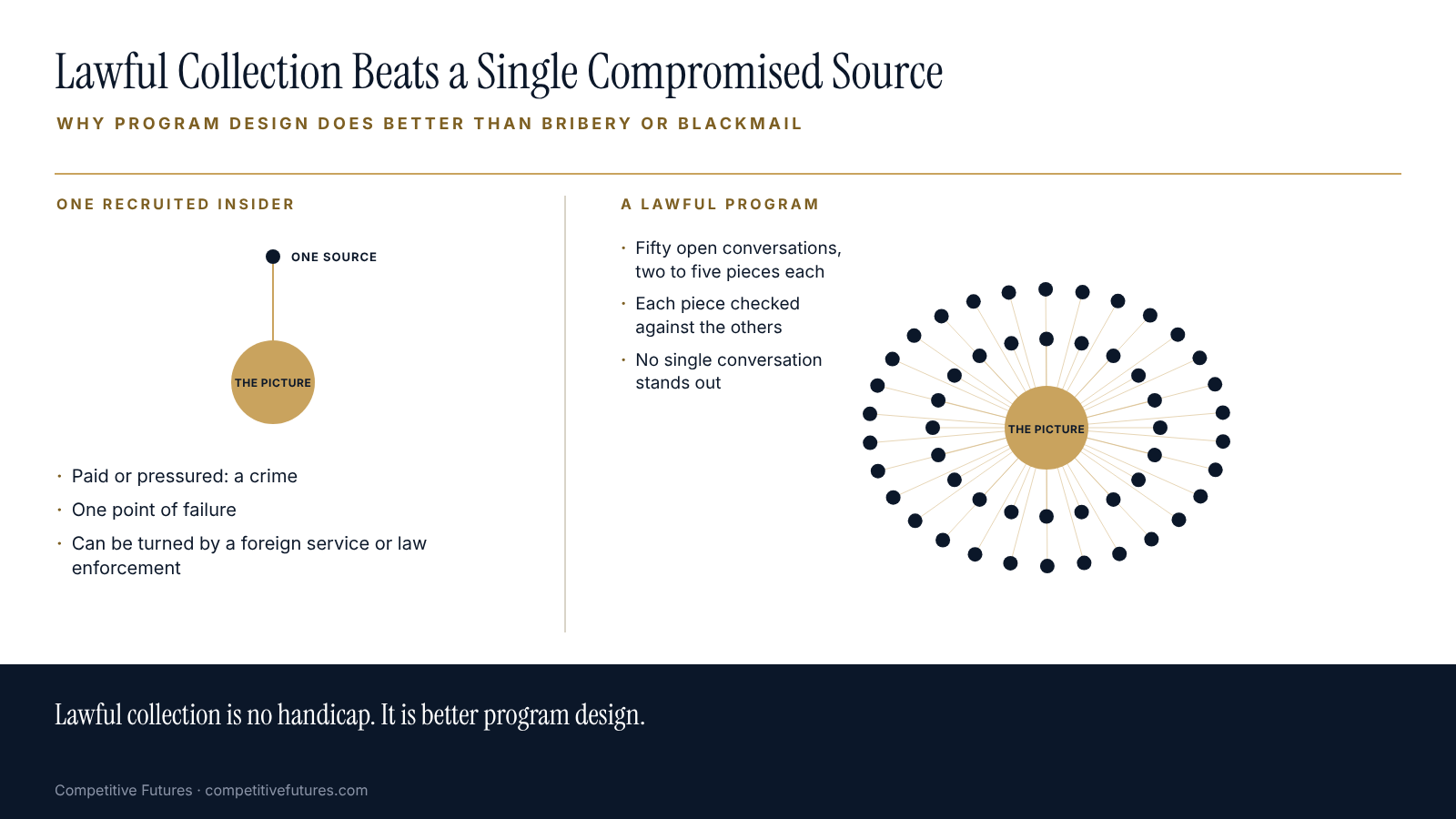
A single compromised source is the opposite: one point of failure. A person who has been paid or pressured into handing over secrets can be discovered, and once discovered can be turned against whoever recruited them, by a foreign service or by law enforcement. For a state service that means a blown operation. For a company it means a prosecution. The Yanjun Xu case on our elicitation techniques page shows how it happens: after the engineer’s first trip, the FBI took over his communications, and Xu’s later requests went to the Bureau without his knowing it.
The line between espionage and competitive intelligence costs a client nothing. Staying on the right side of it keeps everyone out of prison and produces better intelligence.
Money: Aldrich Ames
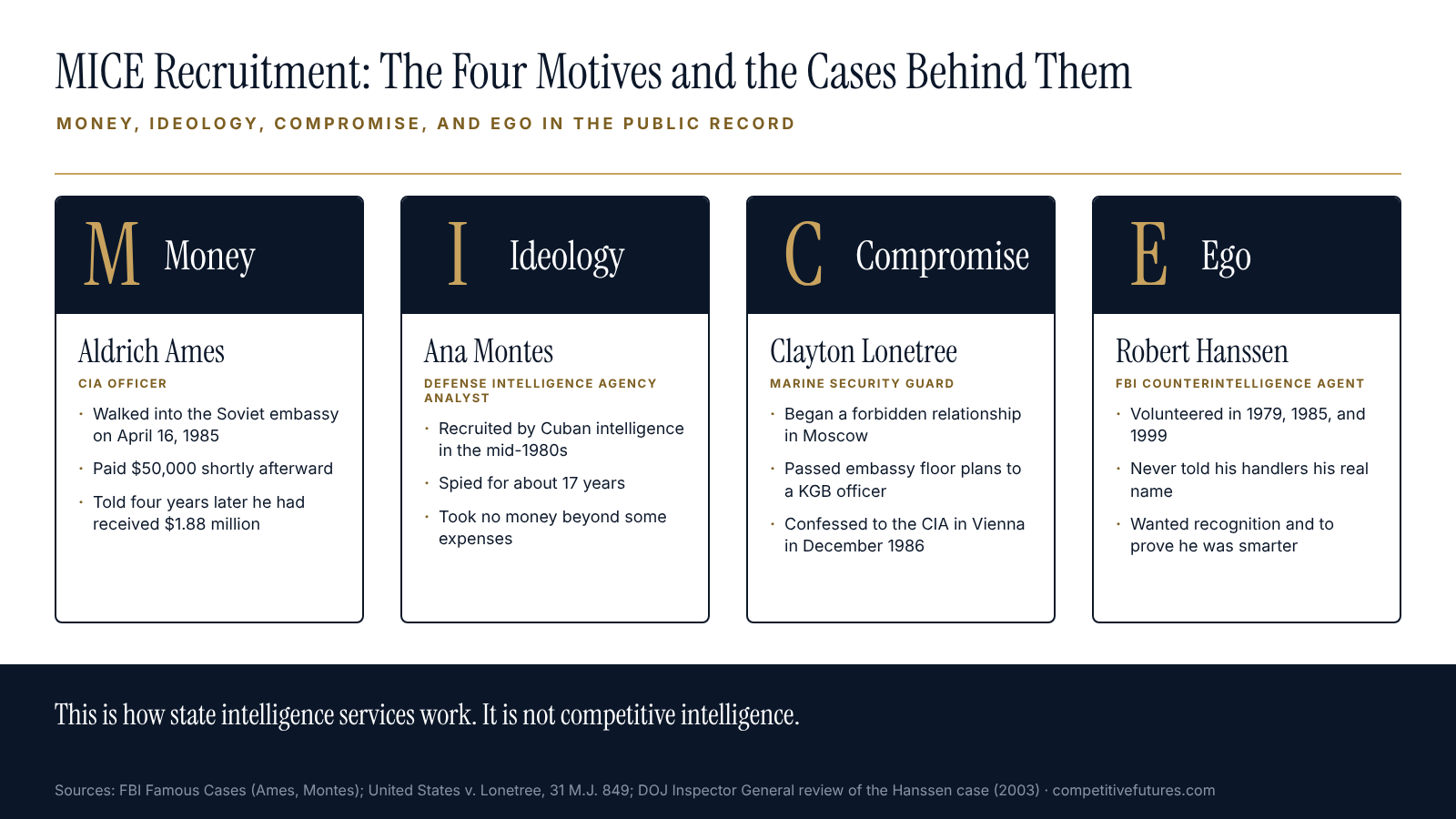
On April 16, 1985, Aldrich Ames, an officer in the CIA’s Soviet and East European Division, walked into the Soviet embassy in Washington and offered his services to the KGB. They paid him $50,000 shortly afterward. Four years later the KGB wrote to tell him he had received $1.88 million. By the FBI’s count, Ames compromised more than 100 U.S. intelligence operations, and 10 American assets died. He was arrested in February 1994 and is serving life without parole.
Money is the easiest motive to understand and the easiest to detect, because it shows. Reports of Ames’s unexplained wealth helped open the FBI investigation in 1993. It is also the motive handlers trust least. A source who works for money will work for whoever pays more, and one who is treated purely as hired help may stop producing when the money changes.
Ideology: Ana Montes
Ana Montes was the Defense Intelligence Agency’s senior analyst on Cuba. Cuban intelligence recruited her in the mid-1980s, and she spied for Havana for about 17 years. The FBI describes her motive as “pure ideology.” She opposed U.S. policy toward Latin America, and she took no money except reimbursement for some expenses. She was arrested ten days after the September 11 attacks, pleaded guilty in 2002, and was sentenced to 25 years. At sentencing she told the court she had obeyed her conscience rather than the law.
Ideological sources are the hardest to catch and among the most damaging. They do not spend money they should not have, they need no bribe to keep going, and they can work for decades. Montes memorized what she read at work and typed it up at home, so she never carried a document out of the building.
Compromise: Clayton Lonetree
Clayton Lonetree was a Marine Security Guard at the U.S. embassy in Moscow in the mid-1980s. Guards were forbidden close contact with Soviet citizens. He began a relationship with Violetta Seina, a Soviet translator at the embassy, and through her met “Uncle Sasha,” a KGB officer who began asking questions. Lonetree passed information about the embassies in Moscow and Vienna, including floor plans and the locations of offices. In December 1986, in Vienna, he walked up to the CIA station chief and confessed. A court-martial convicted him on 13 counts in August 1987. The broader claims at the time, that Marine guards had let the KGB into the Moscow embassy, were never proven.
This is the honey trap that fills spy novels. It is a real technique, and the Soviets used it. Lonetree’s case also shows its limits. Once the person who has been compromised does the arithmetic and decides that confession is safer than continuing, the operation is over.
Ego: Robert Hanssen
Robert Hanssen, an FBI counterintelligence agent, volunteered to Soviet military intelligence in 1979, to the KGB in 1985, and again to its successor in 1999. He never told his Russian handlers his real name. The Justice Department’s Inspector General found that money played a part, but it did not explain the whole case. The review cites Hanssen’s low self-esteem, his desire to prove he was smarter than the people around him, his wish for recognition, and what he himself called an addiction to espionage. His failing finances drove the last phase. He was paid at least $500,000 and diamonds between 1985 and 1991.
Ego is the motive that hides inside the others. A man passed over for promotion, a scientist who feels unrecognized, an employee convinced that management does not see their talent: each can find in a handler the first person who seems to take them seriously.
Most Spies Are Not Recruited at All
The Defense Personnel and Security Research Center (PERSEREC) has tracked every American publicly known to have committed an espionage-related offense since 1947, 209 people by its 2017 report. Its findings cut against the popular picture.
In the cohort since 1990, about 60% volunteered and about 40% were recruited. Money remains the most common motive, but it has fallen sharply: it was a motive for 41% of offenders from 1947 to 1979, for 45% in the 1980s, and for 28% since 1990. Divided loyalties, meaning allegiance to another country or cause alongside or above allegiance to the United States, came second at 22%. Disgruntlement and ingratiation were close behind, and more offenders now cite the desire for recognition. Most offenders in the recent cohort received no payment at all.
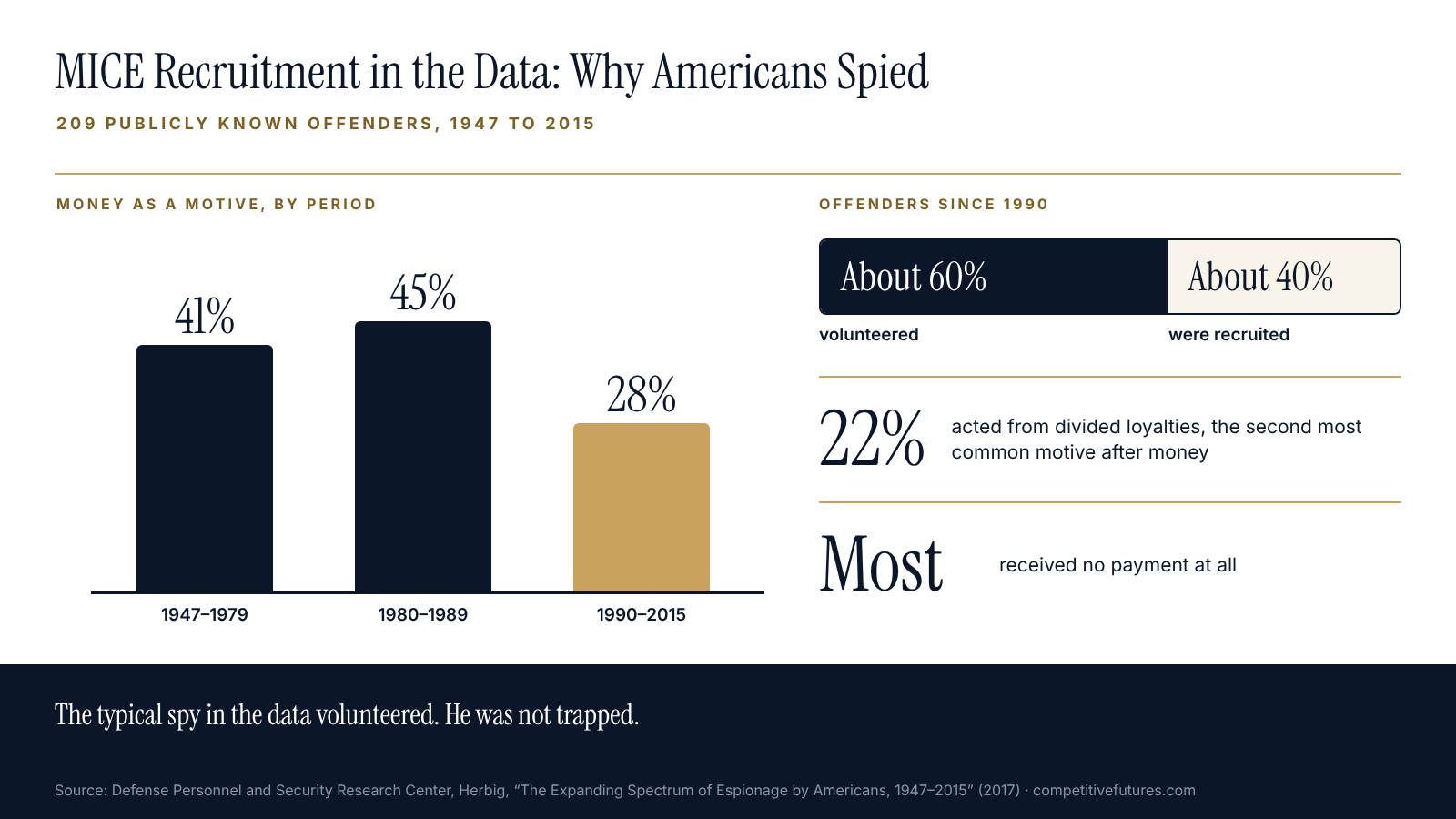
The typical spy in the data is not someone who was trapped. More often it is a person who walked in with a grievance, a cause, a debt, or a need to matter, and went looking for a buyer.
Coercion Makes Poor Agents
The blackmail story is popular because it is dramatic, and because it flatters the target: nobody chooses to betray, they are forced. Professionals have long been skeptical of it for a practical reason. A coerced agent is angry, resentful, and does only enough to avoid exposure. He has every reason to lie, to deliver junk, and to watch for the moment when confessing becomes the better deal. The 2013 critique of MICE in Studies in Intelligence, the U.S. intelligence community’s professional journal, makes exactly this point and notes that coercion is actively discouraged in American training.
None of this means compromise is harmless. Services do collect it. The more common use is as an anchor on a relationship that started willingly. A source who has already taken money, signed a receipt, or handed over one document has created his own compromise, and both sides know it.
Motives Are Built, Not Found
The deeper problem with MICE is that it treats motive as a fixed trait waiting to be discovered. In practice, intelligence officers build cooperation over months or years, and the motive often appears only after the relationship does.
The case of Glenn Duffie Shriver shows the progression. In October 2004, while living in Shanghai after his studies, Shriver developed a relationship with three people he came to learn were officers of Chinese intelligence. At their request he agreed to return to the United States and apply to work in U.S. intelligence or law enforcement. Over the next several years he applied to the State Department’s Foreign Service and the CIA’s clandestine service, met his handlers about 20 times, and accepted more than $70,000 in three cash payments, which he described as payment for his “friendship.” He lied on his CIA application to conceal the relationship. He pleaded guilty in 2010 and was sentenced to four years in prison in January 2011.
Was that money, ego, or compromise? It was all three, and none of them was present on the first day. Each small step made the next one easier to take.
The 2013 critique proposed replacing MICE with RASCLS, built on the psychologist Robert Cialdini’s six principles of influence:
- Reciprocation: a favor creates an obligation.
- Authority: people defer to those who seem powerful or well informed.
- Scarcity: a rare opportunity, or a deadline, invites commitment.
- Commitment and consistency: a small yes makes a larger yes easier.
- Liking: people help those who seem similar to them and who appreciate them.
- Social proof: people follow what others like them have already done.
These are the same principles at work in sales, fundraising, and every professional relationship. That is why they work in espionage too.
What This Means for a Company Defending Itself
The people who steal from companies act on the same motives. An engineer selling designs to a foreign competitor, a sales director taking a customer file to a rival, and a researcher recruited through a flattering invitation to lecture abroad all have one or more of the four letters behind them. The Economic Espionage Act makes theft of trade secrets for a foreign government or for private gain a federal crime, and several of the most serious recent cases began with exactly the kind of gradual cultivation described above. Our page on elicitation techniques walks through one of them.
Three conclusions follow for executives and security officers.
- Profiles do not catch spies. Millions of people are in debt, angry at their employer, or loyal to a second country, and nearly all of them will never betray anyone. Watching for a type wastes effort and poisons a workplace. Watching for behavior, such as unexplained wealth, unreported foreign contacts, or interest in information outside one’s job, is more useful.
- Most cases are walk-ins. The first defense is knowing which information actually matters and limiting who can reach it. A company that has never decided what is sensitive cannot protect it from a willing seller. See our pages on protecting trade secrets and the Economic Espionage Act.
- Give people a way out. Recruitment works by small steps, and most targets sense something wrong long before the final one. Lonetree confessed on his own. An employee who can report an odd approach without fear of punishment is a better control than any screening program. This is the foundation of a working insider risk program.
MICE remains a fair checklist for why a person might cooperate with a foreign service. It is a poor description of how cooperation actually happens. The services that do this well build a relationship and let it do the work.
Frequently asked questions
What does MICE stand for in espionage?
MICE stands for Money, Ideology, Compromise (sometimes Coercion), and Ego. It is Cold War shorthand used by intelligence officers and counterintelligence trainers to describe why people agree to spy. Real cases rarely fit one letter. Most involve two or three motives at once, and they often change over the life of the relationship.
Is MICE used in competitive intelligence?
No. MICE describes how state intelligence services recruit people to betray a trust, and that work is a crime in the country where it happens. Competitive intelligence is a lawful profession carried out under a real name and a disclosed affiliation. Bribery and misrepresentation are named as improper means of acquiring a trade secret in 18 U.S.C. § 1839. Competitive Futures does not pay for confidential information or pressure anyone to provide it. In our experience, a lawful program that draws on many open sources also produces better intelligence than a single recruited insider.
What is the most common motive for espionage?
Among Americans prosecuted for espionage-related offenses, money remains the most common single motive, but it has declined. The Defense Personnel and Security Research Center found money was a motive for 45% of offenders in the 1980s and 28% of those since 1990. Divided loyalties to another country or cause came second at 22%, and the desire for recognition is rising.
Are honey traps and blackmail common?
They are real, but they are not the main way spies are made. The U.S. data show that most people who spy volunteer. Coerced agents also make poor sources: they resent their handlers, do as little as they can, and often look for a way out. The Marine guard Clayton Lonetree, drawn in through a forbidden relationship in Moscow, walked into a CIA station in Vienna and confessed.
What is RASCLS?
RASCLS is an alternative to MICE built on Robert Cialdini’s six principles of influence: Reciprocation, Authority, Scarcity, Commitment and consistency, Liking, and Social proof. Instead of asking what weakness a person has, it describes how a relationship moves someone toward cooperation one step at a time. It was proposed in 2013 in Studies in Intelligence, the professional journal of the U.S. intelligence community.
How does MICE apply to companies?
The same motives drive insiders who sell trade secrets: debt or greed, a cause or a second loyalty, leverage someone holds over them, and grievance or a need to be recognized. Companies cannot read minds, and most people under financial strain or carrying a grudge never betray anyone. What helps is knowing which information matters, watching for behavior rather than profiles, and giving people a safe place to report an approach.
Work with Competitive Futures
We help companies understand how their people are approached and build an organization where the approach gets reported. Contact the company to talk about yours.
Related analysis
- Elicitation: How Information Leaves a Company One Conversation at a Time
- Corporate Counterintelligence: How Companies Protect Their Secrets From Competitors and Foreign Services
- Insider Risk Programs: How Companies Protect Their Secrets From the People Who Already Have the Keys
- Protecting Trade Secrets: What “Reasonable Measures” Means and Why Courts Decide Cases on It
- The Economic Espionage Act: History, Case Law, and Controlling Precedent
- Competitive Intelligence
Sources
- Defense Personnel and Security Research Center, Katherine L. Herbig, “The Expanding Spectrum of Espionage by Americans, 1947–2015,” Technical Report 17-10 (2017)
- Defense Personnel and Security Research Center, Katherine L. Herbig, “Changes in Espionage by Americans: 1947–2007,” Technical Report 08-05 (2008)
- “An Alternative Framework for Agent Recruitment: From MICE to RASCLS,” Studies in Intelligence 57, no. 1 (March 2013)
- FBI, “Aldrich Ames” (Famous Cases)
- Senate Select Committee on Intelligence, “An Assessment of the Aldrich H. Ames Espionage Case and Its Implications for U.S. Intelligence” (1994)
- FBI, “Ana Montes: Cuban Spy” (Famous Cases)
- U.S. Navy-Marine Corps Court of Military Review, United States v. Lonetree, 31 M.J. 849 (1990)
- CIA FOIA Reading Room, press file on the Lonetree case (1987)
- U.S. Department of Justice, Office of the Inspector General, “A Review of the FBI’s Performance in Deterring, Detecting, and Investigating the Espionage Activities of Robert Philip Hanssen,” Unclassified Executive Summary (August 14, 2003)
- U.S. Department of Justice, “Michigan Man Sentenced 48 Months for Attempting to Spy for the People’s Republic of China” (January 21, 2011)
- 18 U.S.C. § 1831, Economic espionage
- 18 U.S.C. § 1832, Theft of trade secrets
- 18 U.S.C. § 1839, Definitions
- Strategic and Competitive Intelligence Professionals, Code of Ethics
We help companies understand how people are approached, why some of them say yes, and how to build an organization where the approach gets reported instead.
This piece is part of our guide to Intelligence Collection and OSINT.