The Deep State Was Real: Derin Devlet and the History of Turkey’s State Within the State
Türkçe: Derin Devlet Gerçekti: Türkiye’de Devlet İçindeki Devletin Tarihi
Since early 2017, Americans of a certain political persuasion have talked about a “Deep State”: a shadowy network of unelected officials said to run the country no matter who wins the election. Many other Americans treat the phrase as a punchline.
Both groups are using a Turkish word. Deep state is a translation of derin devlet, and in Turkey it was not a theory. The Turkish deep state had an office, a budget, weapons depots, and a body count. Its Cold War core was a secret army unit founded in 1952 to fight communism, housed in the same Ankara building as the American military aid mission and paid for by the United States for two decades. A sitting prime minister found out it existed by accident.
This page covers where the Turkish deep state came from, the car crash that exposed it, the coups it is tied to, and the coup-plot trials that were supposed to finish it off and turned out to be built on forged evidence. For the official services, see our guide to Turkish intelligence.
At a glance
- The term: Derin devlet, “deep state.” It entered everyday Turkish after a car crash at Susurluk on 3 November 1996 and reached American politics in early 2017.
- What it means in Turkey: Networks inside the army, police, and intelligence services that worked with ultranationalist militants and organized crime, outside the law and outside the control of elected governments.
- Older roots: The Special Organization of 1913–1918 and the paramilitary habits of the late Ottoman Empire.
- Cold War core: A stay-behind unit founded in September 1952, the year Turkey joined NATO, later called the Special Warfare Department (Özel Harp Dairesi) and known to the public as the Counter-Guerrilla.
- Who paid: The United States, until 1974.
- Coups: The army overthrew or forced out elected governments in 1960, 1971, 1980, and 1997.
- The trials: The Ergenekon and Sledgehammer (Balyoz) cases, 2007–2019, convicted hundreds of officers of plotting coups. Every conviction was later overturned.
What Turks mean by derin devlet
The historian Ryan Gingeras defines the deep state as a shadow or parallel system of government in which unofficial or unacknowledged people help make and carry out state policy (Gingeras, “How the Deep State Came to America”). In Turkish usage the phrase answers a specific question: why do people who work for the state keep turning up next to gangsters, death squads, and coup plots?
It was never one organization with a membership list. It was a set of overlapping networks with a shared belief that the state had enemies the law could not reach: communists, Kurdish separatists, Islamists, Armenian militants, and sometimes the elected government.
Did Atatürk create the deep state?
Not in the form the phrase describes. Two things are true about the early Republic. Mustafa Kemal Atatürk’s government policed communism from the start: it set up an official Communist Party in 1920 to keep the movement under control, and the leaders of the real one were killed off Trabzon in January 1921. It also founded the Republic’s first intelligence service, the National Security Service, in 1926.
The secret anti-communist army at the center of the deep state came later. It was founded in 1952, 14 years after Atatürk’s death, under the elected Democrat Party government and with American help. What Atatürk’s generation did supply was the personnel and the habits. Many of the men who built the Republic had served in the Committee of Union and Progress and its Special Organization, which used bandits and released convicts as instruments of state policy. Historians trace the deep state’s working method, the state hiring outlaws to do what it could not do openly, to those years. Our history of Ottoman intelligence covers them.
The army also inherited a role. It saw itself as the guardian of Atatürk’s secular republic, with a duty to step in when politicians endangered it. Every coup that followed was justified in those terms.
1952: a secret army against communism
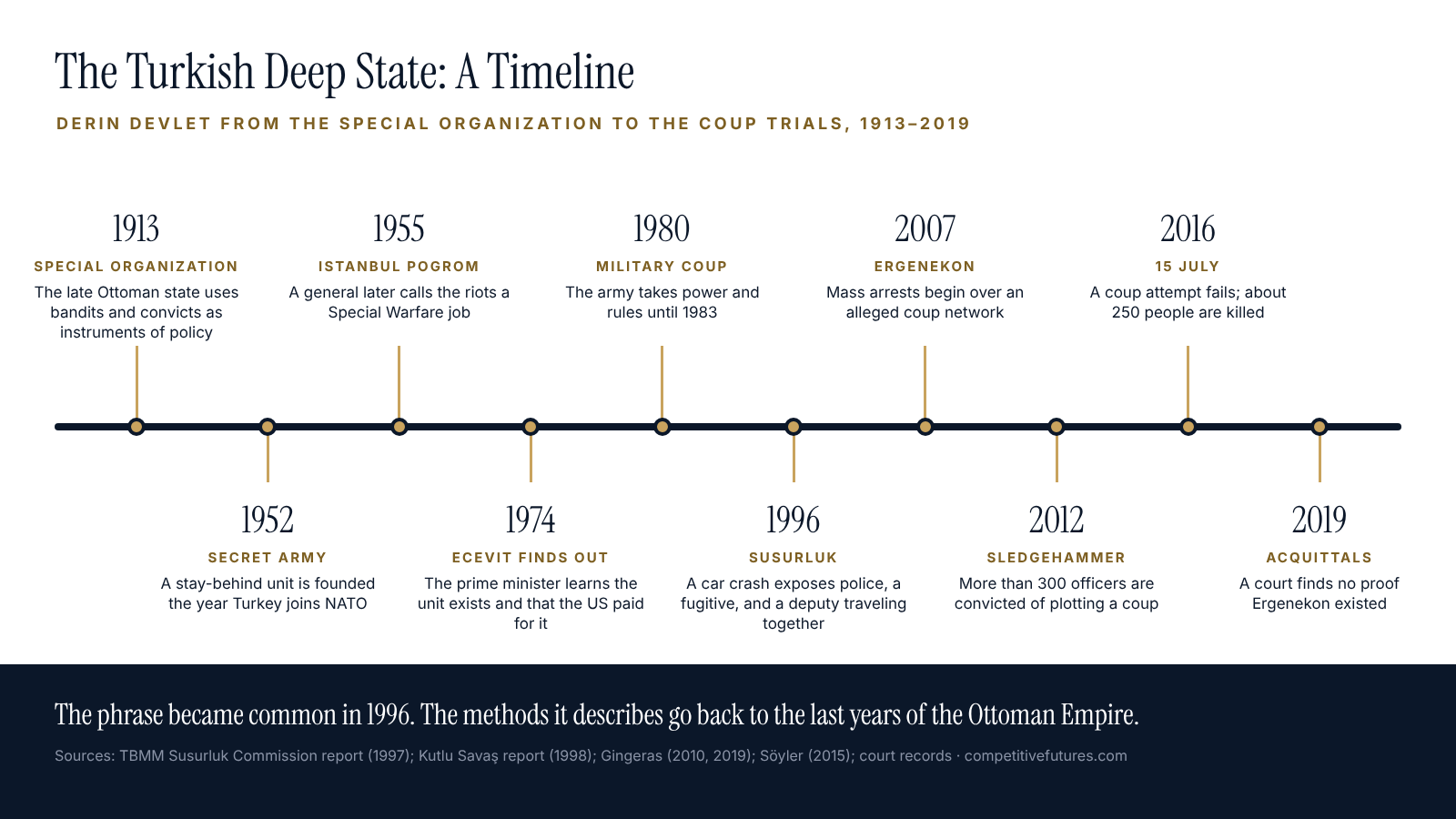
Turkey joined NATO in February 1952. That September the General Staff, which had asked the US Army for help, set up a unit for unconventional warfare. It was renamed the Mobilization Inspection Board (Seferberlik Tetkik Kurulu) the next year and later became the Special Warfare Department (founding documents from US military archives).
Its official mission was the same as that of the “stay-behind” networks NATO countries built across Western Europe: if the Soviet Union invaded or communists took power, trained cells would stay behind enemy lines and fight as guerrillas. The unit worked out of the building of the American military aid mission in Ankara. It kept hidden weapons depots around the country and trained civilians as well as soldiers.
The public learned of it because of a budget request. In 1974, Prime Minister Bülent Ecevit was asked by the chief of the General Staff for emergency money for something called the Special Warfare Department. Ecevit had never heard of it. He asked who had been paying until then and was told the United States had, from a secret fund, and that the department sat in the same building as the American mission (Ecevit’s account). American funding ended that year. Ecevit later told the president he suspected the unit’s hand in the political violence of the 1970s.
From stay-behind to counter-guerrilla
No Soviet invasion came, and the unit’s skills were turned inward.
The Istanbul pogrom, 1955. On 6 and 7 September 1955, mobs destroyed thousands of Greek-owned homes, shops, and churches in Istanbul after a false report that Atatürk’s birthplace in Salonica had been bombed. In 1991 a retired general who had led the Special Warfare Department, Sabri Yirmibeşoğlu, told a journalist that the riots were “a Special Warfare job” and a magnificent piece of organization (his remarks). He later tried to walk the statement back. In 2010 he added that Turkish operatives had burned a mosque in Cyprus to stiffen the resistance of Turkish Cypriots.
The 1970s. Street fighting between left and right killed thousands of people before the 1980 coup. Ultranationalist youth militants known as the Grey Wolves did much of the killing on the right, and officers and politicians at the time, Ecevit among them, said the Special Warfare Department had members inside that movement. The gunmen who fired on a May Day rally in Istanbul’s Taksim Square in 1977, where 34 people died, were never identified.
The 1990s. In the war against the Kurdistan Workers’ Party (PKK) in the southeast, thousands of killings went unsolved. Many were attributed to JİTEM, a gendarmerie intelligence unit whose existence the state denied for years.
Susurluk, 1996: the crash that proved it
On the evening of 3 November 1996, a black Mercedes hit a truck near the town of Susurluk in western Turkey. Three of the four people inside were killed (chronology).
- Hüseyin Kocadağ, a senior police official who had helped found the police special operations teams.
- Abdullah Çatlı, a Grey Wolves leader wanted for the murder of seven left-wing students in 1978 and for heroin trafficking, and sought by Interpol. He was carrying an identity card in a false name and official credentials.
- Gonca Us, a former beauty queen and Çatlı’s companion.
- Sedat Edip Bucak, the survivor: a member of parliament from the governing True Path Party and the head of a Kurdish clan whose militia fought the PKK for the state.
The car also held pistols, submachine guns, and silencers. A police chief, a fugitive killer, and a governing-party deputy had been traveling together, armed, and nobody could offer an innocent explanation. Interior Minister Mehmet Ağar, a former national police chief, resigned within days. Millions of people switched their lights off for one minute every evening in protest.
A parliamentary commission and a report commissioned by the prime minister, released in January 1998, described what the crash had exposed: state officials had used ultranationalist fugitives and drug traffickers to kill people the state considered enemies, and had protected them in return. Parliament lifted the immunity of Bucak and Ağar (Constitutional Court record). The military side of the network was never examined.
After Susurluk, derin devlet was part of the language. Presidents and prime ministers used the term, and Recep Tayyip Erdoğan said the deep state had existed since Ottoman times and promised to root it out.
The coups
The Turkish army removed elected governments four times in less than 40 years.
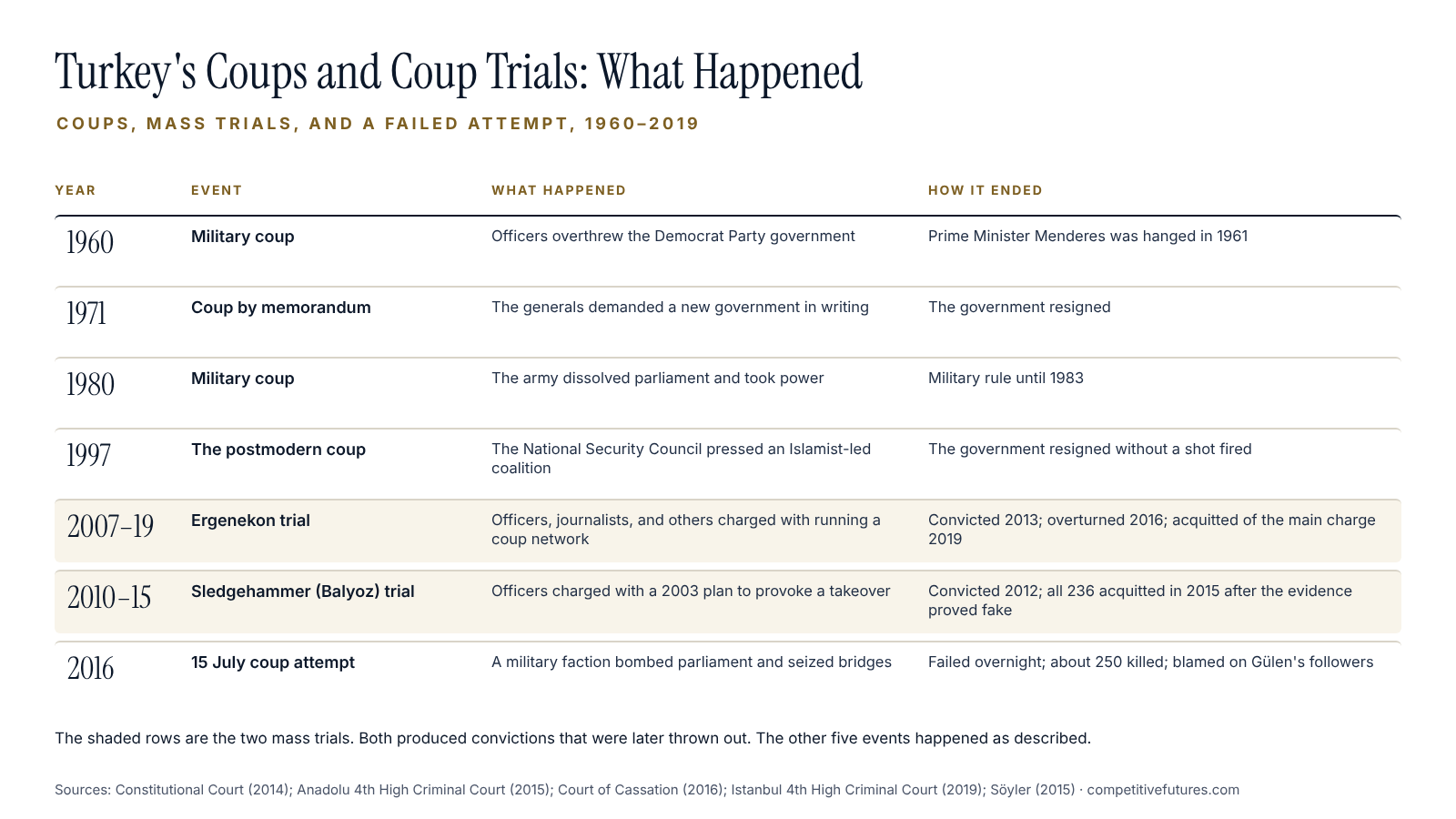
- 27 May 1960. Officers overthrew the Democrat Party government. Prime Minister Adnan Menderes was tried and hanged in 1961.
- 12 March 1971. The generals delivered a memorandum and the government resigned.
- 12 September 1980. The army took power outright, dissolved parliament, and ruled until 1983. Hundreds of thousands of people were detained.
- 28 February 1997. The military-dominated National Security Council forced an Islamist-led coalition out of office without moving a tank. Turks call it the postmodern coup.
In April 2007 the General Staff posted a late-night warning on its website about the election of a president from Erdoğan’s party. That time the government did not back down. It called an election and won.
Ergenekon and Sledgehammer: the plots that were, and were not
In June 2007 police found a crate of hand grenades in a house in Istanbul. Prosecutors said it led them to a secret organization called Ergenekon, a network of officers, lawyers, academics, journalists, and gangsters that planned bombings and assassinations to create chaos and bring on a coup against Erdoğan’s government. Hundreds of people were arrested.
In January 2010 a newspaper published documents it said described a 2003 army plan, code-named Sledgehammer (Balyoz), to bomb mosques and provoke a clash with Greece as the pretext for a takeover.
The courts convicted on both.
- Sledgehammer. In September 2012 more than 300 officers were sentenced to prison.
- Ergenekon. On 5 August 2013 a court declared Ergenekon a terrorist organization and sentenced a former chief of the General Staff, İlker Başbuğ, to life.
For many Turks this was the deep state finally in the dock. Then the cases fell apart.
The Sledgehammer documents were dated 2003 but had been written with software released years later and named organizations that did not exist in 2003. In June 2014 the Constitutional Court ruled that the defendants’ rights had been violated. At the retrial the prosecutor himself said the digital evidence was fake, and on 31 March 2015 all 236 defendants were acquitted (retrial verdict).
The Ergenekon convictions were overturned in April 2016. On 1 July 2019 a court acquitted 235 defendants of belonging to the organization, finding no proof that an organization called Ergenekon had existed (second verdict).
The police and prosecutors who built both cases were later accused of belonging to the movement of the cleric Fethullah Gülen, then an ally of Erdoğan’s government and by 2013 its enemy. The government now says the trials were a Gülenist operation to purge the army and replace its officers.
So the record on the overthrow accusations is mixed. The four interventions above happened. Some of the people tried in the 2000s had real histories in the networks Susurluk exposed. And the two great coup-plot cases rested on fabricated evidence and ended in acquittals.
15 July 2016
On the night of 15 July 2016 a faction of the armed forces tried to seize power. Jets bombed the parliament building, soldiers closed the Bosphorus bridges, and about 250 people were killed before the attempt collapsed by morning. The government blamed Gülen’s followers inside the military, which it calls a parallel state. Gülen, who lived in Pennsylvania, denied ordering it and died in 2024. Tens of thousands of officers, judges, police, and teachers were dismissed or jailed.
In 20 years the label “deep state” had moved from the Kemalist officer corps and its gangster allies to the religious movement that had helped prosecute them.
How the deep state came to America
English-language scholars borrowed the term from Turkish in the 1990s and 2000s. A former congressional staffer, Mike Lofgren, used it in a 2014 essay about the national security establishment and Wall Street. In early 2017 it entered the vocabulary of President Trump’s supporters as a name for officials they believed were working against him from inside the government.
The American usage and the Turkish original differ in kind. The Turkish deep state is documented in parliamentary reports, court records, and the statements of the generals who ran it, and it involved armed men and killings. The American term usually describes career officials resisting or slow-walking an elected administration’s policy. Readers can judge for themselves what the American version amounts to; the Turkish record is the baseline for what the phrase first meant.
What the Turkish deep state teaches about intelligence and oversight
- Secret units with no budget line answer to whoever pays. For 22 years Turkey’s prime ministers did not know the Special Warfare Department existed, because Washington funded it. Any intelligence function, public or corporate, needs a named owner who signs for the money.
- Capabilities built for one enemy get used on the next. The unit was created for a Soviet invasion and ended up active in domestic politics. Define the mission in writing and review it when the threat changes.
- Deniable partners become liabilities. The state used fugitives and traffickers because they could be disowned. In the end they were in the same car as a police chief and a member of parliament. Vendors, fixers, and intermediaries who do what the organization will not do itself carry the same risk.
- Check the evidence before you act on the conclusion you wanted. Many people believed the Sledgehammer documents because they fit what they already knew about the army. The file metadata said otherwise. Testing a favored conclusion against the evidence that would disprove it is the purpose of Analysis of Competing Hypotheses.
- An investigation can be an operation. The Ergenekon and Sledgehammer prosecutions removed one network from the state and installed another. When a case conveniently clears the way for the people bringing it, ask who benefits.
Frequently asked questions
Where does the term “deep state” come from?
It is a translation of the Turkish phrase derin devlet. The phrase became common in Turkey after the Susurluk car crash of 3 November 1996 exposed ties between police officials, a fugitive ultranationalist, and a member of parliament. Scholars brought it into English, and it entered American politics in early 2017.
Was the Turkish deep state real?
Yes. A parliamentary commission and a prime-ministerial report after the 1996 Susurluk crash documented cooperation between state officials, ultranationalist militants, and organized crime. Its Cold War core, the army’s Special Warfare Department, was founded in 1952, was funded by the United States until 1974, and was acknowledged by Prime Minister Bülent Ecevit.
Did Atatürk create the deep state?
No. Atatürk’s government suppressed communism and founded Turkey’s first intelligence service in 1926, but the secret anti-communist unit at the center of the Turkish deep state was created in 1952, 14 years after his death. Historians trace its methods to the Special Organization of the late Ottoman Empire, in which many founders of the Republic had served.
What was the Susurluk scandal?
On 3 November 1996 a Mercedes crashed near Susurluk. Inside were a senior police official, the wanted ultranationalist Abdullah Çatlı, and a governing-party member of parliament, Sedat Bucak, along with weapons and silencers. Only Bucak survived. The crash showed that the state was working with fugitives and traffickers, and the interior minister resigned.
What were the Ergenekon and Sledgehammer trials?
They were mass trials, begun in 2007 and 2010, of officers, journalists, and others accused of plotting to overthrow the Turkish government. Courts convicted hundreds in 2012 and 2013. The Sledgehammer convictions were thrown out after the digital evidence was shown to be fabricated, and all defendants were acquitted in 2015. The Ergenekon defendants were acquitted of the main charge in 2019.
Is the American “deep state” the same thing as the Turkish one?
No. The Turkish deep state involved secret military units, militants, and organized crime, and it is documented in official reports and court records. In American politics the term usually refers to career officials believed to be resisting an elected administration. The two share a name and little else.
Work with Competitive Futures
Turkey spent 40 years learning what happens when secret capabilities have no owner, no budget line, and no review. We build intelligence functions for companies and governments with the mandate and the limits written down at the start. Request a 20-minute conversation.
Related analysis from Competitive Futures
- Turkish Intelligence: History, Structure, and the Headlines
- The History of Ottoman Intelligence: From Mehmed the Conqueror to the Special Organization
- The History of MI5 and MI6: From the Secret Service Bureau to Thames House and Vauxhall Cross
- James Jesus Angleton: Counterintelligence in a Wilderness of Mirrors
- Analysis of Competing Hypotheses
- Intelligence Services Around the World
References
- Gingeras, R. (2010). Last rites for a “pure bandit”: Clandestine service, historiography and the origins of the Turkish “deep state.” Past & Present, 206, 151–174.
- Gingeras, R. (2011). In the hunt for the “Sultans of Smack”: Dope, gangsters and the construction of the Turkish deep state. Middle East Journal, 65(3), 426–441.
- Gingeras, R. (2014). Heroin, Organized Crime, and the Making of Modern Turkey. Oxford University Press.
- Gingeras, R. (2019). How the deep state came to America: A history. War on the Rocks.
- Güllapoğlu, F. (1991). Tanksız Topsuz Harekât. Tekin Yayınevi.
- Jenkins, G. (2009). Between Fact and Fantasy: Turkey’s Ergenekon Investigation. Central Asia-Caucasus Institute, Silk Road Paper.
- Jenkins, G. (2014). The Balyoz retrial and the changing politics of Turkish justice. Turkey Analyst, 7(12).
- Lofgren, M. (2016). The Deep State: The Fall of the Constitution and the Rise of a Shadow Government. Viking.
- Söyler, M. (2015). The Turkish Deep State: State Consolidation, Civil-Military Relations and Democracy. Routledge.
- Türkiye Büyük Millet Meclisi. (1997). Susurluk Araştırma Komisyonu Raporu.
- Başbakanlık Teftiş Kurulu. (1998). Susurluk Raporu [the Kutlu Savaş report].
- Anayasa Mahkemesi. Decision 1997/74 on the parliamentary immunity of Sedat Edip Bucak and Mehmet Ağar.
- Anayasa Mahkemesi. (2014, June 18). Individual applications in the Balyoz case.
This piece is part of our guide to Intelligence Services Around the World.