James Jesus Angleton: Counterintelligence in a Wilderness of Mirrors
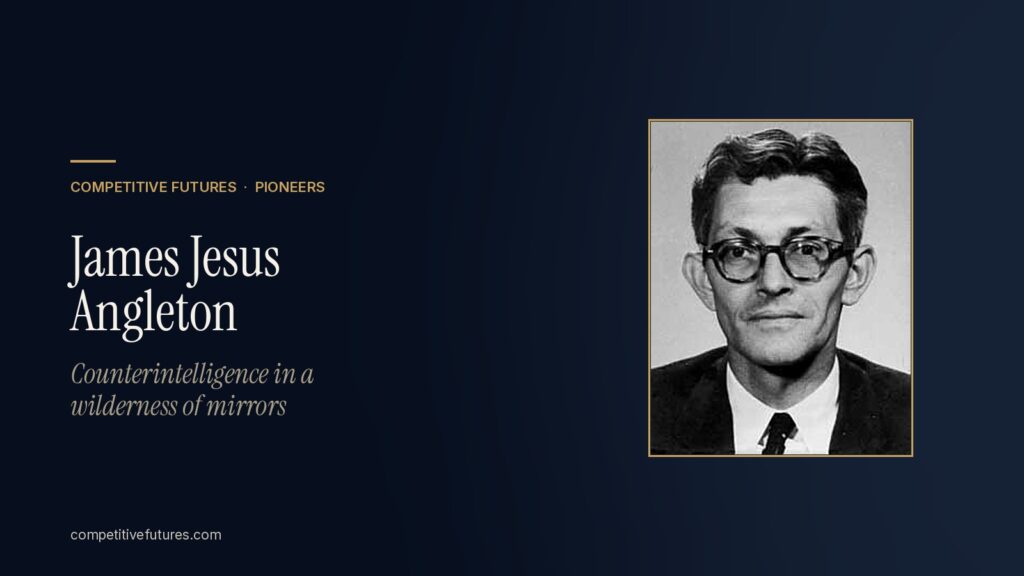
James Jesus Angleton (1917–1987) ran counterintelligence at the Central Intelligence Agency for twenty years, from 1954 until his forced departure in December 1974. Among American intelligence officers, few have shaped the profession as much or divided it as sharply. He helped build the CIA, ran its liaison with Israel, and turned counterintelligence into a discipline of its own. He also spent the second half of his career pursuing a Soviet penetration of the Agency that, on the available record, was far smaller than he believed, and he oversaw a mail-opening program that read the letters of Americans for nearly two decades.
His career is a case study in the central problem of counterintelligence. Adversaries really do build systems to deceive whole governments and populations. But a mind trained to see deception can come to see it everywhere, and at that point the counterintelligence service starts doing the adversary’s work for it. Angleton’s story shows both halves of that problem, and it is worth knowing for anyone who analyzes information that someone may be trying to manipulate.
At a glance
- Born: 9 December 1917, Boise, Idaho. Died: 11 May 1987, Washington, D.C., of lung cancer.
- Education: Malvern College, England; Yale (B.A., 1941); Harvard Law School (did not finish).
- War service: U.S. Army and the Office of Strategic Services’ counterintelligence branch, X-2, from 1943; chief of X-2 in Italy by 1944.
- CIA career: founding officer, 1947; chief of the Counterintelligence Staff, 1954–1974.
- Known for: his friendship with Kim Philby, his reliance on the defector Anatoliy Golitsyn, the detention of Yuri Nosenko, the molehunt, and the HTLINGUAL mail-opening program.
A poet before he was a spy
Angleton was born in Boise to James Hugh Angleton and Carmen Mercedes Moreno, and he spent much of his youth in Europe. He attended English preparatory schools and Malvern College before going to Yale in 1936 (CIA). At Yale he edited Furioso, a little magazine of poetry, and corresponded with Ezra Pound and E. E. Cummings (Journal of Cold War Studies review of Holzman, 2010).
Biographers often connect that literary training, the New Criticism’s close reading of a text for hidden layers of meaning, to the way he later read intelligence. The connection is an interpretation, not a documented fact. What is documented is that he brought a reader’s habits to a profession built on documents, sources, and stories, and that he took the phrase most associated with him, the “wilderness of mirrors,” from T. S. Eliot’s poem “Gerontion” (Robarge, Studies in Intelligence, 2009).
Learning the craft: X-2 and the lessons of Double Cross
After a year at Harvard Law School, Angleton was drafted in March 1943 and recruited into X-2, the counterintelligence branch of the Office of Strategic Services. He trained in London alongside British intelligence, and by late 1944, at 27, he was chief of X-2 in Italy (CIA).
London gave him a close view of the most successful deception operation of the war. Through the Twenty Committee, Britain controlled the German agents in the country and used them to feed Berlin a false picture of Allied plans, including the FORTITUDE deception before D-Day. The CIA’s chief historian, David Robarge, concludes that this wartime exposure to DOUBLE CROSS and FORTITUDE helped shape Angleton’s later conviction that Moscow was running deception on the same scale against the West (Robarge, 2009).
The lesson he drew was correct as far as it went. A disciplined service that controls an adversary’s channels of information can make that adversary believe almost anything. The question that ran through the rest of his career was how to tell when it was happening.
Founding the CIA
Angleton stayed in Italy after the war, building relationships with Italian and other services and playing a major role in American operations around the 1948 Italian election. He moved into the new CIA in 1947 and is counted among its founding officers. By 1949 he was a senior leader in the Office of Special Operations, and he took over the Agency’s liaison with Israel’s intelligence and security services (CIA).
The Israel account stayed with him for most of his career. Robarge describes his control of it as an administrative anomaly and one source of his influence inside the Agency (Robarge, 2009). Israel later dedicated two memorials to him in Jerusalem (Robarge, Journal of Intelligence History, 2003).
In 1954 Allen Dulles made him chief of the Counterintelligence Staff, the post he held for the next twenty years.
Kim Philby
Angleton knew Kim Philby of Britain’s Secret Intelligence Service from the war, renewed the acquaintance in Rome, and worked closely with him when Philby was the British liaison in Washington from 1949 to 1951 (Royden, Studies in Intelligence, 2011). Philby had been a Soviet agent since the 1930s. He defected to Moscow in 1963.
Reviewers of the scholarly literature agree that the friendship, and his failure to suspect Philby, fed Angleton’s later conviction that Western services were penetrated and that the Soviets were capable of almost anything (Journal of Cold War Studies, 2010; Robarge, 2009). For a counterintelligence chief, Philby proved the threat was real. He also became the frame through which every later case was read.
Golitsyn and the theory of strategic deception
In December 1961 Anatoliy Golitsyn, a KGB officer, defected to the CIA in Helsinki. Angleton came to trust him more than any other source. Golitsyn told him the KGB had penetrated Western services, that it would send false defectors to discredit him, and that apparent splits in the Communist world were staged.
Angleton gave Golitsyn unusual access, including CIA personnel files, so the defector could help identify possible moles, and he used Golitsyn as a sounding board on the bona fides of other Soviet defectors and volunteers. Golitsyn found them all wanting (Royden, 2011).
The larger theory held that Moscow was running a long-term program of “strategic deception” and that events such as the Sino-Soviet split and Tito’s break with Stalin were disinformation. Robarge writes that Angleton held to these readings long after they had been discredited, and that the relationship with Golitsyn became professionally unbalanced as the defector’s claims grew larger (Robarge, 2009). Golitsyn later set out the theory publicly in New Lies for Old (1984).
The theory was not absurd on its face. The Soviet service had run large deceptions before. In the 1920s its “Trust” operation built a fake anti-Bolshevik underground that lured émigré leaders and Western services for years. The difficulty was that the theory, as Golitsyn framed it, could absorb any evidence. A defector who confirmed it was genuine. A defector who contradicted it was a plant.
The Nosenko case
That logic met its test in Yuri Nosenko, a KGB counterintelligence officer who contacted the CIA in Geneva in 1962 and defected in 1964. Nosenko contradicted Golitsyn on key points, including the existence of a high-level mole, and he said the KGB had judged Lee Harvey Oswald unsuitable and had no hand in the Kennedy assassination. To Angleton and to officers in the Soviet division, the timing and content looked too convenient (CIA).
From 4 April 1964 to 27 October 1967, the CIA held Nosenko in solitary confinement, first in a safe house and then in a purpose-built facility at Camp Peary, Virginia, under hostile interrogation aimed at getting him to confess he was a KGB plant. He never did (Assassination Records Review Board staff summary). The FBI believed him; the CIA did not let him testify to the Warren Commission. The Soviet division ran the detention, and Angleton’s direct role remains disputed, but he supported the judgment behind it.
The CIA later concluded that Nosenko was a genuine defector, employed him as a consultant, and had him lecture on the KGB. Angleton never changed his view (CIA). A 1968 Inspector General report criticized the Soviet division’s performance from 1964 to 1967 and attributed its problems to its preoccupation with the case (CIA FOIA). A later internal history by John Hart, The Monster Plot, gave the episode the name that stuck. The CIA methodologist Richards Heuer, who had once found the master-plot theory persuasive himself, used the case to show how capable analysts reason their way into error, and it became the starting point for his work on cognitive bias.
The molehunt
Acting on Golitsyn’s leads, the Counterintelligence Staff’s Special Investigations Group searched for a Soviet penetration inside the CIA. The investigations of staff officers, under the codename HONETOL, peaked in 1964 and 1965 (CIA FOIA). Officers in the Soviet division came under suspicion, some careers ended or stalled, and some of those officers were later cleared and compensated.
The CIA’s own historians have judged the effort harshly. Robarge calls the molehunt counterproductive and sometimes harmful. He finds that it diverted counterintelligence from other targets, including the East German, Czechoslovak, Chinese, and Cuban services, and that the one known Soviet penetration of the period did less damage than the molehunt itself. He also cautions that some popular accounts overstate the damage (Robarge, 2009). Cleveland Cram, a retired station chief the Agency hired after 1974 to study Angleton’s tenure, wrote a multivolume history that remains classified. His published review of the counterintelligence literature is sharply critical of Angleton’s theories and of the writers who spread them after his retirement (Cram, CIA Center for the Study of Intelligence, 1993).
The domestic programs
Angleton’s staff also ran the CIA’s largest domestic mail-opening program. In 1955 he proposed that the Agency review all mail between the United States and the Soviet Union passing through New York and open a small share of it. Richard Helms approved, and the program, HTLINGUAL, began in early 1956. Over its life, more than 2.7 million envelopes were photographed and more than 215,000 letters were opened (CIA, Studies in Intelligence). The Senate’s Church Committee found that the watch list included American organizations and writers, among them the Federation of American Scientists and the authors John Steinbeck and Edward Albee (Church Committee, Book II). DCI James Schlesinger ended the program in 1973.
Helms also placed MHCHAOS, the program that collected information on the American antiwar movement in search of foreign links, inside the Counterintelligence Staff, with its chief reporting directly to him (CIA, Studies in Intelligence). Robarge notes that press accounts overstated Angleton’s personal role in it.
The end of his career
On 22 December 1974, the New York Times published Seymour Hersh’s report on CIA domestic operations and named Angleton. Director William Colby had already decided to remove him from counterintelligence and the Israel account, and Angleton left the Agency that month (New York Times, 1987). Robarge writes that his departure was overdue, a judgment he says even Richard Helms came to accept.
In September 1975 Angleton testified publicly before the Church Committee on the mail program and the Huston Plan (Senate hearings, vol. 2). In one exchange he said a secret intelligence service could not be expected to follow every overt order of the government. He then withdrew the statement on the record. The hearings led directly to the permanent congressional intelligence committees and to the Foreign Intelligence Surveillance Act of 1978.
In retirement he grew orchids, fished, and briefed writers, among them Edward Jay Epstein, who carried his theories to a wider audience. He died in Washington on 11 May 1987.
The case for and against
The judgments on Angleton have not converged. At a 2012 Wilson Center conference, former officers, historians, and journalists, including Tennent Bagley, Edward Jay Epstein, David Robarge, and David Wise, still disagreed sharply about his record (Wilson Center, 2014).
His defenders point out that the penetrations he feared were real in kind. Philby, the Cambridge network, and the KGB’s success against Western services were facts, and after his departure the KGB recruited Edward Lee Howard and Aldrich Ames inside the CIA and Robert Hanssen inside the FBI. Bagley, who ran the Nosenko case, went to his death believing Nosenko was a plant.
The CIA’s own historians credit him with real contributions: no known Soviet penetration of the Agency’s staff during his tenure beyond the case already noted, help to allied services in uncovering Soviet espionage, good working relations with the FBI, and establishing counterintelligence as a discipline with its own resources. Robarge’s overall judgment is that the negatives outweigh them (Robarge, 2009). He adds that a complete assessment will require declassifying the case files, including Cram’s study.
What Angleton’s career teaches about deception
The lessons from Angleton apply well beyond the CIA. Anyone working against a sophisticated adversary, whether a foreign service, a disinformation operation aimed at a whole population, or a competitor running a campaign, faces the same structure of problems.
- Deception at scale is real. The Trust, Double Cross, and Philby were not theories. A service that dismisses the possibility of large, patient deception will eventually be deceived.
- A theory that explains every outcome cannot be tested. Once contradicting evidence is read as proof of deception, nothing can disconfirm the theory. The discipline is to write down in advance what evidence would show you are wrong, and to hold every hypothesis, including your favorite, to the same standard. That is the purpose of Analysis of Competing Hypotheses.
- One source should not grade all the others. Golitsyn became the measure of every later defector. When a single source’s account becomes the test of truth, the whole system inherits that source’s errors, or its agenda.
- Paralysis is also a win for the adversary. A deception operation succeeds if you believe the lie. It also succeeds if you stop believing anything, distrust your own people, and stop collecting. On the CIA historians’ account, the molehunt cost more than the penetration did.
- Tools pointed inward carry their own cost. Programs justified by a foreign threat ended up reading Americans’ mail and cataloguing domestic dissent. The resulting loss of public trust reshaped American intelligence for a generation.
Counterintelligence demands holding two possibilities at once: that you are being deceived, and that your belief that you are being deceived is itself the error. Angleton’s career is the standard reference for what happens when only the first is allowed. For the psychology behind both failures, see Cognitive Bias: A Field Guide for Leaders.
Frequently asked questions
Who was James Jesus Angleton?
James Jesus Angleton (1917–1987) was chief of the CIA’s Counterintelligence Staff from 1954 to 1974. A founding officer of the Agency, he ran its liaison with Israel and became known for his search for Soviet penetration of the CIA, his reliance on the defector Anatoliy Golitsyn, and the HTLINGUAL mail-opening program.
What does “wilderness of mirrors” mean?
It is a phrase from T. S. Eliot’s 1920 poem “Gerontion” that Angleton used to describe counterintelligence: a world of deceptions, double agents, and false defectors in which reflections are hard to tell from reality. It became the title of David C. Martin’s 1980 book about Angleton and the CIA.
What was the “monster plot”?
It was the theory, built largely on Golitsyn’s claims and accepted by Angleton, that the KGB was running a vast deception against the West, including a high-level mole in the CIA and false defectors such as Yuri Nosenko. Critics inside the CIA gave it the name; the Agency later concluded that Nosenko was genuine.
Did Angleton find a mole in the CIA?
The molehunt he led in the 1960s did not uncover the high-level penetration Golitsyn described, and it damaged the careers of officers who were later cleared. The CIA’s chief historian has concluded that the molehunt did more harm than the one known Soviet penetration of the period. Later KGB recruitments inside the CIA, such as Aldrich Ames, came after Angleton left.
Why was Angleton forced out of the CIA?
Director William Colby had already decided to remove him when the New York Times reported on CIA domestic operations, including mail opening run by Angleton’s staff, on 22 December 1974. He left the Agency that month and testified before the Senate’s Church Committee in 1975.
Work with Competitive Futures
We work on the problem Angleton’s career illustrates: judging information that someone may be trying to shape, without being captured either by the deception or by suspicion of it. Request a 20-minute conversation.
Related analysis from Competitive Futures
- Richards Heuer: The CIA Officer Who Taught Analysts How Their Minds Fail
- Cognitive Bias: A Field Guide for Leaders
- Corporate Counterintelligence
- Insider Risk Programs
- Analysis of Competing Hypotheses
References
- Central Intelligence Agency. Agency people: James Angleton, master spy hunter.
- Central Intelligence Agency. Evolution of surveillance policies. Studies in Intelligence.
- Cram, C. C. (1993). Of Moles and Molehunters: A Review of Counterintelligence Literature, 1977–92. Center for the Study of Intelligence, CSI 93-002.
- Engelberg, S. (1987, May 12). James Angleton, counterintelligence figure, dies. The New York Times.
- Heuer, R. J., Jr. (1987). Nosenko: Five paths to judgment. Studies in Intelligence, 31(3).
- Hoffman, B., & Ostermann, C. (Eds.). (2014). Moles, Defectors, and Deceptions: James Angleton and His Influence on US Counterintelligence. Woodrow Wilson International Center for Scholars.
- Holzman, M. (2008). James Jesus Angleton, the CIA, and the Craft of Counterintelligence. University of Massachusetts Press.
- Mangold, T. (1991). Cold Warrior: James Jesus Angleton: The CIA’s Master Spy Hunter. Simon & Schuster.
- Martin, D. C. (1980). Wilderness of Mirrors. Harper & Row.
- Robarge, D. (2003). Moles, defectors, and deceptions: James Angleton and CIA counterintelligence. Journal of Intelligence History, 3(2), 21–49.
- Robarge, D. (2009). “Cunning passages, contrived corridors”: Wandering in the Angletonian wilderness. Studies in Intelligence, 53(4).
- Royden, B. (2011). James J. Angleton, Anatoliy Golitsyn, and the “Monster Plot”: Their impact on CIA personnel and operations. Studies in Intelligence, 55(4).
- U.S. Senate, Select Committee to Study Governmental Operations with Respect to Intelligence Activities. (1976). Hearings, Vol. 2: Huston Plan; Vol. 4: Mail Opening; Final Report, Books II and III.
- Wise, D. (1992). Molehunt: The Secret Search for Traitors That Shattered the CIA. Random House.
This piece is part of our guide to The Pioneers of Strategy, Intelligence, and Foresight.