Bertrand de Jouvenel, Hugues de Jouvenel and Futuribles: The French School of Foresight
Bertrand de Jouvenel (1903–1987) was a French political philosopher, economist and futurist who founded Futuribles in 1960 and gave European futures studies its philosophical foundation. His son Hugues de Jouvenel built Futuribles into a lasting institution, founding the journal Futuribles in 1975 and leading the organization for half a century. Together with the philosopher Gaston Berger, they created la prospective, the French school of foresight, which treats the future not as something to be predicted but as a range of possible futures to be explored, chosen and built.
If Herman Kahn and RAND gave the world the scenario, the de Jouvenels and Futuribles gave it a philosophy of why scenarios matter: because the future is not yet decided, and what people do now decides it.
At a glance
- Bertrand de Jouvenel: born 31 October 1903, Paris; died 1 March 1987, Paris. Author of Du Pouvoir (On Power, 1945) and L’Art de la conjecture (The Art of Conjecture, 1964).
- Hugues de Jouvenel: born 1946 in Switzerland. Délégué général of Futuribles International from 1974; founder and editor-in-chief of the journal Futuribles (1975); now honorary president.
- Futuribles: founded 1960 as the Futuribles International Committee; association created 1968; based in Paris.
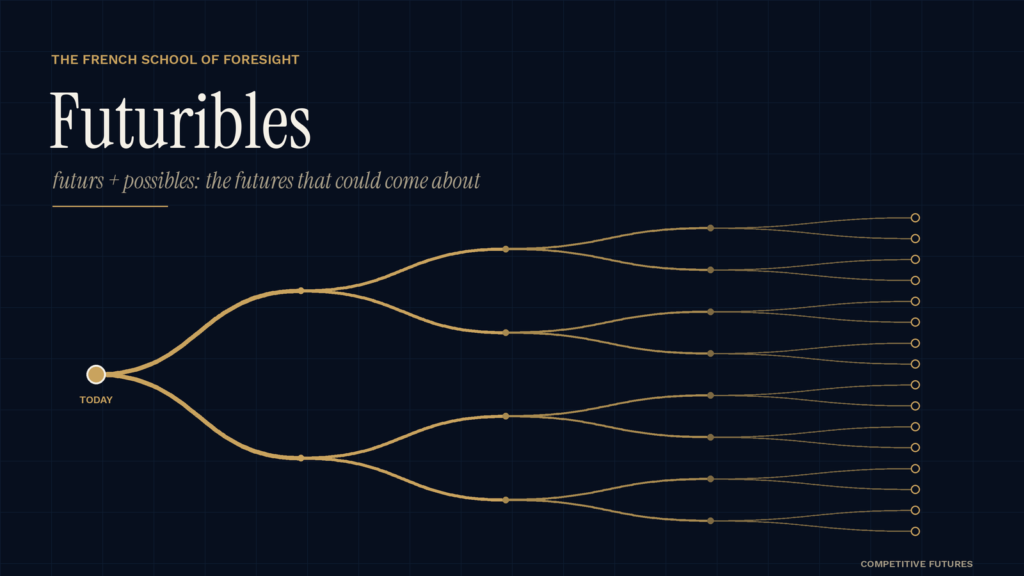
- The word: futuribles joins “futures” and “possibles”: the futures that could come about.
- Lasting contributions: the idea of plural, possible futures; la prospective as a discipline tied to action; and the institutions that spread it across Europe, Africa and Latin America.
Bertrand de Jouvenel: from journalist to philosopher of power
Bertrand de Jouvenel was born in Paris into a family at the center of French public life. His father, Henry de Jouvenel, was a politician, diplomat and director of the Paris daily Le Matin (Encyclopaedia Universalis).
He began as a journalist and traveled widely, interviewing figures including Lloyd George, Churchill and Hitler (Encyclopedia of Libertarianism). His politics in the 1930s moved from Franco-German reconciliation and moderate socialism to the far right: in 1936 he joined Jacques Doriot’s Parti populaire français. He left it in the autumn of 1938 over the party’s support for the Munich agreement. During the war he joined the Resistance in Corrèze in 1942 and fled to Switzerland in 1943 when the Gestapo learned of his activities (same source).
It was in Swiss exile that he wrote his best-known book, Du Pouvoir (Geneva, 1945; On Power, 1948), a study of how the modern state accumulates power, especially through war. It made him one of the major liberal political thinkers of the postwar period. He was a charter member of the Mont Pèlerin Society in 1947, and went on to write Sovereignty (1955) and The Pure Theory of Politics (1963).
His turn to the future grew out of that work. A thinker who studied how power grows unchecked naturally asked how societies could see consequences coming in time to act on them.
The invention of Futuribles
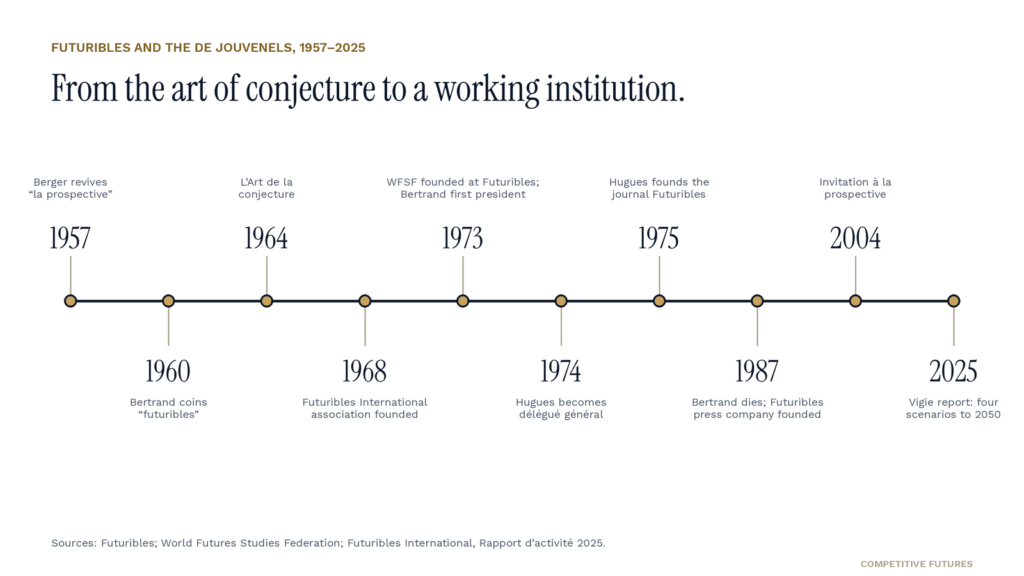
In 1960 Bertrand de Jouvenel coined the word futuribles and set up the Futuribles International Committee (Futuribles). From that year, a Paris research company he directed, SÉDÉIS, published a series of Futuribles papers in which scholars across Europe and the United States tried to conjecture how political and social structures would change.
The project had powerful backers. The historian Elke Seefried documents the role of the Ford Foundation in its founding (Shaping Tomorrow’s World, Berghahn), and the seminars that produced de Jouvenel’s main book were organized by the Congress for Cultural Freedom (PhilPapers), which was later revealed to have been covertly funded by the CIA. In the Cold War, how the West thought about the future was itself contested ground: Marxism claimed to know where history was going, and Futuribles was built on the opposite premise (Farsight).
De Jouvenel summarized that premise for a RAND audience in 1965: the future is not a single unknown waiting to be discovered, but one of many possible futures (RAND, P-3045). The phrase “possible futures” became the foundation of everything that followed.
The Art of Conjecture
De Jouvenel set out his theory in L’Art de la conjecture (Éditions du Rocher, Monaco, 1964; English translation, The Art of Conjecture, 1967). It remains the most important philosophical statement of what it means to study the future, and Britannica credits it with giving the field a systematic philosophical rationale (Britannica).
Three of its ideas still define serious foresight:
- The future is the domain of the possible, not of facts. Statements about the past can be true or false; statements about the future cannot. We can only make reasoned judgments of likelihood, which is why foresight is an art of conjecture rather than a science of prediction (de Jouvenel, Res Publica, 1965).
- Conjecture must be disciplined and open. Because no forecast can be proved in advance, de Jouvenel argued for a “surmising forum,” a public, structured debate in which competing conjectures could be examined and challenged.
- Foresight exists to serve decision. The point of conjecture is prudent judgment: to let leaders and citizens see problems before they arrive and act while they still have room to choose.
The book was developed from reports to Congress for Cultural Freedom seminars in 1962 and 1963 and served as the program for the Futuribles group (PhilPapers). Transaction’s later English edition calls de Jouvenel the man who, more than any other, created the serious study of the future in our time (Taylor & Francis).
For how to judge a forecast once you have one, see how to evaluate a forecast.
Gaston Berger and the birth of la prospective
Futuribles did not develop alone. In 1957 the philosopher and senior civil servant Gaston Berger revived the word prospective to describe a forward-looking attitude in public decision, and his Centre d’études prospectives published the journal Prospective. Berger died in 1960, the year Futuribles began (Futuribles).
The two streams merged. In 1968 the Futuribles International association was created to continue the work of both de Jouvenel’s committee and Berger’s center. It built close links with France’s two great engines of public-policy foresight, the Commissariat général du Plan and the regional-planning agency DATAR (same source). That connection to the state is a defining feature of the French school: la prospective grew up inside planning ministries, not just universities or think tanks.
Ecology, the Club of Rome and the world federation
De Jouvenel’s foresight was never only about politics. In Arcadie, essais sur le mieux-vivre (1968) he argued that economic growth measured in money could hide the destruction of nature and of quality of life, which has led scholars such as Ivo Rens to call him an overlooked pioneer of political ecology. He was a member of the Club of Rome, and in 1978 he chaired a government working group on the future of France’s forests.
He also helped give futures studies a global home. The World Futures Studies Federation was founded in Paris on 26 May 1973, registered in France with its headquarters at the Maison Internationale Futuribles, and elected Bertrand de Jouvenel its first president (WFSF).
Hugues de Jouvenel: building the institution
If Bertrand supplied the philosophy, his son Hugues de Jouvenel built the institution that has carried it for more than fifty years.
Born in Switzerland in 1946, Hugues became délégué général (managing director) of Futuribles International in 1974 (Encyclopedia.com). In 1975 he founded the journal Futuribles, and the association became one of France’s main centers for foresight training. In 1987 he set up a publishing company to run the journal, which also went on to provide foresight support for organizations (Futuribles, 2024). He directed the Futuribles group, edited the journal, taught at France’s École nationale d’administration, and later served as president of Futuribles International. He is now its honorary president, and still the journal’s founder and editor-in-chief (Futuribles, 2025 activity report).
Hugues’s contribution was to turn la prospective from an intellectual movement into a practice that governments, regions and companies could actually use. His editorials in Futuribles repeat one line, borrowed from the philosopher Maurice Blondel: the future is not foreseen, it is built (Futuribles no. 374, 2011). The journal’s tagline makes the same point: anticipation in the service of action.
His short handbook Invitation à la prospective / An Invitation to Foresight (2004), published in French and English, set out the method plainly. In his telling, foresight means identifying the heavy trends, the major uncertainties, the emerging signals and the strategies of the actors involved, then building scenarios that show what could happen and what can be done about it. He has testified before the French Senate, the National Assembly and the Economic, Social and Environmental Council on foresight and public policy, and he carried the method abroad, from a long-range study of Catalonia to a sustained partnership with Colombia’s Universidad Externado.
In 2019 he summarized the family’s project for an English-language audience in World Future Review: integrating a sense of the long term into decision-making and action (World Future Review, 2019).
Futuribles today
Futuribles International is still based in Paris and still works the way its founders intended: as a shared foresight service for members, not a single forecasting shop. Its president is Yannick Blanc; François de Jouvenel is its délégué général and runs the Futuribles group (Futuribles, 2025 activity report). Members include public agencies, companies and the French Senate.
Its main programs in 2025:
- Vigie, the shared foresight watch. Members pool a monitoring and analysis service across five fields: economy, environment, geopolitics, science and technology, and society. In 2025 it produced 58 watch notes, 11 in-depth foresight analyses and 93 book reviews, among other outputs.
- The Vigie report. Each year Futuribles publishes a major foresight report for members. The 2026 edition, Horizon 2050: le monde face à ses limites (“the world facing its limits”), covers population, climate and biodiversity, economy and resources, and geopolitics, and sets out four global scenarios to 2050. It was presented to members in December 2025.
- Forums. Standing groups on geopolitics (a scenario cycle for 2025–2026), Africa, health to 2040 and French regions, plus working groups on water and industry, the future of work, public services and food.
- Training and methods. Courses on foresight, scenario building, design fiction and Causal Layered Analysis; a largely English-language foresight toolbox; and a lab that ran workshops on serious games and wargaming in 2025.
The activity report notes that the military and defense community are among Futuribles’ most active partners. Sixty years on, foresight in the French tradition is still what de Jouvenel designed it to be: a tool for people who have to make decisions under uncertainty.
Why the French school matters
The de Jouvenels and Futuribles established one of the two great traditions of modern futures thinking, and arguably the more complete one.
The American tradition, born at RAND and the Hudson Institute with Herman Kahn, was rooted in defense analysis: it gave the world scenarios, systems analysis and quantitative forecasting. The French tradition began with a different question. It asked not “what will happen?” but “what could happen, and what do we want to happen?” The historian Elke Seefried describes de Jouvenel’s approach as a normative style of thought, concerned with values and the good society as much as with trends.
Four ideas from the French school now underpin strategic foresight everywhere:
- Futures are plural. There is no single future to predict, only a range of possible futures to explore. This is why good foresight produces scenarios rather than point forecasts.
- The future is built, not discovered. Because human choices shape outcomes, foresight is about agency as much as anticipation.
- Foresight belongs in decision-making. La prospective was designed to sit next to planners, ministers and executives, not to stay in the seminar room.
- Conjecture must be debated in the open. De Jouvenel’s surmising forum anticipates today’s practice of challenging forecasts, testing assumptions and tracking signals.
The school’s reach is wide. It shaped French state planning through the Plan and DATAR, gave the World Futures Studies Federation its first home and president, and spread through Futuribles’ training and partnerships to Spain, Latin America and francophone Africa. Practitioners who have never read de Jouvenel use his ideas every time they write “possible futures” on a whiteboard.
For how these ideas show up in practice, see our guides to strategic foresight and scenario planning, and our piece on building a foresight culture.
Frequently asked questions
Who was Bertrand de Jouvenel?
Bertrand de Jouvenel (1903–1987) was a French political philosopher, economist and futurist. He wrote On Power (1945) and The Art of Conjecture (1964), founded Futuribles in 1960 and was the first president of the World Futures Studies Federation.
What does “futuribles” mean?
De Jouvenel coined the word in 1960 by joining “futures” and “possibles.” It means the possible futures that could come about, as opposed to a single predicted future.
What is la prospective?
La prospective is the French school of foresight, developed from the late 1950s by Gaston Berger and Bertrand de Jouvenel. It treats the future as a set of possible futures to be explored and shaped by present decisions, rather than predicted.
Who is Hugues de Jouvenel?
Hugues de Jouvenel, Bertrand’s son, led Futuribles International as délégué général from 1974, founded the journal Futuribles in 1975 and built Futuribles into France’s leading foresight center. He is now its honorary president and still edits the journal.
What does Futuribles do today?
Futuribles International is a Paris-based foresight association. It runs a shared watch and analysis service called Vigie, publishes an annual foresight report and the journal Futuribles, hosts forums on geopolitics, Africa and health, and trains organizations in foresight and scenario methods.
Work with Competitive Futures
We practice foresight in the tradition the de Jouvenels and Kahn built: possible futures, explored rigorously, in the service of decisions. Request a 20-minute conversation, or see our keynote topics, including “Building a Foresight Culture.”
Related analysis from Competitive Futures
- Herman Kahn: The Father of Scenario Planning
- Strategic Foresight: A Practitioner’s Guide to Seeing What’s Coming
- Scenario Planning
- How to Build a Foresight Culture
- How to Evaluate a Forecast
References
- de Jouvenel, B. (1945). Du Pouvoir: histoire naturelle de sa croissance. Geneva: Éditions du Cheval ailé. (English: On Power, 1948.)
- de Jouvenel, B. (Ed.). (1963). Futuribles: Studies in Conjecture. Geneva: Droz.
- de Jouvenel, B. (1964). L’Art de la conjecture. Monaco: Éditions du Rocher. (English: The Art of Conjecture, London: Weidenfeld & Nicolson, 1967.)
- de Jouvenel, B. (1965). Futuribles. RAND Corporation, P-3045.
- de Jouvenel, B. (1965). Science politique et tâches de prévision. Res Publica, 7(1).
- de Jouvenel, B. (1968). Arcadie, essais sur le mieux-vivre. Paris: SÉDÉIS.
- de Jouvenel, H. (2004). Invitation à la prospective / An Invitation to Foresight. Paris: Futuribles.
- de Jouvenel, H. (2019). Futuribles: Origins, Philosophy, and Practices—Anticipation for Action. World Future Review, 11(1), 8–18.
- Futuribles International. (2026). Rapport d’activité 2025. Paris.
- Mahoney, D. J. (2005). Bertrand de Jouvenel: The Conservative Liberal and the Illusions of Modernity. Wilmington, DE: ISI Books.
- Seefried, E. (2015). Shaping Tomorrow’s World: A Twentieth-Century History of West German, Cold War, and Global Futures Studies. New York: Berghahn.
- World Futures Studies Federation. History. https://archive.wfsf.org/?p=46
This piece is part of our guide to Pioneers of Strategy, Intelligence, and Foresight.