Every New Information Technology Promises World Peace

Tip 16 of my 2011 satire How to Predict the Future…and WIN! was a piece of advice I still hear in boardrooms, usually without the irony: “Never make comparisons to history! Those jerks didn’t even have computers!”
The serious answer underneath it included a pattern I have been watching ever since:
“Every new information technology comes with a promise of world peace and ubiquitous, high quality, free education – and then we go ahead and use it for war, entertainment and pornography.”
In 2011 I ran through the telegraph, radio, television and the internet. In 2026 the newest information technology is artificial intelligence, and right on schedule, it has arrived with promises of abundance and a cure for most of what ails us. Before you build a strategy on those promises, it is worth looking at how the last four rounds went.
The promise, every time
The telegraph

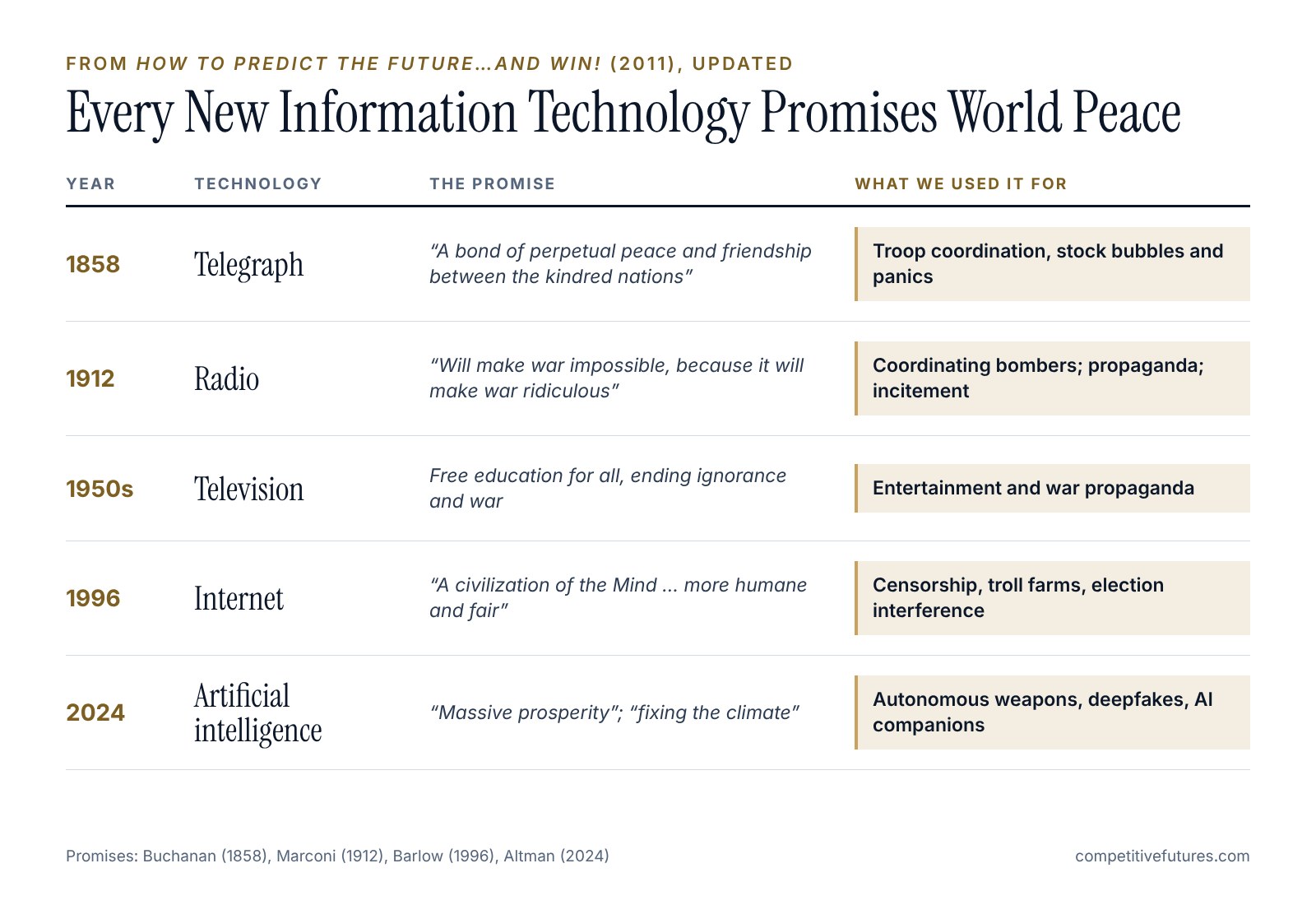
In August 1858, Queen Victoria and President James Buchanan exchanged messages over the first transatlantic cable. Buchanan called it “a bond of perpetual peace and friendship between the kindred nations” and “an instrument destined by Divine Providence to diffuse religion, civilisation, liberty, and law throughout the world” (The Leader, August 28, 1858).
As I put it in the book, the actual uses turned out to be “troop coordination, creation of stock bubbles and depressions.” Less than three years after Buchanan’s message, his own country was at war with itself, and both sides ran the war over the wires.
Radio
“The coming of the wireless era will make war impossible, because it will make war ridiculous,” Guglielmo Marconi promised in 1912 (Ivan Narodny, “Marconi’s Plans for the World,” Technical World Magazine, October 1912). Two years later the First World War began. A generation after that, radio was coordinating bombers over cities.
It got darker still. In 1994, Radio Télévision Libre des Mille Collines in Rwanda broadcast the names of Tutsi and of Hutu who opposed the killing. In 2003, the International Criminal Tribunal for Rwanda convicted two of the men who controlled it of direct and public incitement to genocide, finding that its broadcasts “called explicitly for the extermination of the Tutsi ethnic group” (ICTR, Prosecutor v. Nahimana et al., judgment summary; the convictions were partly narrowed on appeal in 2007).
Television
Television, I wrote, was supposed to deliver free education, which would end ignorance and therefore war. The actual uses: “stultifying entertainment and war propaganda, occasionally at the same time.”
The internet
In 1996, John Perry Barlow told the governments of the world that in cyberspace “we will create a civilization of the Mind” that would be “more humane and fair than the world your governments have made before” (“A Declaration of the Independence of Cyberspace,” National Constitution Center).
In March 2000, President Bill Clinton said China’s attempt to crack down on the internet was “sort of like trying to nail Jell-O to the wall,” and that economic innovation and political empowerment “will inevitably go hand in hand” (American Presidency Project). Twenty-six years later, Freedom House reports that internet users in China have faced “the world’s worst conditions for internet freedom for over a decade” (Freedom House, Freedom on the Net 2026). The Jell-O stayed on the wall.
Meanwhile, the open platforms that were supposed to spread democracy became a tool against it. In February 2018, a federal grand jury indicted thirteen Russian nationals and three Russian companies, including the Internet Research Agency, for a scheme to interfere in the 2016 U.S. election that allegedly used “hundreds of accounts on social media networks” (U.S. Department of Justice).
To be fair to the internet, my 2011 list of its actual uses also included “online education” and “coordinating revolutions against dictators.” The promise is never entirely false. It is just never the whole story, and it is rarely the first chapter.
Now it is AI’s turn
In September 2024, OpenAI’s Sam Altman wrote that in the coming “Intelligence Age,” “astounding triumphs – fixing the climate, establishing a space colony, and the discovery of all of physics – will eventually become commonplace,” and that its defining characteristic “will be massive prosperity” (Sam Altman, “The Intelligence Age”). Some of that may come true. Here is what the first chapter looks like so far, measured against the three uses I predicted in 2011:
- War. In August 2023, the Pentagon launched Replicator, an initiative to field “all-domain attritable autonomous systems” at “a scale of multiple thousands” within 18 to 24 months (Defense Innovation Unit).
- Entertainment. AI-generated video, music and companions are already competing for the same hours of attention that radio and television once fought over.
- Pornography. In May 2025, Congress made it a federal crime to knowingly publish AI-generated intimate images of real people without consent, and required platforms to remove reported nonconsensual intimate images within 48 hours of a valid request (Congressional Research Service, “The TAKE IT DOWN Act”). Congress does not usually pass a law about a problem that does not exist yet.
None of this means the promises are lies. It means the pattern held for the fifth time in a row.
Why the pattern repeats
New technology changes what people can do. It does not change what people want to do. In the book I wrote that if you read enough history, “you don’t see how truly strange people were, you see how alike we are across the ages.” People want power, safety, status, distraction and sex, and every new medium is put to work on all five, usually long before it gets around to curing ignorance.
The hard part of studying the future is telling the difference between what is truly new and what is “a past reality with a new coat of paint slapped on.” As I wrote then: “The soul of a great intelligence analyst is to be able to distinguish which is which.”
How to use this pattern in your strategy
- Discount the brochure. When a new technology is sold with promises of peace, democracy or universal education, treat those as the best case, not the base case. Build scenarios around the other outcomes too. A tool like the Impact/Probability Matrix makes that discipline routine.
- Ask who will use it for war, entertainment and pornography. Translated into business terms: who will weaponize it against you, who will use it to capture your customers’ attention, and who will abuse it in ways that create legal and reputational risk. Those three groups usually move first.
- Follow the first money. The earliest profitable uses of a technology tell you more about its near future than the keynote speeches do. Watch what people pay for, not what they promise.
- Separate the same old from the brand new. AI-written propaganda is new in speed and scale but old in purpose. Treat the new part as the variable and the old part as the constant.
- Stay open to the good chapter. The internet did deliver online education, eventually. The promise often comes true in part, late, and for different people than predicted. Leave room in your plans for that too.
Know the past
I ended that tip in 2011 with a line I would put on a coffee mug if I sold coffee mugs: “Know the past and dare to make original mistakes.”
Every generation thinks its new technology is the one that finally changes human nature. So far, human nature is undefeated. The organizations that see the next five years most clearly will be the ones that remember the last hundred and fifty.
Frequently asked questions
Did the telegraph promise world peace?
Yes. When the first transatlantic cable opened in 1858, President James Buchanan called it “a bond of perpetual peace and friendship between the kindred nations.” Less than three years later the United States was in a civil war fought partly over the telegraph wires.
What did Marconi say about radio and war?
In 1912, Guglielmo Marconi said “the coming of the wireless era will make war impossible, because it will make war ridiculous.” The First World War began two years later.
Is AI the latest technology promised to bring peace and prosperity?
Yes. AI leaders have promised massive prosperity, solutions to climate change and scientific breakthroughs. Its early uses also include autonomous weapons and AI-generated nonconsensual imagery, which Congress criminalized in the 2025 TAKE IT DOWN Act.
How should businesses evaluate claims about new technology?
Treat utopian promises as the best case, not the base case. Ask who will weaponize the technology, who will use it to capture attention, and who will abuse it, then build scenarios around each and watch where the first money flows.
How to Predict the Future…and WIN! is still available in paperback and on Kindle.
Related analysis from Competitive Futures
- I Wrote a Book About Predicting the Future in 2011. Here’s My Scorecard.
- Intelligence Is Always Wrong. Decide Anyway.
- The Future Is More Down-and-Dirty Than Sexy
- The Impact/Probability Matrix: A Scenario Planning Tool
Want this kind of analysis for your organization? Contact Competitive Futures or learn more about Eric Garland.
About Competitive Futures
Competitive Futures has provided strategic intelligence and foresight to corporate and government clients since 2002. Its principal, Eric Garland, publishes analysis here, on Game Theory Today, and in the Systemics Quarterly Brief.
Read next
- Seventy Countries, Six Cities: The Global Network Behind Iran
- The Systemics Quarterly Brief: 2026 Prospectus
- Strategic intelligence services for executives and governments
- All analysis from Competitive Futures
Stay in touch
Leave your email and a note about the Brief, a briefing for your team, or this piece, and we will be in touch.