Win/Loss Analysis: The First Step Toward Competitive Intelligence

Win/loss analysis is the practice of asking buyers, after they’ve made a decision, why they chose you or why they chose someone else. It sounds almost too simple to need a name. In practice, it is one of the most valuable and most neglected disciplines in business. For many organizations, it’s also the first real step toward competitive intelligence.
Organizations learn to see in stages
No company is born with a working intelligence function. The ability to sense what is happening in the market — what we call sensing capacity — is built over time, one layer on top of the last. We describe it as a pyramid with five levels.
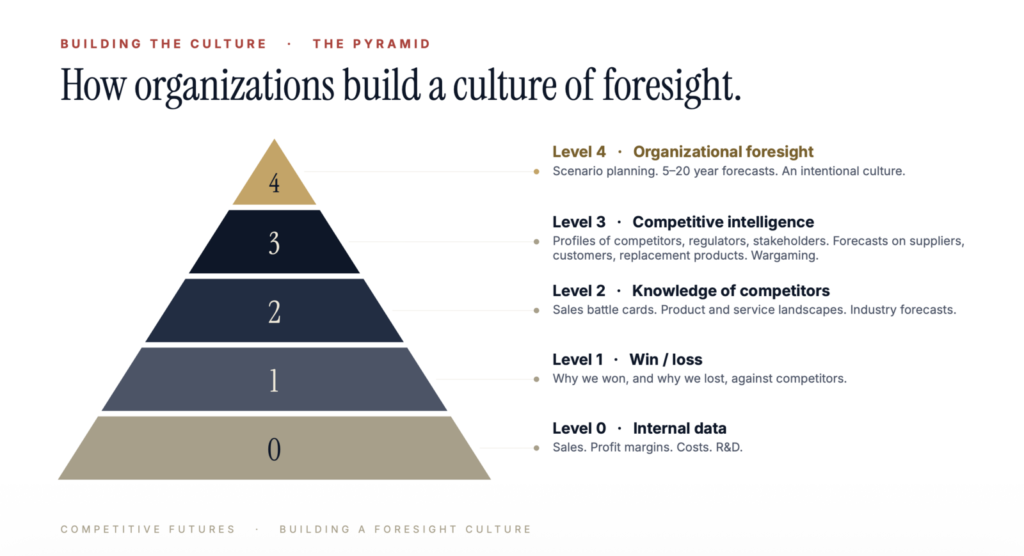
- Level 0: Internal data. Sales, margins, costs, R&D. Every company has this. It tells you what happened to you, not why.
- Level 1: Win/loss. Why we won, and why we lost, against competitors. This is the first time the organization systematically looks outside its own walls.
- Level 2: Knowledge of competitors. Sales battle cards, product and service landscapes, industry forecasts.
- Level 3: Competitive intelligence. Profiles of competitors, regulators, and stakeholders; forecasts on suppliers, customers, and replacement products; wargaming.
- Level 4: Organizational foresight. Scenario planning, 5–20 year forecasts, and an intentional foresight culture.
Most organizations live at Level 0. They have dashboards full of their own numbers and very little systematic knowledge of the people on the other side of the table. Moving up the pyramid doesn’t start with a big intelligence budget. It often starts with a plain question: why did that customer pick someone else?
Why the obvious answer is usually wrong
Ask a sales team why a deal was lost and the most common answer is price. Sometimes that’s true. Often it’s the answer that is easiest to give, the one that doesn’t reflect on the seller and can’t be argued with. Buyers rarely volunteer the real reason to the person who just lost their business. They’re being polite, they want to end the conversation, or they don’t want to hurt a relationship they may need later.
This is a predictable bias, not a character flaw. People explain their losses with outside causes and their wins with their own skill, and organizations inherit those habits. (Our cognitive bias field guide covers the pattern.) A loss record in a CRM that says “price” is a hypothesis, not a finding. Treating it as one of several competing explanations, and testing it, is the same discipline we describe in analysis of competing hypotheses.
Win/loss analysis replaces the guess with evidence. You go to the buyer, after the decision is final, and you ask.
What the buyer tells you
A well-run win/loss conversation reaches people who have just done the hardest research anyone will ever do on your market. They compared you against your rivals with their own money at stake. They sat through the demos, read the proposals, negotiated the terms, and checked the references. Very few market studies can match that.
What comes back is rarely about price alone. Buyers talk about who understood their problem, who was easy to work with, which proposal answered the question they were actually asking, what a competitor promised that you didn’t, and what nearly changed their mind. Our colleague Ellen Naylor, a Fellow of the Council of Competitive Intelligence Fellows and a pioneer of the field who ran her first win/loss project at Bell Atlantic in 1989, notes that many companies prefer a neutral third party to conduct these interviews, because buyers open up more to someone who isn’t trying to sell them anything (Naylor, Jinfo, 2012).

A single interview is an anecdote. The value comes from the analysis of many: the pattern that shows up across a dozen losses in one region, one product line, or against one competitor. Naylor’s research, set out in her book Win/Loss Analysis: How to Capture and Keep the Business You Want, finds that companies acting on a formal win/loss program improve their win rates by 15 to 30 percent.
Competitive Futures has run win/loss programs for clients, and our experience matches hers. Few intelligence investments pay back as quickly, or tell a leadership team as much about its own market.

Win/loss interviews must be conducted openly. The interviewer says who they are and why they’re calling, and a buyer who declines is thanked and left alone. That standard is what makes the findings usable and keeps the program clear of the problems we describe in ethical collection in competitive intelligence.
Why so few companies do it
If win/loss is so useful, why is it rare? Mostly because of the people who stand to learn the most from it. A 2018 review in SCIP’s Competitive Intelligence journal found that win/loss programs often fail before they produce results because of resistance from management, especially sales management, which can see the exercise as second-guessing the sales effort (Beurschgens, Competitive Intelligence, 2018).
That resistance is worth taking seriously. A win/loss program that sales sees as an audit will be starved and ignored. A program that sales sees as a source of advantage — better answers to objections, earlier warning of a competitor’s new offer — becomes something the sales team asks for. We’ve written about explaining competitive intelligence to the sales team for exactly this reason.
From “why we lost” to “who they are”
Win/loss is where an outward-looking habit begins. Once it is running, it rarely stays at Level 1.
The same competitor keeps coming up in loss interviews. Sooner or later someone asks what that competitor is really offering, how it prices, and who it hires. The answers become battle cards and product landscapes. That’s Level 2, knowledge of competitors.
Then the questions get harder. Why is that competitor willing to accept those margins? What does its ownership want? Which regulator could change the rules for both of you? What would it do if you cut your price, or entered its home market? Answering those questions takes competitor analysis in the tradition Michael Porter laid out in 1980, plus profiles of the regulators and stakeholders around the deal, and eventually wargaming. That’s Level 3, competitive intelligence in the full sense.
At the top of the pyramid, the questions move from today’s rivals to tomorrow’s market: which competitors don’t exist yet, what replaces your product, and what the industry looks like in ten years. That is the work of strategic foresight and scenario planning.
None of the higher levels work well without the lower ones. A scenario study built by an organization that doesn’t know why it loses deals rests on guesses about its own market. Win/loss keeps the whole structure tied to what buyers actually do.
Signs you need win/loss analysis
- Your loss reasons in the CRM are mostly “price,” “timing,” or “no decision.”
- Win rates are falling and nobody can say why with evidence.
- A new competitor keeps appearing in deals and nobody knows much about it.
- Product, marketing, and sales tell different stories about why customers buy.
- Nobody outside the sales rep has spoken to a lost prospect in the last year.
- Leadership wants a competitive intelligence function but doesn’t know where to start.
Frequently asked questions
What is win/loss analysis?
Win/loss analysis is the systematic study of why buyers chose your company or a competitor. It usually relies on interviews with decision-makers after a purchase is final, followed by analysis of patterns across many decisions.
Who should conduct win/loss interviews?
Ideally, someone other than the salesperson on the deal. Buyers tend to speak more candidly to a neutral interviewer, whether an internal team outside sales or an outside firm.
Is win/loss analysis the same as competitive intelligence?
No. Win/loss is one input to competitive intelligence, and often the first one an organization builds. Competitive intelligence goes further, into profiles of competitors, regulators, and stakeholders, forecasts, and wargaming.
How much can win/loss analysis improve results?
Ellen Naylor’s research, published in Win/Loss Analysis: How to Capture and Keep the Business You Want, finds that companies acting on a formal win/loss program raise win rates by 15 to 30 percent. Results depend on whether the organization acts on what it learns.
Is it ethical to interview prospects who chose a competitor?
Yes, when it is done openly. The interviewer identifies themselves and the purpose of the conversation, and the buyer is free to decline.
Building your sensing capacity
We help organizations climb the pyramid, from a first win/loss program to a full competitive intelligence function and, for leadership teams that want it, a foresight culture. See our competitive intelligence work or request a 20-minute conversation.
Further reading
For anyone building a win/loss program, the books by our colleague Ellen Naylor, a Fellow of the Council of Competitive Intelligence Fellows, are the place to start:
- Win/Loss Analysis: How to Capture and Keep the Business You Want (2016), her 12-step process, which won an IPPY Book Award.
- Loosen Their Lips: How to Capture the Information You Seek During a Conversation (2025), on the interviewing and elicitation skills that win/loss depends on.
More options are on our list of competitive intelligence books.
Related analysis from Competitive Futures
- What Is Competitive Intelligence?
- How to Build a Competitive Intelligence Function
- Michael Porter and the Origins of Competitive Intelligence
- Elicitation: The Soul of Human Intelligence
- How to Build a Foresight Culture
- Why Smart Organizations Still Can’t See Obvious Disasters
References
- Beurschgens, A. (2018). Win/loss analysis in action: 8 lessons from applied win/loss analysis. Competitive Intelligence, 21(2), 68–71. Strategic and Competitive Intelligence Professionals. PDF
- Fleisher, C. S., & Bensoussan, B. E. (2007). Win/loss analysis. In Business and Competitive Analysis (ch. 15). FT Press. PDF
- Naylor, E. (2002). Increasing sales through win/loss analysis. Competitive Intelligence Magazine, 5(5), 5–8.
- Naylor, E. (2012, May 10). Interviewing: An essential part of effective win-loss analysis. Jinfo. Link
- Naylor, E. (2016). Win/Loss Analysis: How to Capture and Keep the Business You Want. Business Intelligence Source.
- Naylor, E. (2025). Loosen Their Lips: How to Capture the Information You Seek During a Conversation. Business Intelligence Source.
- Porter, M. E. (1980). Competitive Strategy: Techniques for Analyzing Industries and Competitors. Free Press.
This piece is part of our guide to Competitive Intelligence: The Complete Guide.