The End of the Cold War, Wasn’t: The Mueller Investigation and Russia’s 2016 Operation
The Mueller investigation is usually remembered as an argument about one American campaign. Its lasting finding is about Russia. Volume I of the special counsel’s report opens with the statement that the Russian government interfered in the 2016 presidential election “in sweeping and systematic fashion,” and then spends 200 pages showing how. The methods it describes were not new. Its second section is titled “Russian ‘Active Measures’ Social Media Campaign,” and active measures is the KGB’s own term for covert influence operations.
That is the larger point of the record. The Cold War ended as a military and ideological standoff in 1991. As an intelligence contest it kept going, with the same services, the same doctrine, and new delivery systems built by American companies. Public attention moved elsewhere while Moscow’s services kept working.
This page covers the Soviet playbook, the run-up to the 2016 election, what Russia did, the January 2017 Intelligence Community Assessment, and the appointment of Robert Mueller as special counsel. It ends with what the investigation means for governments, companies, and citizens.
At a glance
- What it was: a Justice Department special counsel investigation, from 17 May 2017 to March 2019, into Russian interference in the 2016 election and related matters.
- Who ordered it: Rod Rosenstein, the Deputy Attorney General, serving as Acting Attorney General for the matter, in Order No. 3915-2017.
- The central finding: Russia interfered through two operations, a social media campaign by the Internet Research Agency and a hack-and-leak campaign by the GRU, Russia’s military intelligence service.
- The scale: Facebook estimated that Internet Research Agency content may have reached 126 million people. The GRU stole hundreds of thousands of documents.
- On the Trump campaign: the investigation did not establish that members of the campaign conspired or coordinated with the Russian government in its interference.
- The investigation’s size: 19 attorneys, about 40 FBI personnel, more than 2,800 subpoenas, nearly 500 search warrants, and about 500 witnesses.
- The Soviet precedent: the January 2017 Intelligence Community Assessment said that “Russia, like its Soviet predecessor, has a history of conducting covert influence campaigns.”
The Soviet playbook
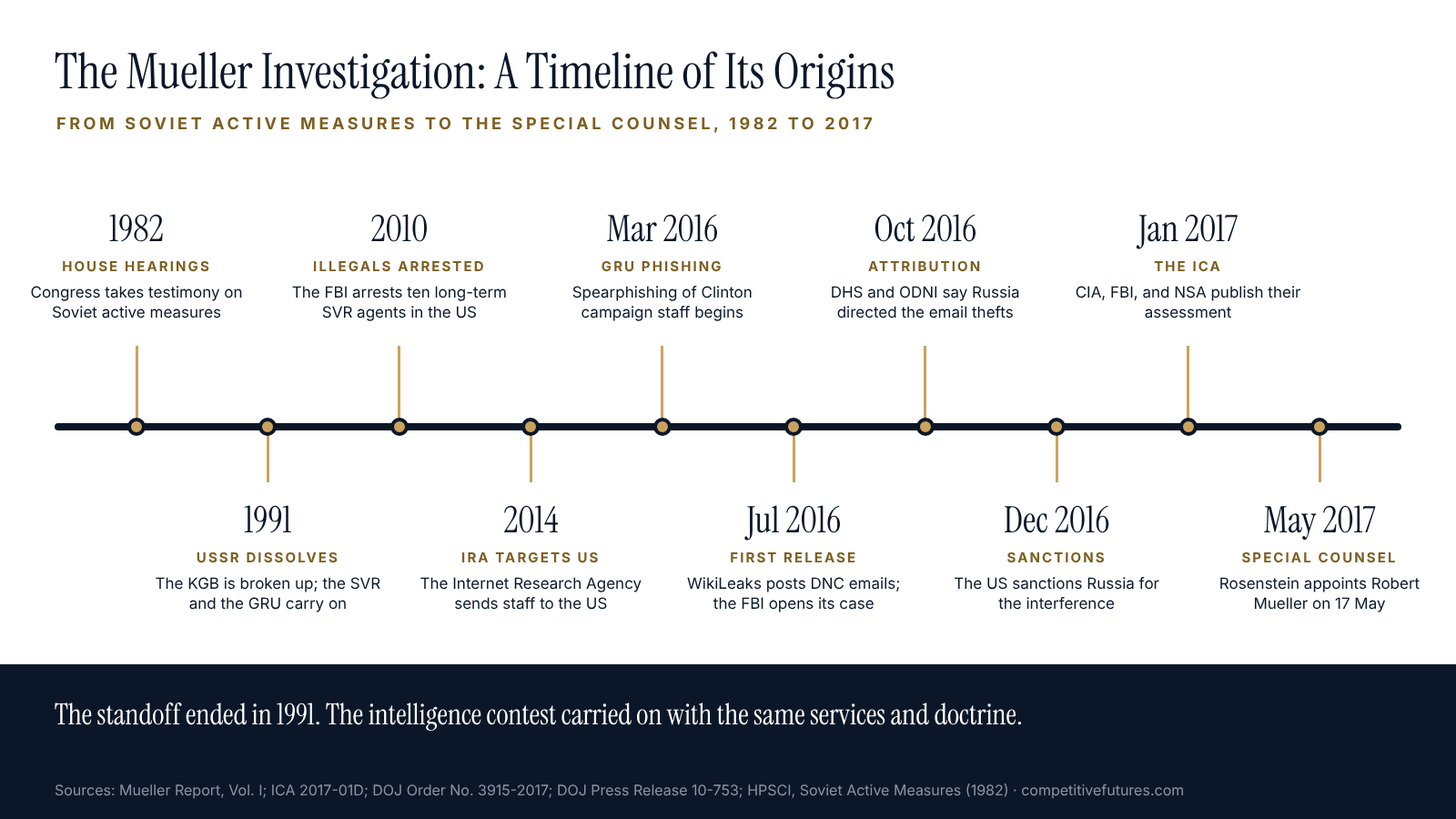
The United States government documented this kind of operation long before 2016. In July 1982 the House Permanent Select Committee on Intelligence held two days of hearings on Soviet active measures. Senior CIA and FBI officials testified, and so did Stanislav Levchenko, a KGB major who had run such operations in Tokyo before defecting in 1979 (Reagan Library).
The State Department kept the public record. An interagency body it chaired, the Active Measures Working Group, reported to Congress on Soviet front groups, forgeries, and disinformation. Its 1987 report defined active measures as deceptive operations meant to manipulate the opinions or actions of individuals, publics, or governments (State Department, 1987). The cover of that report reproduced a Pravda cartoon from 31 October 1986 promoting the story that the AIDS virus had been made in a Pentagon laboratory.
The methods were consistent:
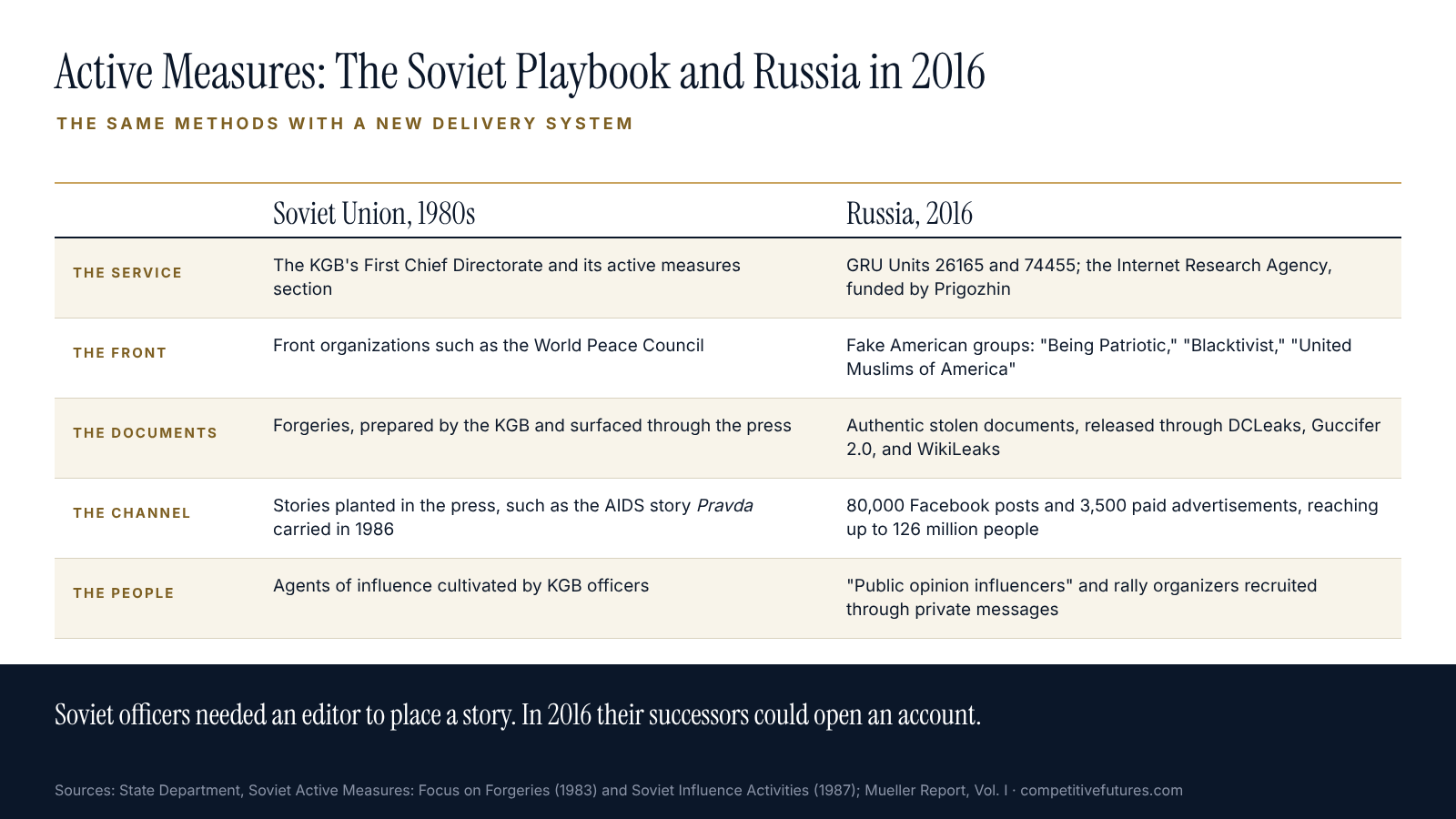
- Front organizations. Groups such as the World Peace Council presented Soviet positions as the voice of independent citizens.
- Forgeries. A 1983 State Department study described how the active measures section of the KGB’s First Chief Directorate prepared forged documents and surfaced them through the press (State Department, 1983).
- Media placement. A story would be planted in a small foreign newspaper and then quoted by larger ones until its origin was lost.
- Agents of influence. Officers cultivated people who could carry a message to audiences that would never have trusted a Soviet source.
What did end, and what didn’t
The Soviet Union dissolved in December 1991, and a great deal ended with it: the Warsaw Pact, the command economy, and the ideological claim that had organized Soviet foreign policy. Those changes were real, and they are why the phrase “the end of the Cold War” took hold.
The intelligence services were another matter. The KGB was broken up, but its foreign intelligence arm continued as the SVR, and the GRU was never dissolved. The doctrine stayed with the institutions that practiced it.
The evidence reached American courtrooms well before 2016. In June 2010 the FBI arrested ten people in the United States who had been living for years under false identities on long-term assignments for the SVR; eleven were charged with conspiring to act as unlawful agents of the Russian Federation (Department of Justice). They were returned to Russia in a prisoner exchange the following month. The FBI had kept working the problem. Public and political attention had moved on to other things.
What changed between 1985 and 2016 was the delivery system. Soviet officers needed a cooperative editor to place a story. Their successors could buy an advertisement, open an account, and speak to Americans directly, in the first person, as Americans. The tools were commercial and built in the United States.
The run-up: 2014 to mid-2016
The Internet Research Agency, based in St. Petersburg and funded by Yevgeniy Prigozhin and his companies, began targeting the United States in 2014. That year it sent employees to the United States on an intelligence-gathering trip. The agency called its work “information warfare.” Mueller’s report describes a program that began as a general effort to undermine the American electoral system and became, by early 2016, an operation that favored Donald Trump and disparaged Hillary Clinton (Vol. I, pp. 4, 14).
The agency’s manual told employees to work on “public opinion influencers” and to seek personal contact with them (Vol. I, p. 31). That is the agent-of-influence method written down for a social media staff.
In March 2016 the GRU began sending spearphishing emails to Clinton campaign staff and volunteers. In April it broke into the networks of the Democratic Congressional Campaign Committee and the Democratic National Committee. On 14 June the DNC and its security firm announced the breach publicly.
Russia’s two operations
The social media campaign. Internet Research Agency employees posed as American activists and groups across the political spectrum, with names such as “Being Patriotic,” “Secured Borders,” “Blacktivist,” and “United Muslims of America.” According to Facebook, 470 agency-controlled accounts made 80,000 posts that reached at least 29 million people and may have reached 126 million. The agency bought about 3,500 advertisements for roughly $100,000. Twitter identified 3,814 agency-controlled accounts. The agency also organized dozens of political rallies inside the United States, recruiting real Americans who did not know who they were dealing with (Vol. I, pp. 14–31).
The hack-and-leak campaign. Two GRU units, 26165 and 74455, carried out the intrusions. They stole hundreds of thousands of documents and released them through two invented personas, DCLeaks and Guccifer 2.0, and then through WikiLeaks. The first WikiLeaks release came on 22 July 2016. The second began on 7 October, less than an hour after the release of a video damaging to the Trump campaign (Vol. I, pp. 4–5, 36–48).
The two operations update the Soviet methods one for one. The fake grassroots groups are front organizations. The stolen documents take the place of forgeries, and they work better, because they are authentic. WikiLeaks did the job of the small foreign newspaper.
Election administration. The GRU also targeted the people and companies that run elections. It compromised the Illinois State Board of Elections and reached a database holding information on millions of registered voters. It installed malware on the network of a company that makes voter registration software, and in November 2016 it sent spearphishing emails to more than 120 accounts used by Florida county election officials. The special counsel did not investigate this activity further; the FBI, the Department of Homeland Security, and the states handled it separately (Vol. I, pp. 50–51).
The government’s response, 2016 to 2017
- 31 July 2016. After a foreign government reported a conversation with a Trump campaign adviser, the FBI opened an investigation into whether people associated with the campaign were coordinating with the Russian government.
- 7 October 2016. The Department of Homeland Security and the Office of the Director of National Intelligence said publicly that the Russian government had directed the email compromises and intended them to interfere with the election.
- 29 December 2016. The United States imposed sanctions on Russia for the interference.
- 6 January 2017. The intelligence community released its assessment.
The January 2017 Intelligence Community Assessment
The assessment, written by the CIA, the FBI, and the National Security Agency, was published in declassified form on 6 January 2017 (ICA 2017-01D). Its key judgments were:
- Vladimir Putin ordered an influence campaign aimed at the 2016 election. Its goals were to undermine public faith in the democratic process, denigrate Hillary Clinton, and harm her electability and potential presidency.
- Putin and the Russian government developed a clear preference for Donald Trump.
- Putin and the Russian government aspired to help Trump’s chances when possible. The CIA and the FBI held this judgment with high confidence and the NSA with moderate confidence.
- The GRU used Guccifer 2.0, DCLeaks, and WikiLeaks to release stolen material.
- Russian intelligence gained access to elements of multiple state or local electoral boards. The Department of Homeland Security assessed that the systems involved were not used in vote tallying.
- Moscow would apply what it learned to future operations against the United States and its allies.
The assessment stated that it did not evaluate what effect the Russian activity had on the outcome of the election.
The reviews. The assessment has been examined three times, and the argument has centered on a single judgment, the one about what Putin “aspired” to do.
- The Senate Select Committee on Intelligence, in a bipartisan report released in April 2020, found that the assessment presented a coherent and well-constructed intelligence basis, that analysts were under no political pressure, and that the difference in confidence levels was reasonable and properly shown (Volume 4).
- The CIA’s Directorate of Analysis reviewed the assessment’s tradecraft in June 2025. It found procedural problems: a compressed schedule, uneven access to the most sensitive reporting, unusually heavy involvement by agency heads, and the attachment of a summary of the Steele dossier over analysts’ objections. It concluded that the “aspired” judgment did not merit high confidence and that the NSA’s moderate confidence was the better fit. It did not dispute the credibility of the underlying reporting, found most of the tradecraft robust, and called the overall assessment defensible (CIA Tradecraft Review).
- A House Intelligence Committee majority staff report, completed in 2020 and declassified in July 2025, criticized the sourcing of the same judgment (ODNI release).
The dispute is about how confident analysts should have been in one sentence about Putin’s intentions. None of the three reviews disputes that the Internet Research Agency and the GRU ran the operations described above. Mueller’s finding on those operations rests on a separate body of evidence: subpoenas, search warrants, and two federal indictments.
Why Mueller was appointed
On 20 March 2017 the FBI director, James Comey, confirmed in testimony to the House Intelligence Committee that the Bureau was investigating the Russian government’s interference, including any links or coordination between the Russian government and people associated with the Trump campaign. On 9 May the President fired him.
Eight days later, on 17 May 2017, Rod Rosenstein signed Order No. 3915-2017. Attorney General Jeff Sessions had recused himself from the matter, so Rosenstein acted as Attorney General. The order appointed Robert S. Mueller III, a former FBI director, as special counsel and authorized him to conduct the investigation Comey had confirmed, including:
- any links or coordination between the Russian government and individuals associated with the Trump campaign,
- any matters arising directly from the investigation, and
- efforts to interfere with the investigation itself (Department of Justice).
Mueller did not start from nothing. The FBI had been investigating for nearly ten months. His office grew to 19 attorneys working with about 40 FBI agents, analysts, and staff. It issued more than 2,800 subpoenas, executed nearly 500 search warrants, obtained more than 230 orders for communications records, made 13 requests to foreign governments, and interviewed about 500 witnesses (Vol. I, p. 13).
What Mueller established
The report is precise about the strength of its own evidence, and it is easiest to read in four tiers.
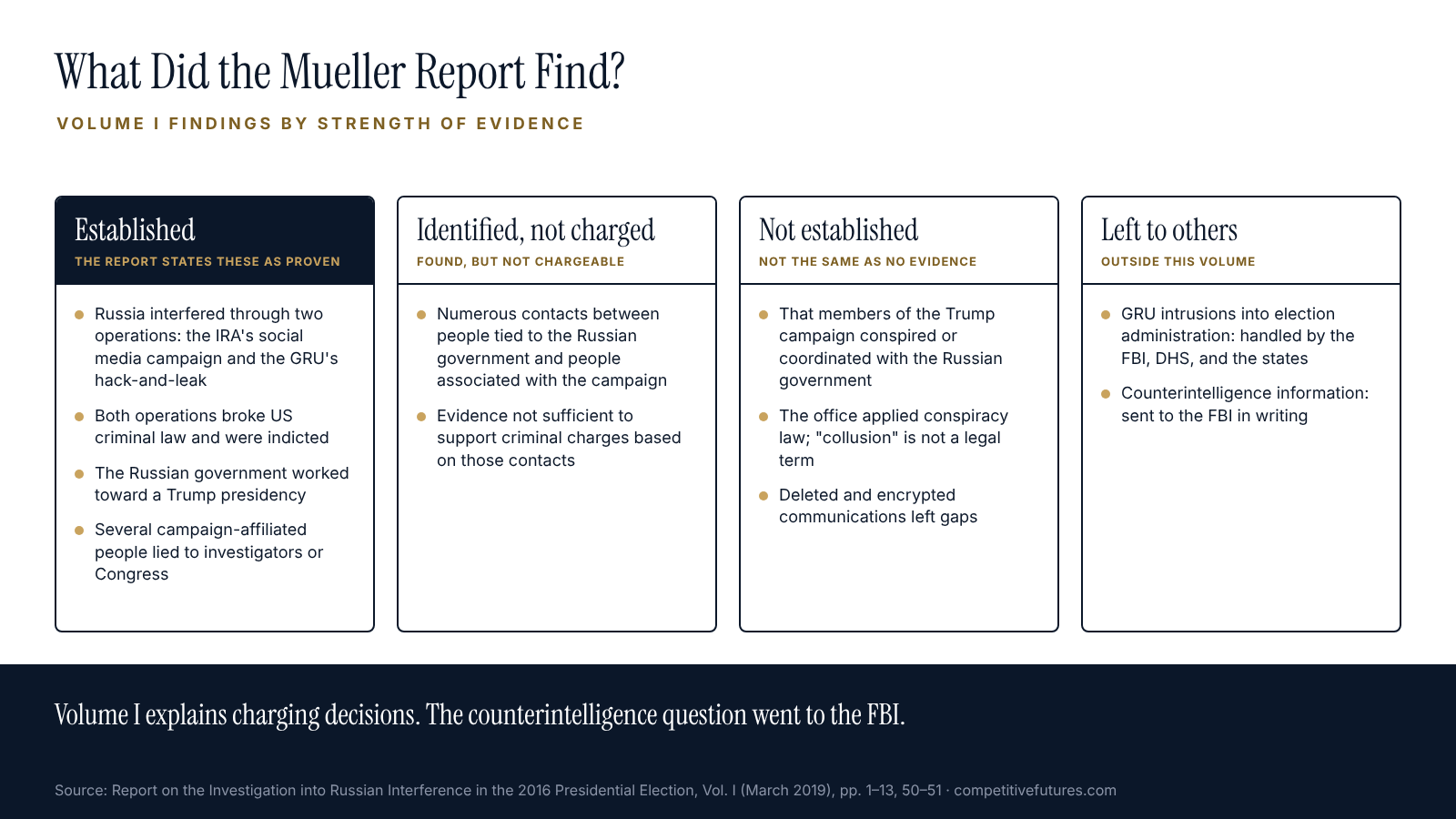
Established. Russia ran both operations, and both violated United States criminal law. A grand jury indicted 13 Russian nationals and three Russian entities, including the Internet Research Agency, in February 2018, and 12 GRU officers in July 2018. The Russian government perceived that it would benefit from a Trump presidency and worked toward that outcome. Several people affiliated with the campaign lied to investigators or to Congress, and the report says those lies materially impaired the investigation.
Identified, not charged. The investigation found numerous contacts between people tied to the Russian government and people associated with the campaign. The evidence was not sufficient to support criminal charges based on those contacts.
Not established. The investigation did not establish that members of the Trump campaign conspired or coordinated with the Russian government in its interference. The report explains its terms: it applied the law of conspiracy, because “collusion” is not a federal offense or a legal term of art, and it warns that a statement that the investigation did not establish a fact “does not mean there was no evidence of those facts” (Vol. I, p. 2). It also records that some witnesses deleted communications or used encrypted applications, and that the office could not rule out that the missing material would have changed the picture (Vol. I, p. 10).
Left to others. The intrusions into election administration went to the FBI, DHS, and the states. Counterintelligence information went to the FBI in writing and is not all in the report, which describes itself as a summary of what was needed to explain charging decisions (Vol. I, p. 13).
That last point matters for how the report is read. A prosecutor asks whether admissible evidence would sustain a conviction. A counterintelligence service asks what a foreign service is doing and how to stop it. Volume I answers the first question and hands the second to the FBI.
What it means for governments, companies, and citizens
For governments
- An adversary’s institutions can outlast the political settlement that was supposed to end the rivalry. Threat assessments should follow the adversary’s services and doctrine, whatever the diplomatic calendar says.
- The weakest layer was the one with the least money: county election offices and their software vendors.
- The report identifies gaps in the law. Statutes on stolen property do not reach intangible data, and campaign finance law has trouble putting a value on information (Vol. I, pp. 176, 186–188).
For companies
- Platforms and vendors were the attack surface. The operation used purchased advertising, ordinary user accounts, and computer infrastructure rented inside the United States and paid for with bitcoin the GRU had mined.
- Business relationships were the main channel of approach to political figures. Counterparty due diligence is a security function, and it should cover a counterparty’s ties to a foreign state.
- The criminal exposure in this record came from false statements to investigators and from unregistered work for foreign principals. Meetings alone were not charged.
- Record retention cuts both ways. Deleted messages and disappearing-message applications left investigators unable to corroborate witnesses, which protects no one who was telling the truth.
For citizens
- The accounts were built to look like neighbors. Americans on the left and the right followed them, shared their posts, and in some cases attended rallies they had organized.
- Neither the assessment nor the report makes a finding on whether the operations changed any votes.
- Exposure was the main defense in the 1980s, when the State Department published the forgeries and named the fronts, and it still is.
What the Mueller investigation teaches about building an intelligence function
- Watch the institution along with the headline. The services that ran active measures in 1982 were still in business in 2016. An organization that retires a threat because the news has moved on will be surprised by it. That is the subject of our guide to strategic surprise.
- Keep the evidentiary standards separate. An intelligence assessment, a criminal charge, and a business decision each have their own threshold. Confusing them produces either paralysis or overreach.
- State your confidence and show the dissent. The most durable part of the 2017 assessment is the line where one agency recorded a lower confidence level than the other two. Analysis of Competing Hypotheses exists to force that discipline before publication.
- Say what you did not look at. Mueller’s report lists what it could not obtain and what it left to others. A finding without its limits will be misread.
- Assume the adversary will use your own infrastructure. The 2016 operation ran on American platforms, American servers, and American habits of trust.
Frequently asked questions
What was the Mueller investigation?
The Mueller investigation was a Justice Department special counsel investigation into the Russian government’s interference in the 2016 presidential election and related matters. Robert S. Mueller III, a former FBI director, led it from his appointment on 17 May 2017 until he delivered his report to the Attorney General in March 2019. Volume I of the report covers Russian interference, and Volume II covers actions toward the investigation itself.
Why was Robert Mueller appointed special counsel?
The FBI had been investigating Russian interference since July 2016, and Director James Comey confirmed the investigation to Congress on 20 March 2017. The President fired Comey on 9 May. Eight days later Deputy Attorney General Rod Rosenstein, acting as Attorney General because Jeff Sessions had recused himself, appointed Mueller in Order No. 3915-2017 to carry the investigation forward.
What did the Mueller report find about Russian interference?
It found that Russia interfered in the 2016 election in sweeping and systematic fashion through two operations. The Internet Research Agency ran a social media campaign using fake American personas, and the GRU, Russia’s military intelligence service, hacked Democratic Party organizations and the Clinton campaign and released the stolen documents. Both operations were charged in federal indictments.
Did the Mueller report find collusion?
The report says collusion is not a federal crime or a legal term, so the office applied conspiracy law. It did not establish that members of the Trump campaign conspired or coordinated with the Russian government in its election interference. The report adds that a statement that the investigation did not establish a fact does not mean there was no evidence of it.
What was the 2017 Intelligence Community Assessment?
It was an assessment by the CIA, the FBI, and the NSA, released in declassified form on 6 January 2017, which judged that Vladimir Putin ordered an influence campaign aimed at the 2016 election. A Senate review in 2020 upheld it. A CIA review in 2025 called it defensible overall but found that one judgment about Putin’s intentions did not merit high confidence.
What are active measures?
Active measures is the Soviet and Russian term for covert operations meant to influence the politics of another country: front organizations, forgeries, planted news stories, and agents of influence. The United States documented them in congressional hearings in 1982 and in State Department reports through the 1980s. The Mueller report uses the term for the Internet Research Agency’s 2016 campaign.
Work with Competitive Futures
The 2016 operation surprised a country that had stopped looking for it. We build intelligence and early-warning functions for governments and companies that would rather not be surprised. Request a 20-minute conversation.
Related analysis from Competitive Futures
- Strategic Surprise: Why Organizations Get Blindsided, and How to See It Coming
- Russian Intelligence: History, Structure, and the Headlines
- American Intelligence: History, Structure, and the Headlines
- Analysis of Competing Hypotheses
- James Jesus Angleton: Counterintelligence in a Wilderness of Mirrors
- J. Edgar Hoover: Building American Counterintelligence
- Enforcement Risk
References
- Special Counsel Robert S. Mueller III. Report on the Investigation into Russian Interference in the 2016 Presidential Election, Volume I. U.S. Department of Justice, March 2019.
- Office of the Deputy Attorney General. Order No. 3915-2017, Appointment of Special Counsel to Investigate Russian Interference with the 2016 Presidential Election and Related Matters, 17 May 2017.
- United States v. Internet Research Agency LLC, et al., No. 18-cr-32 (D.D.C.).
- United States v. Netyksho, et al., No. 18-cr-215 (D.D.C.).
- Office of the Director of National Intelligence. Assessing Russian Activities and Intentions in Recent US Elections, ICA 2017-01D, 6 January 2017.
- U.S. Senate Select Committee on Intelligence. Russian Active Measures Campaigns and Interference in the 2016 U.S. Election, Volume 4: Review of the Intelligence Community Assessment, April 2020.
- Central Intelligence Agency, Directorate of Analysis. Tradecraft Review of the 2016 Intelligence Community Assessment on Russian Election Interference, 26 June 2025.
- Office of the Director of National Intelligence. News Release No. 18-25, 23 July 2025, releasing the House Permanent Select Committee on Intelligence majority staff report.
- U.S. House of Representatives, Permanent Select Committee on Intelligence. Soviet Active Measures, hearings, 97th Congress, 2d Session, 13–14 July 1982. Government Printing Office, 1982.
- U.S. Department of State. Soviet Active Measures: Focus on Forgeries, Foreign Affairs Note, April 1983.
- U.S. Department of State. Soviet Influence Activities: A Report on Active Measures and Propaganda, 1986–87, Publication 9627, August 1987.
- U.S. Department of Justice. “Ten Alleged Secret Agents Arrested in the United States,” Press Release 10-753, 28 June 2010.
This piece is part of our guide to Strategic Surprise and Early Warning.