The Francis Walsingham Fan Club

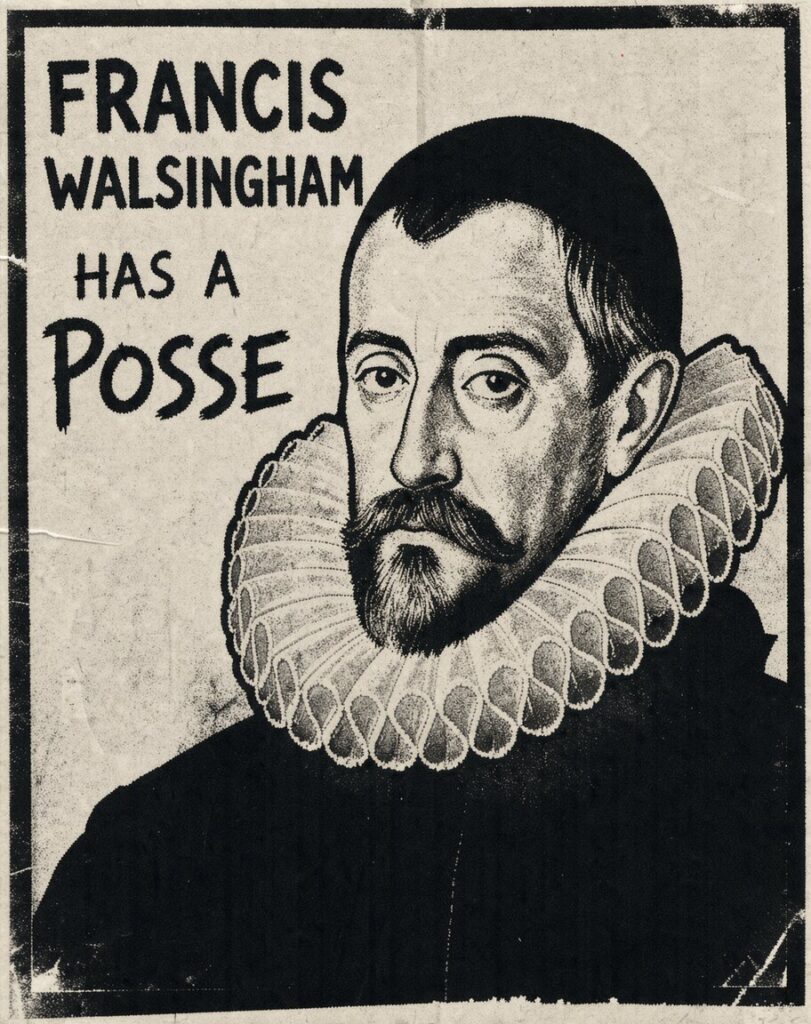
Who is the father of human intelligence? Ben Franklin? J. Edgar Hoover? Wild Bill Donovan? For us here at Competitive Futures, it isn’t close. It’s Sir Francis Walsingham, a Kentish lawyer who ran Elizabeth I’s secret correspondence out of his own house, paid for much of it out of his own purse, read the Queen of Scots’ mail before she did, and died broke on 6 April 1590. This page is our membership card. And while we love the movies with Geoffrey Rush and Cate Blanchett, they aren’t true to the historical record, the way this page is.
We Got the Real James Bond Right Here, 500 Years Ago
Sir Francis doesn’t get enough love compared to fictional characters such as James Bond and Jason Bourne. Still, he has had good biographers: Conyers Read filled three volumes in 1925, and John Cooper, Stephen Alford, and Robert Hutchinson have each written him up since. What he has never had is a fan club. In this series on the history of human intelligence we have already covered the British services and the Habsburg Evidenzbureau, the world’s first permanent military intelligence service. Walsingham belongs at the front of that story, not because he built an institution (he did not, and we will come back to that), but because he showed what one disciplined mind with a good cipher clerk and a reliable brewer could do. In fact, we will always take a HUMINT network built of janitors, busboys, secretaries, and car mechanics over politicians and academics every day of the week. Either way, Walsingham’s groundbreaking work for the British Crown paved the way for all future professionals in the West.
Francis Walsingham: Lawyer Turned Diplomat Turned Spook
Walsingham was born around 1532, the only son of William Walsingham of Scadbury in Chislehurst, Kent, a family of London vintners who had bought their way into a county manor. He entered King’s College, Cambridge, in 1548 and was admitted to Gray’s Inn in 1552. When Mary I came to the throne, a committed Protestant with family ties to the Wyatt rebellion had no future at court, so he left: he was studying civil law at Padua by 1555 and lived in Switzerland and Basel from April 1556 to November 1558. Multilingual, big traveler, perfect operative material.
Elizabeth’s accession brought him home. He sat in Parliament for Bossiney in 1559, then Lyme Regis, and from 1572 until his death for Surrey. In the summer of 1570 he went to France with Sir Henry Norris and succeeded him as ambassador, serving in Paris until April 1573. On 21 December 1573 he was appointed Principal Secretary and sworn to the Privy Council. He was knighted on 1 December 1577. He died at his house in Seething Lane, London, on 6 April 1590, and was buried at St Paul’s without ceremony because of his debts. He died heavily indebted to the Queen, though an inquiry afterward suggested the Crown also owed him money, so the final ledger is murky. We like him more for it. Sir Francis did it for the love of the game.
The St. Bartholemew’s Day Massacre Focuses Him
On 22 August 1572 a correspondent in Paris reported that Admiral Coligny, the Huguenot leader, had been “traitorously striken with a harquebuss out of a window.” Two days later the killing became general. A report calendared that autumn put the dead in Paris at “above 3,000 persons,” with another 1,200 killed at Orleans on 26 August. The St. Bartholemew’s Day Massacre was a covert kinetic operation attributed to Marie de Medecis and intensified the stakes between Catholic and Protestant in Europe. Walsingham, the Ambassador to France, sure didn’t miss it.
Walsingham’s own letters from the city are short, because he could not say much safely; standard spy stuff. On 16 September he wrote to Burghley that he was ill with a fever and that the killings continued “without respect of persons.” The Catholics had gone crazy and started murdering people left-and-right at the wedding of Henri de Bourbon and Marguerite de Valois. On 23 September he observed that the King’s safe-conducts “contain little safety, as has lately been found here,” and asked to be brought home because he “lives here but a languishing life.” His residence became a temporary headquarters for Protestant refugees. Back in England, he advised the Privy Council that open enmity with France might be less perilous than friendship. A man who has watched a state massacre its own citizens over a weekend does not take assurances at face value again. That Medici crew was straight gangster.
He Ran an Agency Out of His House
Popular accounts call Walsingham’s organization the first MI6, and that is generally wrong. Recent scholarship describes it as a web of relationships run from his house in Seething Lane, although that is generally how agencies work at the end of the day. His secretaries were his servants, paid by him rather than by the state, and the historian John Bossy summed up the structure as “household government, if any.” Or, a front company for a state function, which is now standard operating procedure.
Our Evidenzbureau page gives Austria the credit for the first permanent military intelligence service, and nothing here contradicts that. When Walsingham died, his network died with him. Within weeks Burghley and Sir Thomas Heneage were sorting his correspondents into those worth keeping and those to drop. The list they worked from, “The names of foreign places from whence Mr. Secretary Walsyngham was accustomed to receive his advertisements,” survives at SP 12/232 and names Paris, Rouen, Madrid, Lisbon, and St Sebastian among others. Their verdict was that the whole thing was too expensive. But check it, Sir Francis had his network in most of the empires that mattered, including Basque country. He was very good at the game.
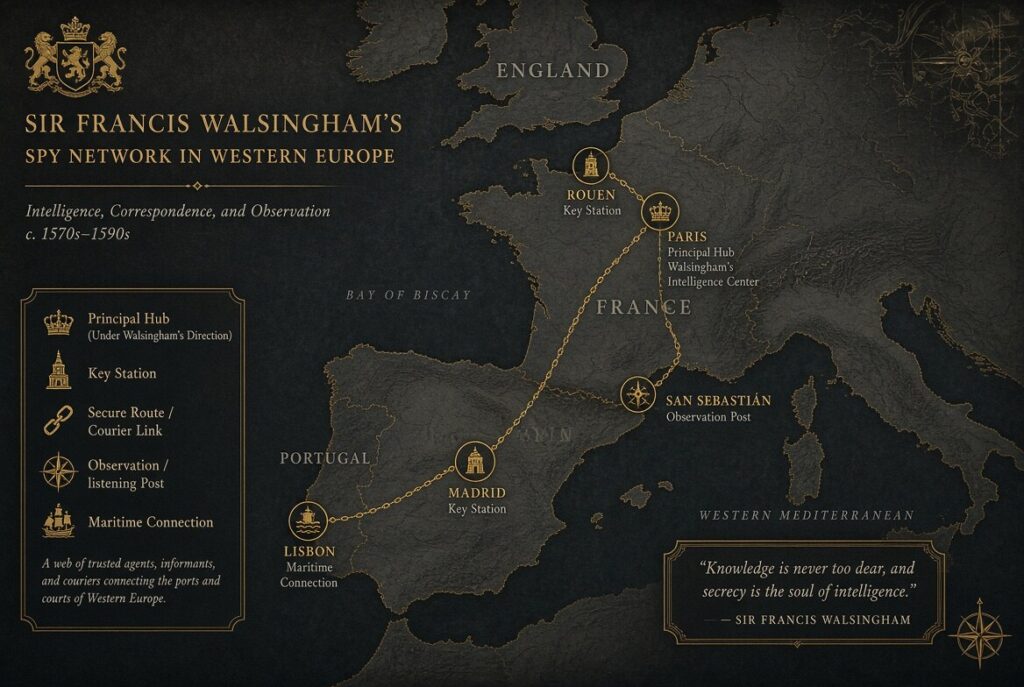
How large was it? One scholarly estimate puts it at roughly seventy correspondents during the 1580s, but only four agents who worked for him over any extended period. Hey, not all agents produce intel at the same rate. Scott McMillin and Sally-Beth MacLean have argued that Walsingham cultivated the impression of a larger system than he possessed, which is itself a master technique. Walsingham knew how to manage impressions. Early disinformation Ops!
Within that household, three people matter most to the story. Thomas Phelippes was the cipher clerk, a linguist and cryptanalyst who, according to The National Archives’ catalogue note on SP 53, took over decipherment from John Somers, clerk of the signet. Early SIGINT game was bangin’. Gilbert Gifford was the courier, a Catholic seminarian who left Rheims on 8 October 1585 carrying letters from Mary’s agent Thomas Morgan, was picked up at Rye around 10 December, and was soon lodging with Phelippes. And the brewer, a man from Burton who supplied beer to Mary’s household at Chartley in Staffordshire, was the channel. Sir Amias Paulet, her keeper since the spring of 1585, called him “the honest man.” This was an early example of a compartmented cell of intel operatives.
The letters appear to have traveled in a corked tube slipped through the bung hole of a cask; early tradecraft. Gifford first secured the brewer with a bribe paid by Mary herself; he later demanded, and received, considerable sums from both sides. The channel was tested on the evening of 16 January 1586, and Mary wrote her first letter through it on 17 January. From then on, every packet she sent or received passed under Paulet’s eye and then under Phelippes’s before it reached its destination. Oops. Watch your OPSEC when trying to overthrow a monarch!
The Babington Plot, or Why to Keep Your OPSEC Tight
In the spring of 1586 Anthony Babington, a young Catholic gentleman, was drawn into a scheme to free Mary and kill Elizabeth. In July he wrote to Mary proposing the assassination. On 17 July Mary answered from Chartley, endorsing the plan and telling Babington to “sett the six gentlemen to woork.” Babington burned the original. The British Library calls this document “the gallows letter,” because when Phelippes finished deciphering it he drew a small gallows on the address leaf: a clerk’s shorthand for what the text would do to its author. Walsingham read the letter two days after Mary wrote it. She was cooked.
Then came the part that still divides historians. Before the letter went on to Babington, a postscript was added in Mary’s cipher asking him to name “the six gentlemen” and to report “how you proceed and as soon as you may.” The gambit may have backfired. On 3 August Walsingham wrote to Phelippes worrying that the postscript had raised “the iealousie,” that is, Babington’s suspicion, and the same day he ordered the arrest. Babington hid for some days in St John’s Wood, was taken, confessed, and was hanged, drawn, and quartered on 20 September 1586. Walsingham played the game hard by modern standards.
Mary’s papers were seized at Chartley, deciphered, and used to bring her to trial at Fotheringhay in October 1586. The guilty verdict was delivered in the Star Chamber on 25 October. Parliament petitioned for execution on 12 November; Elizabeth’s reply to a second delegation on 24 November was the famous “answer answerless.” She let the sentence be proclaimed on 6 December, sat on it for weeks, and signed the warrant on 1 February 1587. Robert Beale, one of Walsingham’s closest associates, read it from the scaffold, and Mary was executed at Fotheringhay on 8 February 1587. Protect your neck.
Walsingham’s Network Succeeded at Military Intelligence When It Mattered Most
Walsingham got caught up in his own web, though. Mary’s execution gave Spain’s Philip II his pretext to go to war against England. It’s OK—his network abroad warned him of Philip’s attack with the Armada. His best-placed source was Anthony Standen, an English Catholic exile in Florence who wrote to London under the alias “Pompeio Pellegrini,” addressed to a “Giacopo Mannucci” who was very probably Walsingham himself. Walsingham’s caught wind from the Venetian ambassador that Spain’s preparations were “proceeding with all speed” and enclosed a muster of 12,058 soldiers at Lisbon. London saw the Armada coming and prepared. That storm was a lucky break though—because it’s smarter to be lucky than it’s lucky to be smart. But it was Walsingham’s intel network that gave Elizabeth time to prepare. It might have saved England.
There Are Some Disputes
Some questions remain from the historical record about Walsingham.
- Entrapment. Did Walsingham catch a plot or build one? Mary accused him of falsifying evidence, which he denied. Bossy argued that Walsingham, Burghley, and the Queen were “not so much discovering facts as inventing them,” while allowing that the underlying intelligence was real. This would be an early version of Russia’s active measures if so. Alford and Cooper showed that Phelippes tampered with the correspondence, which makes the affair at least partly staged. Either way, the Catholics did have it out for Protestant England, and Walsingham’s deception Ops make sense through that lens.
- Size. Was his network 70 agents or 4 good ones? Or does it matter? Modern spycraft says that if we’re still guessing, he did his job perfectly!
- Money. The Crown paid him £750 a year from 1582 and £2,000 a year from 1585, by Privy Seal warrant “for such purposes as the Queen shall appoint,” a phrase broad enough that nobody can say how much went to intelligence. Black budgets! We still have those! That Walsingham supplemented operations from his own pocket is, in one scholar’s words, “almost certain” and would show how much he was addicted to the game. He was roughly £1,600 in debt after a single year in Paris and complained that the embassy was “like to bring me to beggary.” All of that lines up, though. He was a spook, not a businessman—and he likely died broke because of it.
Where to Read More
At The National Archives, SP 12 is State Papers Domestic for Elizabeth I (1558 to 1603), where Francis Walsingham’s working papers and the 1590 list of his foreign sources sit. SP 53 is State Papers Scotland, Series I, Mary Queen of Scots (1568 to 1587), 23 volumes containing the Chartley papers, more than a hundred ciphers, the gallows letter copy, and the postscript. SP 70 is State Papers Foreign for 1558 to 1577, covering his Paris embassy, and SP 78 picks up State Papers Foreign, France, from 1577. The printed Calendars are at British History Online; the Foreign and Venetian volumes are free, while the Domestic and Scotland volumes for the 1580s need a subscription. The Scottish History Society printed the Babington correspondence in 1922, and the National Library of Scotland has digitized it. Serious intel nerd treasure trove.
Lessons from the Big Dog
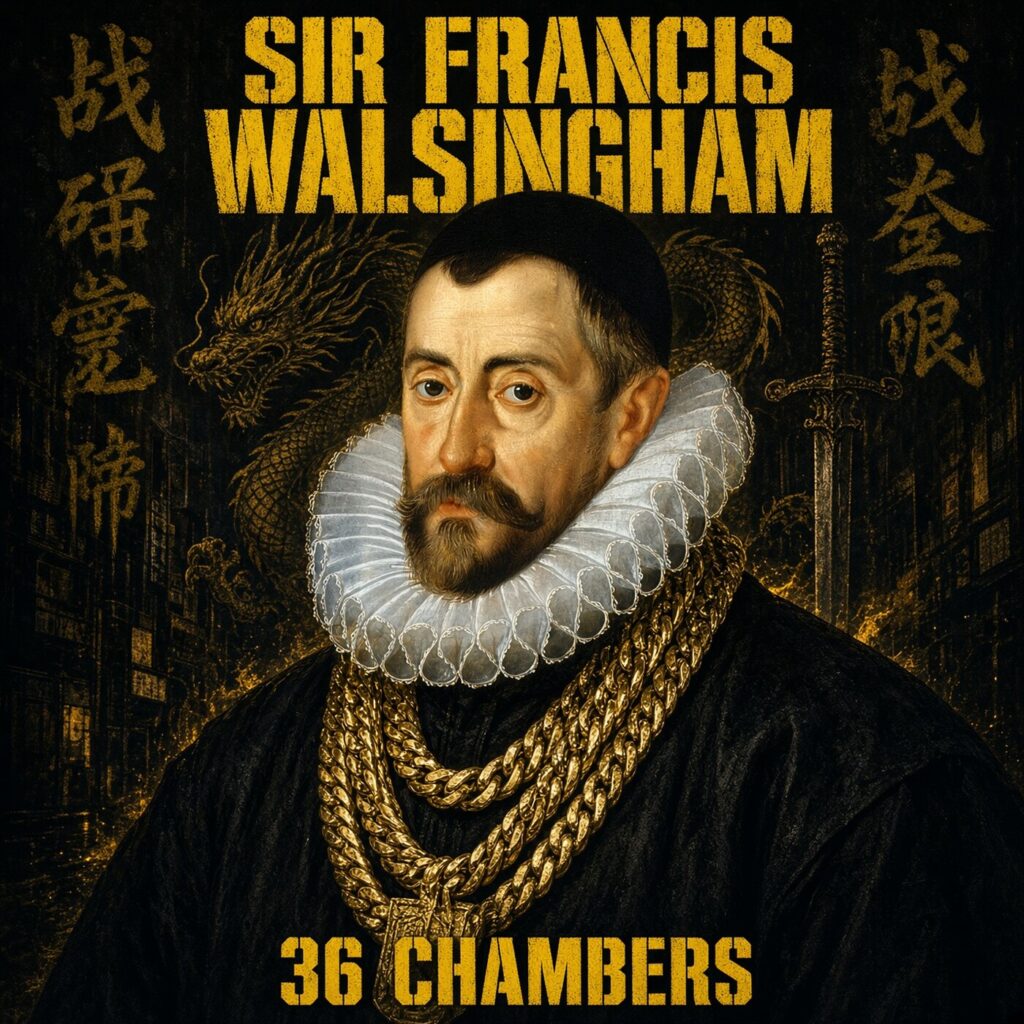
What can we take away from the life of Francis Walsingham?
- Spyin’ Ain’t Easy. He died broke. He did it for the love of the game, but didn’t have much of a financial legacy,
- HUMINT Above All. He didn’t have an agency at his back; he made his own. Give him a cipher clerk, a courier, and a brewer and he could outfox Spain.
- Early COMINT and SIGINT King. He didn’t just wait for people to talk. He read their mail. Interception and decipherment turned a prisoner’s private correspondence into the Crown’s evidence file.
- Deconfliction Pioneer. He let some operations run before he shut them down. The Chartley channel was open for six months before anyone was arrested, long enough for the other side to write down exactly what it intended. Gotcha!
- Source and Methods Quality. He had sources all over and these gave him multiple sources from which to make high confidence assessments. The Armada was reported from Florence, Madrid, and Lisbon a year before it sailed. Thus he was GOATed after he was knighted.
Frequently asked questions
Who was Sir Francis Walsingham?
Francis Walsingham (c.1532 to 1590) was Elizabeth I’s Principal Secretary from 21 December 1573 until his death on 6 April 1590. Born at Scadbury in Chislehurst, Kent, and educated at King’s College, Cambridge, and Gray’s Inn, he spent Mary I’s reign in Padua and Basel, served as ambassador in Paris from 1570 to 1573, and was knighted on 1 December 1577. He ran the Crown’s secret correspondence from his own house in Seething Lane.
What was the gallows letter in the Babington Plot?
On 17 July 1586 Mary, Queen of Scots, wrote from Chartley to Anthony Babington endorsing a plot to kill Elizabeth, telling him to set the six gentlemen to work. Walsingham’s cipher clerk Thomas Phelippes deciphered it and drew a small gallows on the address leaf. The nearest contemporary copy is The National Archives SP 53/18/53; the added postscript asking Babington to name the six is catalogued as SP 53/18 (55).
Did Walsingham entrap Mary, Queen of Scots?
Historians disagree. Mary accused him of falsifying evidence and he denied it. The postscript added to her 17 July 1586 letter is catalogued by The National Archives as forged by Phelippes, and John Bossy argued the government was partly inventing facts rather than discovering them. Stephen Alford and John Cooper treat the affair as at least partly staged. The underlying correspondence, seized at Chartley, was real, and it is in SP 53.
How did Walsingham learn about the Spanish Armada?
From agents abroad. Anthony Standen, an English Catholic exile in Florence writing as Pompeio Pellegrini, is believed by Conyers Read to have supplied a copy of the Marquis of Santa Cruz’s March 1587 report on Spain’s ships, men, and stores, and in 1588 reported from Madrid itself. A 1590 list in SP 12/232 shows Walsingham also received regular advertisements from Lisbon, Madrid, St Sebastian, Paris, and Rouen.
Did Walsingham pay for his spies himself?
Partly. The Crown paid him 750 pounds a year from 1582 and 2,000 pounds a year from 1585 under a Privy Seal warrant for such purposes as the Queen should appoint, which also covered other business. Scholars consider it almost certain he supplemented this from his own income. He died heavily in debt to the Queen and was buried at St Paul’s without ceremony, though an inquiry suggested the Crown also owed him money.
Sources
- History of Parliament Online, “Walsingham, Francis (c.1532–90)”
- History of Parliament Online, “On this day, 24 November 1586: Parliament’s intervention against Mary, Queen of Scots”
- British Library, “The gallows letter” (SP 53/18/53; Cotton MS Appendix L, f. 143v)
- The National Archives, “Forged postscript to Mary’s letter to Babington, by Thomas Phelippes,” SP 53/18 (55), 17 July 1586
- The National Archives, catalogue description of SP 53, State Papers Scotland Series I, Mary Queen of Scots, 1568–1587
- The National Archives, catalogue description of SP 70, State Papers Foreign, Elizabeth I, 1558–1577
- The National Archives, Codes and Secret Messages: SP 53/2 f. 1, a cipher used by Mary, Queen of Scots
- Surrey History Centre via TNA Discovery, LM/1921, Robert Wingfield’s account of the execution of Mary Queen of Scots on 8 February 1587
- Calendar of State Papers Foreign, Elizabeth, vol. 10, 1572–1574, ed. A. J. Crosby (1876), August 1572
- Calendar of State Papers Foreign, Elizabeth, vol. 10, September 1572
- Calendar of State Papers, Venice, vol. 8, 1581–1591, ed. H. F. Brown (1894), January 1588
- Calendar of State Papers, Scotland, vol. 8, 1585–86, ed. W. K. Boyd (1914)
- Calendar of State Papers Domestic, Elizabeth, 1581–90, ed. R. Lemon (1865)
- J. H. Pollen (ed.), Mary Queen of Scots and the Babington Plot, Scottish History Society, 3rd ser., vol. 3 (Edinburgh, 1922), digitized by the National Library of Scotland
- L. Hicks, “The Embassy of Sir Anthony Standen in 1603, Part I,” British Catholic History 5:3 (1959)
- “Sir Amias Poulet to Secretary Walsingham, October 1586,” Camden Third Series, vol. 17 (1909)
- Alexandra Walsham, “Turncoats and Opportunists,” London Review of Books 34:13 (2012), reviewing John Cooper, The Queen’s Agent (Faber, 2011)
- Christopher Mains, “Sir Robert Cecil and Elizabethan Intelligencing, 1590–1603,” PhD thesis, The Open University (2021), citing SP 12/232
- Richard Angus Smith, “Spying and Surveillance in Shakespeare’s Dramatic Courts,” PhD thesis, University of Sydney (2014), on funding and network size
- Stephen Alford, The Watchers: A Secret History of the Reign of Elizabeth I (Bloomsbury, 2012)
- Robert Hutchinson, Elizabeth’s Spymaster: Francis Walsingham and the Secret War That Saved England (Weidenfeld & Nicolson, 2006; paperback 2007)
- Conyers Read, Mr. Secretary Walsingham and the Policy of Queen Elizabeth, 3 vols. (Oxford: Clarendon Press, 1925), library record
We are Competitive Futures, a strategic intelligence practice. We read the primary record so our clients do not have to take anyone’s legend on faith.
This piece is part of our guide to Pioneers of Strategy, Intelligence, and Foresight.