Voter Fraud in 2026: The Game Theory of Election Integrity
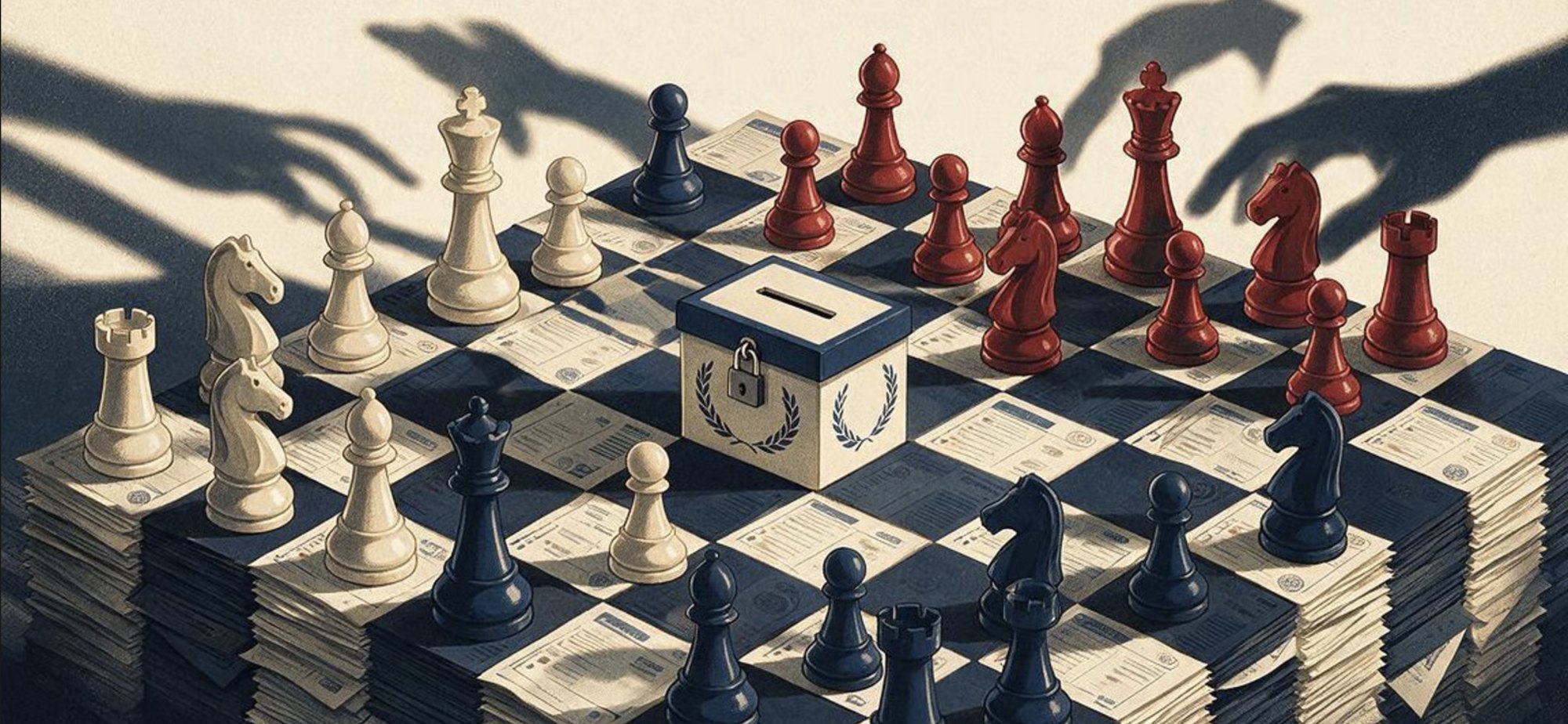
Since January 2021, 271 people have been charged in federal voter fraud cases, and 185 of them in the two months before the 2026 midterms. Here is the game theory of the fight over California’s voter rolls, and the one player that wins no matter who is right.
Election Integrity Since January 6, 2021
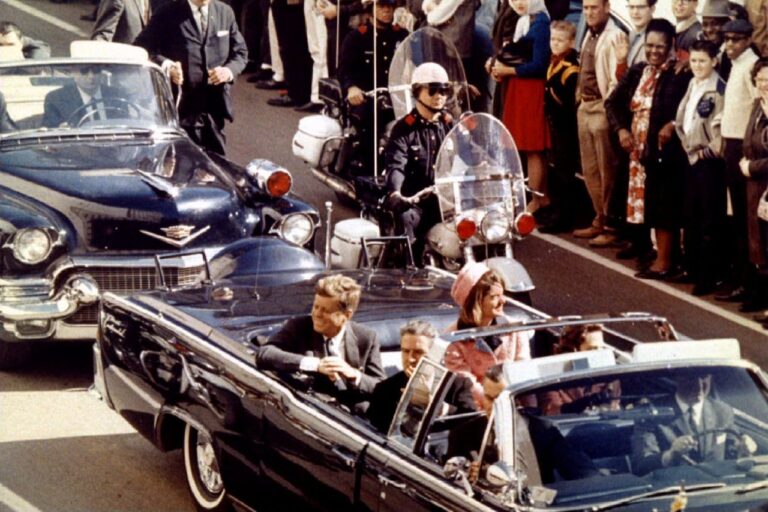
Making sure that American elections are legitimate should not be partisan. There are laws on the books at both the state and Federal levels. Bribery, ballot access, and vote tallies are all covered by numerous statutes. There is also a long history of polluted elections, from rural areas to the Tammany Hall machine in New York. Even JFK joked that his father was buying votes but was cheap and refused to splurge on a landslide.
Accusations about election rigging have been particularly intense in the last ten years. From 2016 to 2020, the Republican case for election integrity was long on assertion and short on evidence: if our guy loses, it was stolen, if he wins, it wasn’t. When Trump won in 2016, they stopped short of Roger Stone’s promised “bloodbath.” When he lost in 2020, they ended at the Capitol with airhorns, rakes and fire extinguishers. It was a disgrace, criminal prosecutions detonated all around the matter, and it set the legitimate cause of election integrity back years.
In 2026 the method has changed. The Trump Administration is systematically showing where there might be election fraud, starting with requests for information on a voluntary basis, followed by prayers for civil remedies, and then onto criminal prosecutions. When states rebuff the Administration, it asks a judge for declaratory or injunctive relief. When a judge rules against it, it appeals. That is the difference between telling and showing.
Four days before the midterms, this is no longer a fight about one election. It is a game with three players, and only two of them are on the ballot. Here is how I read the board.
Time for some game theory: 2 partisan teams and our adversaries
Each player has a different definition of winning, and they don’t need the same evidence to get there.
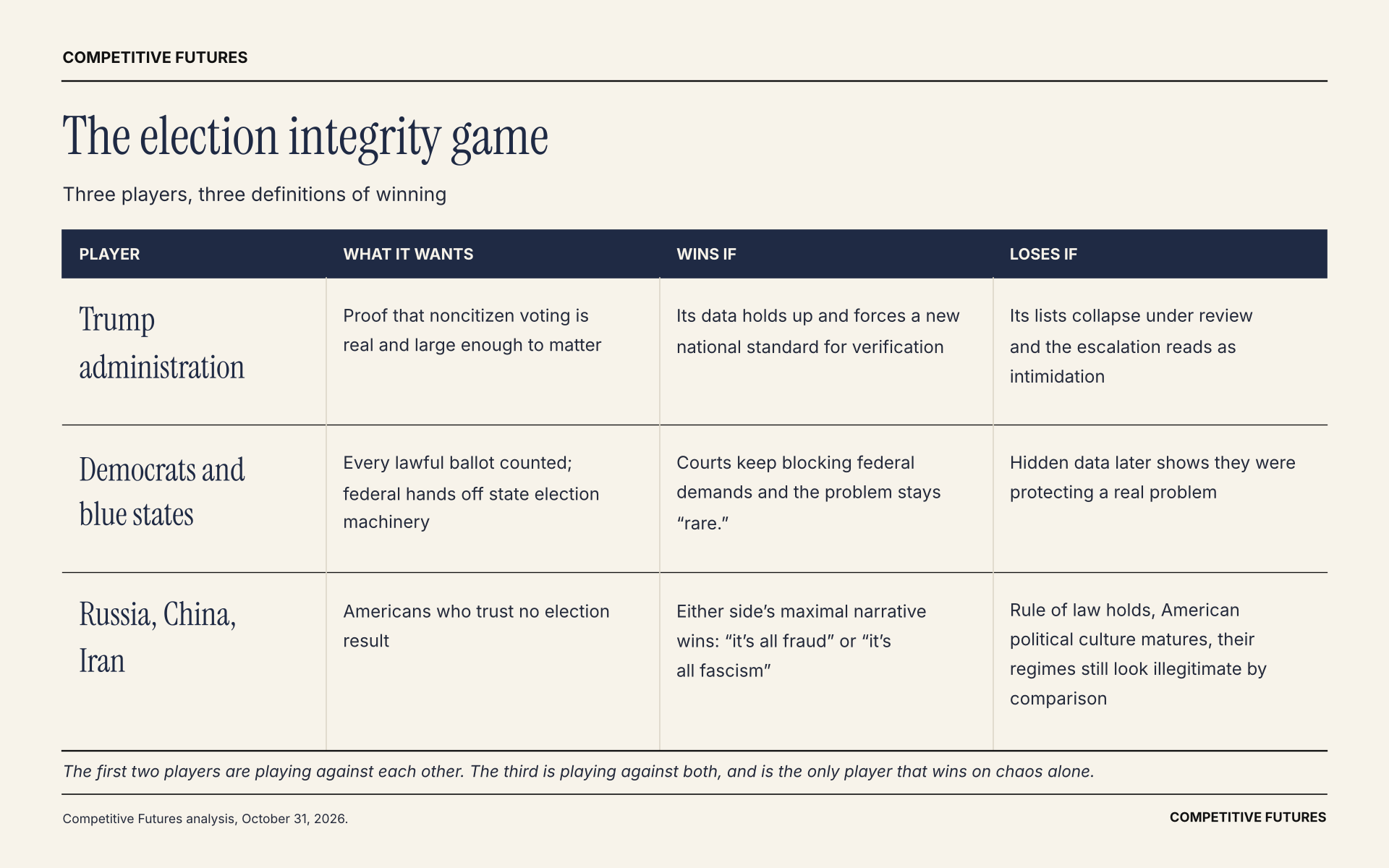
The first two players are playing against each other. The third is playing against both of them, and is the only player that wins on chaos alone.
The moves since 2025: the California voter fraud fight
The Administration has climbed an escalation ladder, and every rung leaves a record of who refused what. Here’s how it’s played out in California.
- The voluntary phase. DOJ requested state voter rolls to check registrations against federal citizenship data. Many states refused, citing voter privacy.
- The civil litigation phase. DOJ sued. Courts have so far found that the statutes it cited don’t authorize what it asked for.
- The prosecution phase. On October 19, DOJ charged 28 green-card holders in California with illegal registration or voting. All 28 were on a list of 20,000 names DOJ calls likely noncitizens.
- The evidence phase. On October 13, DOJ told California and Los Angeles County to set aside the ballots of those 20,000 voters. Judge David Carter refused on October 28. He found DOJ’s method too vague to credit and said the remedy for illegal voting is indictment, not quarantine.
- The aggressive phase. On October 23, letters warning county election workers of prosecution were delivered by armed DHS officers. On October 30, Judge Trina Thompson barred those threats until November 16 and found they likely violated the Voting Rights Act.
The states and the courts won rounds 4 and 5. But the clock matters more than the scoreboard. Thompson’s order runs past Election Day and into the California count, and the grand jury investigations it doesn’t touch keep running after both.
The federal voter fraud record
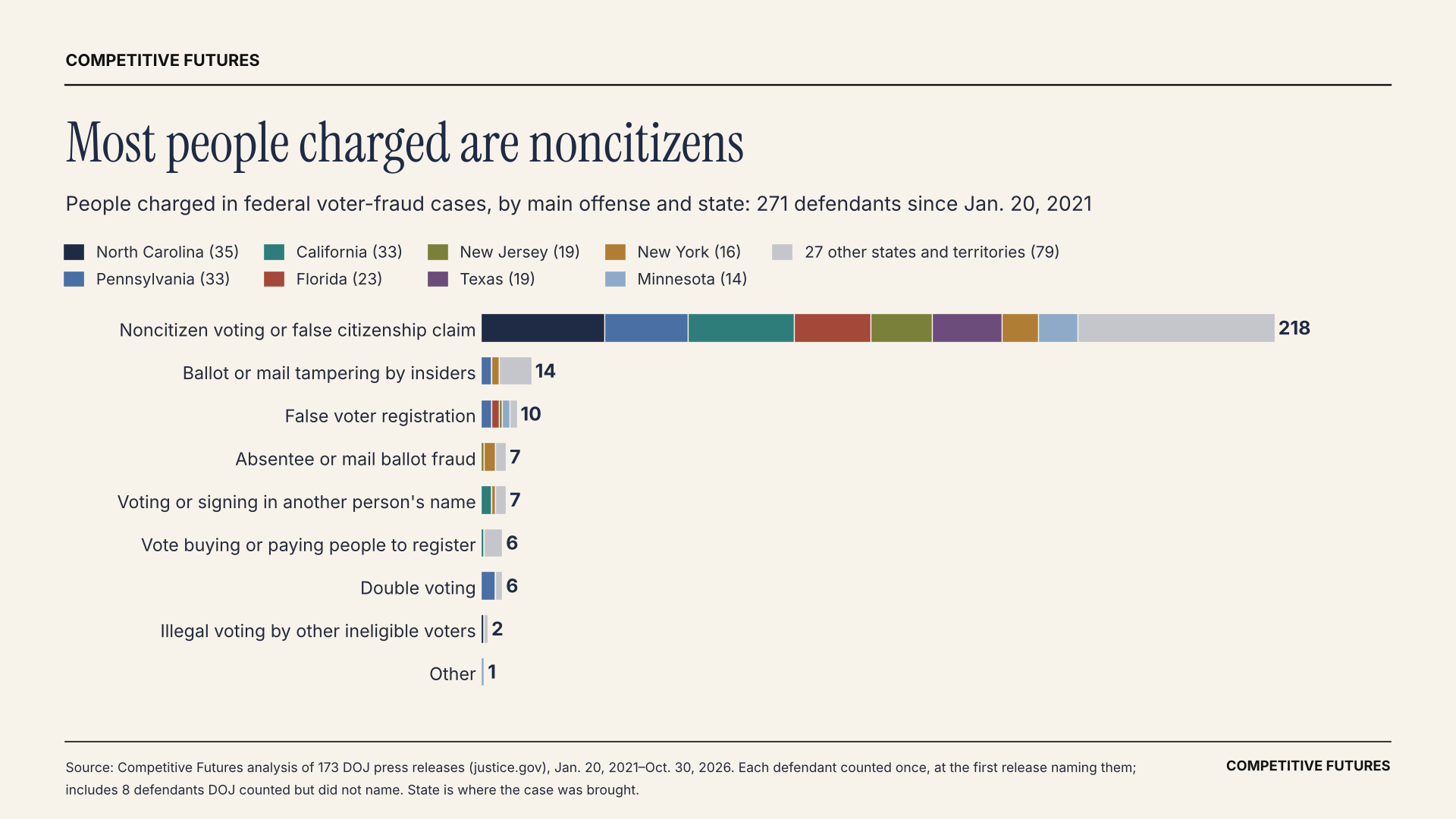
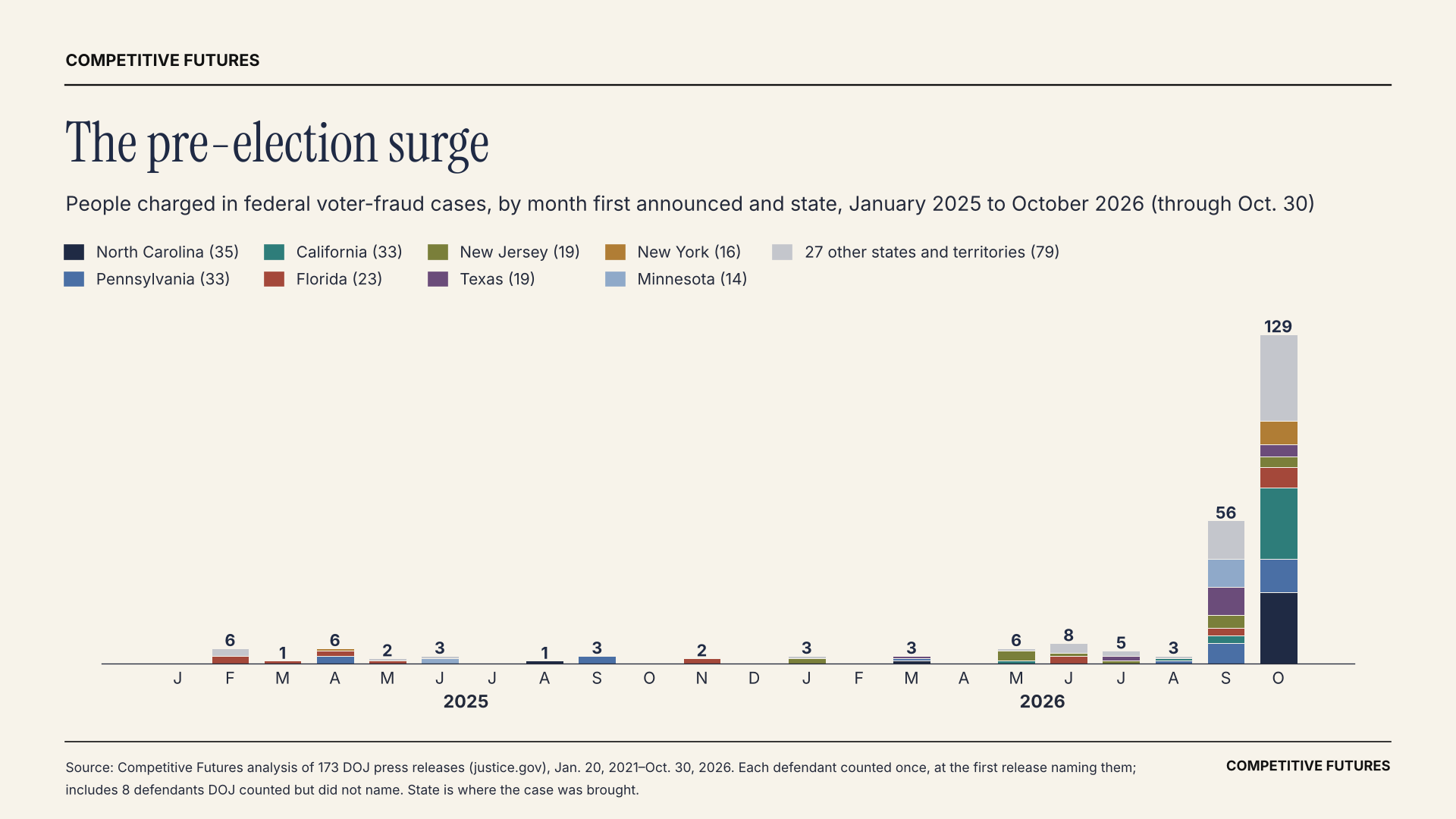
DOJ does not publish a count of election-fraud prosecutions, so the closest thing to an official record is its own press releases. Reading all 173 releases from January 20, 2021 through October 30, 2026, and counting each defendant once, gives 271 people charged in federal voter and ballot fraud cases. Of those, 218 were charged with voting as noncitizens or falsely claiming citizenship to register.
The timing matters as much as the mix. Thirty-four people were charged from 2021 through 2024; 237 were charged in 2025 and 2026.
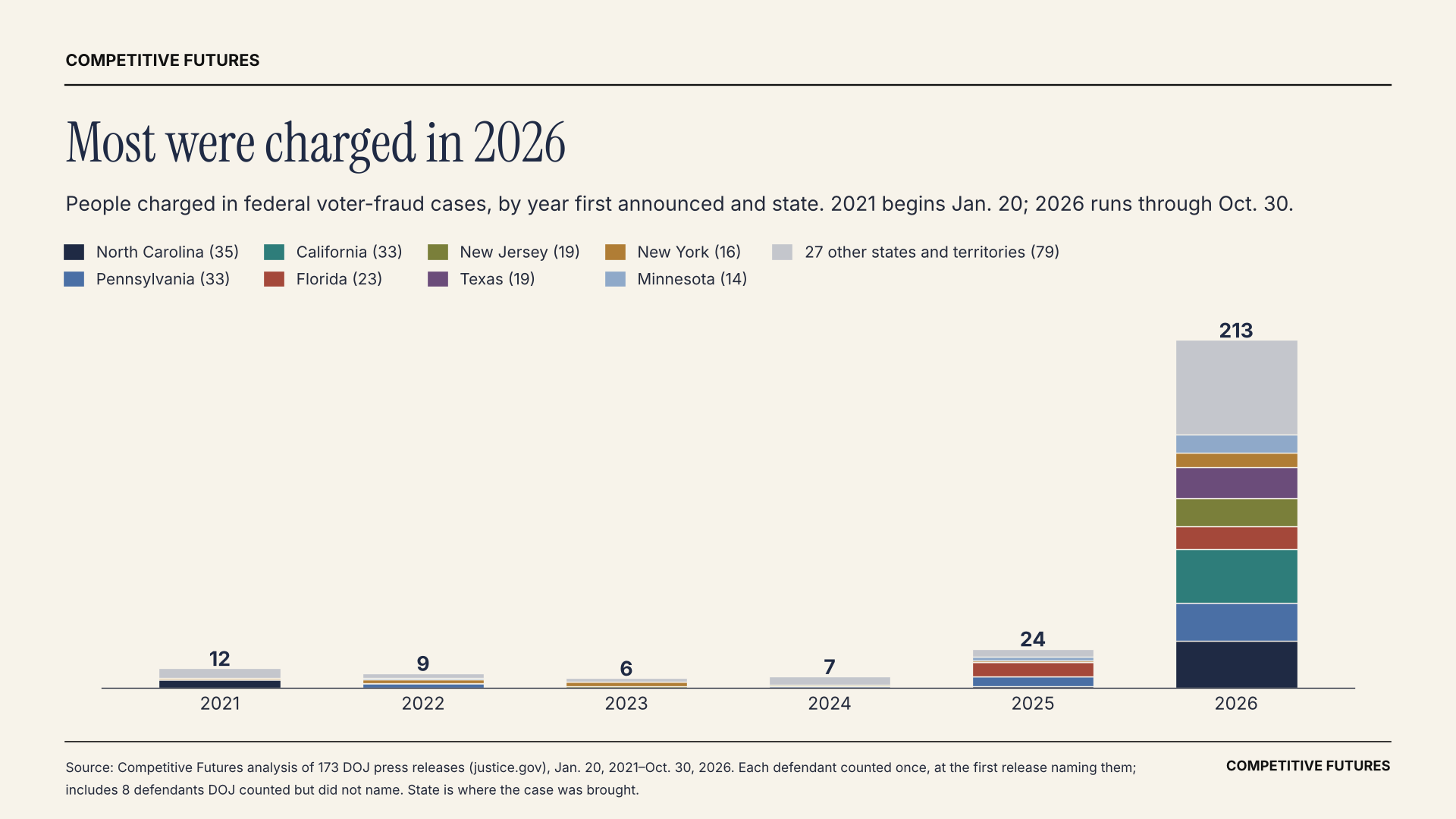
Of the 271, 185 were first announced in September and October 2026, the two months before the midterms. The count tracks the Washington Post’s independent tally: 178 noncitizens charged between January 20, 2025 and October 28, against the Post’s “at least 180.” These are federal cases only, most voter fraud is prosecuted by states, and most of these defendants have so far only been charged.
Foreign election interference: intent and capabilities
Moscow, Beijing and Tehran don’t need either American side to win. They need both sides to believe the other cheated.
The record on this is not speculative. That’s the conclusion of the Intelligence Community Assessment of 2017 which focused on the attacks of the 2016 election. Assessments of 2020 were substantially similar. In October 2024, ODNI, the FBI and CISA jointly attributed to Russian actors a staged video of Bucks County ballots for Trump being torn up. The same network produced a second fake: two supposed Haitian immigrants claiming they would vote twice in Georgia. Note what that pair tells you. Russia manufactured evidence for both stories: Democrats destroying Republican ballots, and noncitizens voting illegally. It doesn’t care which narrative wins. It cares that one does.
The intelligence community’s assessment of the 2022 midterms found the same pattern. Russia worked to undermine confidence in the election. China targeted a handful of races in both parties. Iran exploited social divisions. None attacked the counting itself; they didn’t need to.
For 2026, there is reporting that the Kremlin has authorized another influence campaign, that all three are using AI to scale propaganda, and that Iranian officials have discussed recruiting election insiders and targeting voting systems. Meanwhile, the federal government’s public warnings have gone quiet compared with prior cycles.
Consider the public statements of Sean Wiswesser, a world expert in Russian intelligence tradecraft. He says that Russia just wants us fighting, that they win so long as we trust nothing and lose faith in our institutions.
Here is the uncomfortable part for both American sides. A list of 20,000 “likely noncitizens” with an undisclosed method is raw material for Moscow. So is a court order describing armed federal agents delivering prosecution threats to county clerks. Every unverified claim, from either direction, is ammunition for the player who wins on distrust.
Bluffing versus transparency
Both American players are sitting on undisclosed cards, and in signaling theory, a player with a strong hand shows it.
The states won’t hand over their voter rolls. Their stated reason is privacy: DOJ wants every voter’s license number and partial Social Security number in a federal database. That concern is real. But refusing every form of verification, while insisting the problem is negligible, invites the obvious inference.
DOJ won’t disclose how it built its list. Judge Carter’s central finding was that he couldn’t credit a method DOJ wouldn’t describe, and a USCIS official acknowledged data discrepancies in it. Admitting that databases contain errors in general is not the same as showing your matching criteria so others can test them. That invites the same inference in the other direction.
The stakes are real even if the numbers turn out small. A few hundred illegal registrations is nothing as a share of a statewide electorate. In a House district decided by a few dozen votes, it is everything.
So the game resolves on data that neither side has yet put on the table:
- If the federal data holds up, we get a new national understanding of the problem. State officials who blocked verification while calling it negligible should answer for that.
- If it collapses, and especially if anyone knowingly presented bad data to a court, the attorneys involved should be fired and disbarred. The escalation would then read, in hindsight, as intimidation.
Either way, this does not resolve in four days. That may have been the strategy all along.
The move that beats our adversaries
There is exactly one move that defeats Moscow, Beijing and Tehran at once: a count both American sides accept because both agreed that the outcome is fair.
There are a number of methods that could be acceptable to both sides of Americans, so long as both act in good faith. Draw a random sample of registrations in the contested states. Verify each one by hand against every federal record, with humans resolving each flag, because many citizens have no DHS record at all. People who became citizens as children through a parent’s naturalization are the classic case. That is why matching names and birthdates by machine, however fast, produces false positives. Publish the method and the error rate. A study like this would settle the question in weeks.
Whichever side refuses that design is telling you which cards it holds. And the side that proposes it first takes the high ground away from the foreign player.
Signposts to watch
- November 13: whether DOJ defends its list on the merits at the preliminary injunction hearing, or argues only about authority and scope.
- The 28 prosecutions: convictions versus dismissals, and how many defendants turn out to be citizens or identity-theft victims.
- The voter-roll litigation: whether any court orders states to share data, and what a citizenship check of those rolls actually returns.
- Certification in California and Alaska: whether ballot-segregation demands return, and whether they come with evidence attached.
- The test of discipline: whether the administration accepts final judicial losses on certification as firmly as it has accepted procedural ones. If it does, it will have built the first serious, evidence-based election-integrity case in a generation.
Sources
- Order granting TRO, SEIU v. DOJ, N.D. Cal. No. 26-cv-12800 (Oct. 30, 2026)
- CNN: Judge denies DOJ bid on California ballots
- CBS News: Carter ruling and USCIS discrepancies
- Latin Times: the 28 charged
- RFE/RL: ODNI, FBI and CISA on the Bucks County video
- GMF Alliance for Securing Democracy: Russian fake-fraud videos
- NBC News: intelligence assessment of the 2022 midterms
- Brennan Center: AI and foreign election influence
- Brennan Center: federal defenses recede
- Bloomberg: AI disinformation before the midterms
- Jerusalem Post, citing The Telegraph: Iran’s midterm plans
- U.S. Department of Justice, U.S. Attorney press releases
- Washington Post: We studied 180 voter-fraud cases