Forced Labor Import Ban Risk: How Section 307 and the UFLPA Work and What They Mean for Companies and Governments
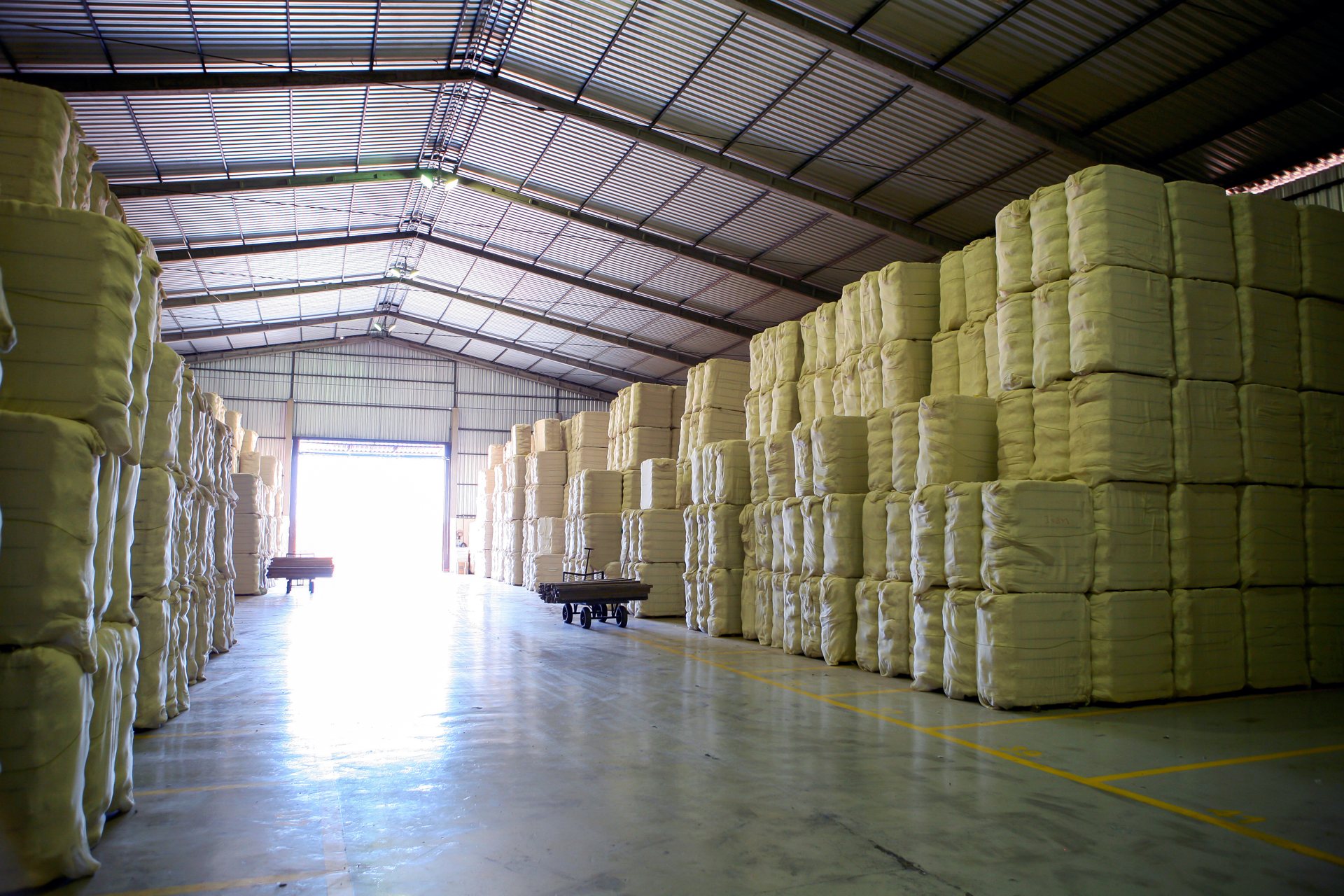
Forced labor import bans began as human rights law. They now work as trade policy, industrial policy, and a lever in strategic competition at the same time. U.S. Customs and Border Protection (CBP) frames its orders in those terms: when it blocked a Serbian copper producer in June 2026, an agency official said that “U.S. manufacturers face unfair competition when foreign companies cut costs by using forced labor” (CBP). In 2026 the trade representative went further, opening Section 301 investigations of 60 economies over whether their “governments have failed to impose and effectively enforce measures banning goods produced with forced labor” (USTR). For a company, the risk is a container held at port because of a raw material three tiers down.
This page explains the two main U.S. forced labor import bans, Section 307 of the Tariff Act of 1930 and the Uyghur Forced Labor Prevention Act (UFLPA), how they became strategic instruments, what enforcement looks like, and what executives and the officials who advise exporters should do about it. It belongs to a series on enforcement risk; sanctions, export controls, investment screening, foreign agent registration, foreign bribery, and data security have their own pages. This is a general overview of public law and agency records, not legal advice. Anyone facing a detention or a specific supply-chain question should talk to customs counsel.
Forced labor import bans at a glance
- Legal basis: Section 307 of the Tariff Act of 1930 (19 U.S.C. § 1307) provides that goods made “wholly or in part” abroad by convict, forced, or indentured labor “shall not be entitled to entry at any of the ports of the United States.” It defines forced labor as “all work or service which is exacted from any person under the menace of any penalty for its nonperformance” and for which the worker does not volunteer, including forced or indentured child labor. The Uyghur Forced Labor Prevention Act, Public Law 117-78, was approved December 23, 2021 (govinfo).
- Who runs it: CBP enforces at the border. The Forced Labor Enforcement Task Force (FLETF), established under the USMCA Implementation Act and chaired by the Department of Homeland Security (DHS), writes the UFLPA strategy and maintains the UFLPA Entity List (Federal Register).
- Withhold Release Orders and Findings: under Section 307, CBP issues a Withhold Release Order (WRO) when information “reasonably indicates” forced labor, and detains matching goods; a Finding rests on a firmer determination and allows seizure and forfeiture. Under a WRO an importer has three months to export the goods or seek an admissibility review (Holland & Knight). After two new orders on September 29, 2026, CBP was enforcing 60 WROs and eight Findings (Thompson Hine).
- The UFLPA presumption: since June 21, 2022, CBP must presume that goods “mined, produced, or manufactured wholly or in part” in the Xinjiang Uyghur Autonomous Region, or by an entity on the UFLPA Entity List, are barred under Section 307. The presumption falls only if the importer has complied with CBP guidance, “completely and substantively responded to all inquiries,” and shown “by clear and convincing evidence” that the goods were not made with forced labor. CBP must report any such exception to Congress and the public within 30 days (Pub. L. 117-78, § 3).
- The Entity List: a notice published October 29, 2026, added BGI Genomics, MGI Tech, and Shenzhen BGI Technology and stated that “there are 190 entities that meet the criteria set forth in the four required lists” (Federal Register public inspection). The previous update, published August 3, 2026, had added 43 entities for a total of 187 (91 FR 48913).
- High-priority sectors: the statute names cotton, tomatoes, and polysilicon. The FLETF’s August 19, 2025, strategy update brought the list to 12: aluminum, apparel, cotton and cotton products, polyvinyl chloride (PVC), seafood, silica-based products including polysilicon, tomatoes and downstream products, and the newly added caustic soda, copper, jujubes (red dates), lithium, and steel (USTR; Thompson Hine).
- Applicability review and exceptions: CBP’s June 2026 guidance separates an applicability review (the goods have no Xinjiang or Entity List link) from an exception (the link is conceded and the presumption rebutted). A UFLPA detention generally allows 30 days to respond (Holland & Knight).
- Enforcement volume: “As of March 2026, pursuant to UFLPA, CBP has detained about 42,000 shipments, valued at $3.9 billion,” under a revised method that counts individual import transactions (Congressional Research Service; CBP). On July 31, 2026, DHS said CBP had denied entry to more than 24,300 shipments worth nearly $1 billion (HSToday; Troutman Pepper Locke).
- Civil penalties: an importer that enters goods by false or misleading statements or omissions faces penalties under 19 U.S.C. § 1592: up to “the domestic value of the merchandise” for fraud, with lower caps tied to lost duties or dutiable value for gross negligence and negligence.
- Criminal exposure: knowingly importing merchandise “contrary to law” is smuggling, punishable by up to 20 years in prison (18 U.S.C. § 545); false entry statements carry up to two years (18 U.S.C. § 542). The forced labor statute also reaches whoever “knowingly benefits” from a venture known, or recklessly disregarded, to use forced labor (18 U.S.C. § 1589).
How forced labor import bans became a strategic instrument
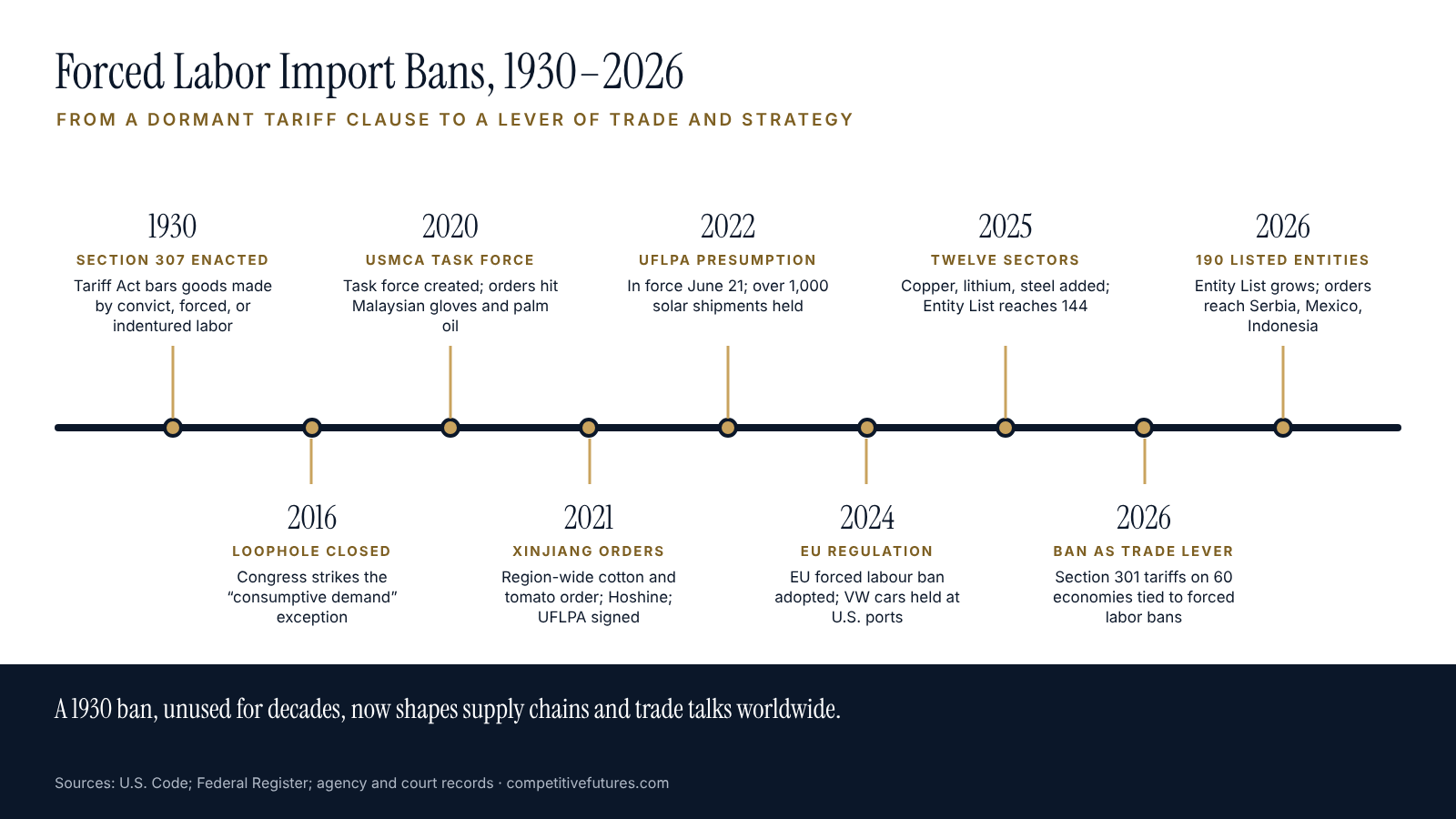
For most of its life Section 307 was a dead letter. The 1930 law let goods made with forced labor in if domestic production could not meet U.S. “consumptive demand,” and, as the Congressional Research Service puts it, “In practice, this provision limits the products to which Sec. 307 could apply”; “between 2000 and 2015 no products were stopped by CBP” (CRS). The Trade Facilitation and Trade Enforcement Act of 2015, signed February 24, 2016, struck the exception (19 U.S.C. § 1307, notes). CBP collected its first forced labor civil penalty under the strengthened regime in 2020 (Mohawk Global).
The law then turned toward strategic competition. The 2020 USMCA was, according to CRS, the first U.S. trade agreement to commit its parties to prohibit forced labor imports, and its implementing act created the FLETF. Orders broadened from single producers to whole regions and sectors: on January 13, 2021, CBP issued a region-wide WRO on cotton and tomato products from Xinjiang (Akin Gump). On January 19, 2021, the Secretary of State determined that China had committed genocide and crimes against humanity against Uyghurs, listing forced labor among the crimes (State Department). Congress passed the UFLPA that December, reversing the burden of proof for an entire region.
On August 31, 2022, the UN Office of the High Commissioner for Human Rights published its own assessment, concluding that patterns of detention in Xinjiang “may constitute international crimes, in particular crimes against humanity,” and addressing allegations of forced labor (OHCHR; Human Rights Watch). China’s mission in Geneva said it “firmly opposes” the assessment and that “Xinjiang has taken actions to fight terrorism and extremism in accordance with the law” (Ghana News Agency). U.S. enforcement rests on the U.S. findings; companies should know both positions.
By 2025 and 2026 the instrument had widened again. The FLETF added five high-priority sectors in August 2025, most of them industrial inputs. Executive Order 14411 of June 3, 2026, directed DHS and the Attorney General to “prioritize the enforcement” of federal law on imports of goods made with forced labor, and tightened requirements on importers of record, including foreign ones (EO 14411). On July 23, 2026, USTR imposed Section 301 tariffs of 10 to 12.5 percent on the 60 investigated economies, setting the lower rate for economies with a forced labor import ban, a commitment to adopt one, or a partial regime (USTR; Federal Register). The ban has become a standard the United States asks trading partners to adopt.
What the risk looks like in practice
The cases below run in date order. Most are administrative actions against goods, not findings against the importer; settlements and company responses are noted. Several involve producers outside China, and several ended in remediation.
PureCircle (2020): the importer pays
CBP collected $575,000 from PureCircle U.S.A. over at least 20 shipments of stevia products processed in China by a producer subject to a May 2016 WRO, which CBP tied to prison labor. (Mohawk Global). PureCircle said it “strongly refutes” the claims, that it “did not admit any liability as part of the settlement,” and that it settled “for less than 7% of the amount sought by CBP” (FoodNavigator). Lesson: a WRO against a foreign producer creates penalty exposure for the U.S. importer, years after the shipments.
Top Glove (2020–2021): remediation is the way back in
CBP issued a WRO on the Malaysian glove maker’s products on July 15, 2020, and converted it to a Finding on March 29, 2021; it then seized shipments that had entered (Malay Mail). The company repaid recruitment fees “totaling over $36.3 million to 12,676 current and eligible former workers,” verified by an independent monitor, and CBP modified the Finding on September 9, 2021, noting “more than $30 million in remediation payments to workers” (U.S. Department of Labor). Lesson: recruitment fees are a core forced labor indicator, and verified repayment is what reopens the market.
Hoshine Silicon and the solar detentions (2021–2022): the raw material decides
On June 24, 2021, CBP issued a WRO on silica-based products of Hoshine Silicon Industry and its subsidiaries, reaching goods made from them, including polysilicon for solar panels; Commerce added Hoshine and four other Xinjiang entities to its export Entity List the same day (Covington). Once the UFLPA took effect, CBP held 1,053 solar shipments between June 21 and October 25, 2022, according to Reuters; a CBP spokesperson said release was “contingent upon how quickly an importer is able to submit sufficient documentation” (Reuters via ThePrint). Lesson: when the order targets an input, every downstream product carries the exposure, and documentation, not argument, gets goods released.
Central Romana (2022): not only an Asia problem
On November 23, 2022, CBP ordered detention of raw sugar and sugar-based products made in the Dominican Republic by Central Romana Corporation, citing five International Labour Organization (ILO) indicators: abuse of vulnerability, isolation, withholding of wages, abusive working and living conditions, and excessive overtime. A CBP official said producers that fail to follow U.S. law “will face consequences” (CBP). Lesson: Section 307 applies to any country, and agricultural commodities from long-standing partners are within reach.
Volkswagen Group (2024): a part three tiers down
In February 2024, several thousand Audi vehicles, about 1,000 Porsches, and several hundred Bentleys were held at U.S. ports, as the Financial Times first reported, after a small electronic component from a Chinese sub-supplier was linked to a UFLPA concern. Volkswagen said the part was being replaced and expected the delays to be resolved by the end of March (Business & Human Rights Resource Centre, citing Reuters). Volkswagen said it learned of the part’s origin in “western China” from its supplier (Crowell & Moring). Lesson: a tiny component can stop a high-value finished product, and supplier notification is not a substitute for mapping.
FGV Holdings (2020–2026): the long road out
CBP issued a WRO on palm oil from Malaysia’s FGV Holdings on September 30, 2020. On January 15, 2026, it modified the order, saying “The company has now made the corrections we required” and that “CBP does not modify WROs or Findings until the agency has evidence” (CBP). CBP noted that its orders in Malaysia’s palm oil and glove sectors since 2019 had led to repayment of more than $85 million in withheld wages and recruitment fees (Sandler, Travis & Rosenberg). Sime Darby Plantation took a shorter route: a 2020 WRO, a Finding in January 2022, and a modification effective February 3, 2023 (International Trade Today). Lesson: an order can last more than five years; remediation needs a budget and independent evidence from the start.
Serbia Zijin Copper (2026): Europe, and an industrial input
On June 16, 2026, CBP ordered detention at all ports of copper and copper products made in Serbia by Serbia Zijin Copper, citing six ILO indicators, including withholding of wages, restriction of movement, and retention of identity documents (CBP). The Chinese-owned company (bne IntelliNews) said it “opposes all forms of forced labor” and was “conducting a comprehensive review” (N1). Serbia’s president said, “We will do everything in our power to help” (N1). Lesson: labor practices, not location, decide the risk, and a host government can be drawn into the case.
CBP also issued WROs on coffee from a Mexican farm in January 2026 (CBP), on two Jordanian garment makers in June (Morgan Lewis), and on two Indonesian palm oil producers in September (Thompson Hine).
What it means for companies
Forced labor import bans work differently from most compliance regimes: the goods, not the company, are the target, and the importer carries the burden of proof. The practical question is whether you can document your supply chain fast enough to get a shipment released.
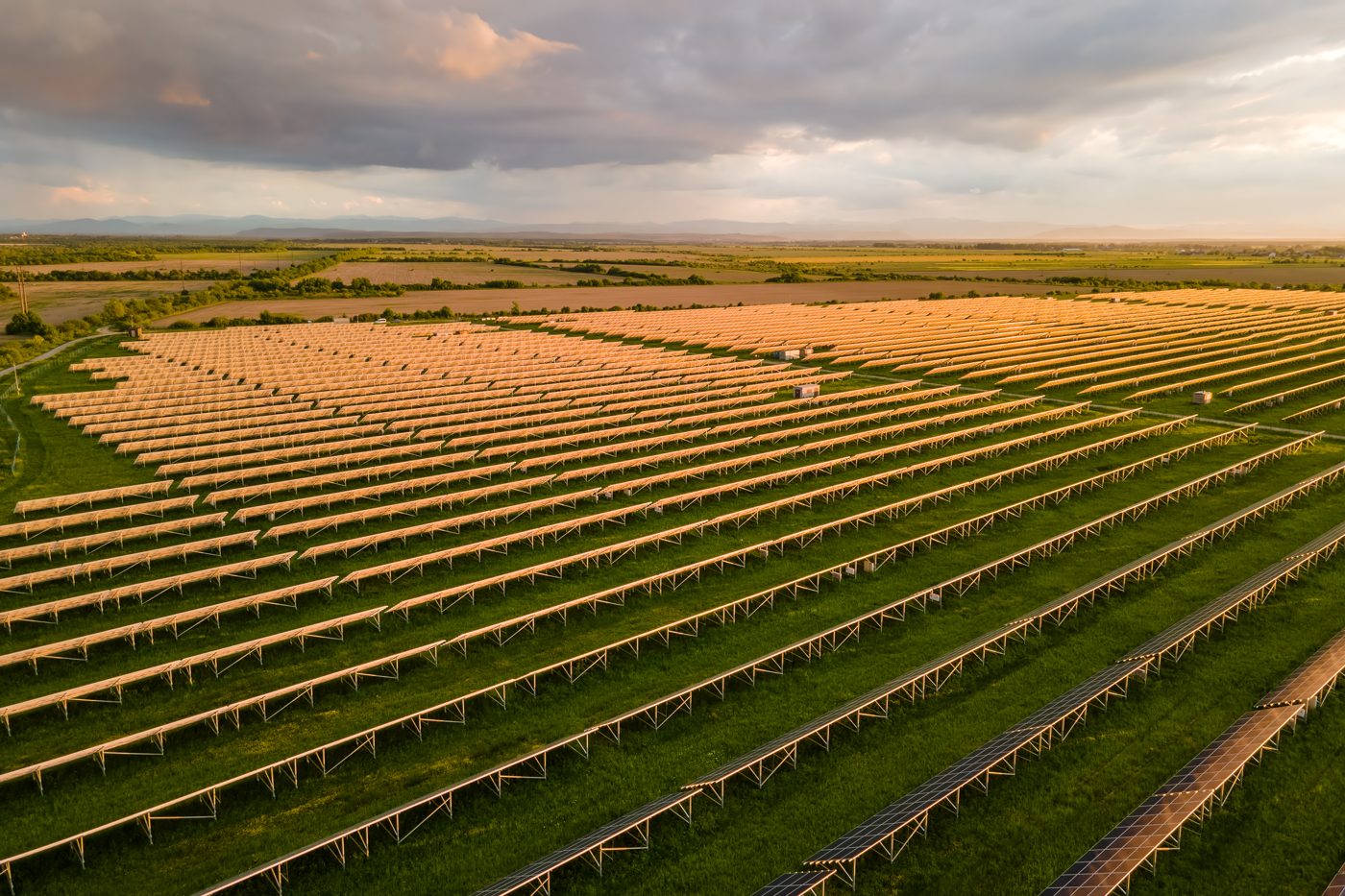
- Map to the raw material. Trace each high-risk product back to the mine, farm, smelter, or polysilicon plant, not only to the last factory. Most high-priority sectors are inputs to electronics, autos, apparel, packaging, and energy equipment.
- Build the evidence file before it is requested. CBP’s 2026 guidance includes supply-chain tracing documents by sector, due diligence examples, and isotopic testing guidance; practitioners warn that “a gap for even one supplier can undermine the entire submission” and that untranslated or incomplete sub-tier records are unlikely to suffice (Holland & Knight).
- Screen against the Entity List continuously. The list grew from 144 entities in August 2025 to 190 by October 2026, and 19 of the 43 added in July 2026 were outside Xinjiang (Kelley Drye). Re-screen suppliers and their parents at each update.
- Audit for ILO indicators, not only certifications. CBP’s orders cite recruitment fees, withheld wages, retained passports, and restricted movement. Ask directly, especially where migrant workers are employed.
- Write it into contracts. Require sub-tier disclosure, audit and traceability rights, cooperation with CBP requests, and notice of any order or listing.
- Use the programs that help. CBP offers Customs Trade Partnership Against Terrorism (CTPAT) members prioritized admissibility review and 48-hour advance notice of new WROs or Findings (Holland & Knight). Executive Order 14411 also pushes foreign importers of record toward CTPAT validation.
- Treat false declarations as the real liability. The penalty and criminal statutes above turn on what an importer says and knows. The Justice Department’s Trade Fraud Task Force, launched August 29, 2025, uses customs law, the False Claims Act, and criminal statutes (Hogan Lovells), and lists “the eradication of forced labor from global supply chains” among its priorities (IRS Criminal Investigation).
Forecasting forced labor import risk
Orders rarely come from nowhere. Signposts include new high-priority sectors in the FLETF’s annual strategy update; Entity List notices; NGO and academic investigations, which CBP cites as evidence; the Labor Department’s list of goods produced with forced labor; congressional letters naming companies; orders against a supplier’s peers; and trade actions that tie market access to forced labor policy. Competitive intelligence and foresight help by assigning indicators to each critical input, scenario-testing a detention of a key product line, and setting in advance the triggers for dual sourcing or exit. The aim is not to predict every order but to have the evidence file ready before one lands.
What it means for governments advising their companies
Trade ministries, export-promotion agencies, and embassy commercial sections increasingly hear one question: what will U.S. customs ask for, and how do we prove it?
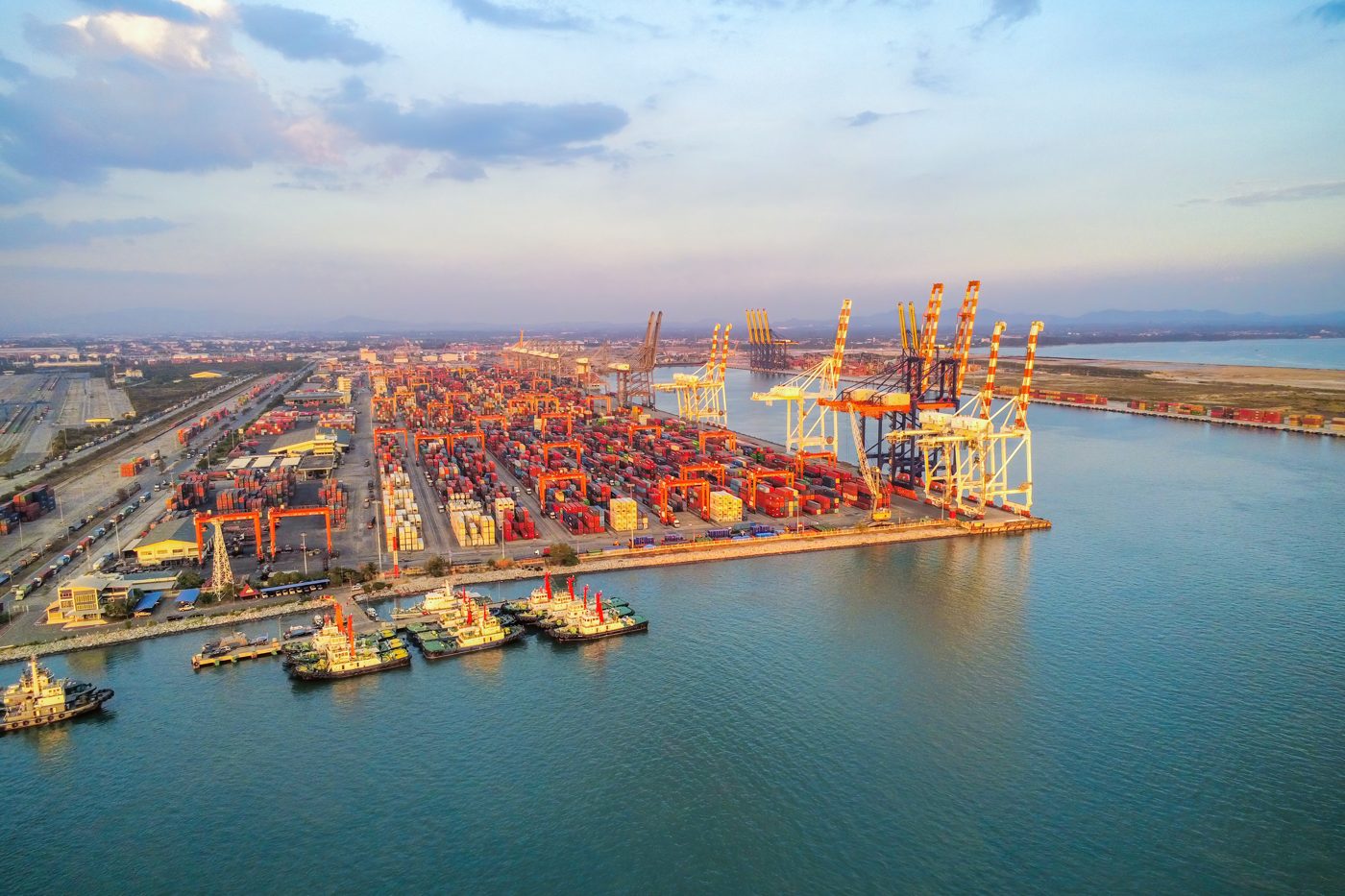
Nexus is the border. No U.S. person, dollar, or component is needed. Section 307 applies to goods from any country that reach a U.S. port, and the UFLPA presumption follows Xinjiang inputs and listed entities wherever the final product is made. In the law’s first year, Malaysia and Vietnam together accounted for most of the value of shipments CBP stopped (Sandler, Travis & Rosenberg), and detentions have since reached shipments from Thailand, India, Mexico, Indonesia, and other countries (Kelley Drye).
Home-country regimes are converging, with differences. The European Union’s Forced Labour Regulation, Regulation (EU) 2024/3015, entered into force December 13, 2024, and applies from December 14, 2027. It covers all sectors and exports as well as imports (Mayer Brown). Unlike the UFLPA, it has no regional presumption; authorities investigate case by case and must establish a violation. The Commission published nonbinding guidelines on June 26, 2026, and a forced labor risk database is still to come (Jones Day). Canada has banned forced labor imports under its Customs Tariff since 2020; on June 12, 2026, it introduced standalone legislation that would let the foreign minister list high-risk goods by region, entity, or individual and deem such goods prohibited if importers cannot supply required tracing information (Global Affairs Canada). Canada’s Fighting Against Forced Labour and Child Labour in Supply Chains Act, in force since 2024, separately requires annual supply-chain reports (Public Safety Canada; Gardiner Roberts). Mexico published its import restriction in the Diario Oficial on February 17, 2023, effective May 18, 2023, citing its USMCA commitment, and opened a petition channel through its digital trade window in June 2025 (El Financiero).
The ban is now part of trade negotiations. In its 2026 Section 301 action, USTR found that 54 economies had failed to impose and effectively enforce a prohibition and that six, including Canada, Mexico, and the EU, had failed to enforce an existing one (Husch Blackwell). “Several governments have contested these findings,” CRS notes (CRS). Whatever a government’s view, tariff rates now depend on whether a home-country ban exists and is enforced.
How good briefings work. Useful advice to exporters is concrete: which of their products fall in high-priority sectors; what tracing evidence CBP accepts; how to respond within 30 days; how U.S., EU, Canadian, and Mexican requirements differ in burden of proof and timing; and how to remediate and petition if a local producer is named. On Xinjiang, a neutral briefing explains that U.S. enforcement rests on U.S. statutory presumptions and findings, notes the OHCHR’s 2022 assessment and China’s rejection of it, and focuses on what exporters must document. That service is useful whatever position a government takes.
Frequently asked questions
Does the UFLPA apply to goods that were not made in China?
Yes. The presumption covers goods made wholly or in part in Xinjiang or by a listed entity, so a product finished in Vietnam, Malaysia, or Mexico with Xinjiang cotton, polysilicon, or aluminum is covered.
How many companies are on the UFLPA Entity List?
190 as of the notice published October 29, 2026, up from 144 in August 2025. Updates come without a fixed schedule.
What happens when CBP detains a shipment?
For a UFLPA detention based on a possible Xinjiang or Entity List link, the importer generally has 30 days to show either that the law does not apply or that the goods qualify for an exception by clear and convincing evidence. Otherwise the goods are excluded.
Can an order against a supplier be lifted?
Yes. CBP modified orders on Top Glove in 2021, Sime Darby Plantation in 2023, and FGV Holdings in 2026 after verified remediation, including repayment of recruitment fees and wages.
Is the EU ban the same as the U.S. ban?
No. The EU regulation, applying from December 14, 2027, relies on case-by-case investigations rather than a regional presumption, and also covers exports. Companies selling into both markets need evidence that satisfies both.
Related reading
- Enforcement Risk: How U.S. Law Became an Instrument of Geopolitics (series hub)
- U.S. Export Controls Risk: How the EAR and the Entity List Work and What They Mean for Companies and Governments
- Investment Screening Risk: How CFIUS and Outbound Rules Work and What They Mean for Companies and Governments
- FARA Risk: How the Foreign Agents Registration Act Works and What It Means for Companies and Governments
- Foreign Bribery Risk: How the FCPA and FEPA Work and What They Mean for Companies and Governments
- Data Security Risk: How the Justice Department’s Bulk Data Rule Works and What It Means for Companies and Governments
- U.S. Sanctions Risk: How OFAC Works and What It Means for Companies and Governments
- The Economic Espionage Act: History, Case Law, and Controlling Precedent
- Competitive Intelligence in Court: Civil and Criminal Cases
- Intelligence Services Around the World: Structure, History, and the Headlines
- American Intelligence: History, Structure, and the Headlines
- Strategic Foresight: A Practitioner’s Guide to Seeing What’s Coming
Competitive Futures helps executives, counsel, and public agencies anticipate forced labor and supply-chain enforcement risk before it reaches the port; details are on the services page.