FARA Risk: How the Foreign Agents Registration Act Works and What It Means for Companies and Governments

Influence is contested ground, and the United States polices it mainly through disclosure. The Foreign Agents Registration Act does not ban lobbying, advising, or public relations for a foreign government. It requires people who do that work in the United States to say so publicly; in the Justice Department’s words, “Disclosure of the required information facilitates evaluation by the government and the American people” (Justice Department). Because the law turns on who directs the work and for whose benefit, it reaches law firms, PR agencies, consultants, think-tank scholars, media outlets, and companies owned or steered by foreign states. The risk is a criminal case, a forced retroactive registration, or a headline that recasts a client relationship as a foreign influence campaign.
This page explains how the Foreign Agents Registration Act works, how it became an instrument of geopolitical competition, what enforcement has looked like from 2017 to 2026, and what executives and the officials who advise companies should do about it. It is part of a series on enforcement risk; sanctions, export controls, investment screening, foreign bribery, forced-labor import bans, and data security get their own pages. This is a general overview of public law and court records, not legal advice; anyone facing a specific question should talk to FARA counsel.
FARA at a glance
- Legal basis: the Foreign Agents Registration Act of 1938, as amended, codified at 22 U.S.C. § 611 et seq. Registration is due within 10 days of agreeing to act as an agent, and “A party may not begin to act as an agent of a foreign principal before registering” (DOJ FARA FAQ). Registrants file supplemental statements every six months (Congressional Research Service).
- Who runs it: “The FARA Unit of the Counterintelligence and Export Control Section (CES) in the National Security Division (NSD)” of the Justice Department (DOJ).
- Who must register: an “agent of a foreign principal” is anyone who acts “at the order, request, or under the direction or control, of a foreign principal” and who, in the United States, engages in “political activities,” acts as a “public relations counsel, publicity agent, information-service employee or political consultant,” solicits or disburses money or other things of value, or “represents the interests of such foreign principal before any agency or official” of the U.S. government (§ 611(c)). Political activity means anything the person believes will, or intends to, “in any way influence” U.S. officials or “any section of the public within the United States” on U.S. domestic or foreign policy, or on the interests of a foreign government or party (§ 611(o)).
- Foreign principals include companies: besides governments and political parties, the term covers “any entity organized under the laws of a foreign country or having its principal place of business in a foreign country” (CRS).
- Key exemptions: accredited diplomats; “private and nonpolitical activities in furtherance of the bona fide trade or commerce” of a foreign principal, and “other activities not serving predominantly a foreign interest” (the commercial exemptions); “legal representation,” which “does not include attempts to influence or persuade agency personnel or officials” outside court and on-the-record proceedings; and agents of foreign companies and individuals registered under the Lobbying Disclosure Act (§ 613). The LDA route “does not apply where a foreign government or a foreign political party is the principal beneficiary” (DOJ FAQ). The burden of establishing an exemption “rests upon the party claiming it” (CRS).
- State-owned companies: the Justice Department says commercial work for a state-owned enterprise “may qualify” for the commercial exemption, but “the exemption will not apply if such activities are directed by a foreign government or political party” (DOJ FAQ).
- Labeling: registrants must file informational materials within 48 hours of distributing them and mark them with “a conspicuous statement that the materials are distributed by the agent on behalf of the foreign principal” (§ 614).
- Guidance routes: a party to proposed activity may seek an advisory opinion under 28 C.F.R. § 5.2, often called a “Rule 2” opinion, about “an actual event, not a hypothetical situation” (DOJ FAQ; Sandler Reiff). Opinions have been published since June 2018 (DOJ). The Unit may send a Letter of Inquiry when it “obtains credible indications that a registration obligation may exist” (DOJ FAQ).
- Civil enforcement: the Attorney General may ask a federal court to enjoin violations or order compliance (§ 618(f)). Failure to register is “a continuing offense for as long as such failure exists” (§ 618(e)).
- Criminal penalties: willful violations and willful false statements are punishable “by a fine of not more than $10,000 or by imprisonment for not more than five years, or both”; some labeling and filing violations carry up to $5,000 and six months (§ 618(a)). The general fines statute raises felony fines to $250,000 for individuals and $500,000 for organizations (18 U.S.C. § 3571); the Justice Department states the FARA maximum as “a fine of not more than $250,000” (DOJ).
- Related statutes: 18 U.S.C. § 951 punishes acting in the United States as an agent of a foreign government, “subject to the direction or control” of that government, without notifying the Attorney General, with up to ten years in prison; it excludes “any person engaged in a legal commercial transaction,” with exceptions. 18 U.S.C. § 219 bars U.S. public officials from acting as foreign agents, with up to two years in prison.
How FARA became a strategic instrument
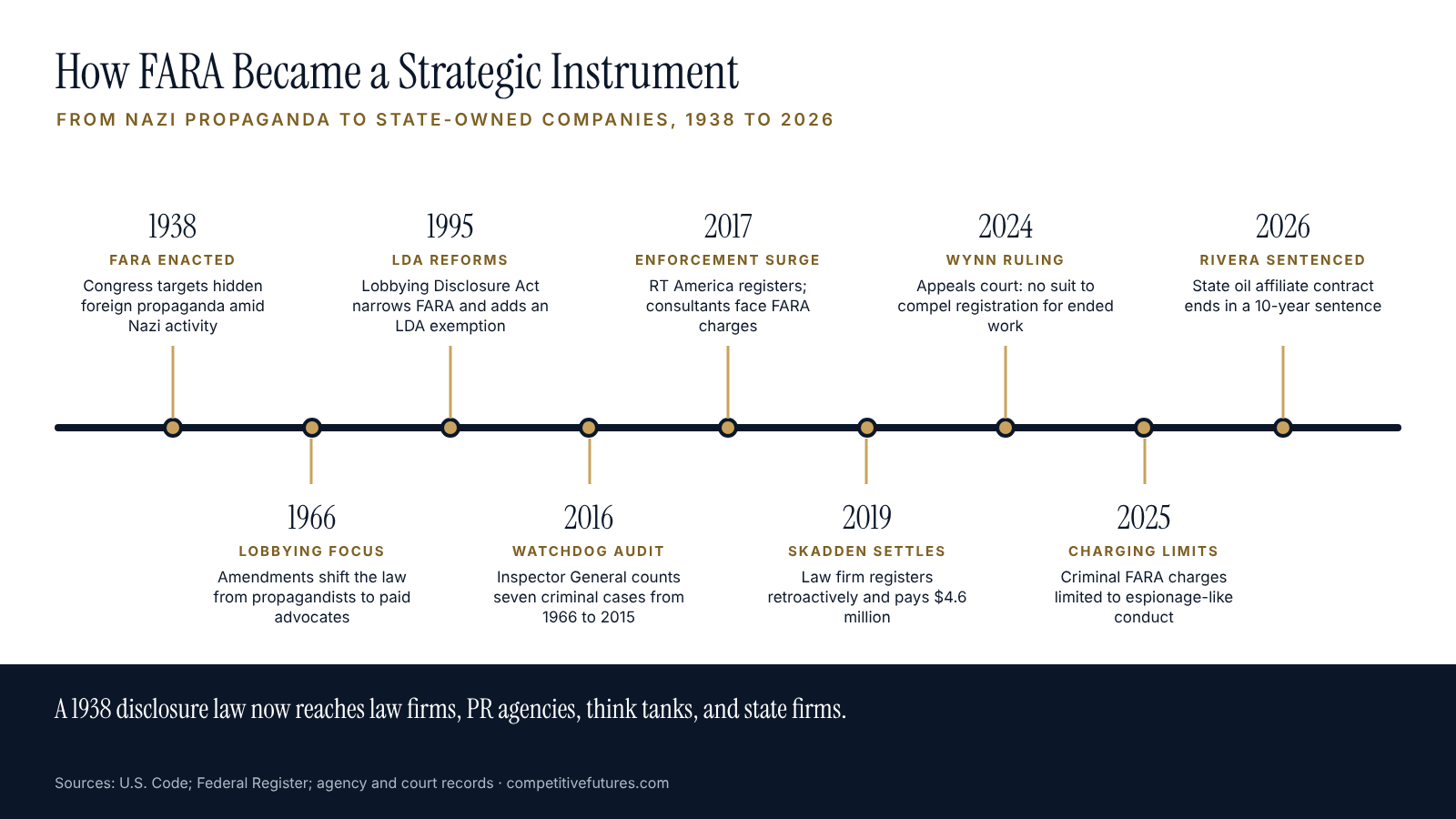
FARA was written for a propaganda war. A House special committee formed in 1934 examined the “extent, character, and objects of Nazi propaganda activities in the United States,” and its former chair, Representative John McCormack, introduced the bill that became FARA in 1938 (CRS). Administration moved from the State Department to the Justice Department in 1942 (same source). After the war, the CRS report notes, “Nazi propaganda was no longer a specific worry,” and the law was little used.
The 1966 amendments refocused FARA from propagandists to professional advocates. Senator J. William Fulbright, whose bill led to the change, summed it up: “The trench coat has been replaced by the gray flannel suit” (CRS). The Lobbying Disclosure Act of 1995 then narrowed FARA, created the LDA exemption for agents of foreign companies, tightened the lawyers’ exemption, and replaced “political propaganda” with “informational materials” (same source).
For decades, enforcement was rare. A 2016 Inspector General audit found that “Between 1966 and 2015, the DOJ only brought seven criminal FARA cases” and that the department had not sought a civil injunction since 1991 (DOJ Inspector General). Foreign-influence investigations from 2017 changed that: prosecutors charged political consultants, pressed state-funded media to register, and published advisory opinions. Results were mixed: guilty pleas, including Elliott Broidy’s in 2020 to conspiring to act as an unregistered agent (DOJ); a 2023 jury conviction of Prakazrel Michel, sentenced in November 2025 to 14 years, which he said he would appeal (Fox 10/AP); and acquittals of Gregory Craig in 2019 and of investor Thomas Barrack on § 951 charges in 2022 (DOJ).
Courts also limited the civil route. In 2022 the department sued casino executive Steve Wynn to compel registration over alleged 2017 advocacy for the Chinese government, which he disputed. The suit was dismissed, and in June 2024 the D.C. Circuit affirmed that registration cannot be compelled once the agency relationship has ended (Courthouse News; Morrison Foerster).
Priorities shifted again in 2025. On January 2, 2025, the department proposed the first major rewrite of the FARA regulations in years, including narrower readings of the commercial exemptions (CRS; Perkins Coie). An Attorney General memorandum dated February 5, 2025, disbanded the FBI’s Foreign Influence Task Force and provided that criminal charges under FARA and § 951 “shall be limited to instances of alleged conduct similar to more traditional espionage by foreign government actors,” directing the FARA Unit to “focus on civil enforcement, regulatory initiatives, and public guidance” (CRS; Covington). In August 2025, prosecutors dropped the FARA-related counts against Representative Henry Cuellar while other charges continued (Caplin & Drysdale via Legal 500). National Security Presidential Memorandum 7 of September 25, 2025, on countering domestic terrorism and organized political violence, then named, among its investigative priorities, organizations and U.S. citizens with ties to foreign actors “engaged in violations of the Foreign Agents Registration Act” (govinfo). Cases already charged continued to trial, and an August 2026 regulatory agenda said the National Security Division “is now considering a final rule that adopts many – but not all” of the 2025 proposals (BakerHostetler).
Congress keeps proposing changes. The Senate passed S. 865, which would require LDA registrants to disclose use of the FARA exemption, on December 17, 2025, and other bills would repeal the LDA exemption altogether (CRS). On October 15, 2026, S. 5682, the Foreign Government-Owned Media FARA Registration Act, was introduced and referred to the Committee on Foreign Relations. It would treat U.S.-operating news services owned, controlled, or financed in whole or in part by a foreign government as foreign agents unless they show editorial independence, and would require an annual report to Congress listing such outlets and their registration status (bill text; status).
What the risk looks like in practice
The matters below run in date order. Several ended in settlements, deferred prosecutions, or acquittals; outcomes are stated as courts and the parties recorded them, and allegations are marked as allegations.
RT America and CGTN America (2017–2019): state media are agents too
In November 2017, T&R Productions, which produced RT America, registered after a Justice Department demand, naming RT’s parent ANO TV-Novosti as its principal and acknowledging that “the Russian Federation finances ANO TV-Novosti to a substantial extent.” The department said, “Americans have a right to know who is acting in the United States”; Russian lawmakers prepared a “symmetric legislative response” (NPR). CGTN America, the Washington bureau of China’s state broadcaster, registered on February 1, 2019 (Wiley).
Lesson: state ownership or funding plus government direction can turn a media or communications business into a registrant, and registration demands can draw reciprocal measures abroad.
Manafort, Gates, and two lobbying firms (2018): the subcontractor is exposed too
Paul Manafort pleaded guilty on September 14, 2018, to conspiracy against the United States, covering unregistered lobbying for Ukraine’s then-president and his party and concealment of the earnings, and to conspiracy to obstruct justice; his deputy Rick Gates had pleaded guilty that February (NPR via KUT). Two Washington firms that Manafort engaged in 2012, nominally for a Brussels think tank, had registered under the LDA and then registered retroactively under FARA in April 2017 (NPR via WGBH). A Justice Department inquiry into executives at those firms ended in 2019 without charges (AP via MPR News).
Lesson: a nonprofit or private front does not change who the real principal is, and firms that take subcontracts carry their own registration duty.
Skadden (2019): a law firm’s report becomes influence work
On January 17, 2019, Skadden, Arps, Slate, Meagher & Flom agreed to register retroactively and pay more than $4.6 million, the amount it received from Ukraine’s Ministry of Justice for a 2012 report on the trial of a former prime minister. The firm acknowledged that it acted as Ukraine’s agent by contributing to a media campaign around the report and that its lead partner made false and misleading statements to the FARA Unit, which the firm did not verify. The department said the conduct “hid from the public that its report was part of a Ukrainian foreign influence campaign” (Justice Department). Skadden said, “We have learned much from this incident” (ABA Journal). The former partner, Gregory Craig, was acquitted of a false-statements charge on September 4, 2019 (NPR).
Lesson: the legal-representation exemption ends where press outreach and influence begin, and answers to the FARA Unit must be checked before they are sent.
Avenue Strategies (2024): a shell company does not hide the client
On January 3, 2024, the U.S. Attorney’s Office in Washington announced deferred prosecution agreements with lobbyist Barry Bennett and consultant Douglas Watts. Prosecutors said a foreign government, identified only as “Country A,” paid Bennett’s firm $2.1 million, about $773,000 of which funded an LLC that Watts set up at Bennett’s direction to run a lobbying and public relations campaign. Bennett accepted a $100,000 fine and an 18-month agreement, Watts a $25,000 fine and a 12-month agreement, with the charges to be dismissed after compliance (Justice Department).
Lesson: routing government-funded advocacy through a separately branded vehicle is a red flag, not a defense.
Menendez, Hana, and Daibes (2024–2025): businesspeople as brokers of access
In July 2024 a Manhattan jury convicted Senator Robert Menendez on all counts, including acting as an agent of Egypt, the first U.S. senator charged or convicted under § 219 (Just Security; DOJ). On January 29, 2025, he was sentenced to 11 years; businessmen Wael Hana, whose company held a meat-certification monopoly arranged with Egypt, and Fred Daibes received eight and seven years. Menendez and Hana maintained their innocence (PBS NewsHour/AP).
Lesson: a commercial concession from a foreign government can be evidence of an agency relationship, and businesspeople who broker access share the exposure. (Bribery risk has its own page in this series.)
David Rivera (2026): the state oil company was the principal
On May 1, 2026, a Miami jury convicted former Representative David Rivera and consultant Esther Nuhfer of conspiring to violate FARA, violating FARA, and money laundering (Wiley). The case centered on a $50 million, three-month consulting contract between Rivera’s firm and PDV USA, a U.S. affiliate of Venezuela’s state oil company; prosecutors said it was cover for lobbying U.S. officials for the Venezuelan government. The defense argued that Rivera believed he had no duty to register and that the work aimed to bring an oil major back to Venezuela, activity it called generally exempt. On October 2, 2026, he was sentenced to 10 years; his lawyers said they would appeal (AP via WLRN).
Lesson: a contract with a state-owned company’s affiliate is not automatically commercial; who directs the work and what it is meant to influence decide the question.
Sue Mi Terry (2026): think tanks are not exempt
Prosecutors charged the former CIA analyst and think-tank fellow in July 2024 with acting as an unregistered agent of South Korea, alleging that she wrote op-eds conveying government positions, arranged access to officials, and accepted luxury goods, and that intelligence officers put about $37,000 into a gift account she controlled at her think tank. The charges were, as the department noted, “merely accusations” (Justice Department). On October 13, 2026, weeks before trial, prosecutors entered a one-year deferred prosecution agreement; Terry agreed to certain facts but maintained her innocence, and her lawyer said her dealings with South Korean officials “were conducted in furtherance of U.S. interests” (AP via MyNorthwest).
Lesson: research institutions need visibility into restricted and unrestricted gifts, and scholars’ paid or directed advocacy can be FARA work even for allied governments.
Other matters remain open. Former New York state aide Linda Sun was charged in 2024 with FARA violations and other offenses (DOJ); a Brooklyn jury deadlocked on all counts, a mistrial was declared on December 22, 2025, and prosecutors said they would seek a retrial. Her lawyer said she “never had to register as a foreign agent because she wasn’t one” (ABC7).
What it means for companies
FARA risk rarely starts with a decision to lobby. It starts with a government-linked client and a scope of work that drifts from commerce into policy.

- Map your principals. Identify which clients and counterparties are foreign governments, political parties, state-owned enterprises, or government-funded bodies, and who actually directs the engagement. The commercial exemption fails where activities are “directed by a foreign government or political party” (DOJ FAQ).
- Scope engagements in writing. State whether work includes contact with U.S. officials, media outreach, or policy messaging, and revisit the analysis when scope changes, as Skadden’s report rollout shows.
- Choose LDA or FARA deliberately. The LDA exemption is unavailable when a foreign government or party is the principal beneficiary, and Congress is weighing bills to narrow or repeal it.
- Diligence intermediaries. Ask who funds the think tank, coalition, or LLC that hires you, and whether a government stands behind it.
- Label and file materials. Build the 48-hour filing and labeling rules into communications workflows.
- Treat government inquiries as high stakes. Verify every statement to the FARA Unit; inaccurate answers drove both the Skadden resolution and the Craig prosecution.
- Ask first. For novel structures, a Rule 2 request gets the department’s view before activity begins.
Forecasting FARA risk
FARA enforcement tracks policy priorities, so its direction can be watched. Useful signposts include the final FARA rule and how it treats the commercial exemptions and state-owned enterprises; Letters of Inquiry and civil actions, which the 2025 memorandum favored; how investigators implement NSPM-7; movement on S. 865, LDA-exemption repeal bills, and S. 5682; new allied registries; and diplomatic friction with a client’s home government, which can raise scrutiny of its advocates. A sound program assigns indicators to each state-linked client, sets thresholds for reassessing registration, and runs scenarios on how a shift in enforcement posture would recast past work, since failure to register is a continuing offense. Competitive intelligence and foresight help by watching the policy pipeline, not only the case reports.
What it means for governments advising their companies
Trade ministries, investment agencies, and embassy commercial sections increasingly ask whether their national champions or state enterprises need to register when they engage in Washington.
Nexus is activity in the United States. FARA attaches to agents acting “within the United States” for a foreign principal, whatever their nationality (§ 611(c)). A non-U.S. company that hires a U.S. firm to influence policy should expect that firm to assess registration and name the company, and its government if the government directs the work. Executives who come to Washington to press policy positions for a state-owned parent may need to assess their own status.
Using registered agents properly. Accredited diplomats are exempt while acting within functions the State Department recognizes (§ 613(a)), but contractors engaged by embassies, trade offices, or promotion agencies are not. Registration is the ordinary route, and “FARA does not limit or regulate the content of speech or messaging” (DOJ FAQ). The risk lies in unregistered or disguised engagements, not registered ones.
Allied regimes now overlap. Australia’s Foreign Influence Transparency Scheme, enacted in 2018 to “provide transparency for the Australian Government and the Australian public,” commenced on December 10, 2018 (Parliament of Australia). The United Kingdom’s Foreign Influence Registration Scheme took effect on July 1, 2025, with a political influence tier (28 days to register) and an enhanced tier covering Russia and Iran (10 days, before any activity); the government said it welcomes “legitimate engagement with all countries” (gov.uk). Maximum penalties are two years for the political tier and five for the enhanced tier (Morrison Foerster). Canada’s registry under the Foreign Influence Transparency and Accountability Act opened on August 4, 2026, with a 14-day deadline for new arrangements, administrative penalties of up to C$1 million, and criminal penalties of up to five years (Gowling WLG). Triggers, deadlines, exemptions, and penalties differ, so a single engagement can require several filings under different tests.
What good briefings cover. Which activities could count as political activity in the United States; when state ownership or direction affects the commercial exemption; how to vet and contract U.S. advisers; what registered firms will disclose about the client; and how allied schemes add obligations. That advice is useful whatever view a government takes of any registry.
Frequently asked questions
Does FARA ban lobbying for a foreign government?
No. It requires registration and public disclosure, and the Justice Department says it does not regulate the content of speech. Registration must come before the activity begins.
Does FARA apply to a non-U.S. company?
Yes, when the company or its agents act in the United States for a foreign principal in covered ways. Foreign companies are themselves foreign principals, so U.S. firms working for them must assess registration.
Is a state-owned company automatically a foreign government for FARA purposes?
Not automatically. Work for a state-owned enterprise may fit the commercial exemption, but not if a foreign government directs it. The 2025 proposed rule would narrow that space; a final rule was still pending in October 2026.
What are the penalties for violating FARA?
Up to five years in prison for willful violations, and fines the Justice Department states at up to $250,000. The government can also seek a court order compelling registration while the agency relationship continues.
How does FARA differ from 18 U.S.C. § 951?
FARA is a disclosure regime for political, publicity, and representational work for many kinds of foreign principals. Section 951 covers acting under a foreign government’s direction or control without notifying the Attorney General, carries up to ten years, and sits closer to espionage. Since February 2025, criminal charges under both are limited to conduct resembling traditional espionage.
Has FARA enforcement stopped since 2025?
No. Criminal charging is narrower and civil enforcement and guidance are emphasized, but earlier cases went to trial and sentencing in 2025 and 2026, and NSPM-7 named FARA violations among investigative priorities.
Related reading
- Enforcement Risk: How U.S. Law Became an Instrument of Geopolitics (series hub)
- U.S. Export Controls Risk: How the EAR and the Entity List Work and What They Mean for Companies and Governments
- Investment Screening Risk: How CFIUS and Outbound Rules Work and What They Mean for Companies and Governments
- Foreign Bribery Risk: How the FCPA and FEPA Work and What They Mean for Companies and Governments
- Forced Labor Import Ban Risk: How Section 307 and the UFLPA Work and What They Mean for Companies and Governments
- Data Security Risk: How the Justice Department’s Bulk Data Rule Works and What It Means for Companies and Governments
- U.S. Sanctions Risk: How OFAC Works and What It Means for Companies and Governments
- The Economic Espionage Act: History, Case Law, and Controlling Precedent
- Competitive Intelligence in Court: Civil and Criminal Cases
- Intelligence Services Around the World: Structure, History, and the Headlines
- American Intelligence: History, Structure, and the Headlines
- Strategic Foresight: A Practitioner’s Guide to Seeing What’s Coming
Competitive Futures helps executives, counsel, and public agencies anticipate foreign-influence and enforcement risk before it lands; details are on the services page.