The Economic Espionage Act: History, Case Law, and Controlling Precedent

Competitive intelligence is a legitimate, valuable discipline. It also sits a few careless steps from a federal felony. The Economic Espionage Act of 1996 (“EEA”) made the theft of trade secrets a federal crime, and the line it draws between lawful research and “improper means” is the line every competitive intelligence program manages every day.
This page is for CI practitioners, security and compliance teams, the executives who commission their work, and the lawyers who advise them. It covers the law’s origins, structure, amendments, controlling cases, and headline prosecutions, and compares two ways of counting who gets charged. The civil and criminal cases in which companies’ own intelligence gathering went wrong, and the SCIP Code of Ethics read against the law, are on our companion page, Competitive Intelligence in Court. This page is a general overview of public law and court records, not legal advice; anyone facing a specific question should talk to counsel.
The Economic Espionage Act at a glance
- The criminal offense: The EEA covers economic and national security crimes. Title 18 U.S. Code Section 1831 punishes trade secret theft by someone “intending or knowing that the offense will benefit any foreign government, foreign instrumentality, or foreign agent.” Section 1832 is the general offense, covering anyone who converts a trade secret “to the economic benefit of anyone other than the owner” while intending or knowing the theft will injure the owner (18 U.S.C. § 1831; § 1832). Both also cover receiving or possessing a stolen secret, attempts, and conspiracies.
- Penalties: Felony charges result in serious penalties. Individuals can be sentenced to prison for up to 15 years and be fined up to $5 million under § 1831. The non-foreign version can get you up to 10 years under § 1832. For organizations, fines are up to the greater of $10 million (§ 1831) or $5 million (§ 1832) or three times the value of the stolen secret, including research and development costs avoided.
- Trade secret: The definition of a trade secret is broad, covering “all forms and types of financial, business, scientific, technical, economic, or engineering information,” if the owner “has taken reasonable measures to keep such information secret” and it has value from not being generally known or “readily ascertainable through proper means by” another person who could profit from it (§ 1839(3)).
- Improper means: For civil cases, the law defines improper means to include “theft, bribery, misrepresentation, breach or inducement of a breach of a duty to maintain secrecy, or espionage through electronic or other means,” but “does not include reverse engineering, independent derivation, or any other lawful means of acquisition” (§ 1839(6)). The criminal sections cover anyone who steals a trade secret, takes or copies it without authorization, or obtains it “by fraud, artifice, or deception” (§ 1832(a)). Several of these acts are crimes in their own right, so one bad collection decision can bring more than one charge.
- Global venue and jurisdiction: The law covers conduct outside the United States by U.S. citizens, permanent residents, and U.S. companies, or when “an act in furtherance of the offense was committed in the United States” (§ 1837).
- Civil suits: Since 2016, owners can sue in federal court under the EEA for injunctions and damages, up to double damages for willful and malicious theft, and, “only in extraordinary circumstances,” ex parte seizure of property (§ 1836).
- Whistleblower immunity: Confidential disclosure to a government official or lawyer to report a suspected violation, or in a sealed court filing, is immune. Employers that omit notice of this immunity from confidentiality agreements lose exemplary damages and attorney fees against employees who did not receive it (§ 1833(b)).
The Emergence of Economic Espionage
Nations have always spied on one another. Sun Tzu devoted the final chapter of The Art of War to the use of spies, writing that what enables “the wise sovereign and the good general to strike and conquer” is “foreknowledge,” and that “this foreknowledge cannot be elicited from spirits” (Sun Tzu, trans. Lionel Giles).
Economics has long been a domain of conflict as well, from naval blockades to Napoleon’s Continental Blockade against British trade in 1806 (Fondation Napoléon).
In the modern era, economies have become more diverse and more interconnected, and competing through innovation has become part of statecraft. Over time, that made it more attractive to spy not only on leaders, militaries, and government laboratories, but on private companies, whose research, designs, and business plans now carry strategic weight.
The tradecraft of espionage came to be used against American companies in two very different forms: as legitimate competitive intelligence, gathered by lawful means, and as outright hostile nation-state spying. Competitive intelligence took shape as a business discipline in the early 1980s, when Michael Porter’s books identified it as a needed business function, and its professional society, SCIP, was established in 1986 (Encyclopedia.com). The Economic Espionage Act arrived about fifteen years after modern competitive intelligence emerged, and the law has kept developing ever since.
Why Congress passed it
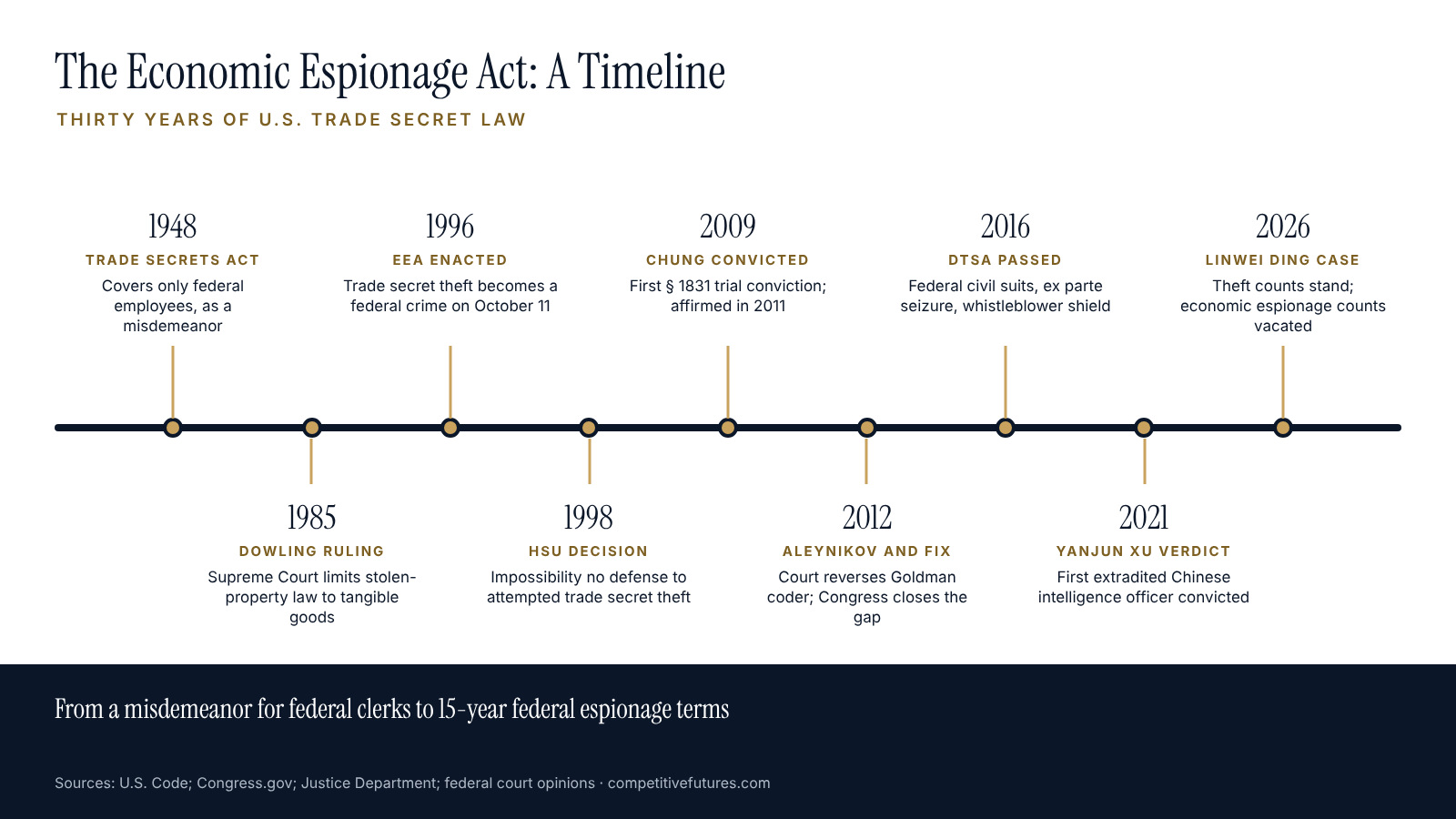
The Economic Espionage Act was a product of the end of the Cold War, when foreign intelligence services turned more of their attention to commercial and technological targets. The Senate Judiciary Committee’s report put it plainly: “Economic superiority is increasingly as important as military superiority” (S. Rep. No. 104-359).
At a February 28, 1996, hearing held jointly with the Senate Select Committee on Intelligence, FBI Director Louis Freeh testified that “foreign governments…actively target U.S. persons, firms, industries, and the U.S. Government itself,” that the FBI’s economic espionage caseload had doubled to 800, and that “twenty-three countries [were] involved in those cases” (S. Rep. No. 104-359).
This posed a problem: federal law had almost nothing to charge. The Trade Secrets Act of 1948 covered only disclosures by federal employees, as a misdemeanor (18 U.S.C. § 1905). The National Stolen Property Act covered stolen “goods, wares, merchandise,” and the courts resisted stretching it to information. In Dowling v. United States, 473 U.S. 207 (1985), a case which turned on bootlegged Elvis Presley records, “the Court suggested that the National Stolen Property Act only [applied] to tangible goods,” as the Senate report summarized. The Tenth Circuit then held in United States v. Brown, 925 F.2d 1301 (10th Cir. 1991), that copied source code was not stolen goods. The report concluded that the property statute “was drafted at a time when computers, biotechnology, and copy machines did not even exist.”
Senators Herb Kohl and Arlen Specter introduced the Senate bill, S. 1556, on February 1, 1996; the House Judiciary Committee reported its version in H.R. Rep. No. 104-788. The EEA, Public Law 104-294, then became law on October 11, 1996.
How the EEA has changed
- Theft of Trade Secrets Clarification Act of 2012 (Pub. L. 112-236, December 28, 2012). The original § 1832 covered only secrets related to a product “produced for or placed in” commerce, the clause the Second Circuit used in April 2012 to reverse Sergey Aleynikov’s conviction. Congress then rewrote it to cover any product or service “used in or intended for use in” interstate or foreign commerce (§ 1832 notes).
- Foreign and Economic Espionage Penalty Enhancement Act of 2012 (Pub. L. 112-269, signed January 14, 2013). This raised the § 1831 individual fine from $500,000 to $5 million and the organizational fine to the greater of $10 million or three times the secret’s value (§ 1831 notes).
- Defend Trade Secrets Act of 2016 (Pub. L. 114-153, May 11, 2016). This move created the civil cause of action, ex parte seizure, and whistleblower immunity, raised the § 1832 organizational fine, and changed the trade secret test from information not readily ascertainable by “the public” to information not readily ascertainable by “another person who can obtain economic value from the disclosure or use of the information” (§ 1839 notes). It also bars injunctions that “prevent a person from entering into an employment relationship” based merely on what the person knows.
Under the Justice Manual, no § 1831 charge may be brought “without the approval of the Assistant Attorney General for the National Security Division,” whose Counterintelligence and Export Control Section reviews requests. For § 1832, “Prosecutors are strongly urged to consult with the Computer Crime and Intellectual Property Section” (Justice Manual 9-59.000).
Controlling case law
The Supreme Court has never decided an Economic Espionage Act case. The law has been built in the courts of appeals.
United States v. Hsu, 155 F.3d 189 (3d Cir. 1998)
Kai-Lo Hsu and Chester Ho were caught in an FBI sting trying to obtain Bristol-Myers Squibb’s process for the cancer drug Taxol, and demanded the unredacted documents to prove they held no real trade secret. The Third Circuit refused: “we hold that legal impossibility is not a defense to a charge of attempted misappropriation of trade secrets,” and it reached the same result for conspiracy (opinion). Believing you are buying a secret is enough for the EEA to apply.
United States v. Martin, 228 F.3d 1 (1st Cir. 2000)
Stephen Martin received confidential IDEXX Laboratories information by email from an IDEXX employee. Affirming his conviction, the First Circuit held that “The relevant question to determine whether a conspiracy existed was whether Martin intended to violate the statute,” not whether each item was in fact a trade secret (opinion).
United States v. Yang, 281 F.3d 534 (6th Cir. 2002)
Pin Yen Yang, his daughter Hwei Chen Yang, and their Taiwanese company Four Pillars paid an Avery Dennison scientist for confidential adhesive research for years; he eventually cooperated with the FBI. The Sixth Circuit affirmed their convictions, adopting Hsu (“In sum, we adopt the reasoning employed by the Third Circuit”), but vacated the sentences because a 14-level downward departure was an abuse of discretion (opinion). Yang is the template case for the paid insider.
United States v. Lange, 312 F.3d 263 (7th Cir. 2002)
Matthew Lange, a former employee of an aircraft parts maker, stole engineering data and offered it for sale; the buyer alerted the company. Judge Frank Easterbrook’s opinion affirmed the conviction, found that locked design rooms, confidentiality notices, and splitting work among subcontractors were reasonable measures, and rejected the general public as the test for “readily ascertainable,” because many things unknown to the public are well known to engineers, which “makes the general public a poor benchmark” (opinion). Congress adopted that view in 2016.
United States v. Chung, 659 F.3d 815 (9th Cir. 2011)
Dongfan “Greg” Chung, a former Boeing engineer, kept Boeing space shuttle and Delta IV documents at home. His 2009 bench-trial conviction on six economic espionage counts and related charges was, the FBI said, “the first conviction by trial under the Economic Espionage Act of 1996” (Justice Department). More precisely, it was the first trial conviction under the economic espionage section, § 1831; earlier trials, including Yang’s, had produced convictions for trade secret theft under § 1832. The Ninth Circuit affirmed and upheld a 188-month sentence, holding that the economic espionage counts required intent to benefit China but not proof of Chinese direction, and that plant security, confidentiality agreements, training, and proprietary markings were reasonable measures even without locks (opinion).
United States v. Aleynikov, 676 F.3d 71 (2d Cir. 2012)
Sergey Aleynikov uploaded Goldman Sachs trading-system source code before leaving for a startup. The Second Circuit reversed both convictions: “the theft and subsequent interstate transmission of purely intangible property is beyond the scope of the NSPA,” and “Goldman’s HFT system was neither ‘produced for’ nor ‘placed in’ interstate or foreign commerce.” The Court also noted that the definitions of §1831 and §1832 differed enough that it rendered those counts legally insufficient given the evidence adduced at trial. Judge Guido Calabresi, concurring, urged Congress to revisit the statute (opinion). It did, eight months later.
United States v. Hanjuan Jin, 733 F.3d 718 (7th Cir. 2013)
Hanjuan Jin, a Motorola engineer, was stopped at the airport in 2007 with a cache of Motorola documents as she left for China. The trial judge acquitted her of economic espionage and convicted her of trade secret theft. Judge Richard Posner’s opinion affirmed the conviction and a 48-month sentence: “The government doesn’t have to prove that the owner of the secret actually lost money as a result of the theft” (opinion).
United States v. Liew, 856 F.3d 585 (9th Cir. 2017)
Walter Liew obtained DuPont’s titanium dioxide technology, largely through former DuPont engineers, and sold it to companies in China’s Pangang Group. His 2014 conviction on all 20 counts was “the first federal jury conviction on charges brought under the Economic Espionage Act of 1996,” and he was sentenced to 15 years (Justice Department). The Ninth Circuit affirmed the conspiracy, attempt, and trade secret convictions, reversed two obstruction counts, and vacated the sentence. Following United States v. Nosal, 844 F.3d 1024 (9th Cir. 2016), it held that conspiracy and attempt require only a firm belief that the information was a trade secret, and quoted Hsu: § 1831 “is designed to apply only when there is evidence of foreign government sponsored or coordinated intelligence activity” (opinion).
Cases that made headlines
Yanjun Xu and GE Aviation (2018–2022)
Yanjun Xu, a deputy division director in China’s Ministry of State Security, sought GE Aviation’s composite engine fan technology through a GE employee who was cooperating with the FBI. Arrested in Belgium in April 2018, he became “The first Chinese government intelligence officer ever to be extradited to the United States to stand trial.” A jury convicted him in November 2021 of conspiracy and attempt to commit economic espionage and trade secret theft; he was sentenced to 20 years in November 2022 (Justice Department). Xu contested the charges at trial.
Xiaoqing Zheng and GE Power (2022–2023)
Xiaoqing Zheng, a GE Power turbine-sealing engineer, was convicted by a jury in March 2022 of conspiracy to commit economic espionage over GE turbine trade secrets that prosecutors said were meant to benefit China. He contested the charges at trial and was sentenced in January 2023 to 24 months and a $7,500 fine (Justice Department).
Anthony Levandowski and Google (2019–2021)
Anthony Levandowski, an engineer who helped lead Google’s self-driving car project and later joined Uber, was indicted on 33 counts and pleaded guilty in March 2020 to one, admitting that a Google tracking document he downloaded was a trade secret. He was sentenced in August 2020 to 18 months, a $95,000 fine, and $756,499.22 in restitution; the judge called it “the biggest trade secret crime I have ever seen” (Justice Department). In January 2021, he received a presidential pardon (Fortune).
Kolon Industries and DuPont Kevlar (2015)
Prosecutors said the South Korean company Kolon Industries obtained DuPont’s Kevlar manufacturing and business information, with help from former DuPont employees, for its competing fiber. In April 2015 Kolon pleaded guilty to conspiracy to convert trade secrets and agreed to pay $85 million in fines and $275 million in restitution. Five Kolon executives and employees indicted in 2012 had not appeared in the United States to face the charges (Justice Department).
Sinovel and AMSC (2018)
Chinese turbine maker Sinovel Wind Group was convicted by a Wisconsin jury in January 2018 of conspiracy, trade secret theft, and wire fraud for obtaining American Superconductor’s wind turbine control software with help from a former employee of an AMSC subsidiary. Sinovel contested the charges at trial. In July 2018 the court imposed the maximum $1.5 million fine, and Sinovel agreed to pay AMSC $57.5 million (Justice Department).
Huawei and T-Mobile’s “Tappy” (2019–present)
Prosecutors first charged Huawei in 2019 over technology from T-Mobile’s phone-testing robot, “Tappy,” and later brought a racketeering indictment in Brooklyn alleging trade secret theft from five U.S. companies, including Cisco and T-Mobile, along with bank fraud and sanctions violations. Huawei denies the charges; when the trial opened in September 2026, its lawyer told jurors the case is “about competition, not conspiracy. Innovation, not theft” (The Next Web). The trial was expected to run about three months, and no verdict had been reported as of this writing.
Linwei Ding and Google’s AI infrastructure (2024–2026)
Former Google engineer Linwei Ding was convicted in January 2026 on seven counts of economic espionage and seven of trade secret theft for taking more than 2,000 pages of confidential AI infrastructure material while secretly affiliated with two China-based companies (CBS News). In August 2026 the judge vacated the economic espionage counts, finding insufficient evidence that Ding knew or intended his conduct would benefit the Chinese government; the theft convictions stood (The Next Web). On September 1, 2026, he was sentenced to just under a year in prison; his lawyers had sought home confinement (KQED). Benefit to a foreign company is a § 1832 problem; § 1831 requires proof aimed at a foreign government or its instrumentality.
Cui Bono? Which countries benefit from economic espionage?
How much trade secret theft involves China? The two best-known sets of figures come from different sources and measure different things. In 2021, the Justice Department said that “about 80 percent of all economic espionage prosecutions” brought by the department alleged conduct that would benefit the Chinese state, and that “there is at least some nexus to China in around 60 percent of all trade secret theft cases” (Justice Department). Andrew Kim’s 2017 study of a random sample of 136 cases, with 187 individual defendants, brought under the Act between 1997 and 2015 found that 48 percent involved theft meant to benefit an American company or person and 34 percent a Chinese entity. None were alleged to benefit Russia. (Cardozo Law Review).
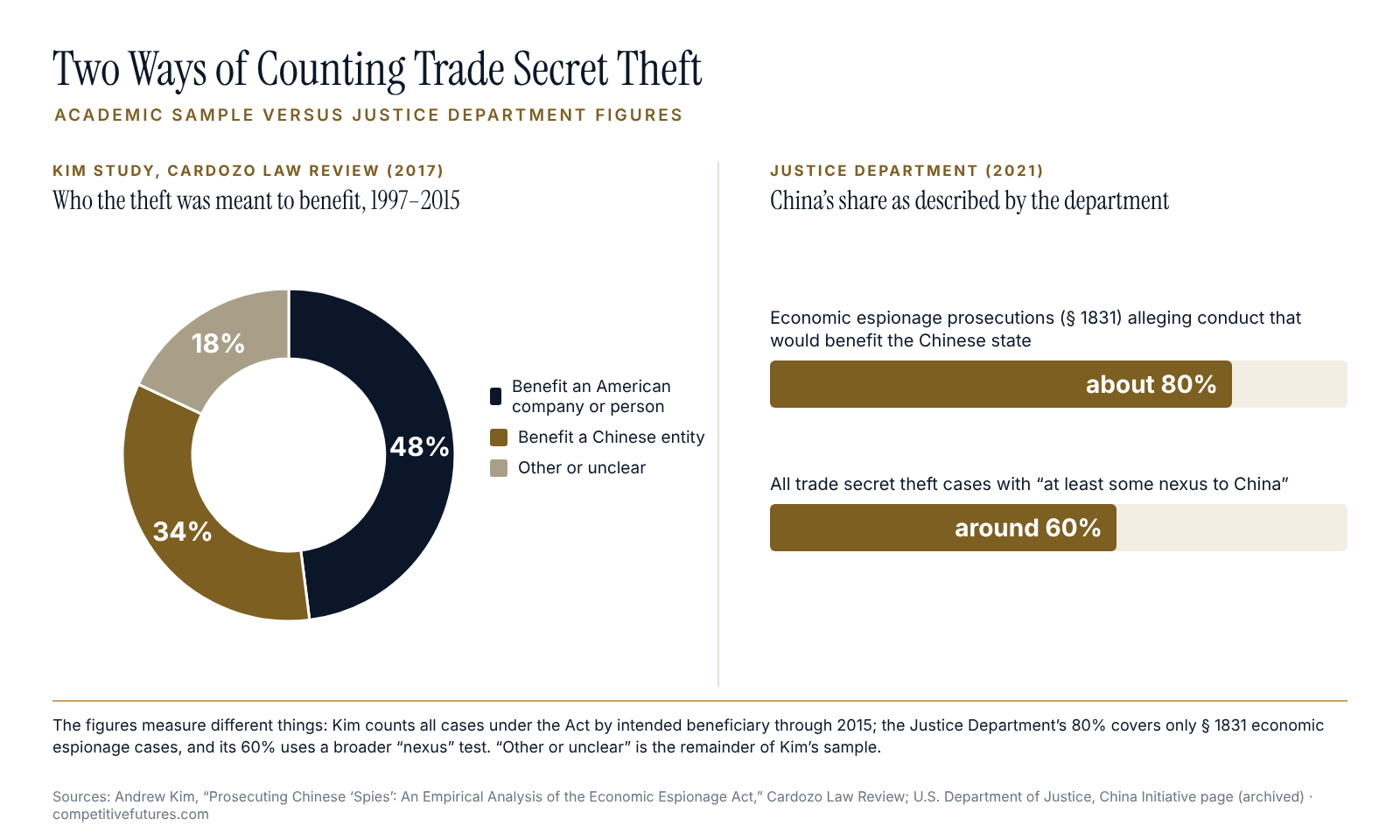
The figures are less contradictory than they look. The department’s 80 percent describes § 1831 economic espionage cases, which require an intended foreign beneficiary and are a narrower category than trade secret theft under § 1832. Its 60 percent figure counts any “nexus” to China, a broader test than “intended beneficiary.” Kim’s sample covers every kind of case under the Act and ends in 2015, before the department’s China Initiative began in 2018.
Read together, they say two things at once: state-directed economic espionage prosecuted in the United States is concentrated on one country, and nearly half of the trade secret theft that reaches federal court is ordinary commercial misconduct meant to benefit American competitors.
Kim’s study also reported that defendants with Chinese surnames received longer average sentences than defendants with Western surnames, and that a larger share of them were never proven guilty of espionage or another serious crime; he noted that this does not prove their innocence (Cardozo Law Review). Court records in his sample did not reliably record citizenship, which is why neither source can say how many defendants were foreign nationals.
For competitive intelligence programs, the second half of that finding matters most. The Act is not only a counterintelligence statute aimed at foreign services; it is the law most likely to be applied to a company’s own employees, contractors, and competitors.
What the Act means for competitive intelligence
None of the prosecutions above involved a professional competitive intelligence function. The statute still sets the boundary every CI program works within. Its definition of “improper means” includes “theft, bribery, misrepresentation, breach or inducement of a breach of a duty to maintain secrecy, or espionage through electronic or other means,” and expressly excludes “reverse engineering, independent derivation, or any other lawful means of acquisition” (18 U.S.C. § 1839). Public filings, patents, published research, trade show conversations under one’s real name, and products bought and taken apart all sit on the lawful side of that line.
To put it simply, if you aren’t committing felonies, you probably aren’t committing economic espionage.
The cautionary cases for the competitive intelligence field are mostly civil and state matters, from DuPont v. Christopher and its airplane over a plant under construction to Hewlett-Packard’s pretexting scandal and the Cardinals’ intrusion into the Astros’ scouting database. We collect them, with the SCIP Code of Ethics read against the law, in Competitive Intelligence in Court: Civil and Criminal Cases.
Frequently asked questions
Is competitive intelligence legal?
Yes. Gathering and analyzing public filings, patents, published research, trade show information, purchased products, and interviews conducted with honest identification is lawful, and the Economic Espionage Act expressly excludes reverse engineering and independent derivation from “improper means.” It becomes a crime when a trade secret is obtained through theft, bribery, misrepresentation, inducing a breach of confidentiality, or espionage, or when someone attempts or conspires to do so. For cases where collection crossed that line, see Competitive Intelligence in Court.
What is the difference between § 1831 and § 1832?
Section 1831 covers economic espionage meant to benefit a foreign government, foreign instrumentality, or foreign agent; it carries up to 15 years and a $5 million fine for individuals and requires National Security Division approval to charge. Section 1832 covers trade secret theft for anyone’s economic benefit and carries up to 10 years. In the 2026 Linwei Ding case, the judge set aside the § 1831 counts for lack of proof of intent to benefit the Chinese government, while the § 1832 convictions stood.
Does reverse engineering violate the Economic Espionage Act?
No, if the product was lawfully acquired. Section 1839(6) states that improper means “does not include reverse engineering, independent derivation, or any other lawful means of acquisition.” License terms may still restrict what a buyer can do.
Related reading
- Competitive Intelligence in Court: Civil and Criminal Cases
- Intelligence Services Around the World: Structure, History, and the Headlines
- Chinese Intelligence: History, Structure, and the Headlines
- American Intelligence: History, Structure, and the Headlines
- Cognitive Bias: A Field Guide for Leaders
Competitive Futures builds competitive intelligence programs that are effective and lawful, and briefs executives and counsel on economic espionage risk; details are on the services page.