American Intelligence: History, Structure, and the Headlines
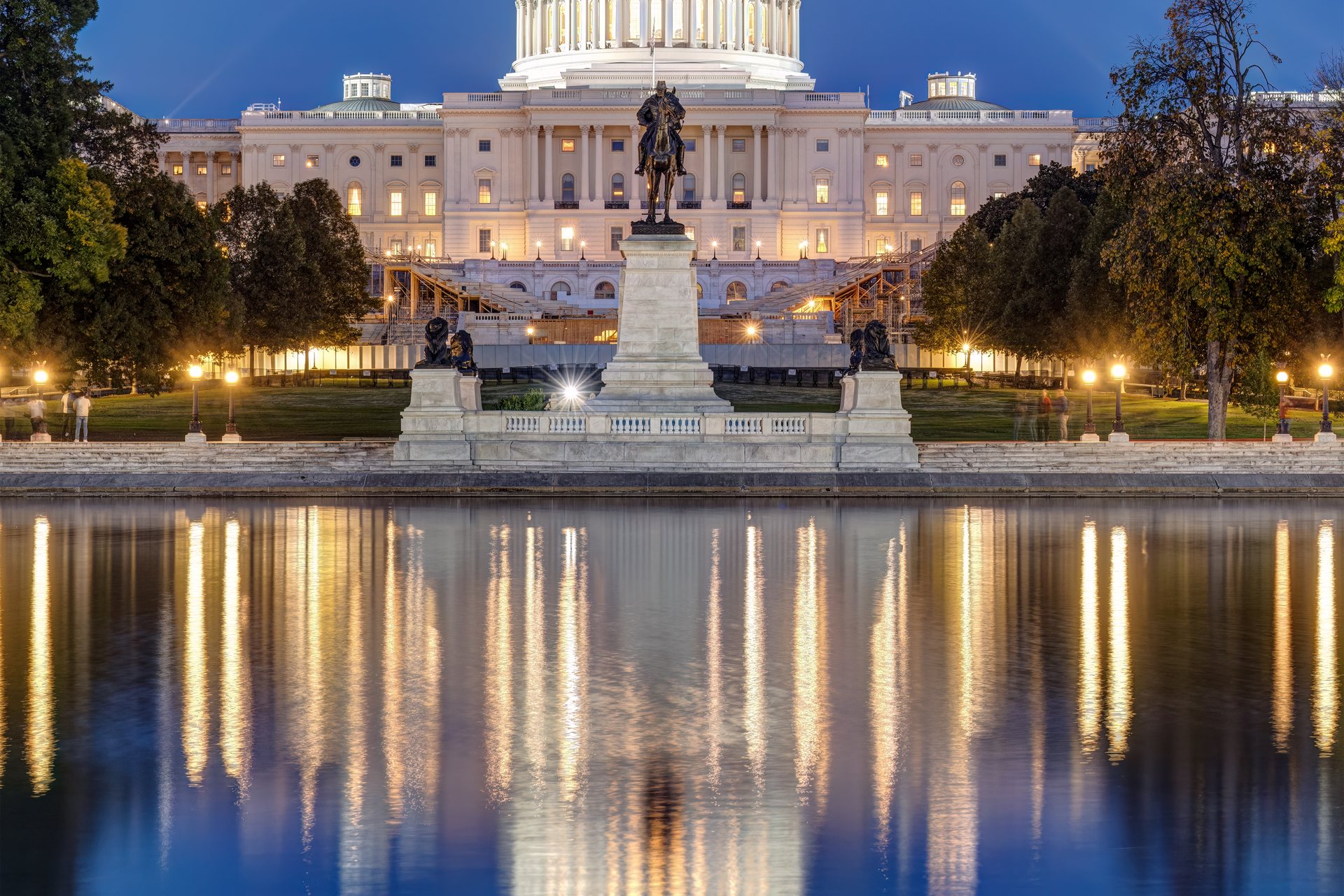
The United States runs the largest intelligence enterprise in the world: 18 organizations, a disclosed annual budget in the tens of billions of dollars, and liaison relationships with nearly every allied government. It is also the most publicly documented. Congress writes its statutes, courts rule on its surveillance powers, and decades of hearings, declassified reports, and criminal trials have put more of its history on the record than that of any other country’s services.
This page is a working overview of American intelligence: where it came from, how the U.S. Intelligence Community is organized and overseen today, and the cases that have put it in the news. It relies on statutes, executive orders, congressional and commission reports, court records, Justice Department releases, and official agency histories, and it notes where a claim comes from a party with an interest in the outcome.
American intelligence at a glance
- The Intelligence Community: 18 organizations headed by the Director of National Intelligence. They include the Office of the Director of National Intelligence (ODNI) itself, the Central Intelligence Agency (CIA), the National Security Agency (NSA), the Defense Intelligence Agency (DIA), the National Geospatial-Intelligence Agency (NGA), the National Reconnaissance Office (NRO), the intelligence elements of the Army, Navy, Marine Corps, Air Force, Space Force, and Coast Guard, and components of the Departments of Energy, Homeland Security, Justice (the FBI and the Drug Enforcement Administration), State, and the Treasury (ODNI).
- Director of National Intelligence: Jay Clayton, formerly U.S. Attorney for the Southern District of New York, confirmed by the Senate 51–47 in July 2026 and sworn in on August 3, 2026 (El Debate; GV Wire). His predecessor, Tulsi Gabbard, stepped down in June 2026.
- Central Intelligence Agency: Director John Ratcliffe, a former Director of National Intelligence, confirmed by the Senate 74–25 in January 2025 (SJV Sun).
- National Security Agency: General Joshua Rudd, who also commands U.S. Cyber Command, confirmed by the Senate 71–29 on March 10, 2026; he had been deputy commander of U.S. Indo-Pacific Command (Nextgov).
- Federal Bureau of Investigation: Director Kash Patel, who “became the ninth Director of the FBI on February 20, 2025” (Congress.gov), and who remained in the post in October 2026 (GV Wire).
- Budget: Congress appropriated $73.3 billion for the National Intelligence Program in fiscal year 2025, including supplemental funding, according to ODNI’s disclosure of October 31, 2025 (ODNI). Military intelligence programs are funded separately.
- Oversight: the Senate Select Committee on Intelligence (SSCI), the House Permanent Select Committee on Intelligence (HPSCI), the Foreign Intelligence Surveillance Court, inspectors general, and the Privacy and Civil Liberties Oversight Board.
- Alliances: the United States and Britain signed the signals intelligence agreement now known as UKUSA on March 5, 1946, the core of the Five Eyes partnership with Canada, Australia, and New Zealand (NSA).
History: from the Culper Ring to the Intelligence Community
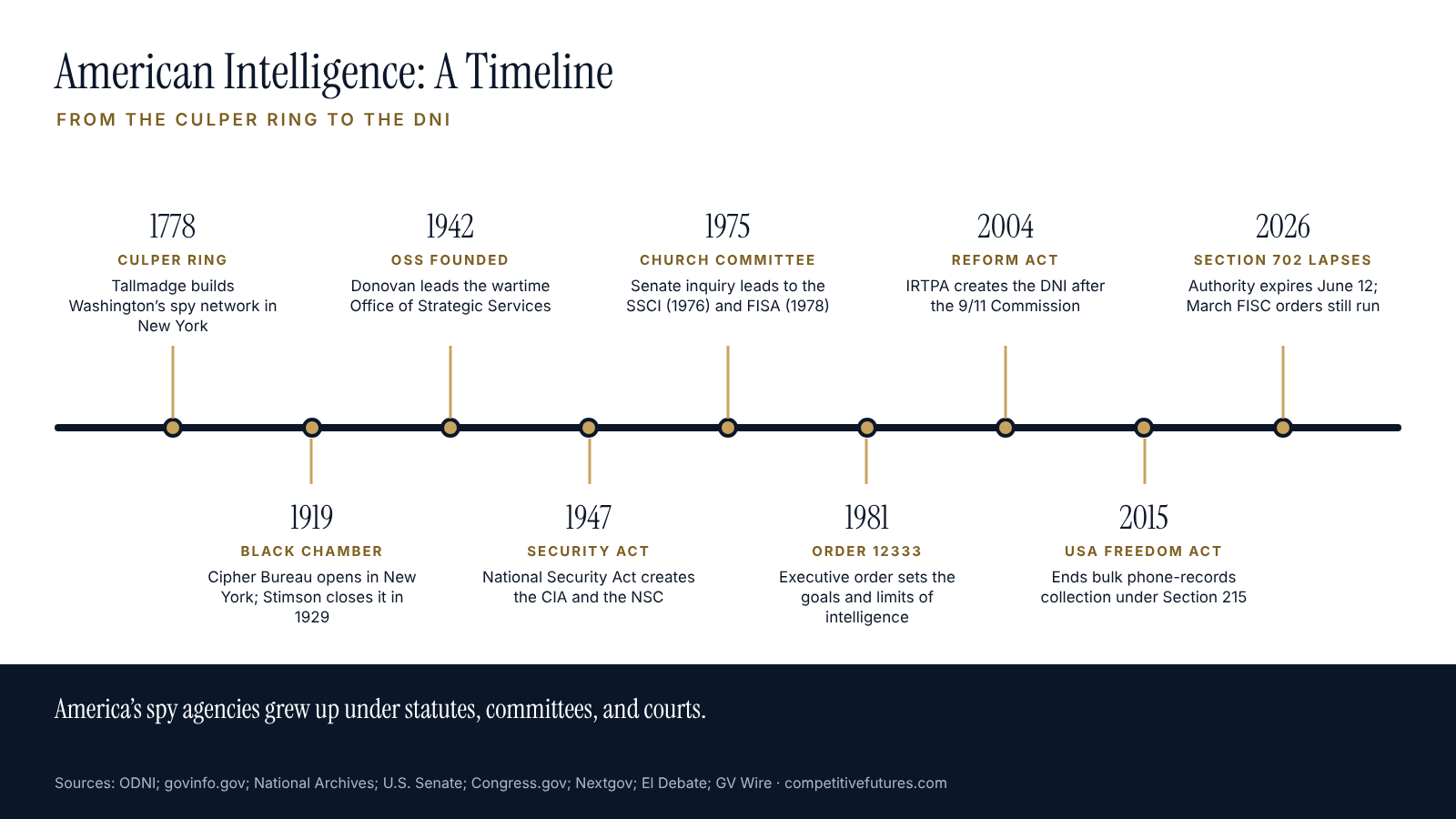
American intelligence is older than the Constitution. In November 1778, George Washington had Major Benjamin Tallmadge build a spy network in British-occupied New York. The Culper Ring, run through agents such as Abraham Woodhull and the merchant Robert Townsend, used pseudonyms, a numerical code, and invisible ink; according to Washington’s Mount Vernon, “no spy was ever unmasked” in its five years of operation. In 1780 it learned of a planned British expedition to Rhode Island; Washington moved his army into position, and the British commander, General Henry Clinton, called off the attack (Mount Vernon).
For most of the next century and a half, intelligence was improvised in wartime and disbanded in peace. The first standing codebreaking office, the Cipher Bureau known as the Black Chamber, was created in May 1919 under an agreement between the State and War Departments and worked in New York under cover as a commercial code company. Herbert Yardley’s staff broke the Japanese delegation’s cipher during the 1921–22 Washington Naval Conference, helping U.S. negotiators hold Japan to its minimum position. Secretary of State Henry Stimson closed the bureau in late 1929; in the NSA’s account, Stimson said, “Gentlemen do not read other gentlemen’s mail” (NSA).
The Second World War changed that permanently. President Franklin Roosevelt appointed William J. Donovan as Coordinator of Information in July 1941, and on June 13, 1942, the office became the Office of Strategic Services (OSS), the country’s first central intelligence and special operations agency. It was terminated by executive order on September 20, 1945 (National Archives). Two years later, the National Security Act of 1947 created the National Security Council, the Central Intelligence Agency, which grew out of the OSS, a unified military establishment under a Secretary of Defense, and the Department of the Air Force (Office of the Historian).
The modern rules date from the 1970s. On January 27, 1975, the Senate voted 82–4 to create a select committee, chaired by Senator Frank Church of Idaho, with Senator John Tower of Texas as vice chairman, to investigate the CIA, FBI, NSA, and other agencies. It documented NSA’s Projects SHAMROCK and MINARET and the FBI’s COINTELPRO, found that abuses had occurred under administrations of both parties since Franklin Roosevelt, and issued its final report on April 29, 1976, with 96 recommendations (U.S. Senate). The Senate created its permanent intelligence committee in 1976, and in 1978 Congress passed the Foreign Intelligence Surveillance Act, which required court orders from a new FISA Court for national security wiretaps. In December 1981, Executive Order 12333 set out the goals, duties, and limits of U.S. intelligence activities, including the rule that no one acting for the U.S. government “shall engage in, or conspire to engage in, assassination” (National Archives).
The next rebuild followed the September 11 attacks. The 9/11 Commission, chaired by Thomas Kean with Lee Hamilton as vice chair, reported in 2004 (9/11 Commission), and on December 17, 2004, the Intelligence Reform and Terrorism Prevention Act provided that “There is a Director of National Intelligence who shall be appointed by the President,” with the advice and consent of the Senate. The same law gave the DNI oversight of the National Counterterrorism Center and created the Privacy and Civil Liberties Oversight Board (govinfo.gov). Before the Act, the Director of Central Intelligence had headed both the CIA and the wider community; the Act separated the two jobs.
How American intelligence is organized today
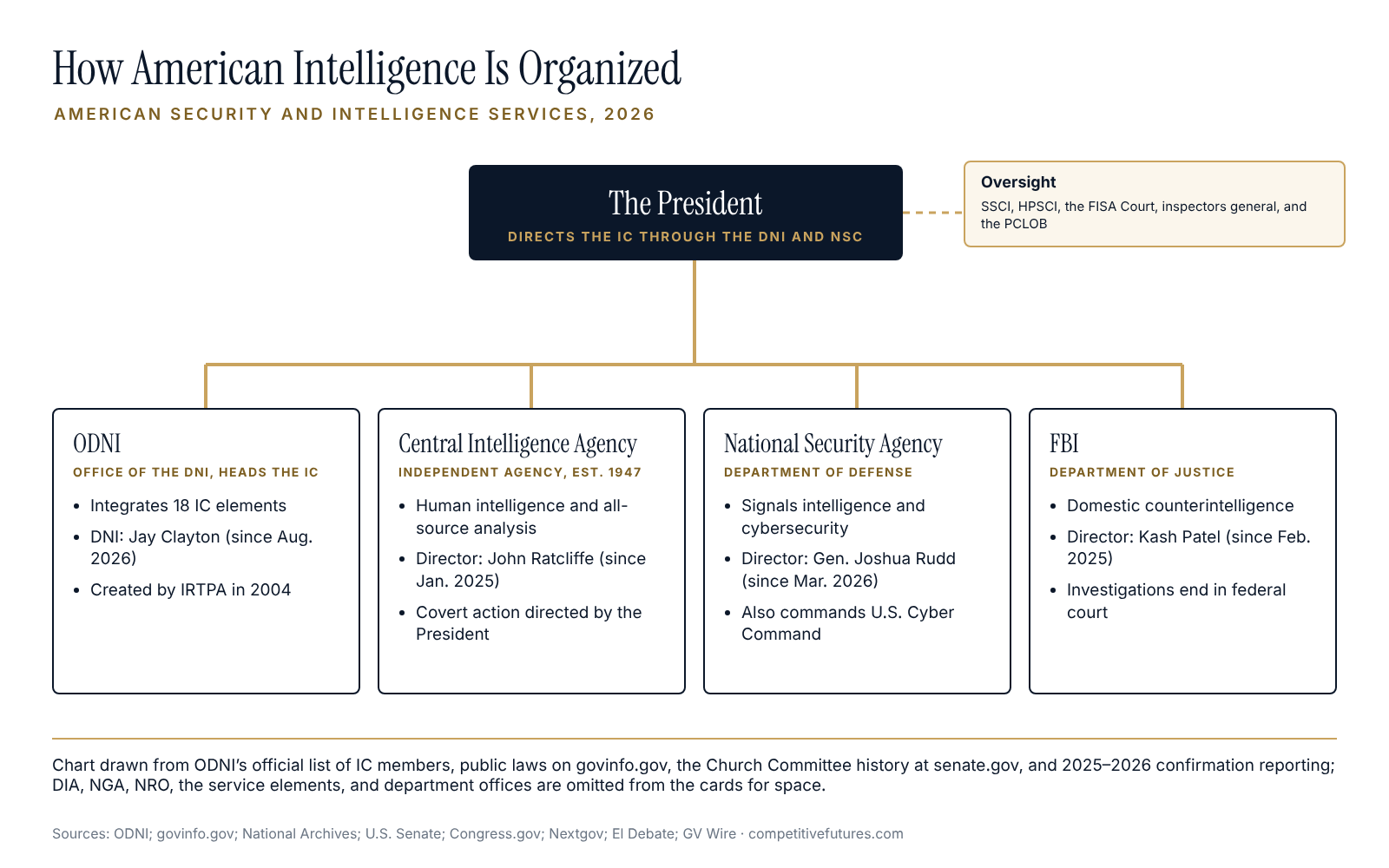
The Intelligence Community is a federation, not a single agency. Most of its 18 members sit inside cabinet departments and answer to a cabinet secretary as well as to the DNI.
- The Office of the Director of National Intelligence leads and integrates the community, presents the President’s Daily Brief, manages the National Intelligence Program budget, and runs national centers including the National Counterterrorism Center and the National Counterintelligence and Security Center.
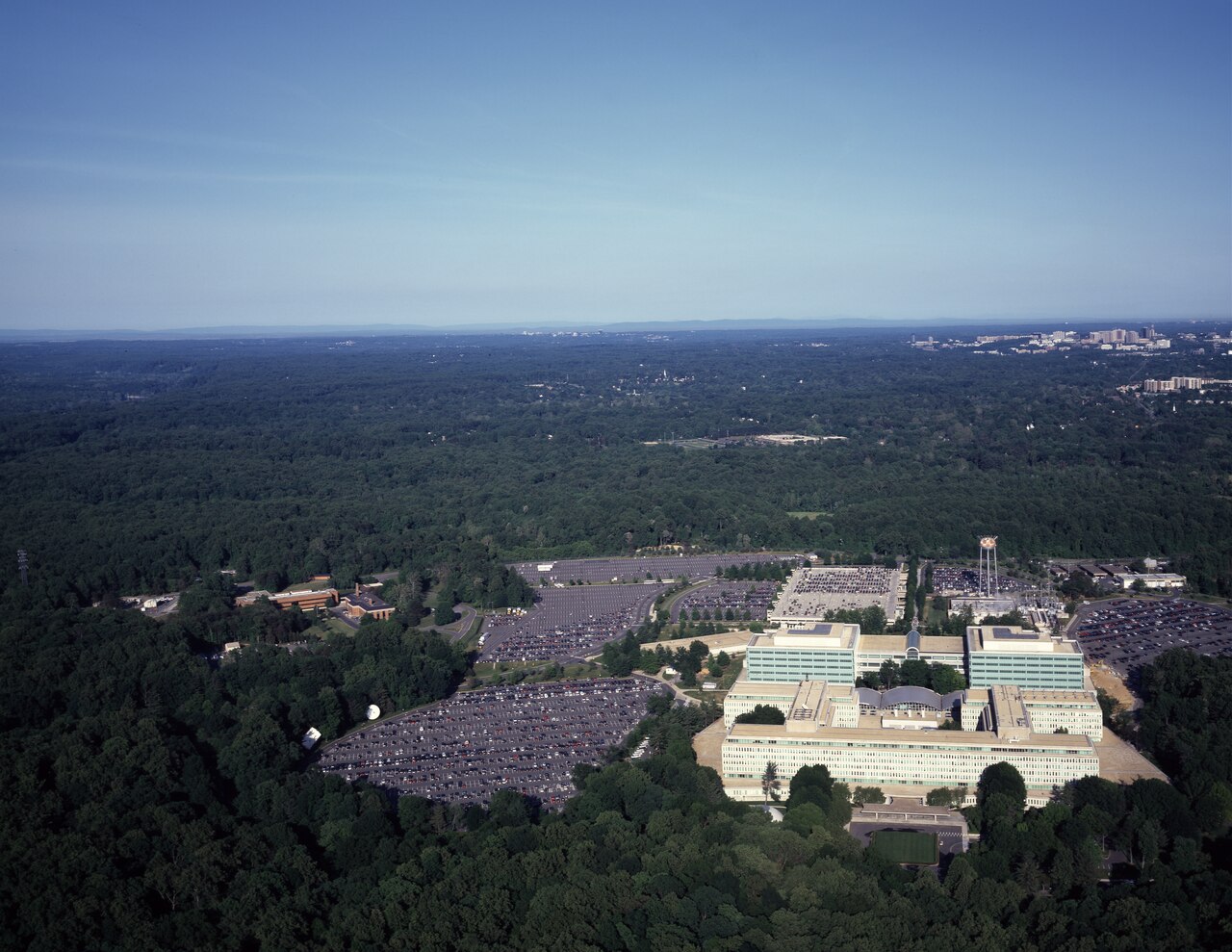
- The Central Intelligence Agency is the independent agency for human intelligence collection abroad, all-source analysis, and covert action directed by the President.
- The Defense Department’s national agencies handle technical collection: the NSA for signals intelligence and cybersecurity, the NGA for imagery and geospatial intelligence, the NRO for building and operating reconnaissance satellites, and the DIA for military intelligence and defense attachés.
- Service intelligence elements of the Army, Navy, Marine Corps, Air Force, and Space Force support their forces; the Coast Guard’s intelligence element sits in the Department of Homeland Security. Space Force is the newest service on ODNI’s list of members.
- The FBI is both the country’s lead domestic counterintelligence and counterterrorism agency and a law enforcement agency, so its intelligence work can end in a courtroom. The Drug Enforcement Administration’s Office of National Security Intelligence is also an IC element.
- Department intelligence offices serve policymakers directly: the State Department’s Bureau of Intelligence and Research (INR), the Department of Homeland Security’s Office of Intelligence and Analysis, the Treasury’s Office of Intelligence and Analysis, which supports sanctions and financial measures, and the Department of Energy’s Office of Intelligence and Counterintelligence, which covers nuclear and energy issues.
Two features set this system apart. Foreign collection is separated from domestic law enforcement: the CIA has no police powers at home, while the FBI investigates inside the United States under Justice Department rules. And the community’s legal authorities are public: the 1947 Act, Executive Order 12333, FISA, and the 2004 reform law define what each agency may do, and the debates over renewing them take place in Congress.
Oversight by design
The oversight system that governs American intelligence today was built on purpose, mostly in the decade after the Church Committee, and it runs through all three branches of government.
In Congress, the Senate Select Committee on Intelligence and the House Permanent Select Committee on Intelligence authorize intelligence spending, receive notifications of covert actions, and conduct inquiries, including the bipartisan Senate reviews of prewar Iraq intelligence and of the 2017 Russia assessment described below.
In the courts, the Foreign Intelligence Surveillance Court reviews applications for electronic surveillance inside the United States for foreign intelligence purposes, and since 2008 it has approved the annual certifications under Section 702, which allows the targeting of non-U.S. persons reasonably believed to be abroad. Congress reauthorized Section 702 in April 2024 through the Reforming Intelligence and Securing America Act (ExecutiveGov). As that authority approached its expiration in 2026, Congress passed a 10-day extension to April 30 (CBS News) and then a further short extension, but did not agree on a longer renewal. According to the Congressional Research Service, Section 702 and the rest of FISA Title VII were “automatically repealed on June 12, 2026” (Congressional Research Service). The law’s transition clause keeps existing orders in effect until they expire; the FISA Court had recertified the program in March 2026, which former officials told the New York Times would let NSA operations continue into March 2027, though some cooperating companies were reported to be weighing whether to keep complying (New York Times via GV Wire). At the end of July 2026 the authority had still not been reauthorized (El Debate).
Inside the executive branch, the Inspector General of the Intelligence Community and agency inspectors general audit programs and investigate misconduct, and the Privacy and Civil Liberties Oversight Board reviews counterterrorism programs for their effect on privacy and civil liberties.
American intelligence in the news
The cases below are drawn from a long record and told from court records, official reports, and Justice Department statements. Each notes its current legal or official status.
Aldrich Ames (1985–1994)
Aldrich Ames, a CIA counterintelligence officer, volunteered to KGB officers at the Soviet Embassy in Washington in 1985. The FBI arrested him in Arlington, Virginia, on February 21, 1994. By the end of 1989, according to the FBI, the KGB had paid him $1.88 million; he compromised more than 100 U.S. intelligence operations and contributed to the deaths of 10 American assets. Ames and his wife, Rosario, pleaded guilty on April 28, 1994. He was sentenced to life without parole, and she received 63 months (FBI). Ames died in federal prison in Maryland in January 2026, at 84 (AP via ABC7).
Robert Hanssen (1985–2001)
Robert Hanssen, an FBI agent, began spying for Moscow in 1985 and continued, with a possible pause in the 1990s, until he was arrested at a dead drop near Vienna, Virginia, on February 18, 2001. He pleaded guilty to 15 counts of espionage on July 6, 2001, and on May 10, 2002, was sentenced to life without the possibility of parole. “Hanssen died on June 5, 2023, at the age of 79,” the FBI records (FBI).
The Iraq WMD estimate (2002–2005)
The October 2002 National Intelligence Estimate on Iraq judged that Baghdad had chemical and biological weapons and was reconstituting its nuclear program. On July 9, 2004, the Senate Intelligence Committee, chaired by Senator Pat Roberts with Senator John D. Rockefeller IV as vice chairman, concluded that most of the estimate’s key judgments were either overstated or not supported by the underlying intelligence. The committee found no evidence that the errors resulted from political pressure on analysts; Rockefeller said the question of how the intelligence was used would be addressed in a second phase of the inquiry (Acronym Institute). On March 31, 2005, the presidential commission co-chaired by Judge Laurence Silberman and former Senator Charles Robb reported that the Intelligence Community had been “dead wrong in almost all of its pre-war judgments” about Iraq’s weapons, and observed of the prewar claims: “And not one bit of it could be confirmed when the war was over” (WMD Commission).
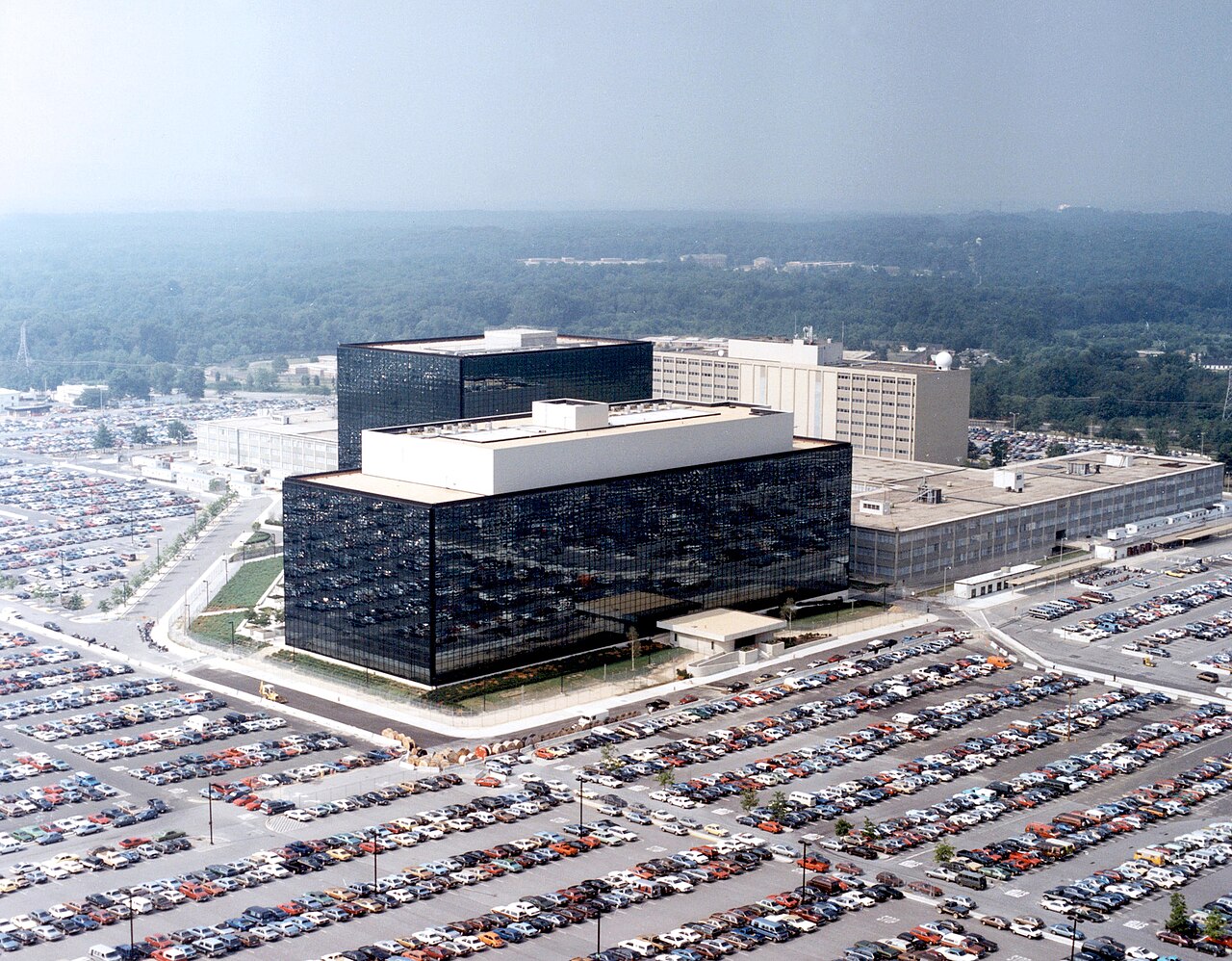
Edward Snowden and the USA FREEDOM Act (2013–2015)
In June 2013, Edward Snowden, an NSA contractor, gave journalists large numbers of documents on NSA surveillance programs, including the bulk collection of Americans’ telephone records under Section 215 of the USA PATRIOT Act. Federal prosecutors in the Eastern District of Virginia charged him in a sealed criminal complaint with theft of government property, unauthorized communication of national defense information, and willful communication of classified intelligence information (JURIST). He received asylum in Russia, and on September 26, 2022, a decree by President Vladimir Putin granted him Russian citizenship; the charges remain pending and he has not stood trial (NPR via Maine Public). Congress responded with the USA FREEDOM Act, enacted on June 2, 2015, which barred orders for business records “without the use of a specific selection term,” ended the bulk telephone-records program, and created a narrower process for obtaining call detail records from providers (govinfo.gov).
The 2017 assessment on Russian election interference (2017–2020)
On January 6, 2017, the CIA, FBI, and NSA released a declassified Intelligence Community Assessment, coordinated by ODNI, on Russian activities aimed at the 2016 U.S. election; a classified version had been delivered the day before. It assessed that President Vladimir Putin approved and directed an influence campaign aimed at undermining public faith in the U.S. democratic process and influencing the presidential election. The Kremlin’s spokesman, Dmitry Peskov, called the accusations “absolutely unfounded” (UPI). In 2020, after a bipartisan inquiry led by Chairman Richard Burr and Vice Chairman Mark Warner, the Senate Intelligence Committee found that the assessment “presents a coherent and well-constructed intelligence basis for the case of unprecedented Russian interference,” that “all analytic lines are supported with all-source intelligence,” and that analysts were under no politically motivated pressure to reach specific conclusions. It called the confidence-level difference “reasonable, transparent, and openly debated” (Senate Select Committee on Intelligence).
The Discord leaks (2023–2024)
Jack Teixeira, a cyber defense operations journeyman with the Air National Guard’s 102nd Intelligence Wing in Massachusetts, began around January 2022 to post highly classified national defense information, including images of hundreds of documents, on the Discord platform. He was arrested in April 2023 after destroying his electronic devices. He pleaded guilty in March 2024 to six counts of willful retention and transmission of national defense information, and on November 12, 2024, U.S. District Judge Indira Talwani sentenced him in Boston to 15 years in prison and three years of supervised release (U.S. Attorney’s Office, District of Massachusetts).
The USS Essex espionage case (2023–2026)
Jinchao Wei, a U.S. Navy sailor based in California, was charged on August 3, 2023 (Military Times). According to the Justice Department, he sold a Chinese intelligence officer thousands of pages of technical and operational information on U.S. Navy surface warfare ships, including about 60 technical and operating manuals, photographs and videos of the amphibious assault ship USS Essex, and details of its defensive weapons, for more than $12,000 over 18 months. A federal jury in August 2025 convicted him of six counts, including conspiracy to commit espionage, espionage, and unlawful export of defense technical data; he was acquitted of one count of naturalization fraud. The department said he had admitted in a post-arrest interview that he gave the materials to the officer. On January 12, 2026, he was sentenced to 200 months in prison (U.S. Department of Justice). In a letter to the judge, Wei blamed “introversion and loneliness” for clouding his judgment (Military Times). Neither the Justice Department release nor the Military Times report included a response from the Chinese government.
How to read coverage of American intelligence
American intelligence produces more primary records than any other service, and more commentary that does not cite them. Much reporting rests on anonymous officials, and leaks often arrive in the middle of policy or budget fights, when the people sharing them have a stake in the outcome. Coverage of surveillance law tends to present either the privacy advocates’ or the agencies’ strongest case. Foreign state media, including outlets funded by the Russian and Chinese governments, regularly present U.S. intelligence cases as fabrications, and their coverage should be read as the position of a party to the dispute.
The discipline is the same one taught in our guides to trend analysis and evaluating forecasts: climb toward primary records. For the United States, that means statutes and public laws on govinfo.gov, ODNI’s annual threat assessments and budget disclosures, the reports of the Senate and House intelligence committees, declassified opinions published by the Foreign Intelligence Surveillance Court, inspector general reports collected at Oversight.gov, Congressional Research Service analyses, indictments, plea agreements, and sentencing records in federal court, and the Justice Department’s public database of registered foreign agents under the Foreign Agents Registration Act (FARA eFile), which shows who lobbies Washington on behalf of foreign governments. When a story rests on a single anonymous official, treat it as a lead, not a finding.
Frequently asked questions
What is the United States’ intelligence agency called?
The United States has no single intelligence agency. It has an Intelligence Community of 18 organizations led by the Director of National Intelligence. The best known are the Central Intelligence Agency (CIA), which collects human intelligence abroad; the National Security Agency (NSA), which collects signals intelligence; and the FBI, which leads domestic counterintelligence.
Who heads American intelligence?
The Director of National Intelligence, Jay Clayton, has headed the Intelligence Community since August 2026. John Ratcliffe has been Director of the CIA since January 2025, General Joshua Rudd has led the NSA and U.S. Cyber Command since March 2026, and Kash Patel has been Director of the FBI since February 2025.
Who oversees American intelligence?
The President directs the Intelligence Community through the DNI and the National Security Council. The Senate and House intelligence committees authorize its budget and conduct oversight, the Foreign Intelligence Surveillance Court approves surveillance under FISA, inspectors general audit and investigate the agencies, and the Privacy and Civil Liberties Oversight Board reviews counterterrorism programs for their effect on privacy and civil liberties.
Related reading
- Intelligence Services Around the World: Structure, History, and the Headlines
- Qatari Intelligence: History, Structure, and the Headlines
- British Intelligence: History, Structure, and the Headlines
- How to Evaluate a Forecast
Competitive Futures briefs companies and governments on intelligence services, foreign influence, and the United States and its alliances; details are on the services page.