Ecuadorian Intelligence: History, Structure, and the Headlines

Ecuador sits between Colombia and Peru, the world’s two largest cocaine producers, and its Pacific ports have become a main exit route for the drug trade. In less than two decades the country has gone from a Colombian air strike on its soil that its president blamed on a compromised intelligence service, to a domestic spy agency accused of watching opponents, to a government that in January 2024 declared an “internal armed conflict” against criminal gangs. Through every turn, the question of who controls Ecuadorian intelligence, and against whom it is pointed, has been at the center of national politics.
This page is a working overview of Ecuador’s intelligence services: where they came from, how they are organized today, and the cases that have put them in the news. It relies on Ecuadorian laws and decrees, court records, U.S. government releases, International Court of Justice filings, and named reporting, and it notes where a claim comes from a party with an interest in the outcome. Ecuadorian politics is sharply divided between supporters of former president Rafael Correa and their opponents, so claims from either camp are attributed.
Ecuadorian intelligence at a glance
- Main intelligence service: the National Intelligence Center (Centro Nacional de Inteligencia, CNI). It was created as the Strategic Intelligence Center (Centro de Inteligencia Estratégica, CIES) by Executive Decree 526 of September 21, 2018, and renamed the CNI by Executive Decree 52 of July 14, 2025, which gave it ministry rank and made it the governing body of the National Intelligence System (El Universo).
- Head: Daniel Correia Peñaherrera, appointed director by Executive Decree 491, published September 3, 2026, after President Daniel Noboa announced the choice on August 28. El Comercio describes a private-sector background in shipping and logistics and a long professional relationship with Noboa within Corporación Noboa (El Comercio).
- Previous head: Michele Sensi-Contugi, who took over the CIES in January 2024 and was reported killed in a helicopter crash in Kenya on August 19, 2026; Luis Carlos Ávila Chábez served as acting director in between (Primicias).
- Reporting line: the CNI’s director is appointed by, and answers to, the president. Daniel Noboa began his current term on May 24, 2025, for the 2025–2029 period, after defeating Luisa González in an April 13, 2025, runoff (Primicias).
- Legal framework: the Organic Intelligence Law, published in the Registro Oficial on June 11, 2025 (Primicias), 12 of whose articles the Constitutional Court suspended in August 2025 while it reviews challenges (Expreso), plus the 2009 Public and State Security Law.
- Relationship with the United States: close on counternarcotics and organized crime. The two governments signed a status of forces agreement in 2023, Ecuador extradited the leader of Los Choneros to New York in 2025, and the U.S. State Department designated two Ecuadorian gangs as terrorist organizations that September. Ecuadorian voters, however, rejected a proposal to allow foreign military bases in November 2025.
History: from Angostura to the CNI
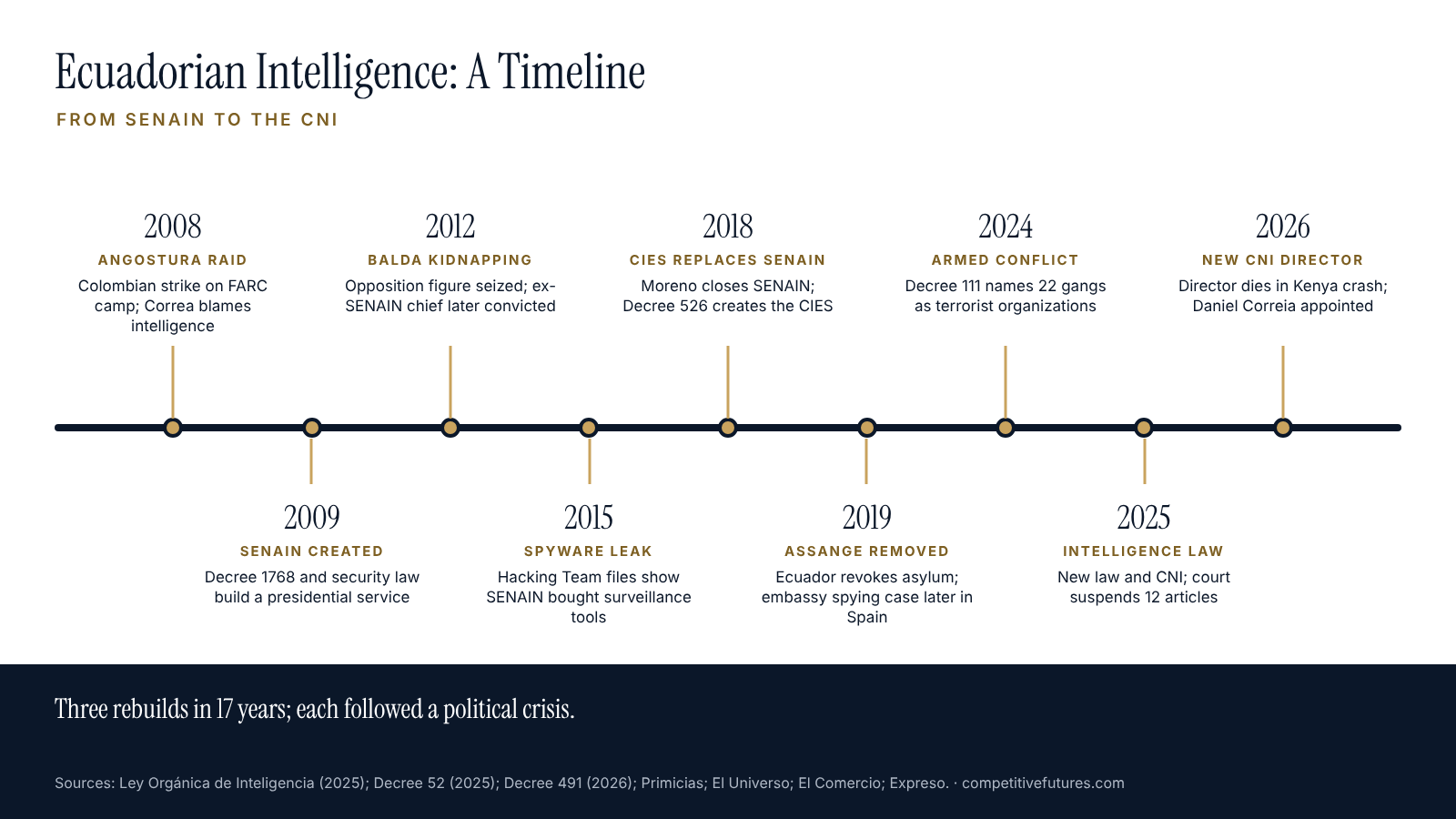
The modern story begins on March 1, 2008, when Colombian forces raided a camp of the Revolutionary Armed Forces of Colombia (FARC) inside Ecuador, killing the senior FARC leader Raúl Reyes and others. President Rafael Correa alleged that Ecuador’s intelligence services had been infiltrated and controlled by the CIA and said they should be investigated for disloyalty. “We are putting a stop to that and will make sure Ecuadorean intelligence services … don’t work for foreign powers,” he said, as senior defense officials left their posts (Al Jazeera). The raid, at Angostura in Sucumbíos province, caused a political crisis at home and a rupture with Colombia (Primicias).
Correa’s answer was to rebuild intelligence under the presidency. On June 8, 2009, he signed Executive Decree 1768 creating the National Intelligence Secretariat (Secretaría Nacional de Inteligencia, SENAIN), with administrative and financial autonomy and a head appointed directly by the president, replacing the old National Intelligence Directorate (Primicias). The Public and State Security Law, published on September 28, 2009, put SENAIN on a statutory footing. It gave the secretariat a permanent fund of “gastos especiales,” special expenses exempt from public procurement rules and accounted for only before the comptroller general, and it required intelligence bodies to obtain authorization from the president of the National Court of Justice before intercepting communications, for no more than 60 days at a time (Ley de Seguridad Pública y del Estado, via WIPO Lex).
According to budget reports reviewed by Primicias, SENAIN managed about USD 310 million between 2012 and 2018, and in 2017, 84 percent of its more than USD 50 million budget went to special or reserved expenses (Primicias). It also drew the most serious allegations against the Correa-era security apparatus, described below.
Correa’s successor, Lenín Moreno, broke with him. On March 20, 2018, Moreno announced, “He dispuesto iniciar el proceso de eliminación de la Senain,” “I have ordered the start of the process of eliminating SENAIN,” citing austerity and what he described as an ethical demand from citizens (El Telégrafo). Decree 526 of September 2018 created the CIES in its place (El Universo). Primicias later reported that the new center failed to anticipate the 2018 border attacks or the October 2019 protests. Guillermo Lasso campaigned in 2021 on abolishing it but kept it (Primicias); in September 2021 he named Fausto Cobo, a former army officer who had been running the prison service, as its director (Primicias).
The current architecture dates from Noboa’s presidency. The Organic Intelligence Law, a bill first introduced in 2018, passed the National Assembly with the minimum 77 votes, against 66, and took effect on publication on June 11, 2025 (Primicias). A month later, Noboa’s implementing regulation renamed the CIES the National Intelligence Center (El Universo).
How Ecuadorian intelligence is organized today
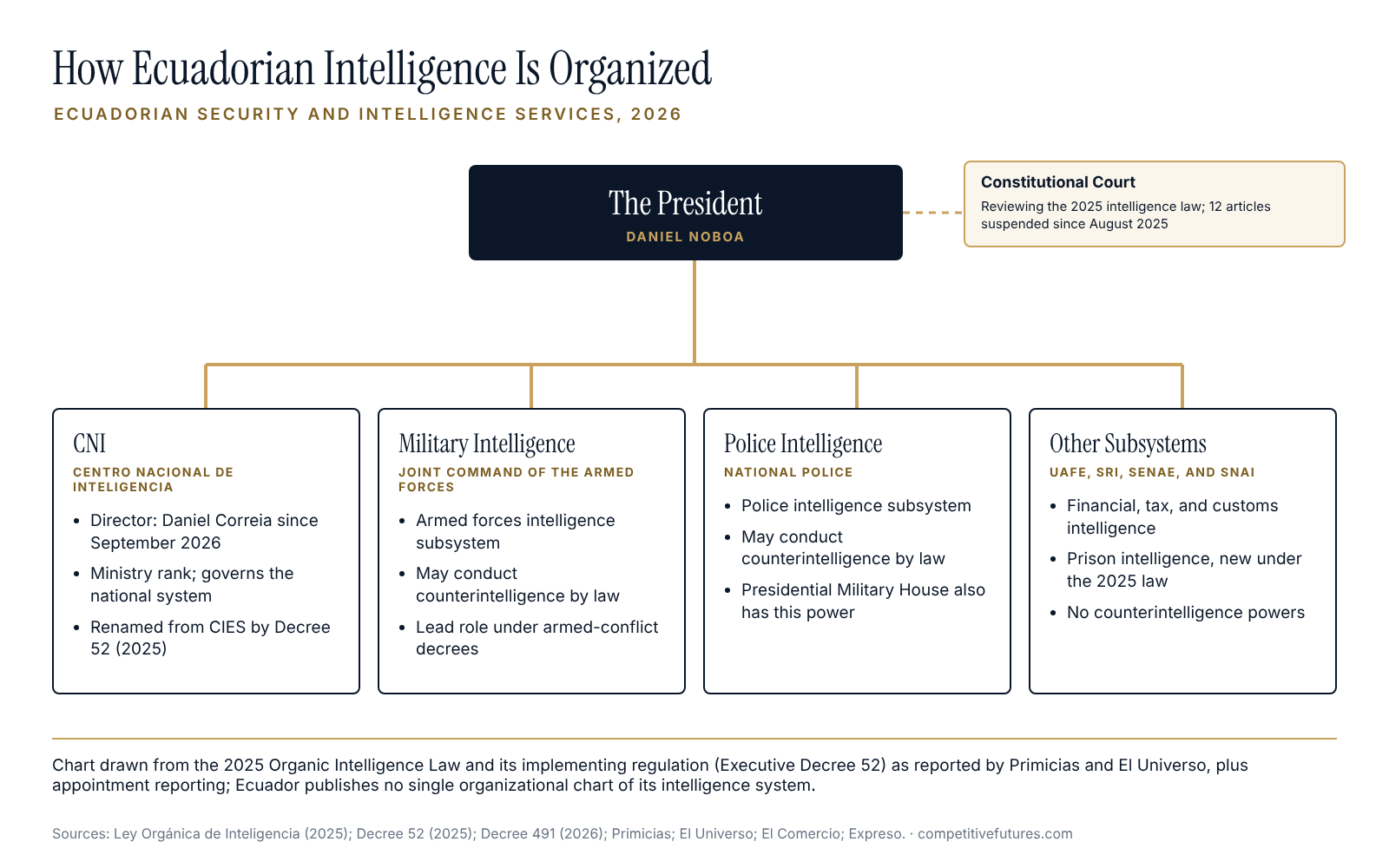
Under the 2025 law, the National Intelligence System consists of one governing entity and seven subsystems, each with its own institutions and responsibilities (Primicias).
- The National Intelligence Center (CNI) is the governing body, with ministry rank, legal personality, and administrative and financial autonomy (El Universo). It carries out intelligence and counterintelligence operations and coordinates the other bodies, and by Executive Decree 328 Noboa also tasked it with vetting bidders and contractors before public contracts are awarded (Expreso).
- Armed forces intelligence, under the Joint Command of the Armed Forces, is one of three subsystems legally permitted to conduct counterintelligence operations.
- National Police intelligence is the second.
- Presidential Military House intelligence, which protects the president, is the third with counterintelligence powers.
- Financial, tax, and customs intelligence come from the Financial and Economic Analysis Unit (UAFE), the tax service (SRI), and the customs service (Senae).
- Prison intelligence, run through the prison service (SNAI), is the only subsystem that did not exist under the previous structure (Primicias).
The law’s powers are what made it contentious. It requires telecommunications companies to provide historical and real-time communications and location data, lets operatives use fictitious identities, and keeps a secret special-expenses budget; opposition legislators feared phones could be tapped without a judge’s prior approval (Primicias). On August 4, 2025, the Constitutional Court provisionally suspended 12 of the law’s articles, covering undercover operations, data requests, interception of communications, the special-expenses fund, and classification of information, saying they “podría afectar de forma grave e irreparable derechos,” could gravely and irreparably affect rights (Expreso). The court held a public hearing on September 1, 2025, but as of July 2026 it had not ruled on the merits (KCH Comunicación). In March 2026, eight United Nations human rights special procedures wrote to Ecuador that covert operations and electronic surveillance under the law did not require prior judicial authorization and that oversight was weak; the government had not answered earlier UN letters, according to the reporting (El Diario).
Two features stand out. First, Ecuador has rebuilt its central service three times in 17 years, and each rebuilding followed a political crisis as much as a change in the threat. Second, the CNI’s leaders since 2024 have come from the president’s business circle rather than the military or police, concentrating control in the presidency.
Intelligence in the “internal armed conflict”
In January 2024, after the gang leader Adolfo Macías, known as “Fito,” escaped from prison and armed men stormed the TC Televisión studios in Guayaquil, Noboa issued Executive Decree 111 on January 9. It recognized “la existencia de un conflicto interno armado,” the existence of an internal armed conflict, and named 22 criminal groups, including Los Choneros and Los Lobos, as terrorist organizations and belligerent non-state actors. The head of the Joint Command announced that every group in the decree had become a military target (El Diario).
The declaration moved intelligence to the center of a military campaign, including inside the country’s prisons; the 2025 law’s new prison-intelligence subsystem formalized that role. It also produced a running legal dispute. In rulings on states of exception, the Constitutional Court repeatedly rejected the armed-conflict ground, finding the gangs had not been shown to meet international humanitarian law’s thresholds of intensity and organization. On June 18, 2026, Noboa issued Decree 424, an ordinary decree that again declared an internal armed conflict and is therefore not subject to the court’s automatic review. It allows the president to pardon members of the security forces, and civilians, who take part in conflict operations, and it allows foreign personnel to take part in internal security actions with immunity, citing a 2023 status of forces agreement with the United States (Primicias). The UN experts’ March 2026 letter argued that Ecuador’s situation does not meet the international requirements for an armed conflict (El Diario). The government’s position, stated in the decrees, is that the gangs are terrorist organizations.
Foreign cooperation, as officially stated, runs mainly through Washington. On September 4, 2025, the U.S. State Department designated Los Choneros and Los Lobos as Foreign Terrorist Organizations and Specially Designated Global Terrorists, linking both groups to Mexico’s Sinaloa and Jalisco New Generation cartels and noting that U.S. and Ecuadorian authorities had cooperated on Fito’s extradition (U.S. State Department statement, via GlobalSecurity.org). Ecuadorian voters set a limit on that relationship: in a November 16, 2025, referendum, 60.58 percent rejected lifting the constitutional ban on foreign military bases (Primicias).
Ecuadorian intelligence in the news
Most public knowledge of how Ecuador uses intelligence comes from six cases. In each, the allegations come from prosecutors, litigants, foreign governments, or reporters, and the people accused have denied them or have not commented, as noted.
Spyware and the Balda kidnapping (2012–2024)
In 2012, Fernando Balda, an opposition politician living in Colombia, was kidnapped there, and Ecuadorian prosecutors traced the operation to SENAIN. Its former head, Pablo Romero, was extradited from Spain and on August 14, 2020, convicted as the indirect perpetrator (“autor mediato”) and sentenced to nine years; in January 2024, the National Court of Justice rejected his final appeal (Primicias). Correa was also called to trial in November 2018, but because Ecuadorian law does not allow trial in absentia for the offense, the case cannot proceed unless he returns from Belgium, where he lives. Correa calls the case political persecution, and his lawyer said there was no evidence of the kidnapping charge against him (Voice of America).
The spyware allegations came from documents leaked from the Italian surveillance firm Hacking Team in 2015. According to El Universo’s reporting on those documents, SENAIN bought 30 packages over three years to infect and monitor computers and phones, with training for its agents in Italy; SENAIN declined to comment (El Universo via Ecuador Times). Former legislators Andrés Páez and Lourdes Tibán alleged violations of their privacy, and prosecutors in a separate case, known as “Caminito,” alleged that SENAIN paid hackers to obtain information on the armed forces, the judiciary, and officials (Primicias).
Julian Assange and the London embassy (2012–2026)
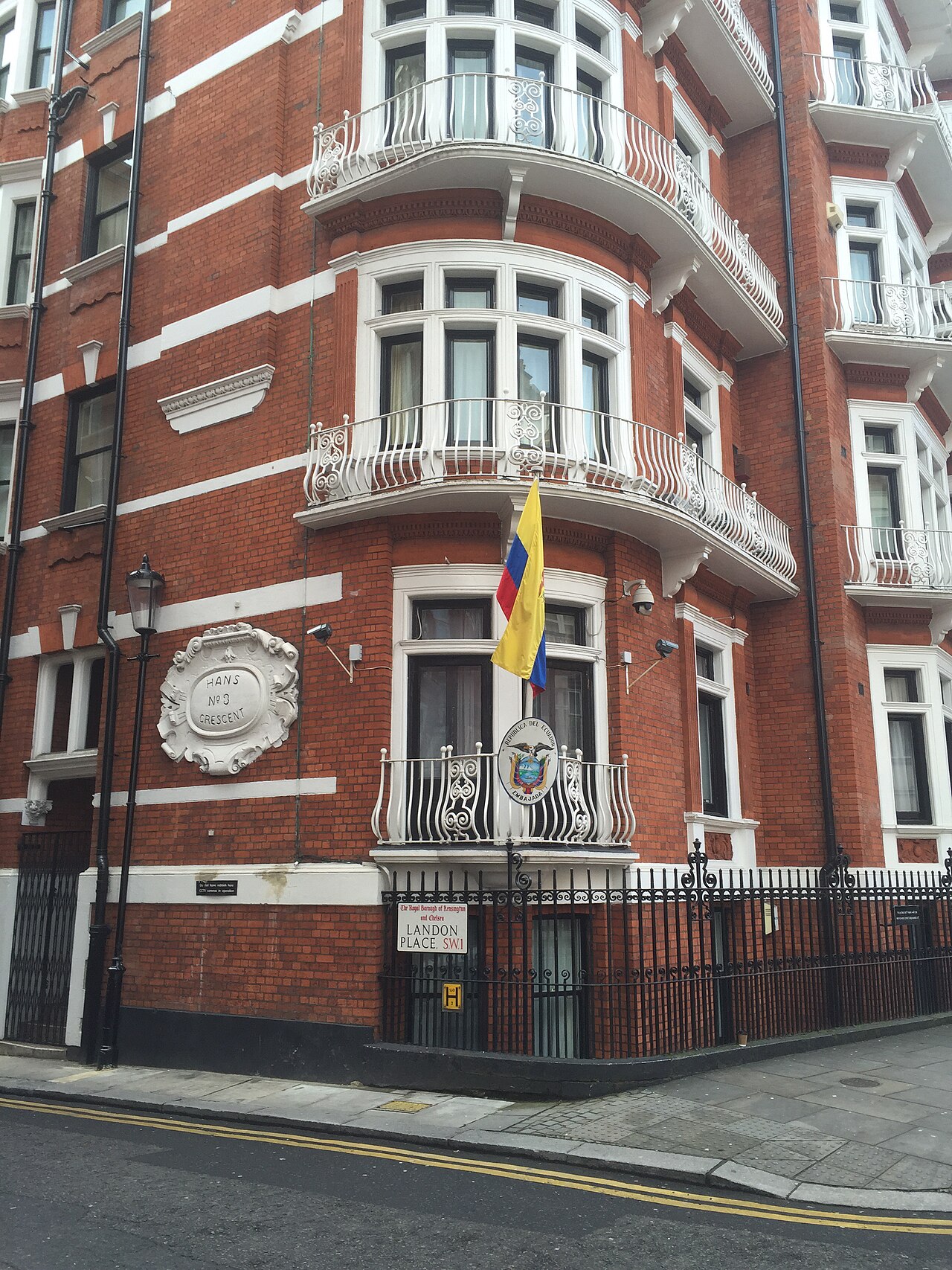
The WikiLeaks founder Julian Assange entered Ecuador’s embassy in London in 2012 and was granted asylum by Correa’s government; in 2019, under Moreno, Ecuador revoked it, allowing British police to arrest him. He pleaded guilty to a single U.S. felony count in Saipan on June 26, 2024, in a deal that let him return to Australia (AP via Korea Times). The intelligence dimension surfaced in Spain. UC Global, a Spanish security company hired by Ecuador’s government to protect the embassy between 2015 and 2018, was accused in court papers of secretly recording Assange’s meetings with lawyers, journalists, doctors, and diplomats and passing material to third parties (AP via WWL). Its founder, David Morales, called Assange’s account a “teoría conspiratoria,” a conspiracy theory, and said former employees had acted out of revenge (EFE via El Mercurio). Prosecutors sought more than 13 years in prison for Morales, but he died in early 2026 before trial at Spain’s National Court, which was expected to close the case against him while proceeding against the company’s operations manager (Público).
The Villavicencio assassination (2023–present)
Fernando Villavicencio, a presidential candidate for the Construye movement, was shot dead in Quito on August 9, 2023 (Extra). On July 12, 2024, a court convicted six members of Los Lobos, sentencing two of them, including the attack’s coordinator, to 34 years (El Comercio). Prosecutors then pursued alleged masterminds. Seven people are accused, including José Serrano, a former interior minister under Correa; Ronny Aleaga, a former assemblyman; and the businessman Xavier Jordán (Teleamazonas). The accused reject the accusations and maintain their innocence (Expreso). Serrano was deported from the United States in late August 2026 and is held in pretrial detention; Jordán lives abroad and is considered a fugitive (Primicias). As of late August 2026, the judge had not ruled on the prosecution’s request to send the seven to trial. No one has been convicted as a mastermind.
Fito’s escape and extradition (2024–present)
Adolfo Macías Villamar, the leader of Los Choneros, was serving a 34-year sentence for drug trafficking, organized crime, and murder when he escaped from prison in January 2024. Ecuadorian authorities found him on June 25, 2025, hiding in an underground bunker in a relative’s house in Manta (AP via WLBT). He was extradited to the United States on July 20, 2025, the first Ecuadorian national extradited under an April 2024 constitutional amendment, and arraigned in Brooklyn on seven counts including cocaine distribution and firearms smuggling (U.S. Drug Enforcement Administration). He pleaded not guilty; his lawyer said of the drug and firearms charges, “As far as I am aware, he did neither” (AP via WLBT). In September 2026, his lawyer told the court that active negotiations were under way to resolve the case without trial; a conference is set for January 27, 2027, and no trial date has been fixed (El Comercio). The charges remain allegations.
The raid on Mexico’s embassy (2024–present)
Jorge Glas, Correa’s former vice president, moved into Mexico’s embassy in Quito on December 17, 2023, and Mexico granted him asylum. On April 5, 2024, Ecuadorian police entered the embassy and arrested him (Expreso). Mexico broke off diplomatic relations and took Ecuador to the International Court of Justice, arguing that the raid “had crossed a line.” Ecuador’s ambassador said Mexico had “misused its diplomatic premises in Quito to shelter a common criminal” (Courthouse News). Ecuador filed its own case against Mexico over the asylum grant (StratNews Global). In May 2024, the court declined Mexico’s request for provisional measures, citing Ecuador’s assurances (AP via ABC17), and in February 2026 it authorized a second round of written pleadings, with Ecuador’s final submission due February 25, 2027 (Expreso). Glas, previously convicted in other corruption cases, was sentenced on June 30, 2025, to 13 years for embezzlement of earthquake reconstruction funds; he says the accusations rest on false facts and are political persecution (Expreso).
A director’s death and a succession (2026)
In June 2026, Noboa signed Executive Decree 421, ordering the Presidential Military House to assess whether the CNI director, Michele Sensi-Contugi, and his family needed protection, amid a year in which Ecuador recorded 9,281 murders (Vistazo). On August 19, 2026, a helicopter crashed near Mount Ololokwe in Kenya’s Samburu County, killing seven people; Ecuadorian government sources told Primicias that Sensi-Contugi and his wife were aboard. Kenyan authorities did not disclose a cause (Primicias). Noboa then named Daniel Correia, a longtime associate from his family’s business group, saying, “La estructura se va a mantener exactamente y ahora estará encargado Daniel Correia,” the structure will stay exactly the same, and Daniel Correia will now be in charge (El Comercio).
How to read coverage of Ecuadorian intelligence
Ecuadorian intelligence is hard to research because almost every story lands on one side of the Correa divide. Correa and his allies describe prosecutions of his former officials as lawfare; their opponents describe the SENAIN years as a surveillance state. Both sides have media outlets, and both have used leaks from the services. Many key facts about Ecuadorian gangs first appear in U.S. indictments, which reflect U.S. priorities. Much of the evidence about the London embassy comes from a Spanish criminal case whose defendant said former employees acted out of revenge.
The discipline is the same one taught in our guide to trend analysis: climb toward primary records. For Ecuador, that means executive decrees and the Registro Oficial, Constitutional Court rulings and case files, National Court of Justice judgments, ICJ orders, U.S. federal court dockets and Justice Department releases, and the U.S. Justice Department’s public database of registered foreign agents (FARA eFile), which lists the lobbyists and consultants representing Ecuadorian government bodies, parties, and companies in Washington. When a story rests on a single leaked document or an anonymous official, treat it as a lead, not a finding.
Frequently asked questions
What is Ecuador’s intelligence agency called?
Ecuador’s main intelligence agency is the National Intelligence Center (Centro Nacional de Inteligencia, CNI), which governs the National Intelligence System. It was created in 2018 as the Strategic Intelligence Center (CIES) to replace the National Intelligence Secretariat (SENAIN), which operated from 2009 to 2018, and was renamed in July 2025.
Who is the head of Ecuadorian intelligence?
Daniel Correia Peñaherrera has directed the CNI since September 2026, when President Daniel Noboa appointed him by Executive Decree 491 after the death of his predecessor, Michele Sensi-Contugi, in a helicopter crash in Kenya.
Is Ecuador’s 2025 intelligence law in force?
Yes, in part. The Organic Intelligence Law took effect on June 11, 2025, but in August 2025 the Constitutional Court provisionally suspended 12 of its articles, including those on interception of communications, data requests, undercover operations, and the special-expenses fund, and as of mid-2026 it had not issued a final ruling.
Related reading
- Intelligence Services Around the World: Structure, History, and the Headlines
- Qatari Intelligence: History, Structure, and the Headlines
- Mexican Intelligence: History, Structure, and the Headlines
- Trend Analysis: How to Tell a Real Trend From Media Hype
Competitive Futures briefs companies and governments on intelligence services, foreign influence, and Ecuador and the Andes; details are on the services page.