Indian Intelligence: History, Structure, and the Headlines
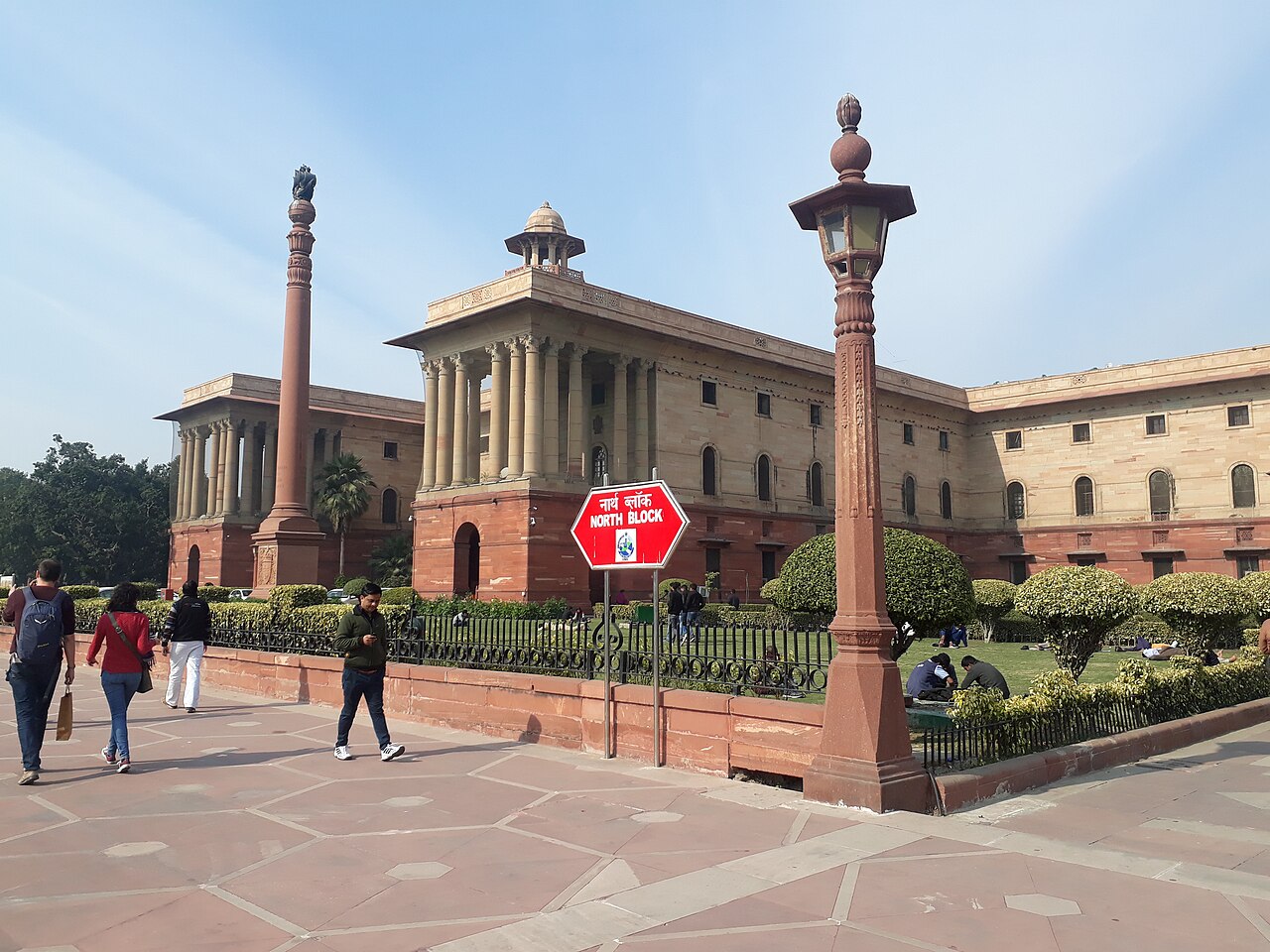
India is the world’s most populous country, a nuclear power with two nuclear-armed neighbors, and a partner that Washington, Moscow, and the Gulf capitals all court. Its intelligence services have worked through several wars with Pakistan, a war with China, decades of insurgency, and the 1999 Kargil conflict. Since 2023 they have also been at the center of criminal cases in Canada and the United States, and in May 2025 they were credited at home with the intelligence behind India’s strikes on Pakistan. Very little of that makes sense unless you understand an intelligence system that is large, old, close to the Prime Minister, and, unusually for a democracy, not governed by any law that sets out what it is for.
This page is a working overview of Indian intelligence: where the services came from, how they are organized today, and the cases that have put them in the news. It relies on Indian government statements and appointment orders; court records from India, the International Court of Justice, the United States, and Canada; official Pakistani statements; and named reporting and scholarship. Where a claim comes from a government or party with an interest in the outcome, the page says so, and it gives the other side’s response.
Indian intelligence at a glance
- Domestic intelligence: the Intelligence Bureau (IB), which functions under the Ministry of Home Affairs and traces its origins to the colonial government of the 1880s.
- Head of the IB: Mahesh Dixit, a 1993-batch Indian Police Service officer, cleared by the Appointments Committee of the Cabinet in June 2026 for a two-year tenure and due to take over on June 30, 2026, from Tapan Kumar Deka, who had led the bureau since 2022 (ETV Bharat). Dixit previously headed the IB’s Kashmir unit (The Wire).
- Foreign intelligence: the Research and Analysis Wing (R&AW, often written RAW), created in 1968 and housed in the Cabinet Secretariat; its chief holds the title Secretary (Research).
- Head of R&AW: Parag Jain, a 1989-batch Indian Police Service officer of the Punjab cadre, appointed for two years in June 2025 (All India Radio). His tenure began on July 1, 2025; he had previously run the Aviation Research Centre (PTI via The Week).
- National Security Adviser: Ajit Doval, reappointed for a third term with effect from June 10, 2024, with the rank of a Cabinet minister and a term co-terminous with the Prime Minister’s (All India Radio).
- Oversight and reporting line: the services answer to the executive. There is no statute setting out their mandate and no parliamentary intelligence committee, a gap that India’s own leading defense think tank has urged the government to close (IDSA).
- Relationship with the United States: a close strategic partnership with real friction. When U.S. authorities passed information to India about a plot against a Sikh separatist in New York, India set up a high-level inquiry committee, which in January 2025 recommended legal action against an individual (The Statesman).
History: from colonial police intelligence to a national security state
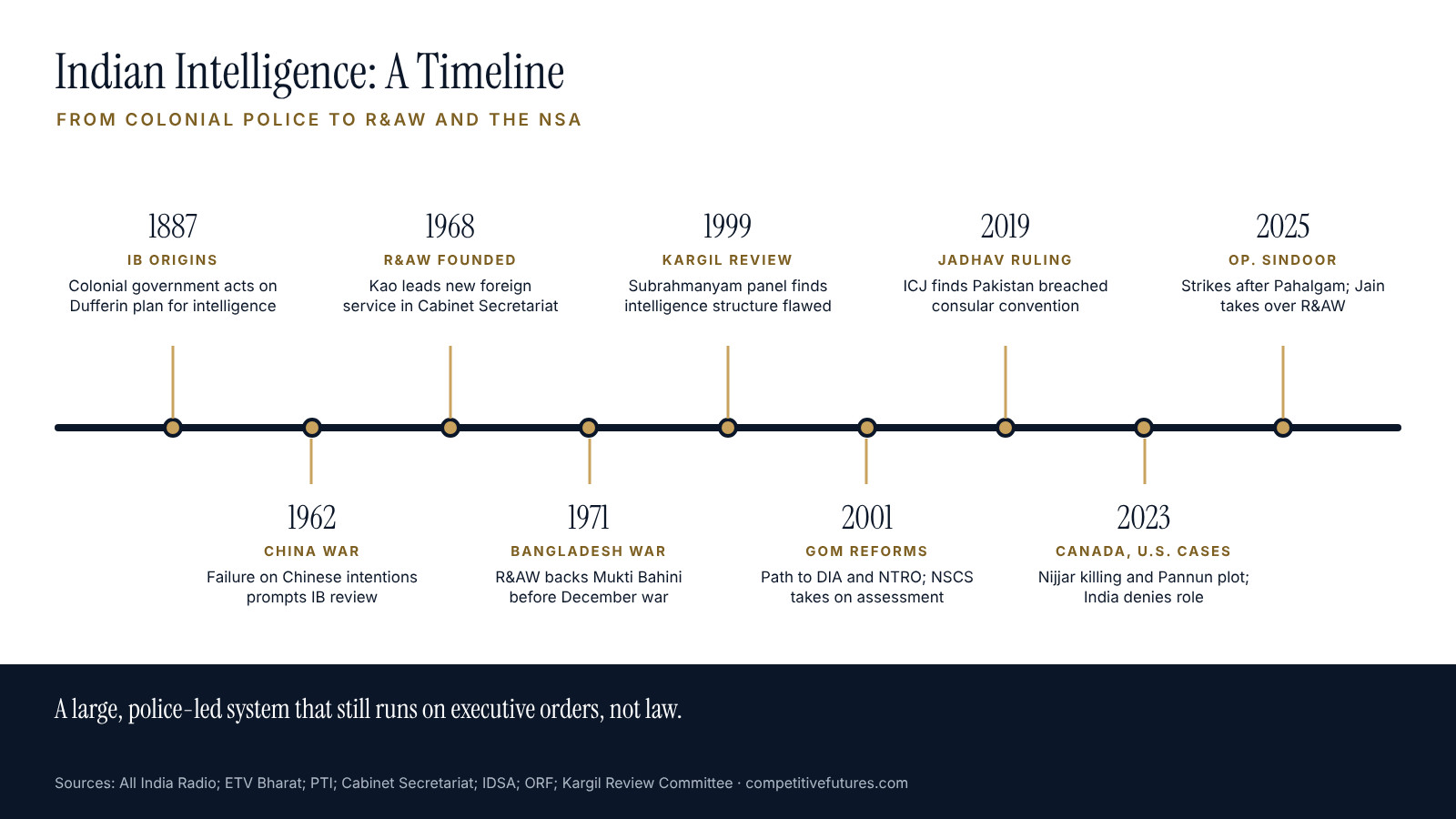
India’s intelligence system began as an arm of colonial policing. A 2012 report by a task force of the Institute for Defence Studies and Analyses (IDSA), the government-funded think tank in New Delhi, describes it as having “emerged as an extension of the Indian police system” under British rule (IDSA). The Intelligence Bureau dates itself to December 1887, when the British government of India acted on a proposal from the Viceroy, Lord Dufferin; India Post marked the bureau’s 125th anniversary with a commemorative stamp in 2013 (iStampGallery, reproducing the India Post issue). After independence in 1947 the IB became the national intelligence agency, responsible for both domestic security and foreign intelligence.
The first great test went badly. The IDSA task force lists “almost total ignorance about Chinese intentions and capabilities in Tibet” among the major failures of the 1950s, and notes that after the 1962 war with China a review of the IB’s performance led to the creation of a new Directorate General of Security (IDSA). The 1965 war with Pakistan and the 1966 revolt in Mizoram added pressure for a separate foreign service.
In September 1968, Prime Minister Indira Gandhi created the Research and Analysis Wing and put Rameshwar Nath Kao, an IB officer, in charge as its first Secretary (Research), a post he held until 1977 (Outlook). Vappala Balachandran, a former Special Secretary in the Cabinet Secretariat, has written that “The government notification only said that the new organisation would do what the IB was doing in foreign intelligence,” and that Kao was later given his own administrative section inside the Cabinet Secretariat, an arrangement that continues (The Tribune). The Cabinet Secretariat itself had set up an Intelligence Wing in 1965 to support the Joint Intelligence Committee (Cabinet Secretariat).
R&AW’s reputation was made in 1971. According to Balachandran, Kao was placed in charge of covert support for Bangladeshi freedom fighters in June 1971, and the service is credited with training large numbers of Mukti Bahini fighters before the December war that ended with Bangladesh’s independence (The Tribune; Outlook).
The modern structure grew out of a failure. In 1999, Pakistani forces occupied heights across the Line of Control near Kargil before India detected them. The government’s Kargil Review Committee, chaired by the strategist K. Subrahmanyam, found that R&AW could not accurately track changes in Pakistan’s order of battle in the area and concluded that “The Indian intelligence structure is flawed since there is little back up or redundancy” (Kargil Review Committee executive summary, via GlobalSecurity.org). A Group of Ministers followed in 2001. As the analyst Manoj Joshi of the Observer Research Foundation (ORF) has described it, its reforms created a Defence Intelligence Agency for strategic military intelligence, a technical agency later renamed the National Technical Research Organisation (NTRO), and gave the National Security Council Secretariat the job of intelligence assessment and coordination, though many recommendations were “undermined by turf battles” (ORF).
How Indian intelligence is organized today
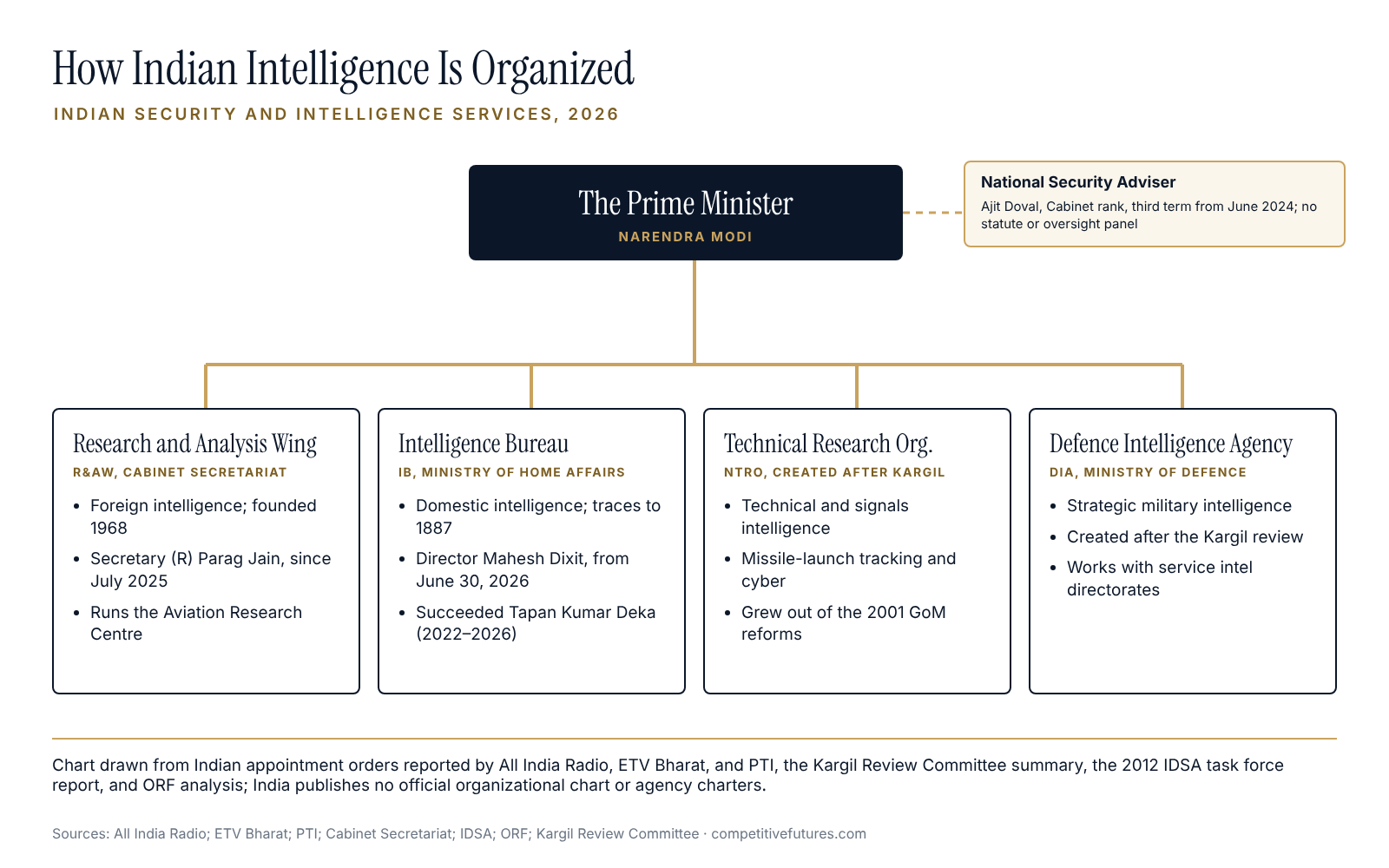
India does not publish an organizational chart, a budget, or the charters of its intelligence agencies; Joshi notes that each agency’s charter has never been made public (ORF). The public picture comes from appointment orders, official reviews, and scholarship. It shows a system built around a few bodies, all answering to the Prime Minister and his National Security Adviser.
- The Intelligence Bureau is the domestic intelligence and counterintelligence service under the Ministry of Home Affairs, with a major role in Jammu and Kashmir. Its directors are senior police officers.
- The Research and Analysis Wing is the foreign intelligence service, administered through the Cabinet Secretariat. The Aviation Research Centre, which Parag Jain ran before taking over R&AW, handles aerial surveillance and related technical collection (PTI via The Week).
- The National Technical Research Organisation handles technical intelligence; according to Joshi, it took over tasks such as tracking foreign missile launches and cyber operations (ORF).
- The Defence Intelligence Agency, created after Kargil, coordinates strategic military intelligence alongside the intelligence directorates of the army, navy, and air force (ORF).
- The National Security Adviser and the National Security Council Secretariat sit at the top, coordinating the agencies and producing assessments for the Prime Minister. Ajit Doval is in his third term in the post.
Two things set this system apart. First, it is run by police officers to an unusual degree: the heads of both the IB and R&AW come from the Indian Police Service, as did the National Security Adviser. Second, almost everything about it rests on executive orders rather than law, which is the subject of the next section.
An intelligence service without a statute
Most democracies with services of India’s size have put them on a legal footing. Britain did so between 1989 and 1994; the United States did so in 1947. India has not. The 2012 IDSA task force said the IB’s legal basis amounted to an entry in the constitutional list of central government subjects, making it “an adhoc administrative arrangement by the Executive,” and warned that “absence of legislative cover can be a serious lacuna as all intelligence work is carried out under executive instructions.” Its central recommendation was blunt: “The intelligence agencies in India must be provided a legal-framework for their existence and functioning,” with their functioning placed under parliamentary oversight (IDSA).
The call has come from across the establishment. In 2011, after Vice President Hamid Ansari criticized the governance of the intelligence agencies and called for a parliamentary oversight committee, an ORF study found that the agencies “had not been established, or were presently being funded, audited, or regulated by law” (ORF). The Congress Party member of Parliament Manish Tewari first introduced a private member’s bill on the subject in 2011, and reintroduced it in 2021 to “regulate the manner of the functioning and exercise of the powers of intelligence agencies,” with warrants for surveillance, an oversight committee of senior politicians, and a tribunal for complaints. It did not become law (ThePrint).
The costs of that gap show up in court. When the Supreme Court took up the Pegasus spyware allegations in 2021, described below, it had no oversight body to turn to and no statute to apply, and it appointed its own committee. The gap also matters abroad: when foreign prosecutors allege that an Indian official acted against someone overseas, there is no public Indian legal framework against which to test whether such an action was authorized.
Indian intelligence in the news
Most public knowledge of how India uses intelligence abroad comes from five cases. In each, the allegations come from foreign governments, prosecutors, or litigants, and India has denied them, disputed them, or responded through its own processes. Several remain before the courts.
Kulbhushan Jadhav and the International Court of Justice (2016–present)
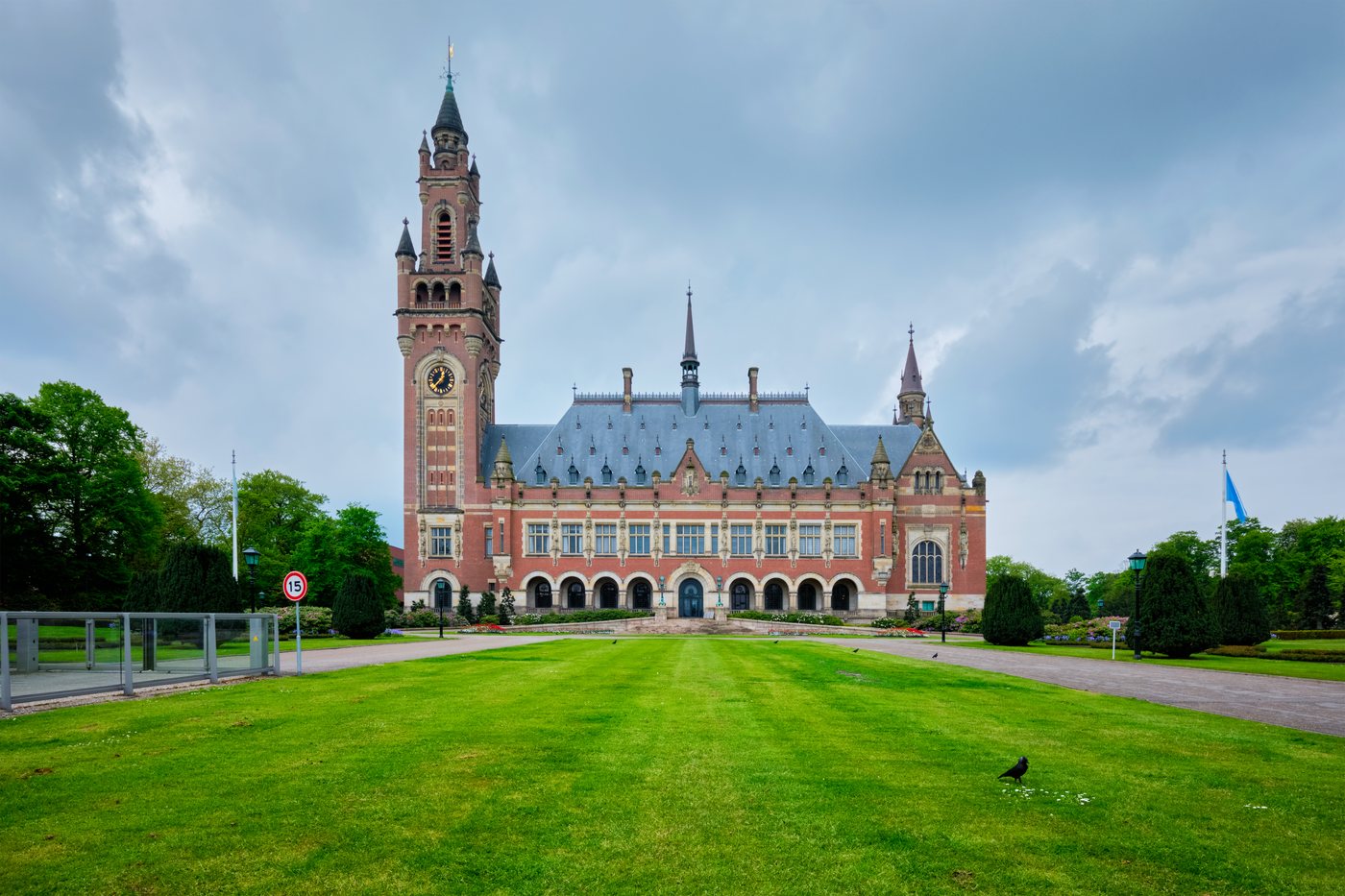
On March 3, 2016, Pakistan arrested Kulbhushan Jadhav, a former Indian Navy officer, saying he had been caught entering Balochistan from Iran. Pakistan alleges that he was an R&AW operative who directed subversive activity in Karachi and Balochistan, and released a confessional video through its military media wing; a military court sentenced him to death in April 2017. India says Jadhav is a retired officer who ran a business in Iran and was abducted from there, and it was denied consular access to him (Dawn). India took the case to the International Court of Justice. On July 17, 2019, the court held that Pakistan had breached the Vienna Convention on Consular Relations, which it said applied “regardless of the allegations that Mr. Jadhav was engaged in espionage activities,” declined India’s request to annul the sentence and free him, and ordered Pakistan to provide effective review and reconsideration of the conviction (International Court of Justice). Pakistan later amended its law to allow limited judicial review of the military court’s decision; India has called the trial “farcical” and said Pakistan has not implemented the ruling “in letter and spirit.” As of April 2025, Jadhav remained imprisoned in Pakistan (PTI via News Arena).
The Pegasus spyware inquiry (2021–2022)
In 2021 an international media consortium reported that more than 300 verified Indian mobile numbers, including those of journalists and politicians, appeared on a list of potential targets for Pegasus, the spyware sold by Israel’s NSO Group. Journalists and the Editors Guild of India petitioned the Supreme Court. The government filed only a limited affidavit, citing national security, and offered to set up its own expert committee. On October 27, 2021, the court refused, ruling that “The State cannot get a free pass every time by raising national security concerns,” and appointed a committee headed by the retired judge R. V. Raveendran (The News Minute; Bar and Bench). On August 25, 2022, the court disclosed that the technical panel had found malware on five of the 29 phones it examined but could not conclude that it was Pegasus, and Chief Justice N. V. Ramana read out the panel’s observation that “the Government of India did not cooperate.” The Solicitor General said he was unaware of that finding (Outlook). The government has maintained its position of not disclosing whether it used Pegasus (BOOM). No finding of unlawful surveillance has been made against any agency.
The killing of Hardeep Singh Nijjar in Canada (2023–present)
On June 18, 2023, Hardeep Singh Nijjar, a Sikh separatist leader, was killed in British Columbia. In September 2023, Prime Minister Justin Trudeau told Canada’s House of Commons that there were credible allegations linking Indian agents to the killing (PTC News). India’s Ministry of External Affairs replied that “Allegations of Government of India’s involvement in any act of violence in Canada are absurd and motivated” (PTI via Telangana Today). In May 2024, Canadian police charged four Indian nationals with first-degree murder and conspiracy to commit murder (National Post, via Unpublished). In October 2024, Canada told India that its High Commissioner and other diplomats were “persons of interest” in the investigation; India rejected what it called “preposterous imputations” and said “the Canadian Government has not shared a shred of evidence with the Government of India” (ThePrint). India expelled Canada’s acting high commissioner and five other diplomats in response (AP via WTOP). In February 2026, Canada’s Attorney General sought an order under the Canada Evidence Act to keep certain information out of the trial on national security and international relations grounds; the trial was expected later in 2026 (PTC News). India’s High Commissioner, Dinesh Patnaik, said the case “is in court” and, on cooperation, “If they need us to cooperate, we will” (National Post, via Unpublished). The accused are presumed innocent, and no court has made any finding about Indian state involvement.
The Pannun plot in New York (2023–present)
U.S. prosecutors allege that in 2023 an Indian government employee directed a plan to kill Gurpatwant Singh Pannun, a Sikh separatist activist, in New York. In October 2024 the Justice Department charged Vikash Yadav, saying he worked for India’s Cabinet Secretariat, which houses R&AW, described his own title as “Senior Field Officer,” and recruited the Indian businessman Nikhil Gupta in May 2023. Gupta allegedly hired a supposed hitman who was in fact an undercover U.S. officer. Yadav was charged with murder-for-hire and remains at large (AP via WTOP). India’s foreign ministry spokesperson said of the unnamed official, “This particular gentleman is not part of the Government of India setup” (The Tribune). In January 2025, a high-level inquiry committee India had set up in November 2023 in response to the U.S. information “recommended legal action against an individual,” without naming him (The Statesman). On February 13, 2026, Gupta pleaded guilty in the Southern District of New York to murder-for-hire, conspiracy to commit murder-for-hire, and conspiracy to commit money laundering (Dawn). His sentencing was moved to November 20, 2026 (PTI via Free Press Journal). Days after the plea, The Wire reported that the Indian government had not commented (The Wire). The charges against Yadav are allegations, and he has not appeared in a U.S. court.
Pahalgam and Operation Sindoor (2025)
On April 22, 2025, gunmen attacked tourists at Pahalgam in Indian-administered Kashmir. India’s Ministry of Defence said the attack killed 25 Indian citizens and one Nepali citizen. In the early hours of May 7, India launched Operation Sindoor, striking nine sites in Pakistan and Pakistan-administered Kashmir that it described as terrorist infrastructure; the ministry called the action measured and non-escalatory and said “No Pakistani military facilities have been targeted” (Press Information Bureau). Pakistan’s foreign minister told diplomats in Islamabad that day, “We once again reject any attempt to link the Pahalgam Attack with Pakistan,” said that the Prime Minister had proposed an independent probe by neutral investigators, and accused India of deliberately targeting civilian areas (Pakistan Ministry of Foreign Affairs). Pakistan’s Foreign Office added that “To date, India has not been able to produce any credible and verifiable evidence of Pakistan’s involvement in the attack” (Dawn). After further exchanges of fire, India’s Foreign Secretary announced on May 10 that the two militaries had agreed that “both sides would stop all firing and military action on land and in the air and sea with effect from 17.00 IST today,” and Pakistan’s foreign minister confirmed a ceasefire (Newslaundry). Indian press reports credited Parag Jain’s team with the intelligence behind the strikes (PTI via The Week); the government has not published an official account of the intelligence role.
How to read coverage of Indian intelligence
India is a hard intelligence topic to research honestly, because the loudest sources usually have a stake. Indian television and parts of the Indian press tend to amplify official accounts and credit the services with successes they cannot independently confirm. Pakistani government statements, including those of its military media wing, are adversarial by design, and so are confessional videos released by any security service. Sikh separatist groups and their opponents both run active advocacy campaigns in Canada, Britain, and the United States. Some of the most important claims about R&AW reach the public through leaks from Canadian or U.S. officials whose evidence has not yet been tested in court.
The discipline is the same one taught in our guides to evaluating forecasts and cognitive bias: climb toward primary records. For India, that means Ministry of External Affairs and Press Information Bureau statements, the published judgment of the International Court of Justice, Indian Supreme Court orders, the U.S. federal docket in the Southern District of New York, the British Columbia court record in the Nijjar case, and the U.S. Justice Department’s public database of foreign agents registered under the Foreign Agents Registration Act (FARA eFile), which lists the lobbyists and consultants working for India, for Pakistan, and for advocacy groups on both sides in Washington. When a story rests on a single anonymous official or a single government’s video, treat it as a lead, not a finding.
Frequently asked questions
What is India’s intelligence agency called?
India has two main civilian agencies: the Research and Analysis Wing (R&AW or RAW), the foreign intelligence service housed in the Cabinet Secretariat, and the Intelligence Bureau (IB), the domestic intelligence service under the Ministry of Home Affairs. The National Technical Research Organisation handles technical intelligence, and the Defence Intelligence Agency coordinates military intelligence.
Who heads Indian intelligence?
Parag Jain has headed R&AW since July 1, 2025, and Mahesh Dixit was appointed to head the Intelligence Bureau from June 30, 2026, succeeding Tapan Kumar Deka. Ajit Doval, the National Security Adviser, coordinates the agencies for the Prime Minister.
Who oversees Indian intelligence?
The executive does. India’s intelligence agencies operate under executive orders rather than a statute, and Parliament has no dedicated intelligence oversight committee. Scholars and former officials have proposed legislation and parliamentary oversight since at least 2011, but none has been enacted, so courts have stepped in case by case, as the Supreme Court did over Pegasus.
Related reading
- Intelligence Services Around the World: Structure, History, and the Headlines
- Qatari Intelligence: History, Structure, and the Headlines
- British Intelligence: History, Structure, and the Headlines
- How to Evaluate a Forecast
Competitive Futures briefs companies and governments on intelligence services, foreign influence, and India and South Asia; details are on the services page.