German Intelligence: History, Structure, and the Headlines

Germany is Europe’s largest economy and, by its own government’s account, a prime target of Russian espionage, sabotage, and influence operations. Its intelligence history is also unusually present in its politics: a foreign service built from a network the U.S. Army and the CIA sponsored after 1945, a domestic service designed to defend the constitution against extremist parties, and the archive of East Germany’s Stasi.
This page is a working overview of German intelligence: where it came from, how it is organized under the law today, who runs it after the 2024–2025 leadership changes, and the cases that have put it in the news. It relies on German statutes, court rulings and court press releases, official government statements, and named reporting, and it notes where a claim comes from a party with an interest in the outcome.
German intelligence at a glance
- Foreign intelligence: the Federal Intelligence Service (Bundesnachrichtendienst, BND), which by law is a federal authority “im Geschäftsbereich des Bundeskanzleramtes,” within the Chancellery’s portfolio (BND Act, Section 1). President: Martin Jäger, a former ambassador in Kabul, Baghdad, and Kyiv, who took office on September 15, 2025, succeeding Bruno Kahl, who left after more than nine years to become ambassador to the Holy See (Federal Government).
- Domestic intelligence: the Federal Office for the Protection of the Constitution (Bundesamt für Verfassungsschutz, BfV), under the Interior Ministry. President: Sinan Selen, appointed by Interior Minister Alexander Dobrindt on October 8, 2025, as the office’s 15th head; he had led it on an interim basis with Vice President Silke Willems since Thomas Haldenwang’s departure (BfV). Haldenwang had announced in November 2024 that he would run for the Bundestag for the CDU (LTO).
- State offices: each of the 16 states must maintain its own authority for constitutional protection, usually called a Landesamt für Verfassungsschutz (LfV); the federal law also bars the BfV from being attached to any police office (Federal Constitutional Protection Act, Section 2).
- Military counterintelligence: the Federal Office for the Military Counterintelligence Service (Bundesamt für den Militärischen Abschirmdienst, BAMAD, usually called MAD), under the Defense Ministry. President: Martina Rosenberg, since October 2020 (Federal Ministry of Defense).
- Coordination: the Head of the Federal Chancellery, Thorsten Frei, also serves as the Federal Government Commissioner for the Intelligence Services (Federal Government).
- Oversight: the Bundestag’s Parliamentary Control Panel (Parlamentarisches Kontrollgremium, PKGr), which oversees the government’s conduct of all three federal services (PKGr Act, Section 1) and is chaired in the current Bundestag by Marc Henrichmann of the CDU/CSU (Bundestag); and the Independent Control Council (Unabhängiger Kontrollrat), a supreme federal authority that has overseen the BND’s technical intelligence collection since 2022, led by its president, Josef Hoch (Unabhängiger Kontrollrat).
- Relationship with the United States: allied. The Federal Republic joined NATO on May 6, 1955 (NATO), and the BND grew out of an organization the U.S. Army and then the CIA sponsored. The partnership has also had public strains, most visibly after the 2013 NSA revelations described below.
History: from the Gehlen Organization to a law-based system
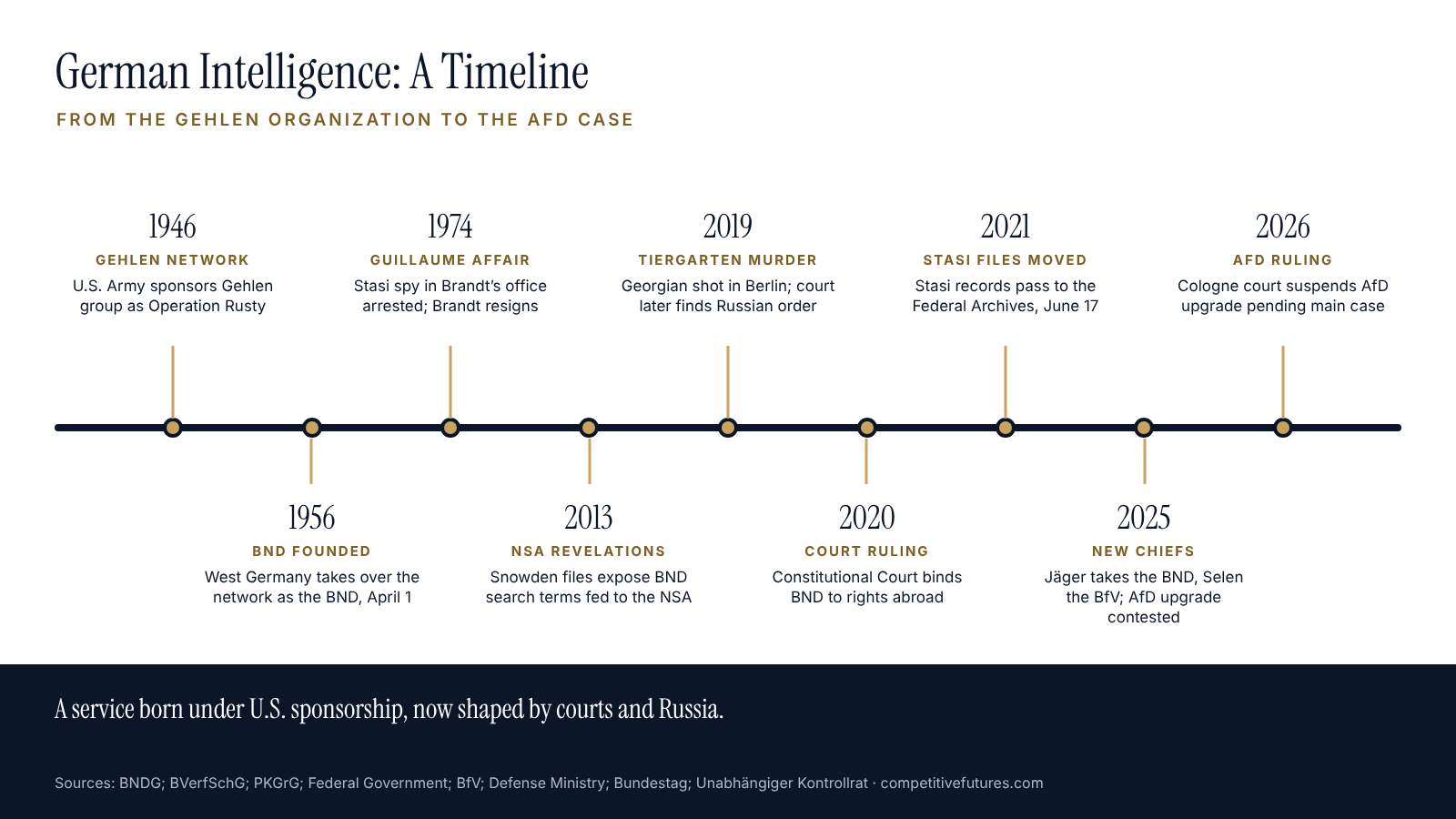
The BND began as an American project. In May 1945, Reinhard Gehlen, whose wartime staff had gathered intelligence on the Soviet Union, surrendered to a U.S. Army counterintelligence team along with his top aides; his officers had microfilmed their Soviet holdings and buried them in the Austrian Alps. The group was rebuilt as an espionage network under U.S. control (Federation of American Scientists). U.S. Army documents from October 1946 discuss it under the cover name Operation Rusty, and by 1948 the Army was pressing the CIA to take over sponsorship, which a 1949 agreement put into effect. Declassified U.S. records collected by the National Security Archive show that Gehlen “employed numerous former Nazis and known war criminals,” and that “at least 100 officers within the Gehlen organization were former SD or Gestapo officers” (National Security Archive).

West Germany took the network over as the Federal Intelligence Service on April 1, 1956 (Federal Agency for Civic Education). It moved its headquarters from Pullach, near Munich, to Berlin in 2019. The domestic service, the BfV, is older still; it marked its 75th anniversary in 2025 (beck-aktuell). Parliamentary oversight began with a confidential committee set up in 1956, replaced in 1978 by a control commission that was renamed the PKGr in 1999 (Konrad Adenauer Foundation).
East Germany’s Ministry for State Security, the Stasi, combined secret police and foreign intelligence; its foreign arm, the HVA, ran agents inside West German institutions, including the chancellor’s office. After reunification, its files were opened to the people they described. More than 1.5 million people have seen their own files since 1992, and the Berlin archive alone holds almost 50 kilometers of material (Stasi Records Archive). On June 17, 2021, responsibility for the records passed to the Federal Archives and the office of the Federal Commissioner for the Stasi Records was dissolved (Federal Archives).
The BND Act of 1990 faced its biggest test in 2013, when Edward Snowden’s NSA disclosures led to reports that the BND had passed lists of phone numbers, email addresses, and search terms to the NSA. A Bundestag inquiry reported in 2017; government and opposition read it differently but agreed that the BND had spied on EU and NATO states beyond its legal powers and that oversight had been insufficient (Federal Agency for Civic Education). On May 19, 2020, the Federal Constitutional Court ruled that the BND is bound by the Basic Law’s fundamental rights even when it monitors foreigners abroad, and that the statutory bases for that surveillance “violate the fundamental right to the privacy of telecommunications.” It gave the legislature until the end of 2021 to fix them (Federal Constitutional Court, 1 BvR 2835/17). The rewrite created the Independent Control Council (Unabhängiger Kontrollrat).
How German intelligence is organized today
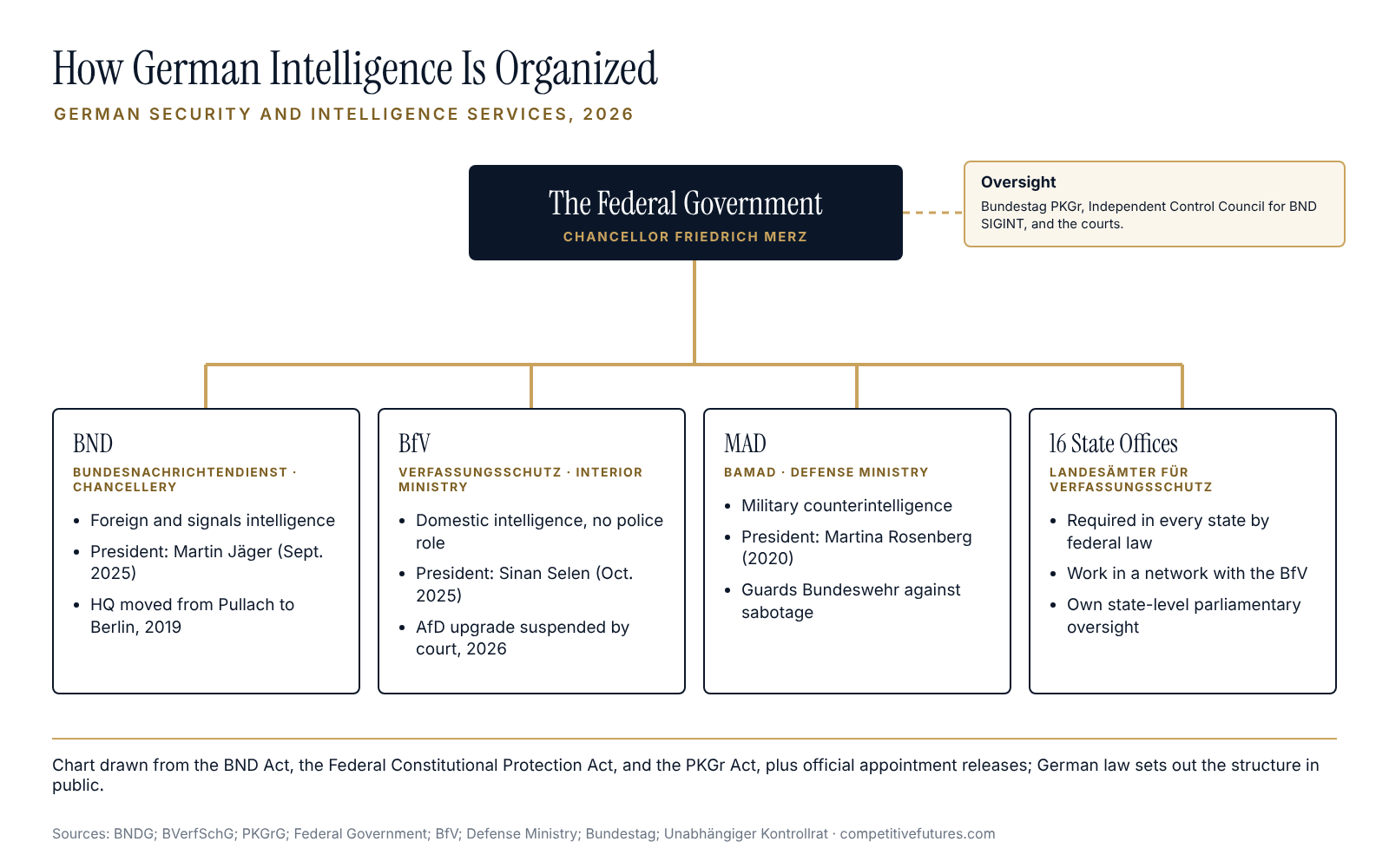
Germany’s services are set out in public statutes, with named heads and annual public hearings. On October 5, 2026, the three federal presidents testified in open session before the PKGr and agreed that Russia is currently Germany’s greatest security challenge; Jäger called Russia “unser gefährlichster Gegner,” our most dangerous adversary (Bundestag).
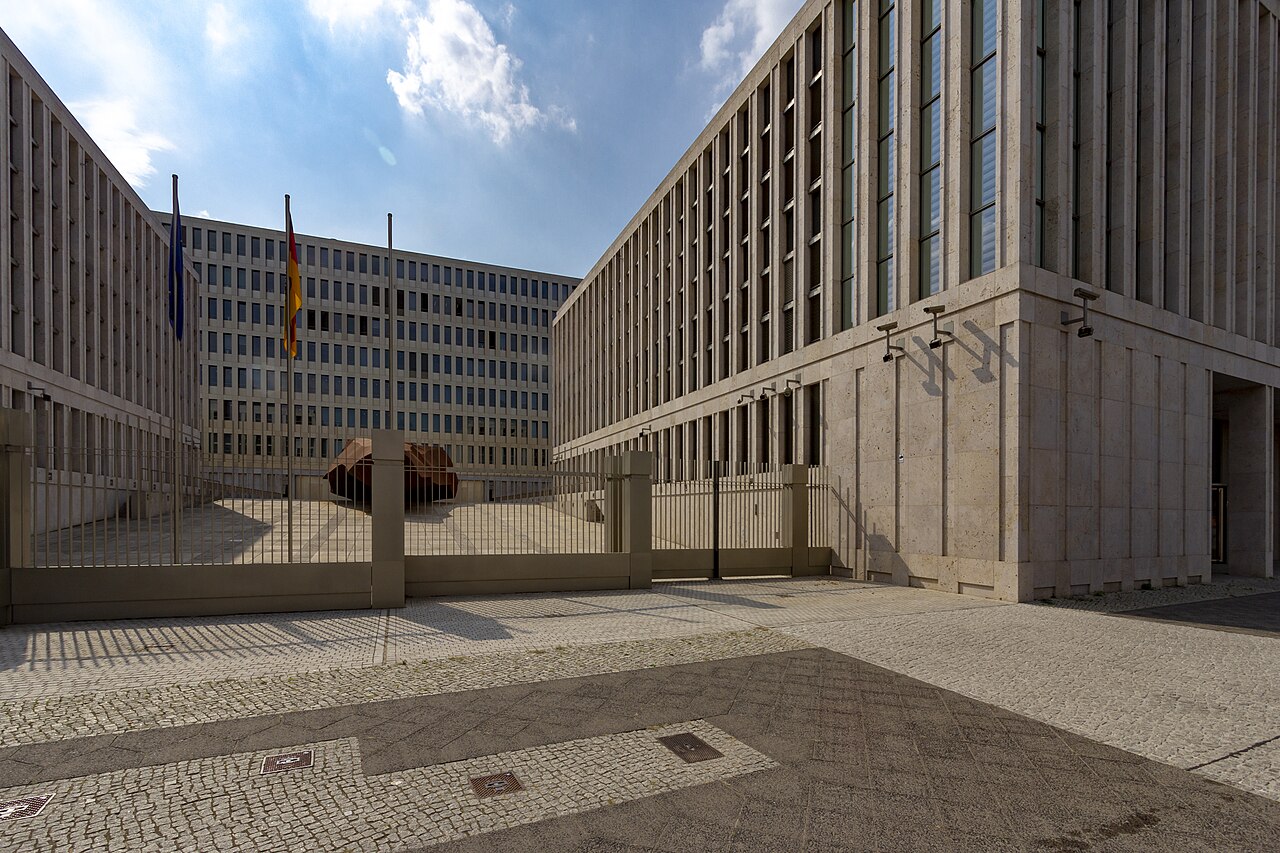
- The BND collects foreign intelligence, including signals intelligence, and reports to the Chancellery. At Jäger’s installation on September 11, 2025, Chancellor Friedrich Merz said, “Wir wollen, dass der BND nachrichtendienstlich auf dem allerhöchsten Niveau mitspielt” (we want the BND to play at the highest intelligence level), and promised a long-overdue reform of intelligence law alongside a new National Security Council (Federal Government).
- The BfV is the domestic intelligence service and works in a network with the 16 state offices. It covers extremism, terrorism, counterintelligence, sabotage, and cyber threats, and the law keeps it organizationally separate from the police. At the 2026 hearing, Selen warned that Russia’s readiness extends beyond espionage to sabotage and “Tötungsoperationen,” killing operations (Bundestag).
- MAD protects the Bundeswehr against espionage, sabotage, and extremism in its own ranks. Rosenberg told the 2026 hearing that the threat to the armed forces had moved from the abstract to the concrete (Bundeswehr).
- Oversight is layered: the PKGr for all three federal services, the Independent Control Council for BND signals collection, the Bundestag’s separate commission under the Article 10 Act for intrusions into the privacy of communications (PKGr Act, Section 1), and the courts. In 2024 the Constitutional Court again required stronger safeguards, this time for strategic surveillance used for cyber defense, and set the end of 2026 as the deadline for a revised law (Federal Agency for Civic Education).
The system is federal, so coordination between Berlin and the states is a recurring issue, and it is heavily lawyered: the push for a more assertive BND will be judged against decades of case law.
Constitutional protection
The BfV’s name describes a model with few equivalents among Western democracies. The BfV and state offices monitor groups, including political parties, whose aims they judge to be directed against the free democratic basic order. A party can be treated as a suspected case (Verdachtsfall), which allows intelligence methods under strict conditions, or classified as a confirmed extremist effort. Classification is not a ban: only the Federal Constitutional Court can prohibit a party.
The Alternative for Germany (AfD) has been in litigation with the BfV for years. On May 13, 2024, the Higher Administrative Court in Münster dismissed the AfD’s challenges to its treatment as a suspected case; on May 20, 2025, the Federal Administrative Court rejected the party’s complaints against the refusal to allow a further appeal, so the Münster judgments became final (Federal Administrative Court).
On May 2, 2025, the BfV announced that it was upgrading the AfD to a “gesichert rechtsextremistische Bestrebung,” a confirmed right-wing extremist effort, citing an ethnic-descent-based concept of the people that it said violates human dignity. The AfD sued on May 5, 2025, and the BfV gave a standstill commitment to keep treating the party as a suspected case until a court ruled (LTO). On February 26, 2026, the Administrative Court in Cologne granted the AfD’s urgent application (case 13 L 1109/25). It found that anti-constitutional tendencies exist within the party but had not yet reached the level needed to shape the party as a whole, and it barred the BfV from treating or publicly describing the AfD as confirmed extremist until the main case is decided at first instance (LTO). The Federal Interior Ministry said it would not appeal and would focus on the main proceedings, which were still pending; the AfD remains a suspected case (dpa via Nordkurier).
The AfD welcomed the ruling. Co-leader Tino Chrupalla called it a very good day for democracy and an interim success, while noting that the main case was still to come, and co-leader Alice Weidel said the court had indirectly blocked those pushing for a party ban. The SPD and the Left said they would continue to press for ban proceedings (ZDF). The sequence shows how the model works: the service makes the assessment, and the courts decide whether it stands.
German intelligence in the news
Most public knowledge of German intelligence comes from cases that reached a courtroom. Each case below names who made the claim, the response of the accused, and the legal status as of October 2026.
The chancellor’s spy: Günter Guillaume (1970–1981)
Günter Guillaume joined the Federal Chancellery in Bonn in 1970 and in 1972 became an aide on party affairs to Chancellor Willy Brandt. He was in fact an officer on special assignment for the Stasi’s foreign intelligence arm, the HVA. He was arrested on April 24, 1974 (Federal Archives), and Brandt resigned on May 6 (Konrad Adenauer Foundation). The Stasi’s own assessment concluded that the case “war nur der äußere Anlaß,” only the outward trigger, for the resignation. In December 1975 Guillaume was sentenced to 13 years and his wife and fellow agent, Christel, to eight years for treason; both were released early in 1981 and returned to East Germany (Federal Archives).
The Tiergarten murder (2019–2024)
On August 23, 2019, Tornike K., a Georgian of Chechen descent who had fought against Russia in the Second Chechen War, was shot dead in Berlin’s Kleiner Tiergarten park. On December 15, 2021, Berlin’s highest criminal court, the Kammergericht, sentenced a Russian national, Vadim K., to life in prison. The court found that he was part of Russia’s state security apparatus and had received the order to kill “von einer staatlichen Stelle innerhalb der Regierung der Russischen Föderation,” from a state body within the Russian government, and the presiding judge called the case state terrorism (Kammergericht press release). Russia denied the allegations, and its ambassador called the ruling “a biased, politically-motivated decision” (AFP via The Citizen). On August 1, 2024, Germany released the convicted man, identified by the AP as Vadim Krasikov, in a multinational prisoner exchange; President Putin had called him a patriot, and the German government said that “our obligation to protect German citizens and solidarity with the U.S. were important motivations” (AP via ABC News).
The Marsalek network and the Bulgarian spy ring (2020–2025)
Jan Marsalek, an Austrian national, is wanted through Interpol for fraud and embezzlement after the 2020 collapse of the German payments company Wirecard, and his whereabouts are unknown (AP via KSAT). In a British case, the Crown Prosecution Service said the ringleader of a group of Bulgarian nationals took instructions from Marsalek, “who acted as the intermediary for Russian Intelligence Services.” The group surveilled journalists, including Christo Grozev, and a U.S. military base in Stuttgart where it believed Ukrainian forces were training. On May 12, 2025, six members were sentenced at the Old Bailey to terms of up to 10 years and 8 months, three after guilty pleas and three after conviction at trial (Crown Prosecution Service). Marsalek has not been tried in that case, and the AP reported no response from the Russian government.
The BND officer on trial for treason (2022–present)
German federal prosecutors charged a BND employee, Carsten L., and an associate, the diamond dealer Arthur E., with especially serious treason, alleging that they passed BND material to Russia’s FSB in 2022. Carsten L. was arrested on December 21, 2022, and Arthur E. at Munich airport the following January (AP via Daily Journal). The trial at the Kammergericht in Berlin opened on December 13, 2023; Arthur E. reportedly confirmed in court that he had carried BND material from Carsten L. to Moscow (Agenzia Nova). By August 2026 the court had heard 98 witnesses, including former BND president Bruno Kahl, and scheduled hearings into January 2027 (dpa via Volksstimme). As of October 2026 there was no verdict, and both men are presumed innocent (inFranken).
The European Parliament aide and China (2024–2025)
On September 30, 2025, the Higher Regional Court in Dresden convicted Jian G., a former aide to the AfD member of the European Parliament Maximilian Krah, of espionage for China in an especially serious case and sentenced him to four years and nine months; prosecutors had sought seven and a half years. Prosecutors said that from 2019 to 2024 he passed information and confidential documents to Chinese authorities and spied on Chinese dissidents. A co-defendant, Yaqi X., who supplied data on cargo and passengers at Leipzig airport, received a suspended sentence. Jian G. denied working for a Chinese intelligence service and his lawyer sought acquittal. Krah, who testified as a witness and was not a defendant, said he knew nothing of the espionage (LTO). Reports of the verdict carried no response from the Chinese government. Krah is separately under investigation in Dresden over alleged Chinese payments; he has not been convicted of any offense.
The air traffic control hack and election interference (2024–2025)
In December 2025, Germany summoned Russia’s ambassador. The Foreign Office said Russia’s military intelligence agency, the GRU, was responsible for a 2024 cyberattack on German air traffic control carried out by the hacker group APT28, and investigators said the GRU had tried to influence the February 2025 federal election through a campaign called Storm 1516 that spread fabricated “pseudo-investigative research” and deepfakes. Moscow did not immediately respond to a request for comment (AP via WTOP).
Sabotage plots (2024–2026)
In April 2024, police in Bayreuth arrested two German-Russian dual nationals. Prosecutors said they were prepared to carry out explosive and arson attacks on military and industrial sites, including U.S. facilities; then-Interior Minister Nancy Faeser said the plans targeted military aid to Ukraine (Al Jazeera). On October 30, 2025, the Higher Regional Court in Munich sentenced the main defendant, Dieter S., to six years for intelligence activity and membership in a foreign terrorist organization; two co-defendants received suspended sentences. Prosecutors said all three worked for a Russian intelligence service, and the defense had sought acquittals (Stuttgarter Zeitung). In a separate case, on August 18, 2026, the Higher Regional Court in Stuttgart sentenced a Ukrainian man to one year and three months for shipping parcels fitted with GPS trackers from Germany to Ukraine to scout sabotage opportunities for what the court called a Russian state entity; two co-defendants were acquitted. The Russian embassy did not respond to Reuters, which noted that Russia has generally called European sabotage allegations groundless (Reuters via TimesLIVE).
How to read coverage of German intelligence
Germany is easier to research than most, because so much ends up in court, and the Constitutional Court publishes its rulings in English. The harder problems are timing and framing. Arrest announcements and leaked investigative details arrive months or years before a verdict, and some cases, like the BND treason trial, run for years; an early headline about a “mole” is an allegation, not a finding. Claims about Russian involvement come from German prosecutors and officials, who have an institutional interest of their own, and Russian denials come from a government that denied the Tiergarten murder before a court found otherwise. On the AfD litigation, the court orders are a better guide than the polarized commentary.
The discipline is the one taught in our guides to trend analysis and evaluating forecasts: climb toward primary records. For Germany, that means the statutes on gesetze-im-internet.de, court press releases, the annual reports of the BfV and the state offices, the Bundestag’s public hearings, and the Stasi files, remembering that those files were written by a secret police force and are not self-proving. For lobbying by foreign governments in Washington, the U.S. Justice Department’s database of registrations under the Foreign Agents Registration Act (FARA eFile) is the place to check. When a story rests on a single anonymous source, treat it as a lead, not a finding.
Frequently asked questions
What is Germany’s intelligence agency called?
Germany has three federal intelligence services: the Federal Intelligence Service (BND), which handles foreign intelligence and reports to the Chancellery; the Federal Office for the Protection of the Constitution (BfV), the domestic intelligence service under the Interior Ministry; and the Military Counterintelligence Service (MAD), part of the Defense Ministry’s portfolio. Each of the 16 states also has its own office for the protection of the constitution.
Who heads German intelligence?
Martin Jäger has been president of the BND since September 15, 2025, Sinan Selen has been president of the BfV since October 8, 2025, and Martina Rosenberg has headed MAD since October 2020. The Head of the Federal Chancellery, Thorsten Frei, coordinates the services as the Federal Government Commissioner for the Intelligence Services.
Is the AfD classified as extremist by German intelligence?
The AfD is treated as a suspected right-wing extremist case, a status the courts confirmed with final effect in 2025. The BfV’s May 2025 upgrade to a confirmed right-wing extremist effort was suspended by the Administrative Court in Cologne in February 2026 pending the main proceedings, which had not been decided as of October 2026; the AfD rejects the classification.
Related reading
- Intelligence Services Around the World: Structure, History, and the Headlines
- Qatari Intelligence: History, Structure, and the Headlines
- Czech Intelligence: History, Structure, and the Headlines
- Trend Analysis: How to Tell a Real Trend From Media Hype
Competitive Futures briefs companies and governments on intelligence services, foreign influence, and Germany and Europe; details are on the services page.