Intelligence Services Around the World: Structure, History, and the Headlines

Intelligence services sit where foreign policy, domestic power, and secrecy meet. That is why they show up in the news so often, and why the stories are hard to read. A poisoning in Salisbury, a hacked email archive in Washington, a dam negotiation between Brazil and Paraguay, and a martial-law night in Seoul all turn on the same question: what does a particular state’s intelligence system do, and who does it answer to?
This guide collects the Competitive Futures country pages on intelligence services. Each page covers one country’s history, how its services are organized today, and the cases that put them in the headlines, with sources cited inline and primary records preferred wherever they exist. This hub explains how to compare them: the jobs every intelligence system does, the different ways governments control those jobs, and the patterns that recur from one country’s headlines to the next.
Intelligence services by country
Each guide below opens with an at-a-glance summary of the main services, who runs them, and who they report to. The pages are updated when leadership or legal status changes.
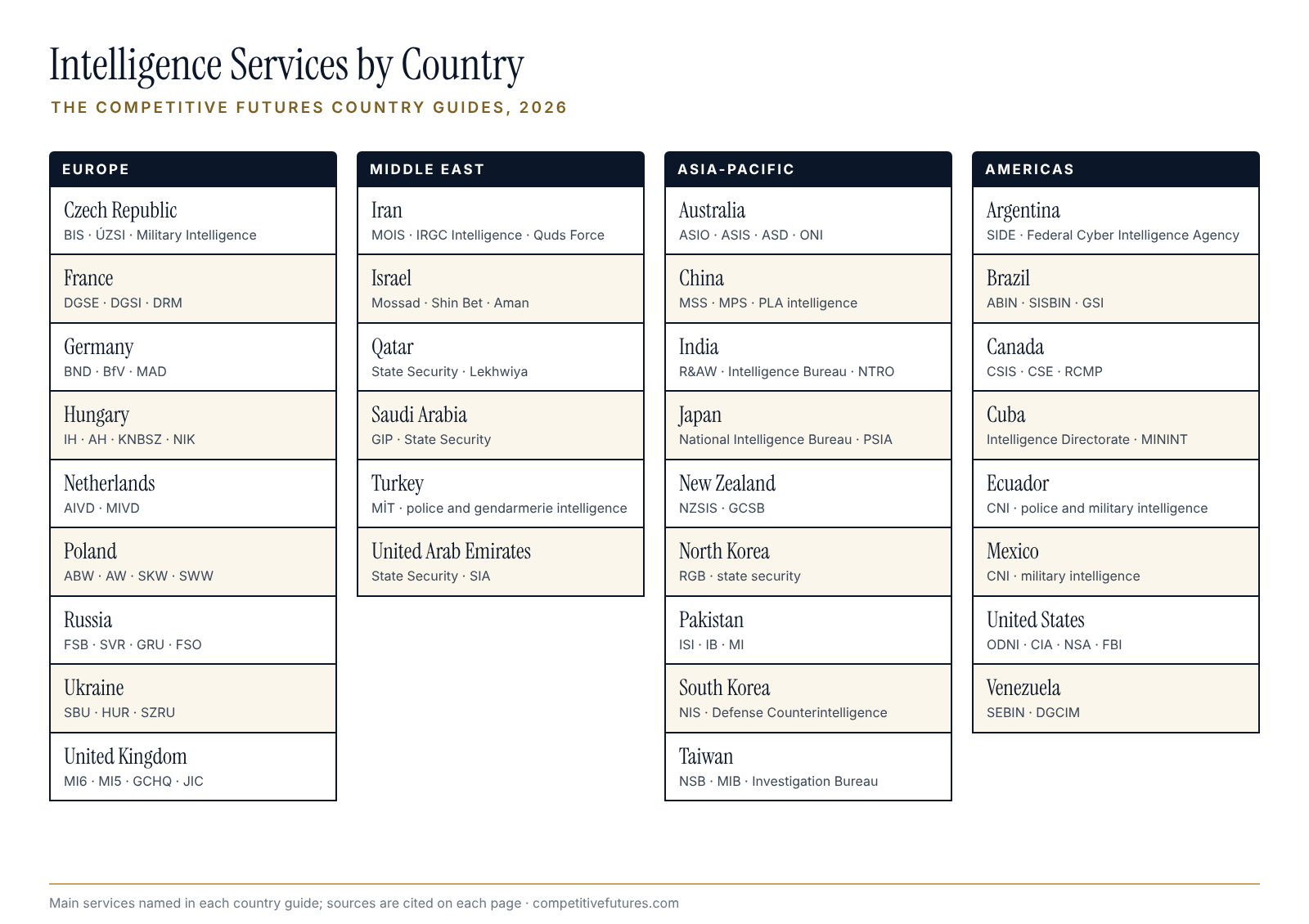
Europe
- Czech intelligence: the Security Information Service (BIS), the Office for Foreign Relations and Information (ÚZSI), and Military Intelligence, built on the ruins of the communist StB.
- French intelligence: the DGSE, the DGSI, and military intelligence, with roots in Napoleon’s police ministry and the Dreyfus affair.
- German intelligence: the BND, the domestic Verfassungsschutz, and military counterintelligence, shaped by the legacies of the Nazi era and the Stasi.
- Hungarian intelligence: the Information Office, the Constitution Protection Office, military national security, and the National Information Centre, in the middle of a 2026 overhaul.
- Dutch intelligence: the AIVD and MIVD, which have made unusually public attributions of Russian and Chinese cyber operations.
- Polish intelligence: the ABW, the Foreign Intelligence Agency, and military services, heirs to the Enigma codebreakers and now on NATO’s eastern flank.
- Russian intelligence: the FSB, SVR, GRU, and FSO, the heirs to the KGB and its predecessors back to the tsarist Okhrana.
- Ukrainian intelligence: the SBU, military intelligence (HUR), and the Foreign Intelligence Service, rebuilt from KGB structures and now operating in wartime.
- British intelligence: MI6, MI5, GCHQ, and the Joint Intelligence Committee, with roots in the Secret Service Bureau of 1909.
Middle East
- Iranian intelligence: the Ministry of Intelligence and the Revolutionary Guards’ intelligence organizations, two rival systems under one Supreme Leader.
- Israeli intelligence: the Mossad, the Shin Bet, and military intelligence, including Unit 8200, and a long tradition of public inquiries into intelligence failure.
- Qatari intelligence: State Security and a foreign policy built on mediation, influence, and the hosting of a major U.S. base.
- Saudi intelligence: the General Intelligence Presidency and the Presidency of State Security, created by royal order in 2017.
- Turkish intelligence: MİT and a tradition of Ottoman intelligence going back more than five centuries.
- Emirati intelligence: State Security, the Signals Intelligence Agency, and the national security adviser’s portfolio.
Asia-Pacific
- Australian intelligence: ASIO, ASIS, ASD, and the Office of National Intelligence, a small community inside the Five Eyes alliance.
- Chinese intelligence: the Ministry of State Security, the Ministry of Public Security, PLA intelligence, and United Front work, under a law that obliges citizens to assist.
- Indian intelligence: the Research and Analysis Wing, the Intelligence Bureau, and the national security adviser, services that operate without a statute of their own.
- Japanese intelligence: the new National Intelligence Bureau, the Public Security Intelligence Agency, and police and defense intelligence.
- New Zealand intelligence: the NZSIS and GCSB, the smallest members of the Five Eyes.
- North Korean intelligence: the Reconnaissance General Bureau, state security, and the hacking units that raise money for the regime.
- Pakistani intelligence: the Inter-Services Intelligence directorate, run by serving military officers and central to the country’s politics.
- South Korean intelligence: the National Intelligence Service and military counterintelligence, shaped by decades of political scandal and reform.
- Taiwanese intelligence: the National Security Bureau, the Military Intelligence Bureau, and the Investigation Bureau, focused on counterintelligence against Beijing.
Americas
- Argentine intelligence: SIDE, restored in 2024, and a history that runs through Operation Condor and the AMIA bombing investigation.
- Brazilian intelligence: ABIN and the Brazilian Intelligence System (SISBIN), under scrutiny since the “ABIN paralela” investigation.
- Canadian intelligence: CSIS, the Communications Security Establishment, and the RCMP, a Five Eyes member with no foreign human-intelligence service of its own.
- Cuban intelligence: the Interior Ministry’s Intelligence Directorate, long known as the DGI, with a record of penetrating U.S. agencies.
- Ecuadorian intelligence: the National Intelligence Center (CNI), successor to SENAIN, at the center of the fight against criminal groups.
- Mexican intelligence: the National Intelligence Center (CNI), the Security Secretariat, and military intelligence aimed at the cartels.
- American intelligence: the 18-member intelligence community under the Director of National Intelligence, including the CIA, NSA, and FBI.
- Venezuelan intelligence: SEBIN and military counterintelligence (DGCIM), the subject of UN findings on political policing.
The four jobs of an intelligence system
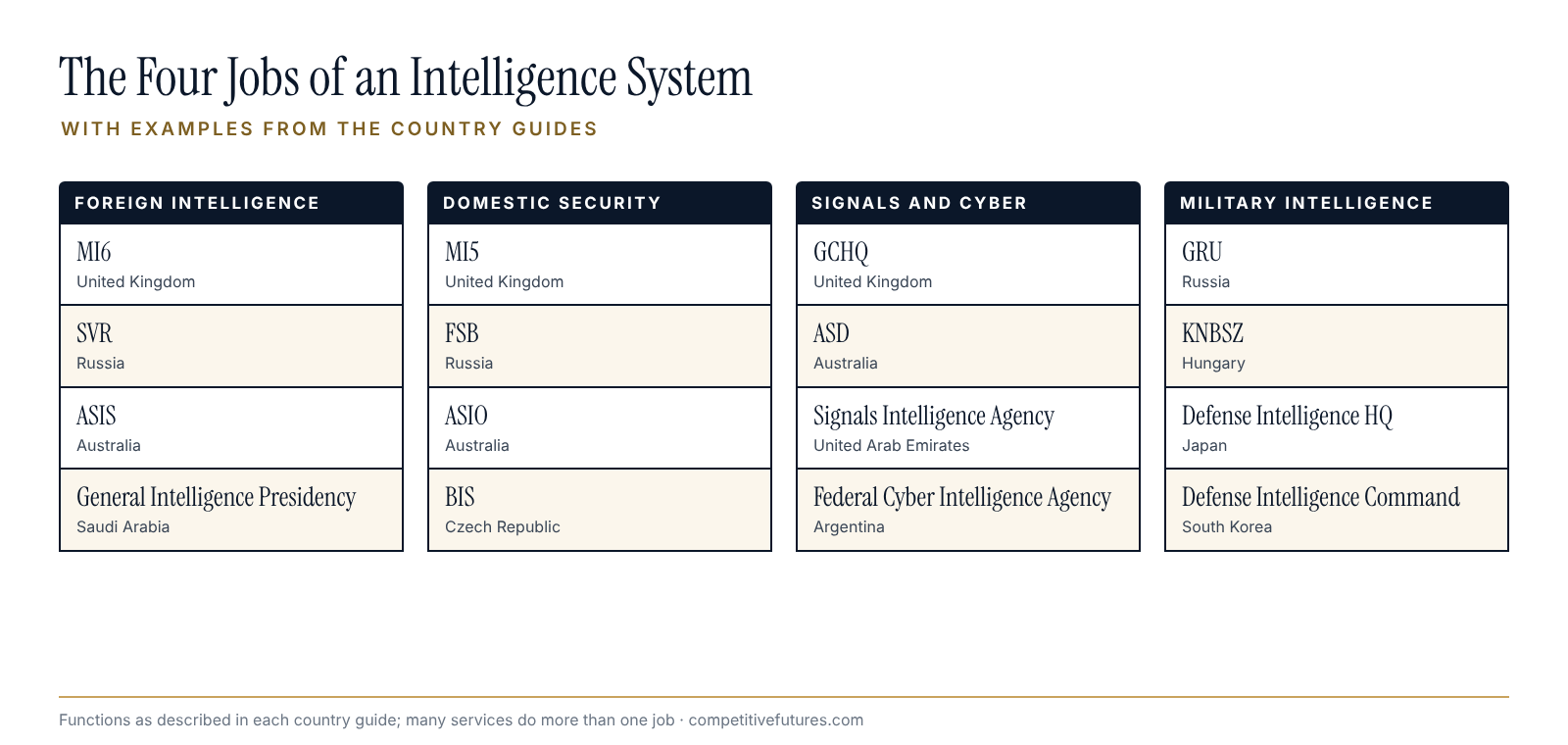
Names and acronyms vary, but almost every national system divides its work into the same four jobs. Some countries give each job to a separate agency; others combine them. Knowing which job an agency does is the first step to understanding any story about it.
- Foreign intelligence collects secrets abroad, usually from human sources. Britain’s MI6, France’s DGSE, Russia’s SVR, Australia’s ASIS, and Saudi Arabia’s General Intelligence Presidency are foreign services.
- Domestic security, often called counterintelligence or security intelligence, protects the state at home from espionage, terrorism, and foreign interference. MI5, the FSB, ASIO, Germany’s BfV, and the Czech BIS do this job. Whether a domestic service can arrest people, or must hand cases to the police, is one of the biggest differences between systems.
- Signals and cyber intelligence intercepts communications and, increasingly, runs offensive and defensive cyber operations. GCHQ in Britain and the Australian Signals Directorate are the best-known examples in this collection; the UAE and Argentina have built dedicated cyber or signals agencies of their own.
- Military intelligence serves the armed forces. In some countries it stays in its lane; in others, such as Russia’s GRU, it runs some of the state’s most aggressive operations abroad.
On top of these four jobs sits a fifth function that is easy to miss: coordination and assessment. Britain’s Joint Intelligence Committee, Australia’s Office of National Intelligence, and Japan’s new National Intelligence Bureau exist to pull the agencies’ reporting together into a single judgment for political leaders. Countries without a strong coordinating body tend to have services that compete for the leader’s ear.
Who controls intelligence: four models
The most useful way to compare intelligence systems is by asking who controls them and who can check them. The country guides fall broadly into four groups. These are descriptions of reporting lines, not grades.
Statute and parliamentary oversight
In the United States, Britain, France, Germany, the Netherlands, Poland, Ukraine, Israel, Australia, New Zealand, Canada, Taiwan, the Czech Republic, Japan, South Korea, Brazil, and Argentina, the main services are set up by law, report to ministers or a head of government, and face some form of parliamentary or judicial oversight. The strength of that oversight varies a great deal, and several of these countries have had scandals precisely because oversight failed: South Korea’s NIS election-comment case, Brazil’s “ABIN paralela,” and Argentina’s long history of intelligence funds and judicial spying are examples covered in the guides.
Presidential or executive control
In Russia, Turkey, Mexico, and Hungary, intelligence answers above all to the head of the executive. Emergency decrees moved Turkey’s MİT under the presidency in 2017, and Russia’s services report directly to the president. Parliaments exist in all of these countries, but their practical power over intelligence is limited, so the direction of the services tends to follow the direction of the leader.
Monarchy and family
In Saudi Arabia, Qatar, and the United Arab Emirates, intelligence is tied closely to the ruling family. Senior posts often go to royals or long-trusted insiders, appointments are made by royal or amiri decree, and the line between national security and regime security is thin. Iran is a special case: a theocratic state in which the Ministry of Intelligence and the Revolutionary Guards’ intelligence organization answer to the Supreme Leader and have often competed with each other.
Party and army
In China, North Korea, and Cuba, the intelligence services serve the ruling party as much as the state, and Chinese law requires organizations and citizens to support national intelligence work. Pakistan is different again: its most powerful service, the ISI, is run by serving military officers, and the military’s role in politics is the central debate covered in the Pakistani guide. India sits between models: its services report to elected ministers but, as the Indian guide explains, operate without a statute of their own.
Patterns in the headlines
Read the country guides side by side and the same kinds of stories keep appearing. Knowing the pattern helps a reader see what is new in a breaking story and what is a familiar move.
Operations against exiles and dissidents
Governments use their services to reach critics abroad. The guides cover Saudi Arabia and the killing of Jamal Khashoggi in Istanbul, Iran’s Mykonos killings in Berlin and the plots against Masih Alinejad, Turkey’s renditions from abroad, and Russia’s poisonings of Alexander Litvinenko and the Skripals. The Indian guide covers Canadian and U.S. allegations over plots against Sikh separatists, which India rejects. These cases usually end up in foreign courts or public inquiries, which makes them some of the best-documented intelligence stories there are.
Influence, lobbying, and money
Some of the most consequential intelligence activity looks like ordinary politics. The Qatari guide covers the Menendez prosecution and the Elliott Broidy hacked-email litigation; the Czech and Hungarian guides cover the Voice of Europe network and the Brussels spy network; the Australian guide covers the foreign-interference laws passed after the Dastyari affair. Here the evidence often lives in court filings and lobbying registrations rather than in leaks.
Hacking and spyware
Cyber operations now appear in almost every guide: Pegasus spyware in Mexico, Hungary, Saudi Arabia, and the UAE; Project Raven in the UAE; Chinese state hacking groups, from Volt Typhoon to those targeting Australia, Japan, and the Czech Foreign Ministry; Brazil’s Itaipu operation against Paraguay; and the North Korean thefts from Bangladesh Bank and the Bybit exchange, which U.S. authorities attribute to Pyongyang. Attribution in these cases usually comes from governments, researchers, or courts, and the accused state almost always denies it.
Scandal and reform
Intelligence systems tend to change after a crisis. South Korea has reorganized its services repeatedly after political scandals, Argentina dissolved and then restored its main agency, Japan created a National Intelligence Bureau in 2026, and Hungary began an overhaul after its 2026 election. A reorganization is worth watching, because it often reveals what a new government thinks went wrong.
How to read intelligence stories
Intelligence reporting is unusually hard to check. Sources are anonymous by necessity, governments leak selectively, and some outlets covering a rival state are funded by governments with a stake in the story. A few habits help:
- Find the primary record. Indictments, judgments, parliamentary reports, official gazettes, and sanctions designations are better evidence than any account of them. In the United States, foreign-agent registrations are public on the FARA eFile system.
- Separate allegation from finding. An accusation, a charge, a conviction, and an acquittal are different things. The country guides state the legal status of each case for this reason.
- Ask who funds the outlet. State media and outlets funded by rival governments can be accurate, but their incentives belong in the reader’s judgment.
- Count the sources. A claim that rests on one anonymous official is a lead, not a fact.
- Watch for your own bias. Readers are quickest to believe intelligence stories that fit what they already think. The guide to cognitive bias covers the traps that matter most.
Frequently asked questions
What is the difference between an intelligence agency and a security service?
An intelligence agency usually means a service that collects information abroad, such as Britain’s MI6 or Australia’s ASIS. A security service protects the state at home against espionage, terrorism, and foreign interference, such as MI5 or ASIO. Many countries combine both jobs in one organization, and the terms are often used loosely.
Who oversees intelligence agencies?
It depends on the country. In parliamentary democracies such as Britain and Australia, ministers direct the services and parliamentary committees, inspectors, and courts review them. In presidential and monarchical systems, the head of state often controls intelligence directly and outside oversight is limited. Each country guide describes its own oversight arrangements.
How are these country guides kept current?
Each guide names the current heads of the main services with a source and a date, and states the legal status of each case. When a leader changes, a court rules, or a law passes, the page is updated. Claims that could not be verified are left out rather than guessed.
Related reading
- Qatari Intelligence: History, Structure, and the Headlines
- Russian Intelligence: History, Structure, and the Headlines
- How to evaluate a forecast
- Strategic foresight: a practical guide
Competitive Futures briefs companies and governments on intelligence services, foreign influence, and geopolitical risk; details are on the services page.