The Futures Wheel: How to Map the Second- and Third-Order Effects of Change

Most strategic surprises are not surprises about the change itself. Everyone saw the change coming. The surprise is what the change did next. The Futures Wheel is the simplest tool I know for seeing that second and third move before it arrives, and it takes nothing but a whiteboard, a marker and an hour with the right people.
What the Futures Wheel is
The Futures Wheel is a structured brainstorm for consequences. You write one change in the center of a page: a trend, a new technology, a regulation, an event. Around it you write its direct consequences. Around each of those you write their consequences, and so on outward, ring by ring. The result looks like a wheel, or a spider’s web, and it shows on one page how a single change ripples through an industry, a market or a society.
The method was invented by Jerome C. Glenn while he was a graduate student. Glenn went on to co-found and lead the Millennium Project, and his own description of the method is a chapter of the project’s Futures Research Methodology, the standard reference collection of futures research techniques. As I wrote in Future, Inc. (AMACOM, 2007), the tool shows “how one change, one driver, one trend, one technology is so interconnected that it changes the future of everything around it.”
Why the outer rings matter most

The first ring is easy. Anyone can tell you that a new technology will be bought by customers, or that a price increase will cut demand. The value of the wheel is in the second and third rings, because those are the effects nobody in the room was assigned to watch. In Future, Inc. I put it this way: “The primary implications are the most obvious—changes that occur specifically because of the driver being analyzed. However, those secondary and tertiary changes are the ones that sneak up on us.”
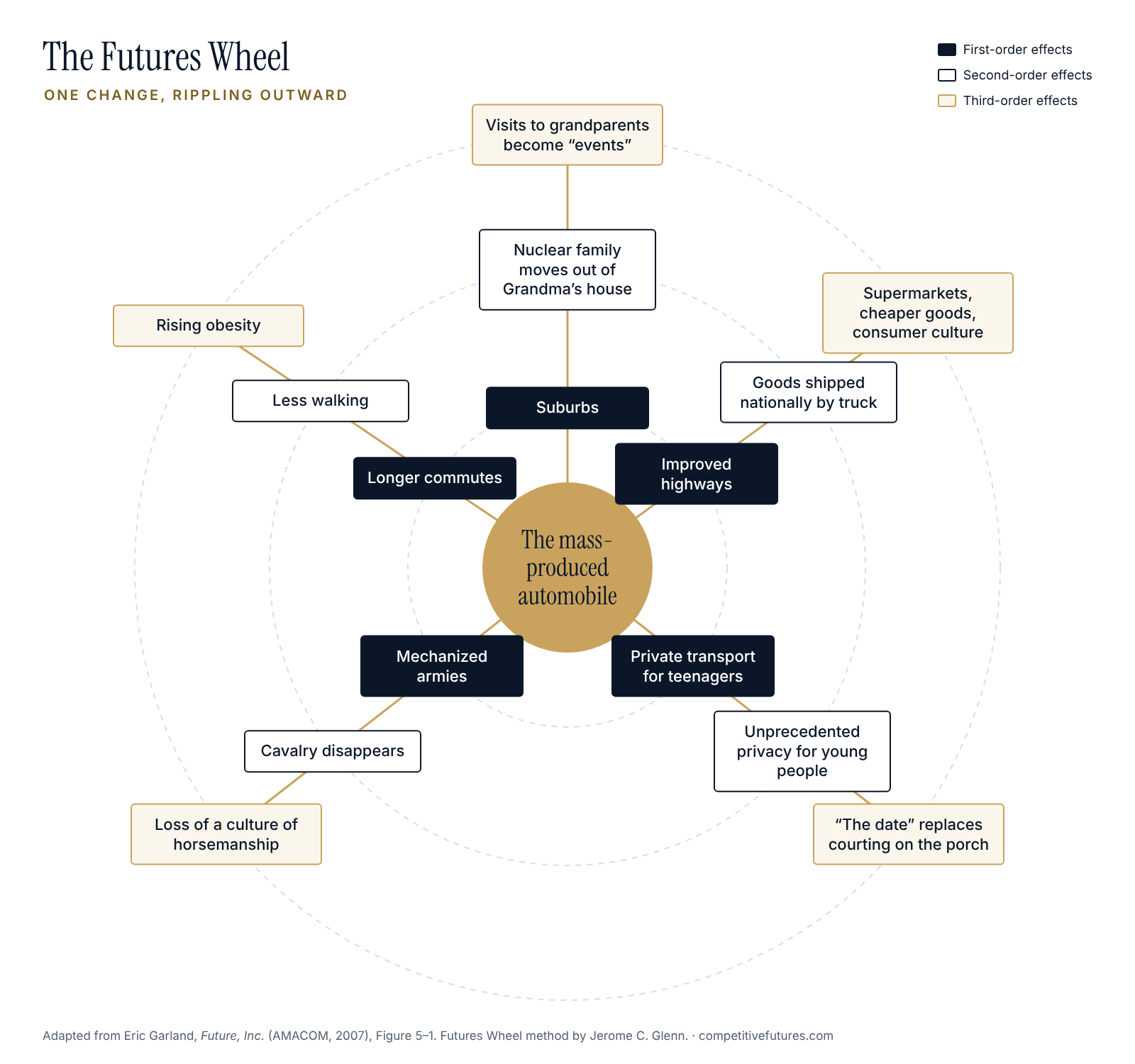
My favorite example is the mass-produced automobile. The first-ring implications are obvious: better roads, faster travel, a car in every garage. Go one ring out and you find suburbs, supermarkets and cheaper goods shipped by truck. Go one more and you find the end of the multigenerational household, a sedentary population, and, as I wrote in the book, teenagers with “unprecedented privacy” and a new courtship ritual called the date. Nobody who designed the Model T was thinking about grandmothers, waistlines or teenage romance. All three were downstream of his assembly line.
A business example from the same chapter: cheap transistors made the desktop computer possible (first ring). The desktop computer put word processing on every executive’s desk (second ring). Executives began typing their own letters, and the corporate typing pool disappeared (third ring), which, alongside much larger social forces, helped move women out of clerical roles and into management. A strategist in 1980 who stopped at the first ring would have forecast a computer market. One who went to the third would have forecast a change in who runs companies.
How to run a Futures Wheel, step by step

- Pick one change and state it precisely. “AI” is too vague to work with. “By 2030, most routine contract review is done by software” is a change you can reason from. A wild-card event works well too; in the book I used a sudden jump in U.S. gasoline to $10 a gallon.
- Write the first ring. List the direct consequences: who gains, who loses, what gets cheaper or more expensive, what becomes possible. Stop at five to eight.
- Write the second ring for each first-ring item. Ask of each one: if this happens, what happens next? Draw a line from each consequence to its parent so the chain of logic stays visible.
- Push to the third ring. This is where the group will slow down and the useful ideas appear. Keep asking “and then what?” until the answers start to sound strange. Strange is good.
- Check the wheel against all five STEEP categories. Society, technology, economics, ecology and politics. Most teams fill the technology and economics branches and leave the social and political ones empty. That is exactly where the surprises hide.
- Mark the implications that matter to you. Circle the ones that would change a decision you are making now: a hire, an investment, a product, a market. Those become questions for further research, or signposts to monitor.
When a group of business students at American University ran the $10-gasoline wheel, they went well past “people will carpool.” They predicted rising real estate prices downtown as commuting became expensive, public transit losing its working-class stigma, imports of tiny European city cars and, eventually, less obesity from more walking. None of those is a fact about oil. All of them would matter to a real estate developer, a transit authority or an automaker.
A recent example: remote work

Run the wheel on the shift to remote work after 2020 and you can watch the rings play out in public data. First ring: fewer people in offices. Second ring: companies need less office space and stop renewing leases. Third ring: office buildings lose tenants and value. By the second quarter of 2024, the U.S. office vacancy rate had hit a record 20.1 percent, according to Moody’s, which attributed the rise mainly to remote work (Fortune). A fourth ring would take you to the lenders holding loans against those buildings, and to the city budgets that depend on downtown property taxes. A bank strategist who drew this wheel in 2020 would have had a three-year head start.
Going further: cross-impact analysis
The Futures Wheel starts from one change. When you have a dozen trends and want to know how they interact, use its bigger sibling, cross-impact analysis. List all your trends down the side of a grid and across the top, then force yourself to consider every pairing. As I wrote in Future, Inc., the grid “makes you check every trend, forecast, or wild-card against every other one.” Most combinations will be dull. A few will be the most important ideas in the project, because nobody else thought to put those two trends in the same sentence.
Common mistakes
- Stopping at the first ring. If every item on your wheel would appear in a trade-magazine article, you have not done the exercise.
- Writing platitudes. In Future, Inc. I listed three “implications” that should never appear on a wheel: that tomorrow will be more competitive than ever, that the future is about efficiency, and that some new gadget means “the future is actually here.” Each says that tomorrow will be like today, only more so.
- Inviting only the usual people. A wheel drawn entirely by engineers will have a rich technology branch and nothing else. In my satirical second book, How to Predict the Future…and WIN! (2011), one of the twenty-five worst practices was “Don’t invite young people, poor people, artists, or any diverse opinions to the table.” Do the opposite.
- Treating the wheel as a forecast. The wheel shows what could follow from a change, not what will. Its job is to widen what you are watching, not to tell you what will happen.
Where the Futures Wheel fits
In a full foresight project, the Futures Wheel sits between research and scenarios. You map the system, collect trends and evaluate expert forecasts, then use the wheel to work out what they mean for you, then assemble the results into scenarios. The whole process is described in the guide to strategic foresight. If you only have an hour, though, the wheel works on its own. Put a change your industry is already talking about in the center of the whiteboard, and do not let anyone leave until the third ring is full.
Frequently asked questions
Who invented the Futures Wheel?
Jerome C. Glenn, a futurist who later co-founded the Millennium Project, developed it as a graduate student. His account of the method appears in the Millennium Project’s Futures Research Methodology.
How long does a Futures Wheel exercise take?
A useful first pass takes 45 to 90 minutes with five to ten people. The research to test the most important implications can take much longer.
What is the difference between a Futures Wheel and a mind map?
A mind map organizes what you already know about a topic. A Futures Wheel is directional: every line runs from a cause to a consequence, and each ring is a step further into the future.
Related reading
- Strategic Foresight: A Practitioner’s Guide to Seeing What’s Coming
- The Impact-Probability Matrix for scenario planning
- Cognitive Bias: A Field Guide for Leaders
Competitive Futures teaches the Futures Wheel and other foresight methods in executive education workshops; details are on the services page.