Russian Intelligence: History, Structure, and the Headlines
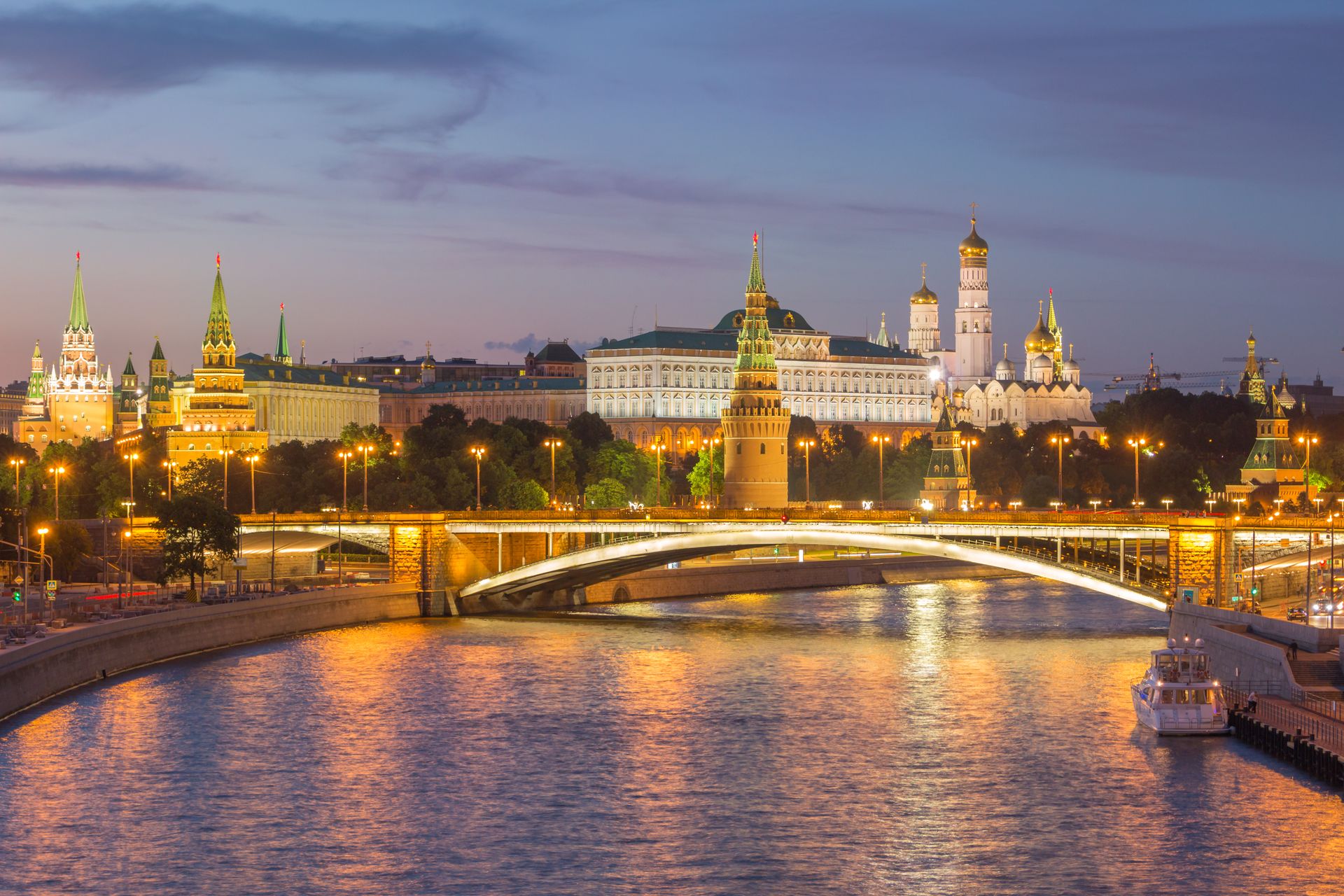
Few governments are as shaped by their intelligence services as Russia’s. The country’s president is a former KGB officer who once ran the domestic security service; several of the men around him came up through the same agencies; and for two decades Russian intelligence officers have been named by courts, public inquiries, and prosecutors across Europe and North America in poisonings, hacking operations, sabotage, and deep-cover espionage. Moscow denies nearly all of it. Understanding these services, and how the evidence against them was assembled, is basic for anyone whose work touches Russia.
This page is a working overview of Russia’s intelligence and security services: where they came from, how they are organized today, and the cases that have put them in the news. It relies on Russian federal law, official Russian statements, Western court records and public inquiries, and named reporting. Each allegation is paired with Russia’s response, and the page distinguishes findings by courts and inquiries from claims by governments or journalists.
Russian intelligence at a glance
- Federal Security Service (FSB): Federalnaya sluzhba bezopasnosti, the domestic security and counterintelligence service and the largest successor to the KGB, governed by Federal Law No. 40-FZ of April 3, 1995 (ConsultantPlus). Director: Alexander Bortnikov, appointed in May 2008, when he replaced Nikolai Patrushev (Al Jazeera). In September 2026, independent outlets reported that he could be replaced in a planned reorganization; there was no official comment (Meduza, citing iStories).
- Foreign Intelligence Service (SVR): Sluzhba vneshney razvedki, the civilian foreign intelligence service, governed by Federal Law No. 5-FZ of January 10, 1996, “On Foreign Intelligence” (Law No. 5-FZ). Director: Sergei Naryshkin, a former speaker of the State Duma, appointed in September 2016 (Gulf Times).
- Military intelligence (GRU): formally the Main Directorate of the General Staff (GU), still almost universally called the GRU. Head: Admiral Igor Kostyukov, who became acting chief in 2018 and then full chief after his predecessor died; he was sanctioned by the United States in 2016 and in 2026 led Russia’s delegation at Ukraine talks in Abu Dhabi (Reuters via Al-Monitor).
- Federal Protective Service (FSO): guards the president and senior officials; it grew out of the KGB’s Ninth Directorate (Federation of American Scientists).
- Oversight and reporting line: all of these bodies answer to the president. The foreign intelligence law states that “general leadership” of the foreign intelligence bodies is exercised by the president (Law No. 5-FZ, Art. 12). The president also forms and heads the Security Council (Constitution, Art. 83), whose secretary since May 2024 has been Sergei Shoigu, the former defense minister (CSTO Parliamentary Assembly).
- Relationship with the United States: adversarial, with narrow working channels. In June 2025, Naryshkin said he and the CIA director had agreed they could call each other “at any time” (Reuters via The Kathmandu Post).
History: from the Okhrana to the KGB’s heirs
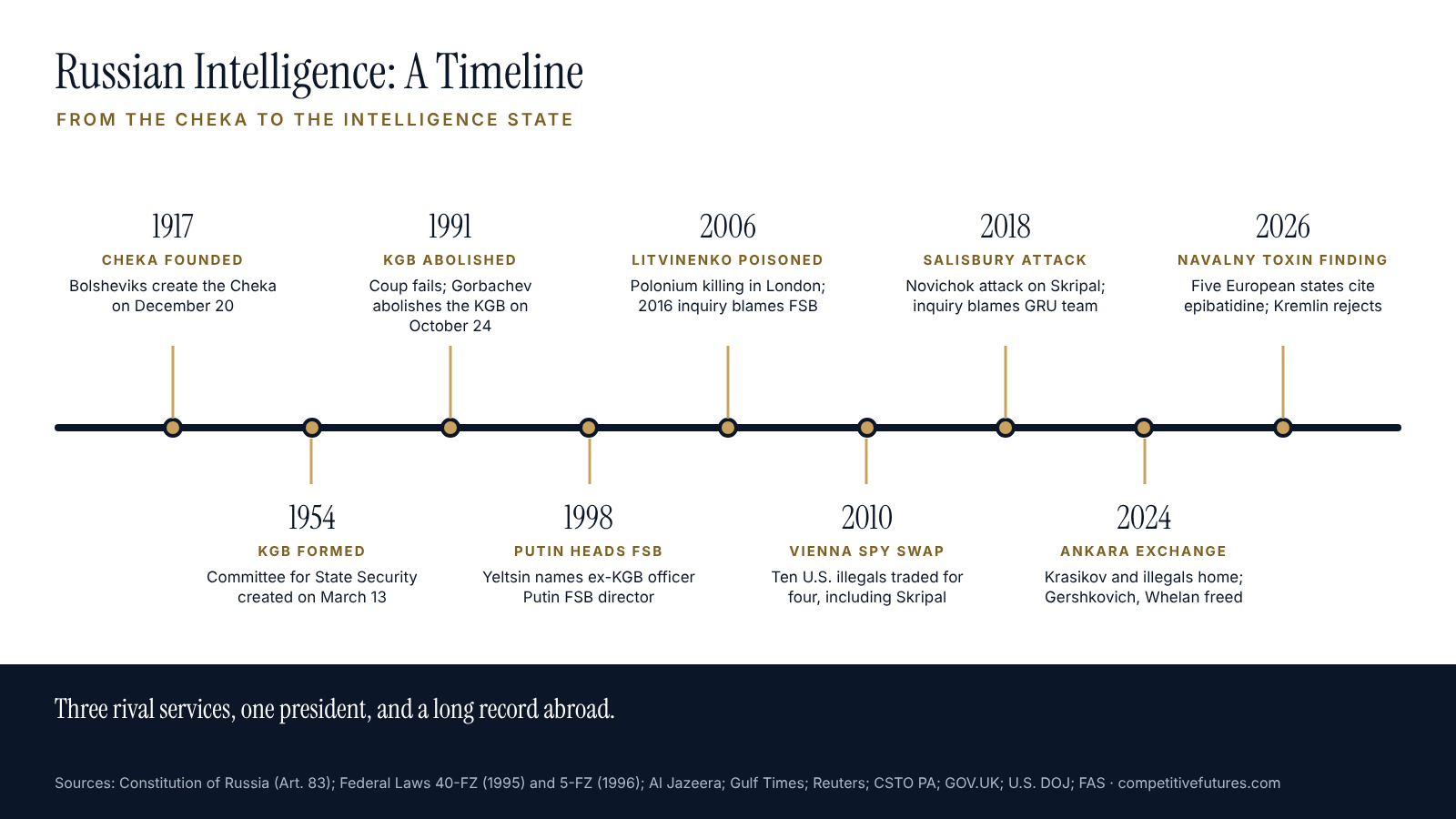
Tsarist Russia’s security police, known as the Okhrana, dated from the early 1880s and specialized in watching and infiltrating revolutionary groups. Weeks after the October Revolution, on December 20, 1917, the Bolsheviks created the Cheka, the “Extraordinary Commission,” under Felix Dzerzhinsky. It was renamed and reorganized repeatedly over the following decades, as the GPU, OGPU, NKVD, and NKGB, until the Committee for State Security, the KGB, was formed on March 13, 1954 (Daniel Meissner, Marquette University). Military intelligence, the GRU, stayed separate under the General Staff.
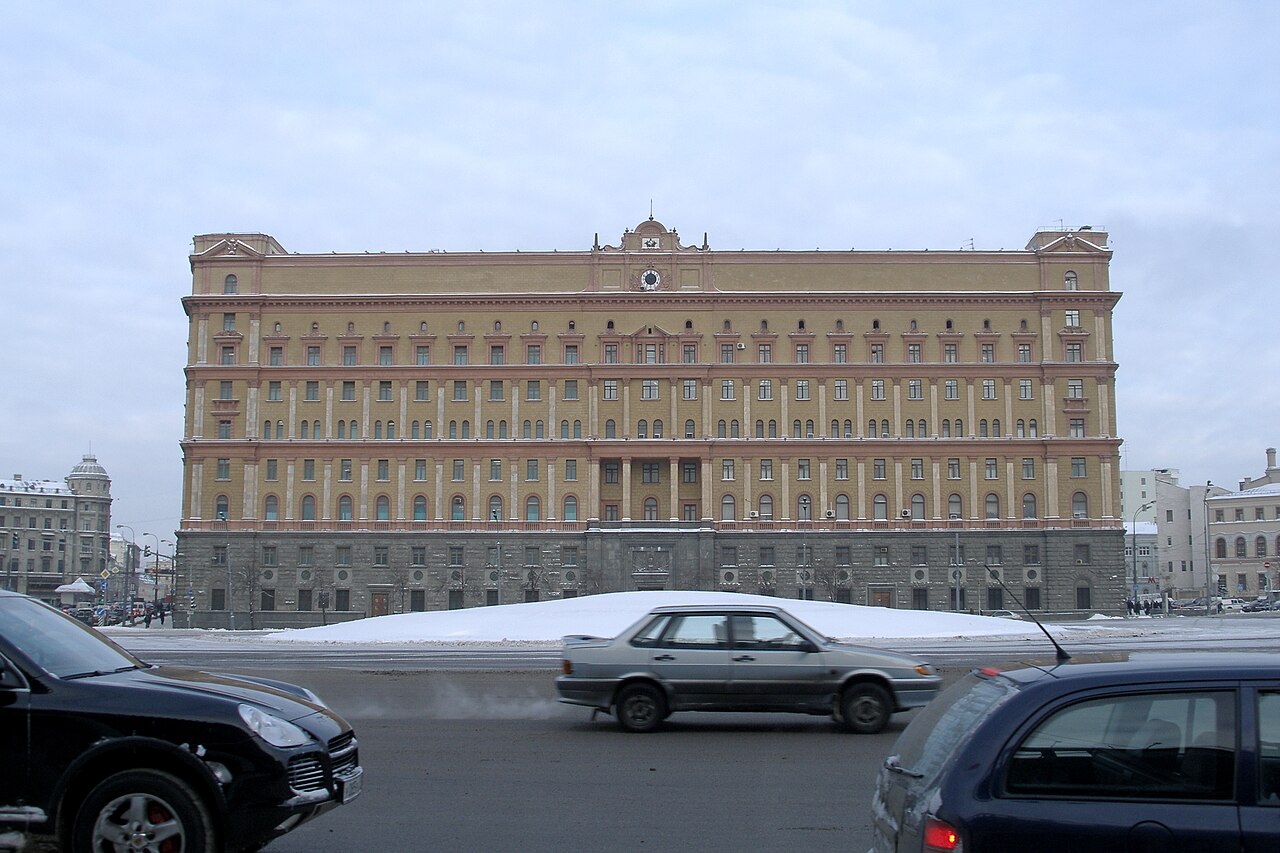
The KGB’s end came from inside. Its chairman, Vladimir Kryuchkov, was one of the leaders of the failed August 1991 coup against Mikhail Gorbachev, and some KGB special forces commanders refused orders to storm the Russian parliament. Kryuchkov was arrested on August 21, 1991; the reformer Vadim Bakatin replaced him the next day; and on October 24, 1991, Gorbachev signed a decree abolishing the KGB (Federation of American Scientists).
The pieces were then rebuilt as separate agencies. Foreign intelligence became a separate service in October 1991 and later the SVR. The guard directorate became the FSO. Domestic security passed to a Ministry of Security, which was disbanded in December 1993 and replaced by the Federal Counterintelligence Service (FAS), which became the FSB under the April 1995 law. The foreign intelligence law names two foreign intelligence bodies, the SVR and the Defense Ministry’s foreign intelligence body, meaning the GRU, and says the FSB’s intelligence work is conducted in coordination with them (Law No. 5-FZ, Art. 11).
Vladimir Putin’s career runs straight through this history. He joined the KGB in 1975, served in Dresden in East Germany, and resigned in 1991 as a lieutenant colonel. Boris Yeltsin made him director of the FSB in 1998; he became secretary of the Security Council in 1999, prime minister in August 1999, and acting president on December 31, 1999 (Britannica).
How Russian intelligence is organized today
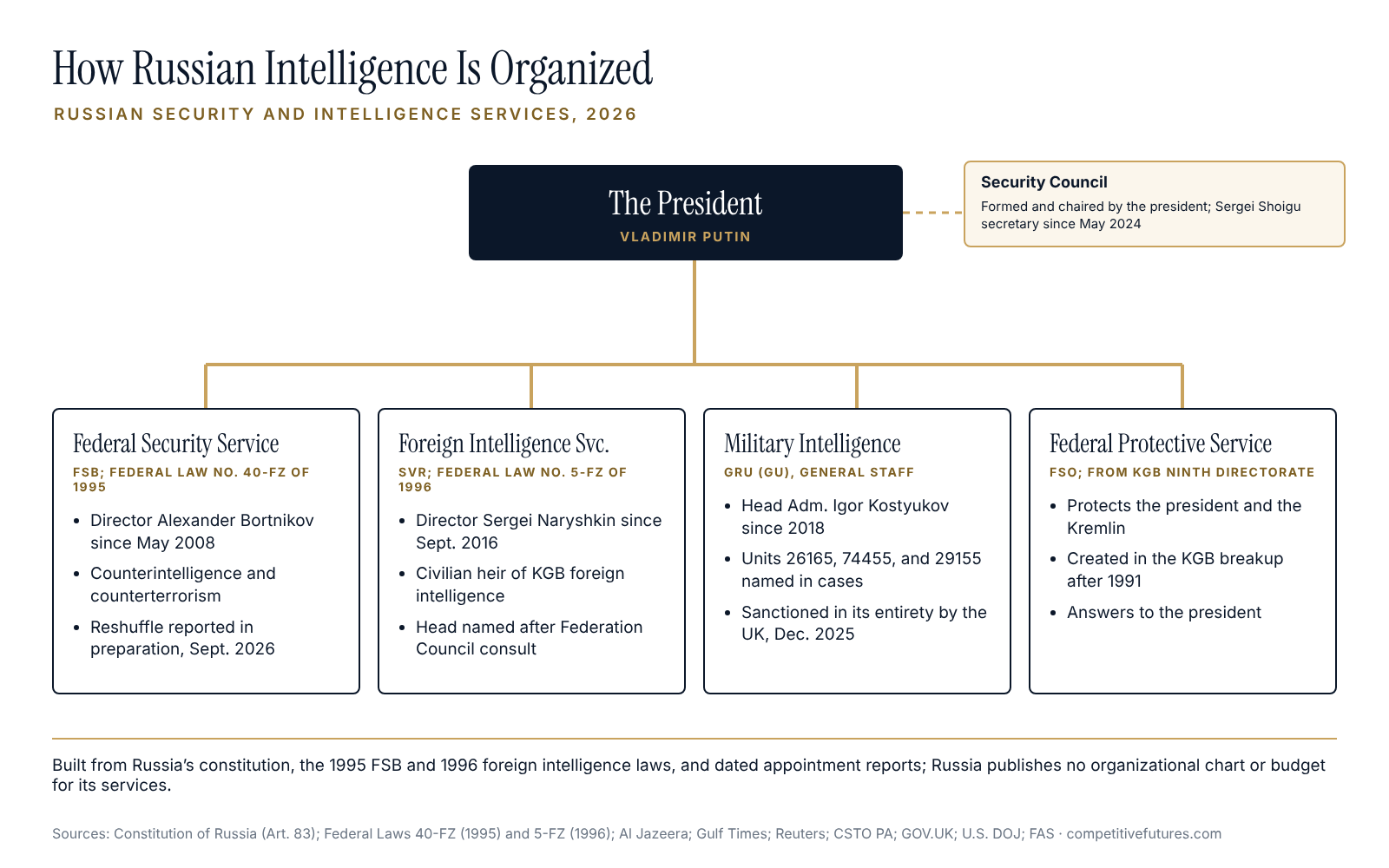
Russia publishes its intelligence laws but not its budgets or organizational charts, so the public picture comes from statute, official appointments, and what foreign courts and governments have established.
- The FSB is the dominant service. It handles counterintelligence, counterterrorism, and domestic political security, and under the 1996 foreign intelligence law it also conducts intelligence work in coordination with the foreign services. Its director chairs the National Anti-Terrorism Committee (TASS).
- The SVR is the civilian foreign intelligence service, the direct heir of the KGB’s First Chief Directorate. Under its 1996 law, the president appoints its director after consulting the Federation Council (Law No. 5-FZ, Art. 12).
- The GRU (GU) is military intelligence under the General Staff. Its numbered units, including 26165, 74455, and 29155, appear in U.S. indictments and European investigations described below.
- The FSO protects the president and the Kremlin.
- The Security Council, formed and chaired by the president, brings the service chiefs together with senior ministers. Patrushev became its secretary in 2008, moving from the FSB, and Shoigu took the post in May 2024.
Two features stand out. First, democratic oversight is thin: the historian Mark Kramer wrote in 2012 that control of the services was “tenuous at best and, in some cases, nonexistent” (PONARS Eurasia). Second, the FSB, SVR, and GRU have overlapping mandates abroad, and many of the operations Western governments have exposed since 2018 were attributed to the GRU.
The intelligence state
Russians call the officials who come from the security, military, and law enforcement agencies the siloviki, roughly “the men of force.” Under Putin they have become the core of the governing class. The career paths show it: Patrushev went from the FSB to 16 years at the Security Council, Shoigu from the Defense Ministry to the same post, and Naryshkin from the speaker’s chair to the SVR. Who rises inside the FSB therefore matters well beyond the service, which is why the reshuffle reported in 2026 is being watched closely.
The system is also unusually open about what it values. After the August 2024 prisoner exchange described below, Putin met the returnees at the airport, and the Kremlin confirmed that one was an FSB officer and two were deep-cover “illegals.” Presidential spokesman Dmitry Peskov said of the illegals’ children, who learned their parents were Russian on the flight home, “That’s how illegals work, and that’s the sacrifices they make because of their dedication to their work” (AP via Irish Examiner). Service chiefs also act as political voices: in late 2025, Bortnikov blamed growing sabotage inside Russia on Ukrainian services working under Western supervision (TASS).
Russian intelligence in the news
Most public knowledge about how Russia uses its intelligence services comes from the cases below. In each, the findings come from courts, public inquiries, prosecutors, or investigative reporters, and Russia has denied them, dismissed them as political, or declined to comment.
The poisoning of Alexander Litvinenko (2006–2016)
Alexander Litvinenko, a former FSB officer who had fled to Britain, died in London in November 2006 after being poisoned with polonium-210. A British public inquiry chaired by Sir Robert Owen reported on January 21, 2016 (GOV.UK). It concluded that Andrei Lugovoi and Dmitri Kovtun poisoned him under FSB direction and found that “the FSB operation to kill Litvinenko was probably approved by Mr Patrushev and also by President Putin.” Both men denied involvement; Lugovoi, by then a member of the Russian parliament, called the inquiry a weak attempt to use “a skeleton in the closet.” The Kremlin warned that the inquiry could further poison relations, and the Foreign Ministry called it “biased” and “opaque” (Al Jazeera). Neither man has been tried.
The illegals ring and the Vienna swap (2010)
On June 28, 2010, the U.S. Justice Department announced the arrest of ten people accused of carrying out “deep-cover” assignments in the United States for the Russian Federation; an eleventh defendant was at large (U.S. Department of Justice). They pleaded guilty to conspiring to act as unregistered agents of a foreign government, and on July 9 they were flown to Vienna and exchanged for four men Russia had imprisoned for spying for the West. One of the four was Sergei Skripal, a former Russian military intelligence colonel convicted in 2006 of passing secrets to Britain. Russia’s Foreign Ministry confirmed the exchange, describing the ten only as “Russian citizens accused in the United States” (Al Jazeera). Skripal settled in Salisbury, England.
Vrbětice and GRU Unit 29155 (2014–2021)
Explosions in 2014 at an ammunition depot near Vrbětice in the Czech Republic killed two workers. In April 2021, Prime Minister Andrej Babiš said there was “clear evidence” linking GRU officers to the explosions, and Prague gave 18 Russian diplomats it identified as intelligence officers 48 hours to leave. Czech police named the two suspects by the aliases “Alexander Petrov” and “Ruslan Boshirov,” the same names used by the men accused of the Salisbury attack (The Moscow Times). Interior Minister Jan Hamáček said the only line of investigation involved members of GRU Unit 29155. President Miloš Zeman publicly questioned the evidence, which the government rejected (RFE/RL). Moscow responded by expelling 20 Czech diplomats, and Russian state media portrayed the accusation as Western-directed. In 2024, the U.S. Justice Department charged five officers of the same unit with cyberattacks on Ukraine; the State Department offered up to $10 million for information on their whereabouts (U.S. Department of Justice).
The 2016 U.S. election hacking indictment (2016–2018)
On July 13, 2018, a federal grand jury indicted 12 officers of GRU Units 26165 and 74455 for hacking the Democratic Congressional Campaign Committee, the Democratic National Committee, and the Clinton campaign, staging the release of stolen documents, and conspiring to hack state election boards, secretaries of state, and election technology companies. The Justice Department stated that there was “no allegation in the indictment that the charged conduct altered the vote count” (U.S. Department of Justice). Russia’s Foreign Ministry said the charges had no basis and that “criminal cases are worked up for obvious political reasons” (CNN). None of the officers has been tried.
The Salisbury nerve agent attack (2018–2025)
On March 4, 2018, Sergei Skripal and his daughter were poisoned with a Novichok nerve agent in Salisbury. Both survived. Months later, Dawn Sturgess, a local woman, died after applying the agent from a discarded “Nina Ricci” perfume bottle. A British public inquiry chaired by Lord Hughes, a former Supreme Court justice, reported on December 4, 2025. He was sure “beyond reasonable doubt” that the attack was carried out by a three-man GRU team using the aliases Alexander Petrov, Ruslan Boshirov, and Sergey Fedotov, and found that it “must have been authorised at the highest level, by president Putin.” He wrote that the team and those who sent them, “and only they, bear moral responsibility for Dawn’s death” (The Irish Times). Russia has denied any involvement. The same day, Britain sanctioned the GRU “in its entirety” and summoned the Russian ambassador (GOV.UK).
The poisoning and death of Alexei Navalny (2020–2026)
In August 2020, the opposition leader Alexei Navalny collapsed on a flight from Tomsk and was evacuated to Germany. The Organisation for the Prohibition of Chemical Weapons confirmed that his blood and urine contained biomarkers of a cholinesterase inhibitor structurally similar to chemicals added to its control lists in 2019, the Novichok family (OPCW). In December 2020, Bellingcat and The Insider, with Der Spiegel and CNN, published telecom and travel data they said showed an FSB unit specializing in poisonous substances had tailed Navalny since 2017, with three operatives in Tomsk at the time. Russia denied the accusations and maintained that no nerve agent had been found while Navalny was in Russia (Bellingcat).
Navalny returned to Russia, was imprisoned, and died in an Arctic prison colony in February 2024 while serving a 19-year sentence; Russian authorities said he fell ill after a walk (The Moscow Times). On February 14, 2026, Britain, Sweden, France, Germany, and the Netherlands said national laboratories had “conclusively confirmed the presence of epibatidine,” a toxin found in South American frogs, and reported Russia to the OPCW for a breach of the Chemical Weapons Convention (Government of Sweden). Peskov replied, “We consider them biased and baseless” (Malay Mail).
Illegals in Slovenia and Brazil, and the Ankara exchange (2022–2026)
Russia still runs the deep-cover officers known as illegals, and since 2022 several networks have been exposed. In Slovenia, Artem and Anna Dultsev, who had lived in Ljubljana under Argentine cover since 2017, were arrested on espionage charges in 2022. Sergey Cherkasov, using the Brazilian identity Victor Muller, was turned away by the Netherlands in 2022 when he tried to take up a post at the International Criminal Court on a false Brazilian passport; He is serving a 15-year Brazilian sentence for using a false document, and in July 2026 Brazil ordered his expulsion once it ends. Russia sought his extradition on a trafficking charge, which Brazil’s Federal Police saw as a ploy to get him back (CNN Brasil). In 2025, the New York Times reported that Brazil’s counterintelligence effort, Operation East, had identified at least nine Russian officers who used Brazilian identities as launch pads to the United States, Europe, and the Middle East; the report included no Russian comment (New York Times via NZ Herald).
The Dultsevs went home on August 1, 2024, in an exchange in Ankara, Turkey, in which Russia and Belarus freed 16 people, including the Wall Street Journal reporter Evan Gershkovich, the former U.S. Marine Paul Whelan, and the opposition politician Vladimir Kara-Murza, while Russia received Vadim Krasikov and others. Krasikov had been serving a life sentence in Germany for a 2019 killing in a Berlin park that German judges said was ordered by Russian authorities. The next day, the Kremlin acknowledged that he was an FSB officer who had once served in its Alpha unit (AP via Irish Examiner).
Sabotage and arson in Poland, Britain, and Germany (2024–2025)
Since 2024, several European governments and courts have tied sabotage to Russian services, often carried out by locally recruited people. In Britain, a fire on March 20, 2024, destroyed Ukrainian-owned warehouses in Leyton, east London, holding supplies for Ukraine. Prosecutors said the organizer, Dylan Earl, had made contact with the Wagner Group, which police said acts on behalf of the Russian state; Earl and Jake Reeves became the first people convicted under the National Security Act 2023 (Counter Terrorism Policing), and in October 2025 they were sentenced at the Old Bailey to 23 and 13 years (Waltham Forest Echo).
In Poland, Prime Minister Donald Tusk said in May 2025 that the 2024 fire that destroyed the Marywilska shopping center in Warsaw “was the result of arson ordered by Russian services,” and Poland closed Russia’s consulate in Kraków (The Record). In November 2025, after an explosive charge damaged the Warsaw–Lublin railway line used for deliveries to Ukraine, Tusk told parliament that the suspects were two Ukrainian citizens “cooperating with the Russian services” who had fled to Belarus (Chancellery of the Prime Minister of Poland). Peskov answered that “Russophobia is flourishing there” (The Moscow Times). In Germany, a Munich court in October 2025 sentenced a German-Russian man, Dieter S., to six years for spying for Russian intelligence and helping plan sabotage against rail lines and military sites, including U.S. bases; he denied all charges (AFP via The Local).
How to read coverage of Russian intelligence
Coverage of Russian intelligence is a contest of sources with interests. Russian state media, including TASS and RT, carry the official line, and the FSB regularly announces plots it attributes to Ukrainian or Western services. Ukrainian outlets and officials, at war with Russia, have every reason to emphasize Russian wrongdoing. Exiled Russian outlets such as Meduza, The Insider, and iStories do serious work but often rely on unnamed sources. Open-source investigators such as Bellingcat have produced some of the strongest public evidence, from travel and telecom records; ask how each record was obtained and who else has confirmed it.
The discipline is the same one taught in our guides to trend analysis and evaluating forecasts: climb toward primary records. For Russia, that means federal laws and decrees, the Litvinenko and Dawn Sturgess inquiry reports, U.S. indictments, European court judgments, OPCW reports, and sanctions designations. For influence work in Washington, the Justice Department’s public database of registered foreign agents (FARA eFile) shows who is paid to represent Russian interests and who is paid to oppose them. Weigh a finding by a court or a public inquiry above a government statement, and a government statement above an anonymous leak.
Frequently asked questions
What is Russia’s intelligence agency called?
Russia has several. The Federal Security Service (FSB) handles domestic security and counterintelligence; the Foreign Intelligence Service (SVR) handles civilian foreign intelligence; and military intelligence, formally the Main Directorate of the General Staff, is still widely known as the GRU. All three descend from Soviet services, and the FSB and SVR were carved out of the KGB after 1991.
Who is the head of Russian intelligence?
Alexander Bortnikov has directed the FSB since May 2008, Sergei Naryshkin has directed the SVR since September 2016, and Admiral Igor Kostyukov has headed military intelligence since 2018. All report to President Vladimir Putin, and Sergei Shoigu has been secretary of the Security Council since May 2024. Independent outlets reported in September 2026 that a reshuffle at the top of the FSB was being prepared.
What is GRU Unit 29155?
Unit 29155 is a GRU unit that Czech authorities linked to the 2014 Vrbětice depot explosions. The suspects in that case were the same officers accused in the 2018 Salisbury attack, and in 2024 the U.S. Justice Department charged other members of the unit with cyberattacks on Ukraine. Russia denies involvement in the Salisbury attack, and none of the officers has been tried.
Related reading
- Qatari Intelligence: History, Structure, and the Headlines
- Turkish Intelligence: History, Structure, and the Headlines
- Cognitive Bias: A Field Guide for Leaders
Competitive Futures briefs companies and governments on intelligence services, foreign influence, and Russia and Eurasia; details are on the services page.