Japanese Intelligence: History, Structure, and the Headlines
Japan is a treaty ally of the United States, a front-line state facing China, North Korea, and Russia, and a technology power whose industrial secrets are a standing target. For most of the postwar era it handled intelligence through a few small, separate offices in the prime minister’s office, the police, the Justice Ministry, the Defense Ministry, and the Foreign Ministry, with no foreign spy service and no general anti-espionage law. On July 31, 2026, that began to change, when Tokyo opened a National Intelligence Bureau under a new cabinet-level council chaired by the prime minister.
This page is a working overview of Japan’s intelligence and security services: where they came from, how they are organized today, and the cases that have put them in the news. It relies on Japanese government publications, court rulings as reported by wire services and the Japanese press, and named scholarship, and it notes where a claim rests on anonymous officials or comes from a government with an interest in the outcome.
Japanese intelligence at a glance
- Central body: the National Intelligence Bureau (Kokka Jōhō-kyoku), set up in the Cabinet Secretariat on July 31, 2026, under Act No. 28 of 2026. It replaced the Cabinet Intelligence and Research Office (Naikaku Jōhō Chōsashitsu, or Naichō), whose roots go back to a research office created in 1952 (Cabinet Secretariat).
- Head: Kazuya Hara, the bureau’s first head, named on July 24, 2026, and handed his appointment by Prime Minister Sanae Takaichi when the bureau opened on July 31. A career National Police Agency officer who joined in 1990, he had been Director of Cabinet Intelligence since June 2023 and earlier ran the agency’s Security Bureau (Jiji Press via Adnkronos; Jiji Press via Adnkronos).
- Other services: the Public Security Intelligence Agency (Kōan Chōsa-chō) under the Justice Ministry; the National Police Agency’s Security Bureau and the prefectural public security police, above all the Tokyo Metropolitan Police Department’s Public Security Bureau; the Defense Intelligence Headquarters (Jōhō Honbu) under the Defense Ministry; and the Foreign Ministry’s Intelligence and Analysis Service.
- Oversight and reporting line: the National Intelligence Council, chaired by the prime minister, first met on July 31, 2026. The Diet has no standing committee dedicated to intelligence oversight (Japan Institute of International Affairs).
- Relationship with the United States: close, and in many areas dependent. Japan is not a member of the Five Eyes intelligence alliance of the United States, Britain, Canada, Australia, and New Zealand, though it cooperates closely with its members, including through bilateral intelligence sharing with Washington and Canberra (The Strategist, ASPI).
History: from the Special Higher Police to the Cabinet’s small office
Modern Japanese intelligence dates to the Meiji era. In the MIT political scientist Richard Samuels’s account, the imperial state leaned on freelance agents and nationalist societies for deniability, while official intelligence was split among the army, the navy, and the diplomats, who rarely coordinated (MIT News).
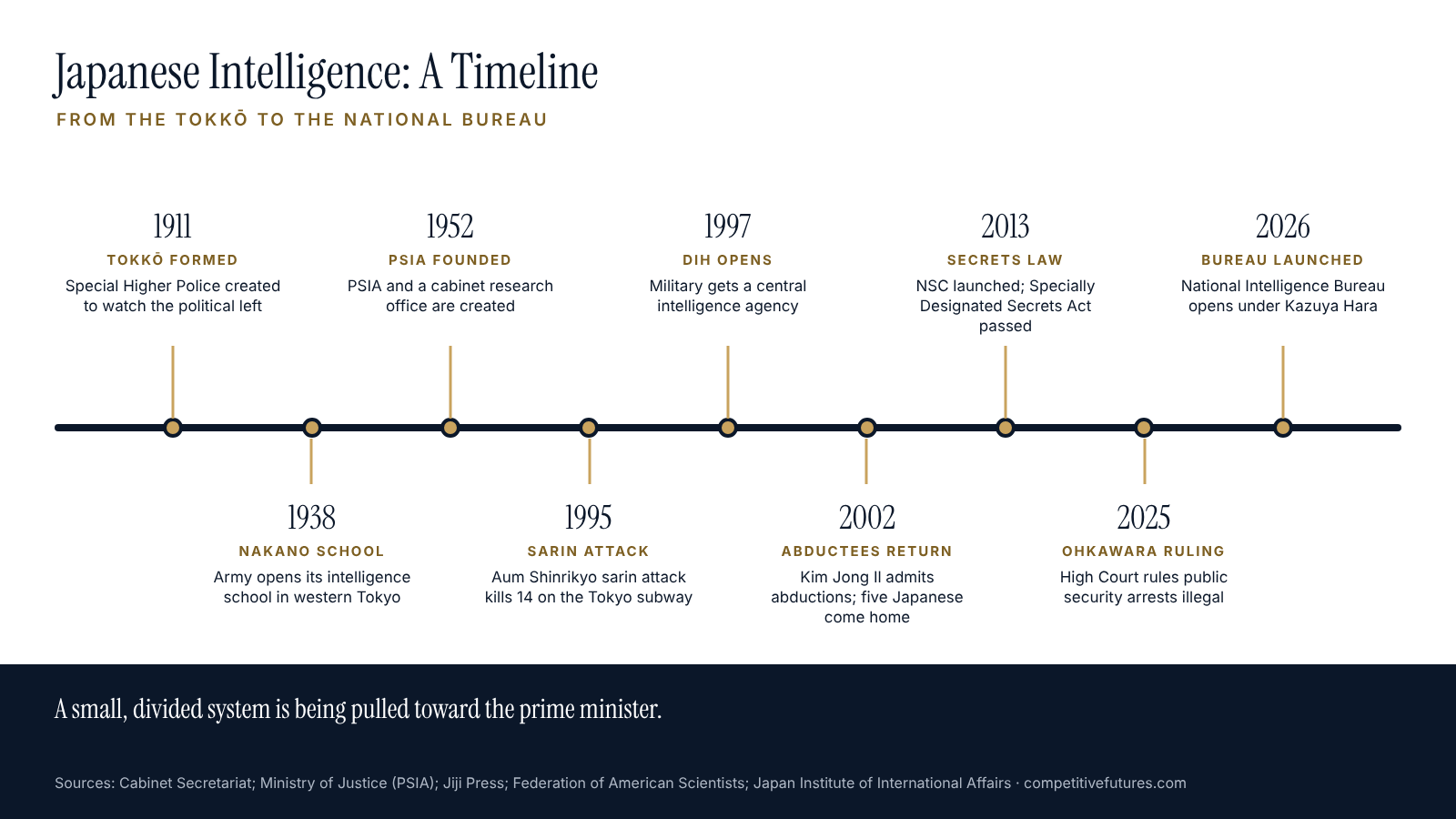
At home, the empire built a political police. The Special Higher Police (Tokkō), set up in 1911, watched anarchists, communists, socialists, and foreigners, and its role grew sharply after the 1925 Peace Preservation Law made it a crime to organize against the imperial order. Tens of thousands of people were detained, arrested, or prosecuted under the law, and some died in custody. The army’s military police, the Kempeitai, became notorious in occupied territories such as Singapore. Allied occupation authorities ordered the Special Higher Police dissolved on October 4, 1945 (Willamette University course materials, excerpting the Kodansha Encyclopedia).
The army opened its intelligence school, the Nakano School, in western Tokyo in 1938. About 2,500 men trained there; one, Hiroo Onoda, kept fighting in the Philippine jungle until 1974. A Japan Times review of a history of the school by the former CIA analyst Stephen Mercado concluded that “the Nakano School was started too late for Japan’s good” (The Japan Times). Samuels concludes that “formal intelligence oversight never existed in authoritarian Japan,” and that rivalry between services was chronic (Naval War College Review).
Defeat swept most of this away, and what replaced it was deliberately small. The Public Security Intelligence Agency was founded on July 21, 1952, when the Subversive Activities Prevention Act came into force (Public Security Intelligence Agency). The same year a research office was created in the Prime Minister’s Office; it moved to the Cabinet Secretariat as the Cabinet Research Office in 1957, became the Cabinet Intelligence and Research Office in 1986, and gained a vice-ministerial coordinating body, the Cabinet Intelligence Council, in 1998 (Cabinet Secretariat). The armed forces did not get a central intelligence agency until a 1996 law created the Defense Intelligence Headquarters, which opened in January 1997 (Federation of American Scientists).
The modern turn came under Prime Minister Shinzo Abe. Japan launched a National Security Council on December 4, 2013, and two days later the Diet passed the Specially Designated Secrets Act, covering defense, diplomacy, counterespionage, and counterterrorism, with prison terms of up to 10 years for leaks. The government presented the two as a package to allow closer intelligence sharing with allies; critics said the law threatened press freedom (Nippon.com; Nippon.com). It took effect on December 10, 2014 (The Diplomat). In May 2024 the Diet extended security clearances to economic security information, such as data on critical infrastructure and advanced semiconductors (The Japan Times). It took effect on May 16, 2025, with penalties of up to five years in prison for leaks (Kyodo via APP).
How Japanese intelligence is organized today
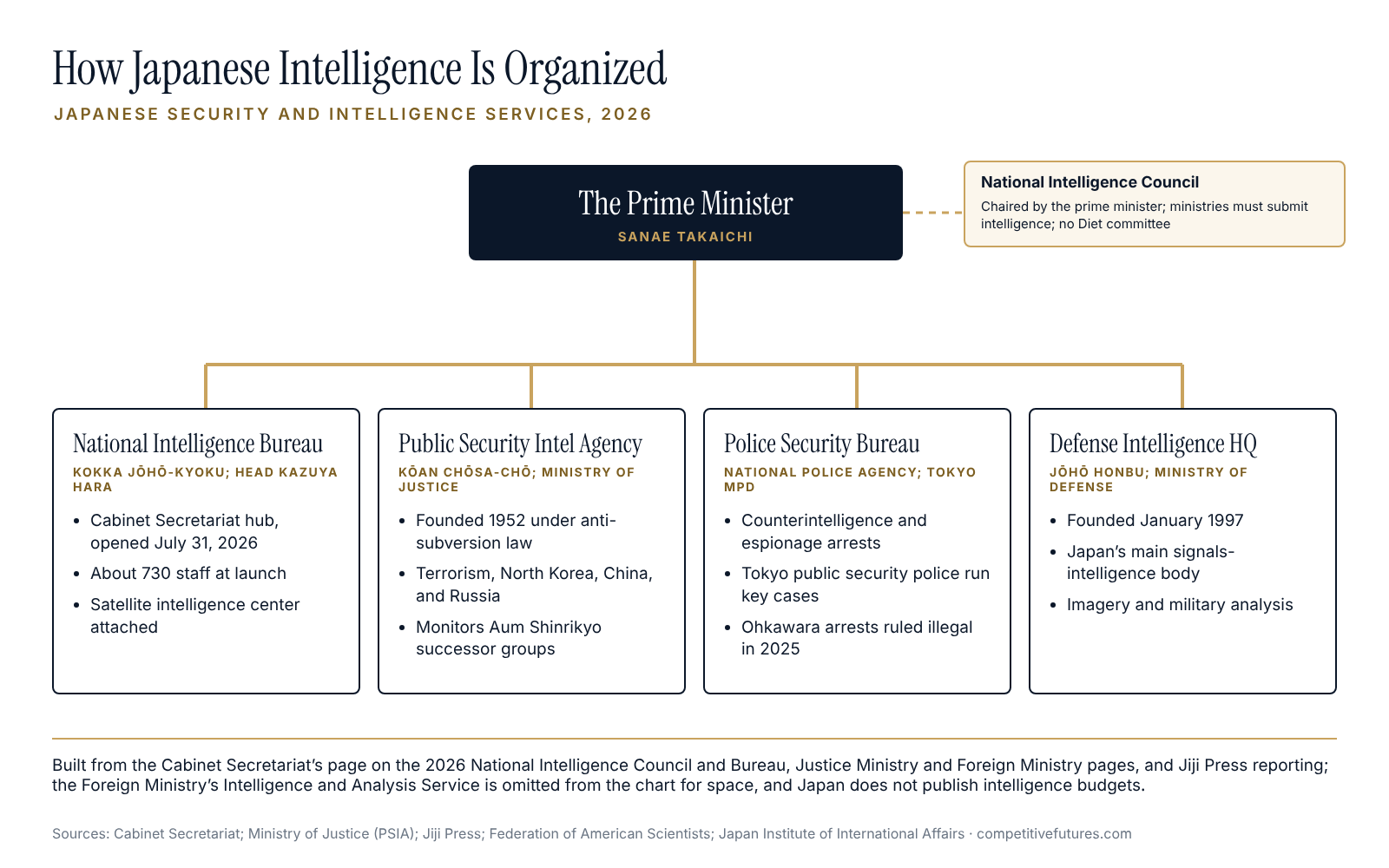
Japan publishes more about its intelligence organization than most countries, though not budgets. The current structure looks like this:
- The National Intelligence Council is a ministerial body chaired by the prime minister. Its members include the chief cabinet secretary, the chair of the National Public Safety Commission, and the ministers of justice, foreign affairs, finance, economy and trade, land and transport, and defense. It sets intelligence policy, including on foreign influence operations, and drafts a medium- to long-term intelligence strategy (Jiji Press via Adnkronos).
- The National Intelligence Bureau is the council’s secretariat and the hub of the intelligence community. It opened with about 730 staff and has general affairs, analysis, research, domestic, two international, and economic departments, eight senior cabinet intelligence analysts, and an emergency information center. The Cabinet Satellite Intelligence Center, which runs Japan’s reconnaissance satellites, sits alongside it (Cabinet Secretariat).
- The Public Security Intelligence Agency, under the Justice Ministry, works under the Subversive Activities Prevention Act and the 1999 law aimed at groups that have committed mass murder. It collects and analyzes information on economic security, international terrorism, North Korea, China, Russia, and domestic organizations, and keeps Aum Shinrikyo’s successors under surveillance (Public Security Intelligence Agency).
- The police carry out counterintelligence and make espionage arrests. The National Police Agency’s Security Bureau directs the public security divisions of the prefectural police, and the Tokyo Metropolitan Police Department’s Public Security Bureau has handled the best-known spy cases.
- The Defense Intelligence Headquarters is the military’s central intelligence agency and Japan’s main signals-intelligence organization. At its founding, its signals directorate was its biggest unit and oversaw listening stations across the country (Federation of American Scientists).
- The Foreign Ministry’s Intelligence and Analysis Service collects and analyzes information on international affairs to support foreign and security policy (Ministry of Foreign Affairs).
The 2026 law does not merge these bodies. The ministries keep their own intelligence functions (The Strategist, ASPI), but they are now legally required to submit documents and information to the council, a provision meant to break down long-standing rivalry among the police, the Public Security Intelligence Agency, and the foreign and defense ministries (Jiji Press via Adnkronos). The head of the new bureau ranks on par with the head of the National Security Secretariat, which some officials privately worry could blur chains of command (Nippon.com).
A spy service that isn’t one
The most striking thing about Japanese intelligence is what it lacks. Japan has no independent foreign human-intelligence service and no dedicated domestic intelligence service, and until 2026 the chief of its central office had limited legal authority over the other agencies (Japan Institute of International Affairs). It has no general anti-espionage law either. As the cases below show, spies are prosecuted under other statutes: the Self-Defense Forces Law, the Unfair Competition Prevention Act, and export-control rules. Critics of the current system call Japan a “spies’ paradise” (The Defense Post).
That gap has been filled in part by the alliance. The 2013 secrets law was designed partly to make intelligence sharing with partners safe; an ASPI analysis says it “helped assure the United States, Australia and other partners” that they could share intelligence securely. The same analysis notes that Australia awarded its Intelligence Medal to a former senior Japanese official, Shigeru Kitamura, in 2022, the first non-Australian to receive it, and that there is “no evidence” Five Eyes membership is on Japan’s agenda (The Strategist, ASPI). The Five Eyes countries have reportedly offered support for the 2026 reforms (Nippon.com).
The Takaichi government says the reform is only a first step. It plans to create a foreign intelligence agency by the end of fiscal 2027 (Jiji Press via Adnkronos), and on September 28, 2026, a government expert panel began discussing a national intelligence strategy, anti-espionage legislation such as a foreign interference prevention law, and the proposed external agency. Takaichi told the panel, “It is essential to enhance intelligence capabilities in order to thoroughly protect the safety of our citizens” (Jiji Press via Nippon.com). Proposals include tougher penalties for espionage on behalf of foreign powers and a registration system resembling the U.S. Foreign Agents Registration Act. Critics fear overreach and threats to privacy (The Defense Post), and a supplementary resolution attached to the 2026 law acknowledged concerns about human rights and the politicization of intelligence (Japan Institute of International Affairs).
Japanese intelligence in the news
Most public knowledge of how Japan’s services work comes from seven episodes. Several of them ended in court, and one, the Ohkawara Kakohki case, ended with the police apologizing for an investigation the courts found illegal.
North Korea’s abductions of Japanese citizens (1978–2002)
The Japanese government has identified 12 incidents in which a total of 17 Japanese citizens were abducted by North Korea. At the first Japan–North Korea summit, in September 2002, Kim Jong Il “admitted, after years of denial, that the abductions of Japanese citizens took place and apologized,” and five abductees came home on October 15, 2002, after 24 years. North Korea has since said the issue is resolved, a position Tokyo calls “unacceptable.” Japanese police have issued arrest warrants for 11 suspects, including North Korean agents, and the government says DNA testing of remains North Korea presented as those of the abductee Megumi Yokota found DNA belonging to someone else (Headquarters for the Abduction Issue). An ASPI analysis says intelligence work contributed to the 2002 returns (The Strategist, ASPI).
Aum Shinrikyo and the Public Security Intelligence Agency (1995–present)
On March 20, 1995, members of the Aum Shinrikyo cult released sarin on the Tokyo subway, killing 14 people and injuring more than 6,000 (The Japan Times). The Public Security Intelligence Agency asked to dissolve the group under the Subversive Activities Prevention Act, but on January 31, 1997, the Public Security Examination Commission rejected the request (Ministry of Justice), finding the evidence of future danger insufficient (The Japan Times). The Diet responded with a new law, in force from December 27, 1999 (Public Security Intelligence Agency), and in January 2000 the commission placed the group under the agency’s surveillance, renewed repeatedly since. The commission has also imposed six-month restrictions on Aleph, the largest successor group, for failing to file required reports (The Japan Times). The seventh such order, effective March 21, 2026, bars Aleph from using its facilities or receiving donations; the agency says the group is still under the “absolute influence” of the cult’s convicted founder, Chizuo Matsumoto, known as Shoko Asahara (Public Security Intelligence Agency). The sources reviewed do not record a response from Aleph.
The Bogatenkov–Hagisaki case (2000–2001)
In September 2000, police arrested Shigehiro Hagisaki, a Maritime Self-Defense Force lieutenant commander working at the Defense Agency’s National Institute for Defense Studies, for passing documents to Viktor Bogatenkov, a naval attaché at the Russian Embassy who reportedly worked for the GRU, Russia’s military intelligence service. Bogatenkov claimed diplomatic immunity and left Japan the day after the arrest. In March 2001, the Tokyo District Court sentenced Hagisaki to 10 months in prison under the Self-Defense Forces Law; prosecutors said he had received ¥580,000, and the court noted that the documents were the least sensitive category of classified material (The Japan Times). A Russian Embassy spokesman called the case “an act of provocation” and said Bogatenkov had left because his assignment was over (The Japan Times).
SoftBank and the Russian trade mission (2020)
In January 2020, the Tokyo Metropolitan Police Department’s Public Security Bureau arrested Yutaka Araki, a former SoftBank employee, on suspicion of taking confidential manuals on the company’s mobile-phone base stations from a company server. Police said he told them he was paid “several tens of thousands of yen” for information given to an official at Russia’s trade representative office (Arab News Japan). The Russian Embassy dismissed the accusations as anti-Russian spy mania (RBC). Police suspected that a former deputy trade representative, Anton Kalinin, had persuaded Araki to obtain the material; Kalinin left Japan in February 2020, and in July prosecutors decided not to indict him. Araki, charged under the Unfair Competition Prevention Act, admitted the charge at a June 2020 hearing, and prosecutors sought two years in prison and a ¥1 million fine (The Japan Times).
The Ohkawara Kakohki false prosecution (2020–2025)
The same police unit produced Japan’s most damaging counterintelligence failure. In March 2020, the Metropolitan Police Department’s Public Security Bureau arrested the president of Ohkawara Kakohki (Ōkawara Kakōki), a maker of spray dryers, and two other executives on suspicion of illegally exporting a machine that could be repurposed to make biological weapons (The Japan Times). One of them, the adviser Shizuo Aishima, was diagnosed with cancer in detention and died in February 2021 (AFP via CBS News). Prosecutors withdrew the charges in July 2021. On May 28, 2025, the Tokyo High Court ordered the national and Tokyo governments to pay about ¥166 million in damages, finding that the police reading of the export rules “lacked rationality,” that the arrests “lacked reasonable grounds,” and that a fraudulent method had been used to obtain a signed statement (The Nation). An internal police report in August 2025 found the bureau’s chain of command “dysfunctional, leading to a serious mistake,” and the superintendent-general said, “We deeply apologize” (The Japan Times). On August 25, 2025, senior police officials apologized at Aishima’s grave (AFP via CBS News).
Chinese hackers and Chinese researchers (2020–2025)
On August 7, 2023, the Washington Post, citing unnamed current and former U.S. and Japanese officials, reported that Chinese military hackers had gained access to Japan’s classified defense networks starting in 2020, and that the head of the U.S. National Security Agency flew to Tokyo to brief Japan’s defense minister. Chief Cabinet Secretary Hirokazu Matsuno said, “we haven’t confirmed the fact that security information has been leaked due to cyber attacks” (Reuters via Insurance Journal). A Pentagon spokeswoman said, “We feel confident in our relationship and the intelligence sharing that we do with Japan,” and Beijing did not immediately comment (Al Jazeera). Separately, in June 2023 police arrested Quan Hengdao, a Chinese senior researcher at the National Institute of Advanced Industrial Science and Technology, on suspicion of sending fluorine-compound research data to a Chinese company. He denied the allegations (Chemistry World), and China’s Foreign Ministry said it was “seriously concerned” about the arrest (South China Morning Post). The Asahi Shimbun reported that the Tokyo District Court convicted him in February 2025 and gave him a suspended sentence of two years and six months and a ¥2 million fine (California Insider, citing the Asahi Shimbun).
The National Intelligence Bureau (2025–2026)
Days after Sanae Takaichi took office in October 2025, her chief cabinet secretary, Minoru Kihara, said she had ordered a new national intelligence agency built by upgrading the Cabinet Intelligence and Research Office, a pledge written into the coalition agreement between her Liberal Democratic Party and the Japan Innovation Party (Jiji Press via Adnkronos). The bill passed the lower house in April 2026 (The Defense Post) and the upper house on May 27, 2026, with support from the ruling parties and the opposition Democratic Party for the People (Jiji Press via Adnkronos). The bureau and the council opened on July 31, 2026. Kihara said the change “will lead to the government making accurate decisions based on higher-quality, timely information” and that records of the council’s proceedings would be kept (Jiji Press via Adnkronos). The reform came amid a diplomatic row with Beijing that followed Takaichi’s November 2025 remarks suggesting Japan might intervene militarily if China attacked Taiwan (The Defense Post).
How to read coverage of Japanese intelligence
Japan is easier to research than most countries in this series, because its government publishes laws, organization charts, and agency statements, often in English. The harder problem is the gap between arrest and proof. Espionage stories usually begin with an arrest by the public security police and details attributed to unnamed investigators. The Ohkawara Kakohki case is the standing reminder that an arrest is not a finding. Foreign reporting has its own provenance problems. The 2023 hacking story rests on anonymous officials, the Russian Embassy’s responses to spy cases are advocacy, and Chinese state outlets such as CGTN and the Global Times, which reflect Beijing’s positions, cover Japan’s intelligence buildup critically.
The discipline is the same one taught in our guide to trend analysis: climb toward primary records. For Japan, that means the Cabinet Secretariat’s pages on the National Intelligence Council and Bureau, the Public Security Intelligence Agency’s press statements and annual reports, Diet records, and court rulings, which Japanese wire services report in detail. For Japan’s lobbying and public relations in Washington, and that of its neighbors, the U.S. Justice Department’s public database of foreign agents registered under the Foreign Agents Registration Act (FARA eFile) lists the firms and their filings. When a story rests on a single anonymous leak, treat it as a lead, not a finding.
Frequently asked questions
What is Japan’s intelligence agency called?
Japan’s central intelligence body is the National Intelligence Bureau (Kokka Jōhō-kyoku), which opened in the Cabinet Secretariat on July 31, 2026, and replaced the Cabinet Intelligence and Research Office, known as Naichō. Japan also has the Public Security Intelligence Agency, the police Security Bureau, the Defense Intelligence Headquarters, and the Foreign Ministry’s Intelligence and Analysis Service, but no separate foreign spy service yet.
Who is the head of Japanese intelligence?
Kazuya Hara, a career National Police Agency officer who had served as Director of Cabinet Intelligence since June 2023, became the first head of the National Intelligence Bureau on July 31, 2026. The National Intelligence Council that the bureau serves is chaired by the prime minister, Sanae Takaichi.
Is Japan part of the Five Eyes?
No. The Five Eyes alliance is made up of the United States, Britain, Canada, Australia, and New Zealand. Japan cooperates closely with its members, adopted its 2013 secrets law partly to reassure them, and has drawn their support for its 2026 reforms, but analysts say membership is not on the agenda.
Related reading
- Qatari Intelligence: History, Structure, and the Headlines
- South Korean Intelligence: History, Structure, and the Headlines
- Trend Analysis: How to Tell a Real Trend From Media Hype
Competitive Futures briefs companies and governments on intelligence services, foreign influence, and Northeast Asia; details are on the services page.