British Intelligence: History, Structure, and the Headlines
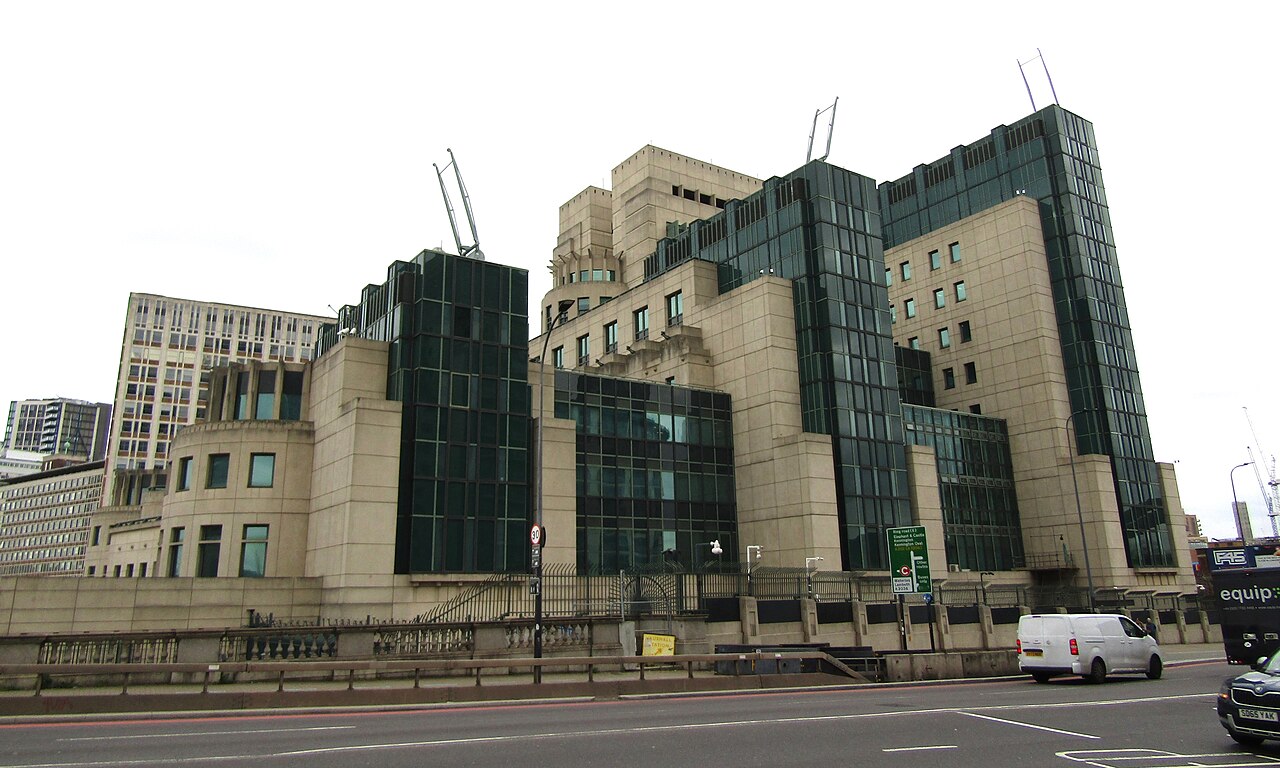
Britain runs one of the oldest, most capable, and most imitated intelligence systems in the world. Its services broke Enigma, lost a generation of secrets to the Cambridge spies, helped write the case for the Iraq war, and now sit at the center of Europe’s response to Russian sabotage, Iranian plots, and Chinese espionage. They are also the United States’ oldest intelligence partner, and much of what Americans call “the intelligence community” was built in conversation with London.
This page is a working overview of British intelligence: where it came from, how it is organized and overseen today, and the cases that have put it in the news. It relies on Acts of Parliament, official inquiry reports, court judgments, government statements, and named reporting, and it notes where a claim comes from a party with an interest in the outcome.
British intelligence at a glance
- Foreign intelligence: the Secret Intelligence Service (SIS, widely known as MI6), headed by Blaise Metreweli, the first woman to lead the service. Her appointment was announced in June 2025 and she took up the post on October 1, 2025; she had been SIS’s Director General for Technology and Innovation (Help Net Security; ThePrint). She gave her first public speech as Chief on December 15, 2025 (GOV.UK).
- Security service: the Security Service (MI5), headed by Director General Ken McCallum since April 2020 (GOV.UK; MI5).
- Signals intelligence and cyber security: Government Communications Headquarters (GCHQ), headed by Director Anne Keast-Butler, who gave GCHQ’s first annual lecture on May 27, 2026 (GCHQ).
- Assessment: the Joint Intelligence Committee (JIC), chaired since July 3, 2026, by Adrian Bird, formerly Chief of Defence Intelligence, who succeeded Dame Madeleine Alessandri (Civil Service World).
- Coordination: the National Security Adviser, Jonathan Powell, who heads the National Security Secretariat in the Cabinet Office and was still in post under Prime Minister Andy Burnham in October 2026 (Jewish Chronicle).
- Oversight: the Intelligence and Security Committee of Parliament (ISC), chaired by Lord Beamish (ISC), and the Investigatory Powers Commissioner, Lord Leveson, in post since October 2019 (IPCO).
- Relationship with the United States: foundational. Britain and the United States signed the signals intelligence agreement now known as UKUSA on March 5, 1946, the core of the Five Eyes partnership with Canada, Australia, and New Zealand (NSA).
History: from two officers to a global service
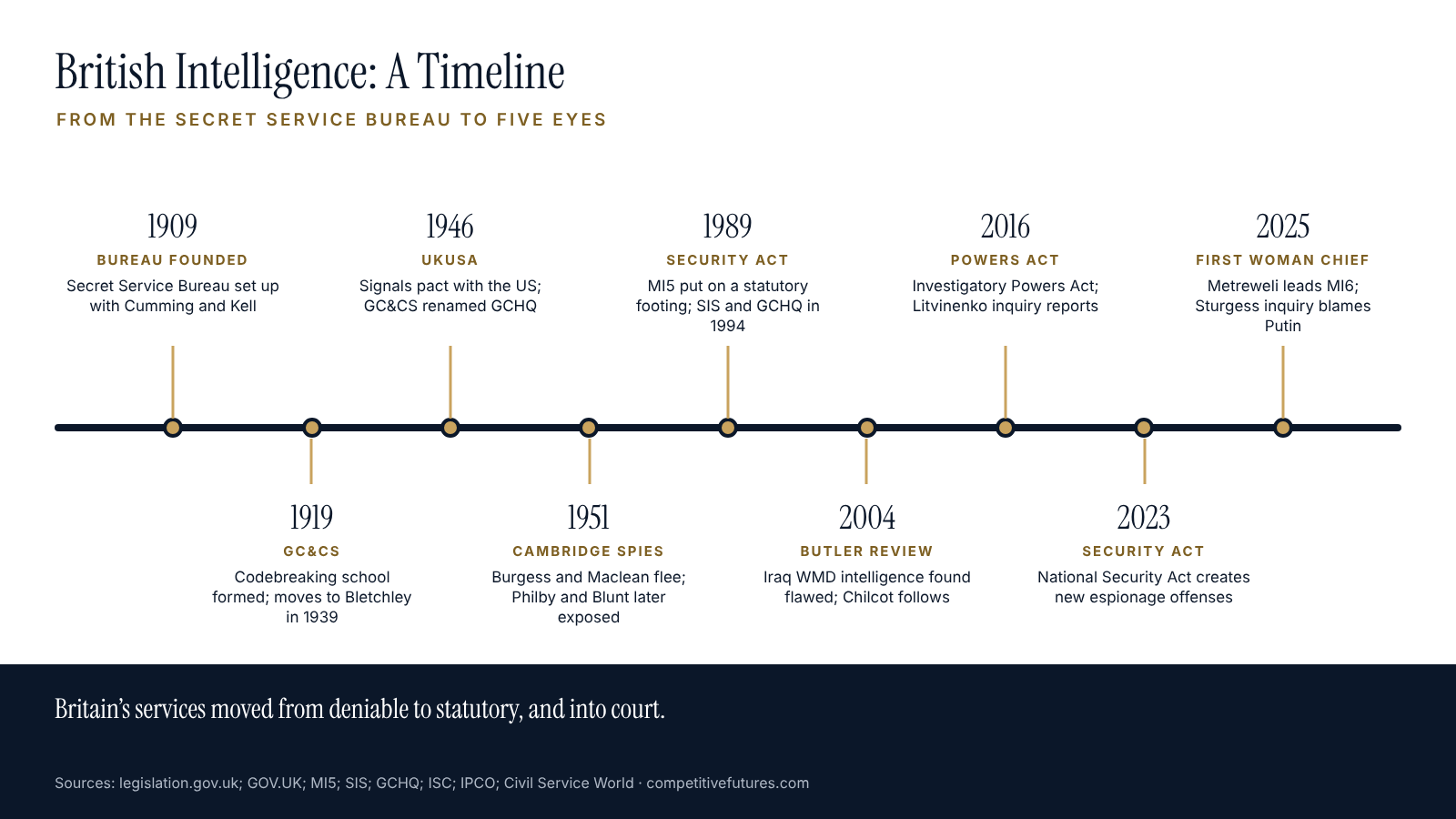
Modern British intelligence began in October 1909, when an official committee alarmed by reports of German espionage set up the Secret Service Bureau. It was “staffed initially by only two officers”: Royal Navy Commander Mansfield Cumming and Army Captain Vernon Kell, who went on to head the services that became SIS and MI5 (MI5).
Signals intelligence followed after the First World War. The Government Code and Cypher School was established in November 1919, moved to Bletchley Park in August 1939, and spent the Second World War breaking German and other Axis codes, including Enigma. It officially became Government Communications Headquarters in April 1946 and began its main move to Cheltenham in the summer of 1952, according to a GCHQ historian writing for the U.S. National Security Agency (NSA Cryptologic Almanac). Wartime cooperation with American codebreakers was made permanent in the 1946 UKUSA agreement.
The early Cold War brought the service’s greatest humiliation. Kim Philby, Guy Burgess, Donald Maclean, Anthony Blunt, and John Cairncross, all Cambridge graduates recruited by Soviet intelligence in the 1930s, penetrated the Foreign Office, SIS, and wartime codebreaking. Burgess and Maclean disappeared in 1951; Philby was confronted in Beirut in January 1963 and gave a partial confession; Blunt confessed to MI5 in April 1964 after being told no action would be taken against him; and Cairncross admitted his recruitment the same year. MI5 released more than 100 files on the ring to the National Archives in January 2025 (The National Archives). The damage to American trust was severe, and the lesson about vetting shaped both services for decades.
For most of the twentieth century the services had no statutory basis at all, and the government did not formally acknowledge SIS. That changed at the end of the Cold War. The Security Service Act 1989 put MI5 on a legal footing and defined its function as “the protection of national security” (legislation.gov.uk). The Intelligence Services Act 1994 set out the functions of SIS and GCHQ and was, in SIS’s words, “the first public acknowledgement of the existence of both MI6 and GCHQ” (SIS). The same Act created the parliamentary Intelligence and Security Committee.
The legal architecture has been rebuilt twice since. After the Snowden disclosures, the Investigatory Powers Act 2016 brought interception, equipment interference, communications data, and bulk powers into a single statute and created the Investigatory Powers Commissioner (legislation.gov.uk). The Investigatory Powers (Amendment) Act 2024, which received Royal Assent on April 25, 2024, changed the rules on bulk personal datasets, oversight, and notices to technology companies (legislation.gov.uk). The National Security Act 2023 replaced most of the old Official Secrets Acts with modern offenses of espionage, sabotage, and foreign interference, and created the Foreign Influence Registration Scheme (legislation.gov.uk).
How British intelligence is organized today
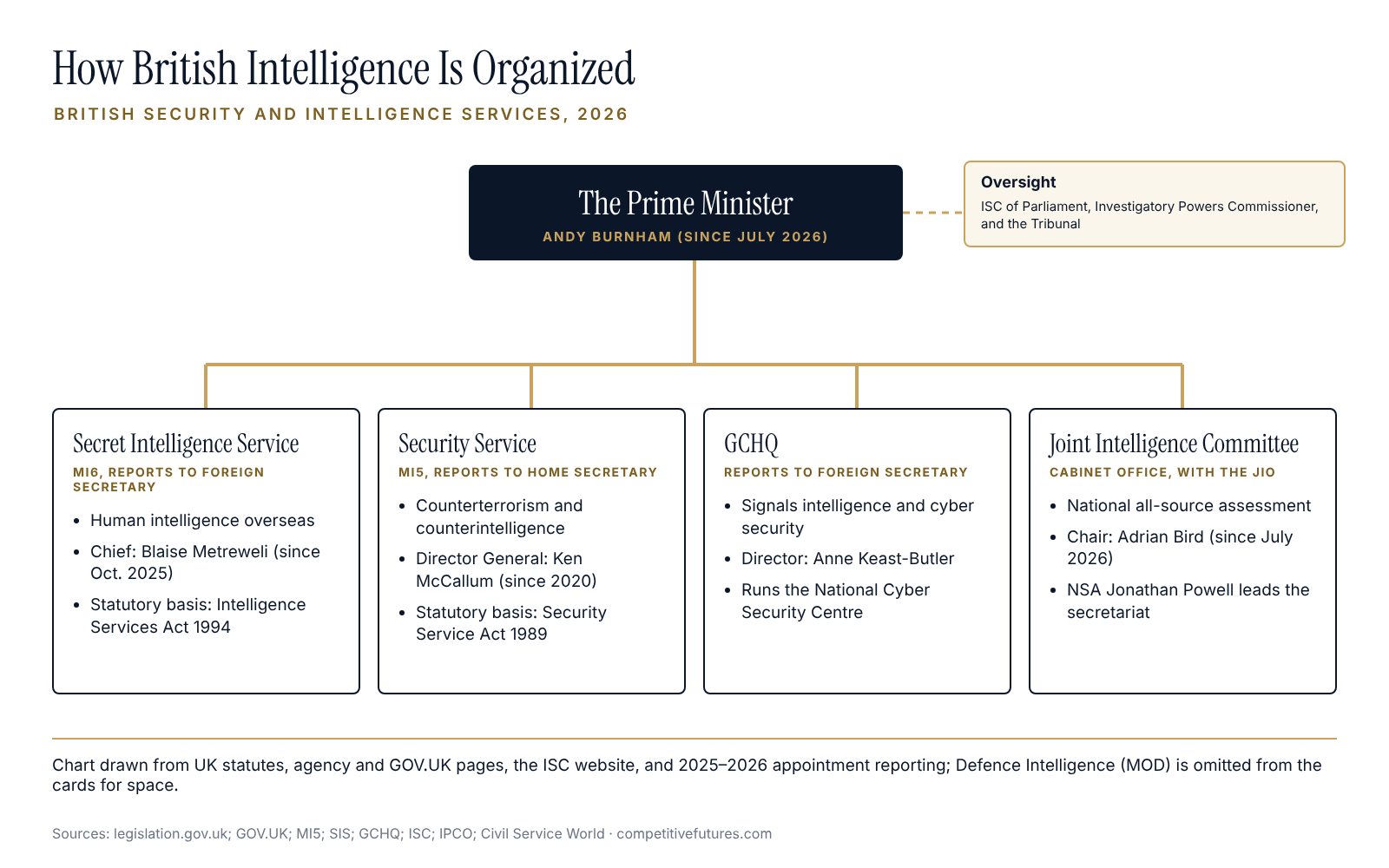
Britain separates collection, assessment, and policy more sharply than most countries. Three agencies collect; a Cabinet Office committee assesses; ministers decide.
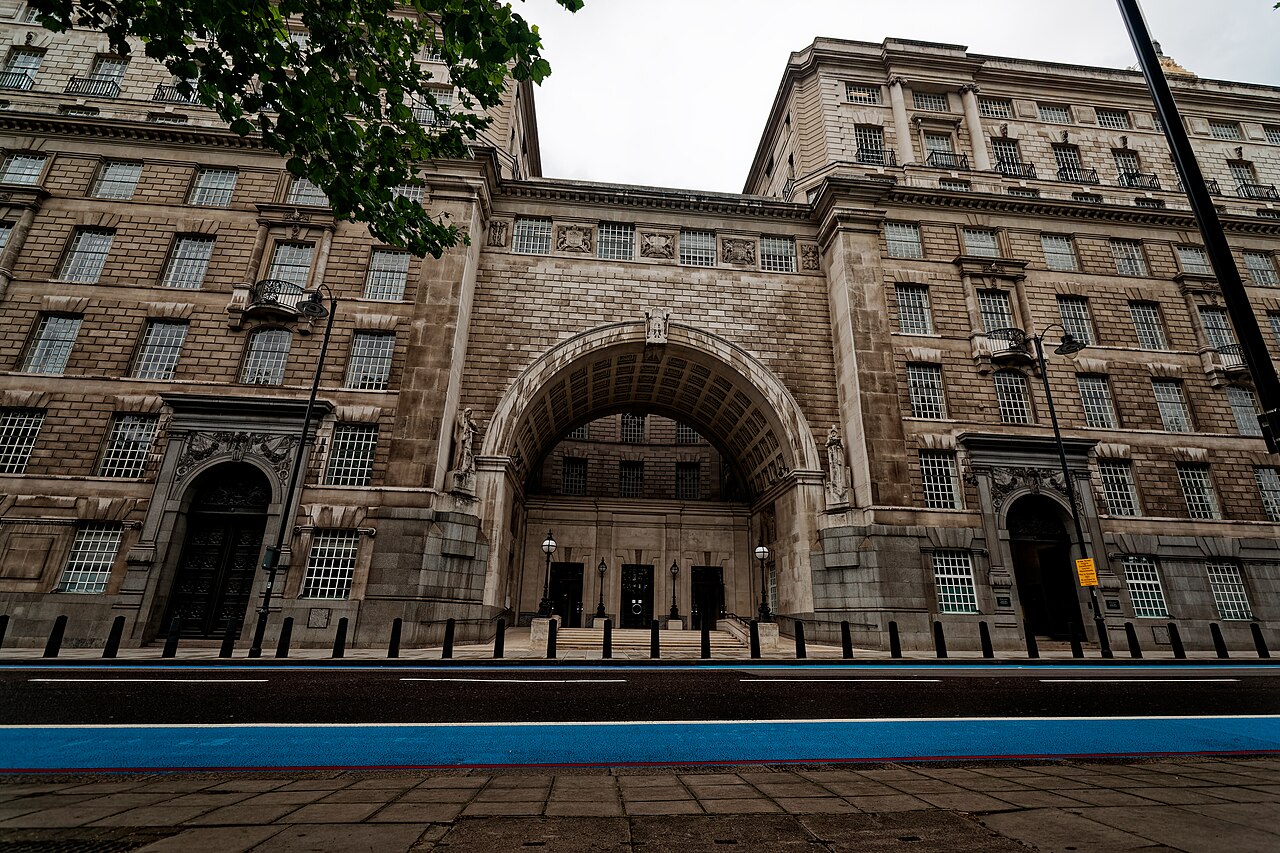
- The Secret Intelligence Service (MI6) collects human intelligence overseas and reports to the Foreign Secretary.
- GCHQ collects signals intelligence, runs the National Cyber Security Centre, and also reports to the Foreign Secretary.
- The Security Service (MI5) handles counterterrorism, counterintelligence, and protective security inside the United Kingdom and reports to the Home Secretary. It has no arrest powers; prosecutions run through the police and the Crown Prosecution Service.
- Defence Intelligence, part of the Ministry of Defence’s Cyber and Specialist Operations Command, provides military intelligence and assessments and works closely with GCHQ, MI5, and MI6. It is led by the Chief of Defence Intelligence, Lieutenant General Matthew Jones (GOV.UK).
- The Joint Intelligence Committee sits in the Cabinet Office, supported by the Joint Intelligence Organisation. Its members include the JIC chair, the National Security Adviser, and the heads of GCHQ, SIS, and MI5, and it is charged with giving ministers assessments and early warning of threats (GCHQ).
- The National Security Secretariat, under the National Security Adviser, supports the National Security Council and coordinates policy across departments.
Oversight comes from three directions. The ISC, strengthened by the Justice and Security Act 2013, oversees the policies, spending, administration, and operations of the agencies, Defence Intelligence, the National Cyber Force, and the Cabinet Office bodies (ISC). The Investigatory Powers Commissioner and his Judicial Commissioners approve the most intrusive warrants and audit their use. The Investigatory Powers Tribunal hears complaints against the agencies. The design is meant to keep the people who assess intelligence separate from the people who collect it, a separation the Iraq inquiries found had worn thin.
The original Five Eyes partner
No foreign relationship matters more to British intelligence than the one with the United States. The March 1946 BRUSA agreement, now called UKUSA, reaffirmed wartime signals cooperation between London and Washington, and its appendices extended arrangements to Canada, Australia, and New Zealand as “Second Parties” (NSA). The result, the Five Eyes, shares signals intelligence, technology, and in many cases assessment, at a depth no other alliance matches.
The partnership works in both directions. GCHQ and the NSA divide collection tasks and share infrastructure; British human intelligence reporting reaches American policymakers; and the 2002 Iraq dossier, the 2013 Snowden disclosures, and the European Court rulings that followed were all, in part, stories about how much the two systems depend on each other. In Strasbourg, the question of whether Britain could lawfully receive intercept material from foreign partners was decided in the government’s favor in both 2018 and 2021, while its own bulk interception regime was not (European Court of Human Rights press release, via Statewatch).
British intelligence chiefs now describe the alliance as one tool among several. In her first speech, Metreweli listed “our Five Eyes partners” among the international partners SIS relies on, alongside European and other allies, and warned of “an aggressive, expansionist and revisionist Russia” (GOV.UK). Keast-Butler told her May 2026 audience that “Russia is scaling up its daily hybrid activity against the UK and Europe” and that “the risk of miscalculation is as high as I’ve ever seen it” (GCHQ).
British intelligence in the news
Most public knowledge of how British intelligence works now comes from statutory inquiries, court judgments, and criminal trials, which is itself a product of the post-1989 legal framework. Eight cases stand out. Where they involve allegations against people or governments, those allegations are attributed and the response noted.
The Iraq WMD dossier (2002–2016)
In September 2002, the government published a dossier on Iraq’s weapons of mass destruction based on Joint Intelligence Committee assessments. No such stockpiles were found after the 2003 invasion. Lord Butler’s review, published on July 14, 2004, faulted SIS for “over-reliance” on questionable human sources that it had not adequately validated, said the claim that Iraq could deploy some weapons within 45 minutes should not have been included without clarification, and found “no evidence of deliberate distortion” of JIC assessments (Arms Control Association). Sir John Chilcot’s Iraq Inquiry went further on July 6, 2016, finding that judgments about Iraq’s capabilities in the dossier were “presented with a certainty that was not justified” and that the JIC should have made clear to Tony Blair that the intelligence had not established its claims “beyond doubt” (Statement by Sir John Chilcot, via Scoop). Blair said he took the decision “in good faith” and that the report “should lay to rest allegations of bad faith, lies or deceit” (Euronews). The episode remains the reference case for the danger of intelligence being pulled into public advocacy.
The Litvinenko murder (2006–2016)
Alexander Litvinenko, a former officer of Russia’s FSB who had fled to Britain, died of polonium-210 poisoning in London in November 2006. The public inquiry chaired by Sir Robert Owen reported on January 21, 2016 (GOV.UK). It found a strong probability that Andrei Lugovoi poisoned Litvinenko under FSB direction, that Dmitri Kovtun was also acting under FSB direction, and that the operation was “probably approved by Mr Patrushev, then head of the FSB,” and also by President Vladimir Putin. Russia’s ambassador called it “absolutely unacceptable” that the report found the Russian state involved (Reuters via Dawn). Neither has been tried.
Snowden and bulk interception (2013–2021)
Documents taken by the former NSA contractor Edward Snowden and published from 2013 described the scale of GCHQ’s bulk interception of internet traffic and its exchange of material with the NSA. Civil liberties groups and journalists took the case to Strasbourg. On September 13, 2018, a Chamber of the European Court of Human Rights held that Britain’s bulk interception regime under the old Regulation of Investigatory Powers Act violated the right to privacy, citing “insufficient oversight” of how cables were selected and how intercepted material was filtered and searched, but stated that “the operation of a bulk interception regime did not in and of itself violate the Convention” (ECHR press release, via the Investigatory Powers Tribunal). The Grand Chamber confirmed the violations in May 2021, requiring “end-to-end safeguards,” and again found the intelligence-sharing regime lawful (ECHR press release, via Statewatch). Both judgments addressed the old law; the Investigatory Powers Act 2016 had by then replaced it.

Salisbury and the death of Dawn Sturgess (2018–2025)
In March 2018, the former Russian military intelligence officer Sergei Skripal, a convicted spy released to Britain in a 2010 prisoner exchange, and his daughter Yulia were poisoned with the nerve agent Novichok in Salisbury. Both survived. In June 2018, Dawn Sturgess, a local woman, died after exposure to the same agent in a discarded perfume bottle. The public inquiry chaired by Lord Hughes reported on December 4, 2025, finding that the GRU operation “must have been authorised at the highest level and by President Putin” (Bevan Brittan). Hughes also found failings in the risk assessment of Skripal’s protection, while ruling that they had no causal effect on Sturgess’s death; her family argued that no proper risk assessment was ever done. The Kremlin continues to deny involvement. The government responded by sanctioning the GRU in its entirety and summoning the Russian ambassador (Al Jazeera).

The Russia Report (2019–2020)
The ISC’s report on Russian activity in the United Kingdom, published on July 21, 2020, concluded that “Russian influence in the UK is ‘the new normal’,” that Britain “welcomed Russian money, and few questions – if any – were asked about the provenance of this considerable wealth,” and that defending democratic processes had been “something of a ‘hot potato’” among government bodies. It said it had not been given any post-referendum assessment of Russian attempts to interfere in the 2016 EU referendum and urged that one be produced (Intelligence and Security Committee). The government’s response, published the same day, said it had “seen no evidence of successful interference in the EU Referendum” and that “a retrospective assessment of the EU Referendum is not necessary” (HM Government).
The Christine Lee interference alert (2022–2024)
In 2022, MI5 issued a rare Interference Alert, distributed to all members of Parliament, naming the London solicitor Christine Lee and alleging that she was “knowingly engaged in political interference” on behalf of the Chinese Communist Party. Lee challenged the alert at the Investigatory Powers Tribunal as factually wrong, procedurally unfair, discriminatory, and a breach of her human rights. The tribunal dismissed all her claims, finding the alert a “proportionate response” and not irrational. Lee was not charged with any offense, and a Solicitors Regulation Authority investigation took no further action (Law Society Gazette; Euronews). The case set a precedent for MI5 using public warnings, rather than prosecutions, against suspected agents of influence.
The Bulgarian spy ring (2020–2025)
Between 2020 and 2023, a group of Bulgarian nationals based in Britain carried out surveillance operations for Russia in the United Kingdom, Germany, Austria, Spain, and Montenegro, including against the investigative journalist Christo Grozev and a U.S. air base in Germany where they believed Ukrainian troops were training. Their ringleader, Orlin Roussev, worked for Jan Marsalek, the fugitive former Wirecard executive. Roussev, Biser Dzhambazov, and Ivan Stoyanov pleaded guilty; three others were convicted at trial in March 2025. On May 12, 2025, the six were sentenced to terms of up to 10 years and 8 months. Roussev had denied any government links, telling police, “No James Bond activity on my end” (AP via KPRC). The Crown Prosecution Service said each defendant “knew exactly who they were spying for”; because the conduct predated the new law, the charges were brought under the Official Secrets Act 1911 and conspiracy legislation (Crown Prosecution Service).
The collapsed China spying case (2023–2025)
In April 2024, prosecutors charged Christopher Cash, a parliamentary researcher, and Christopher Berry under the Official Secrets Act 1911 with passing information about Westminster between 2021 and early 2023 that was allegedly sent to a senior Chinese official. Both denied the charges. In September 2025, about a month before trial, the Crown Prosecution Service dropped the case; the Director of Public Prosecutions, Stephen Parkinson, later wrote that prosecutors could not obtain government statements showing China was a threat to national security, a requirement of the old law, and “when this became apparent, the case could not succeed.” Downing Street denied claims that the National Security Adviser had blocked the evidence (The Guardian via The Irish Times). Days later, McCallum said Chinese state actors present a national security threat “every day” and that he was frustrated when chances to prosecute were not pursued; the Chinese Embassy called the spying allegations “pure fabrication and malicious slander” (AP via PBS NewsHour). In the same October 2025 speech, McCallum said MI5 and the police had disrupted more than 20 potentially lethal Iran-backed plots in the previous year.
How to read coverage of British intelligence
Britain is unusually rich in primary records, and unusually rich in reporting that does not cite them. The services brief selected journalists, former officers write memoirs and newspaper columns, and much of what appears as “security sources say” is unattributable. Foreign state media add their own layer: Russian and Chinese outlets regularly present British cases as fabrications, and their coverage should be read as the position of a party to the dispute.
The discipline is the same one taught in our guides to trend analysis and evaluating forecasts: climb toward primary records. For Britain, that means the statutes on legislation.gov.uk, the reports of the Intelligence and Security Committee, the annual reports of the Investigatory Powers Commissioner, the judgments of the Investigatory Powers Tribunal and the European Court of Human Rights, public inquiry reports, sentencing remarks and Crown Prosecution Service statements, and the Foreign Influence Registration Scheme, which since July 1, 2025, has required anyone working for the Russian or Iranian state in the United Kingdom to register (GOV.UK; GOV.UK). For lobbying in Washington by British entities, and by others about Britain, the U.S. Justice Department’s database of registered foreign agents (FARA eFile) is the place to start. When a story rests on a single anonymous official, treat it as a lead, not a finding.
Frequently asked questions
What is the United Kingdom’s intelligence agency called?
Britain has three main agencies: the Secret Intelligence Service (MI6), which collects foreign intelligence; the Security Service (MI5), which handles domestic security and counterintelligence; and Government Communications Headquarters (GCHQ), which collects signals intelligence and leads on cyber security. Defence Intelligence serves the armed forces, and the Joint Intelligence Committee in the Cabinet Office produces national assessments.
Who heads British intelligence?
No single person does. Blaise Metreweli has been Chief of MI6 since October 2025, Ken McCallum has been Director General of MI5 since April 2020, and Anne Keast-Butler is Director of GCHQ. Adrian Bird has chaired the Joint Intelligence Committee since July 2026, and Jonathan Powell is the National Security Adviser.
Who oversees British intelligence?
Ministers are accountable for the agencies: the Foreign Secretary for MI6 and GCHQ and the Home Secretary for MI5. The Intelligence and Security Committee of Parliament scrutinizes their policies, spending, and operations; the Investigatory Powers Commissioner approves and audits the use of intrusive powers; and the Investigatory Powers Tribunal hears complaints from the public.
Related reading
- Qatari Intelligence: History, Structure, and the Headlines
- Hungarian Intelligence: History, Structure, and the Headlines
- How to Evaluate a Forecast
- Cognitive Bias: A Field Guide for Leaders
Competitive Futures briefs companies and governments on intelligence services, foreign influence, and the United Kingdom and Europe; details are on the services page.