Argentine Intelligence: History, Structure, and the Headlines
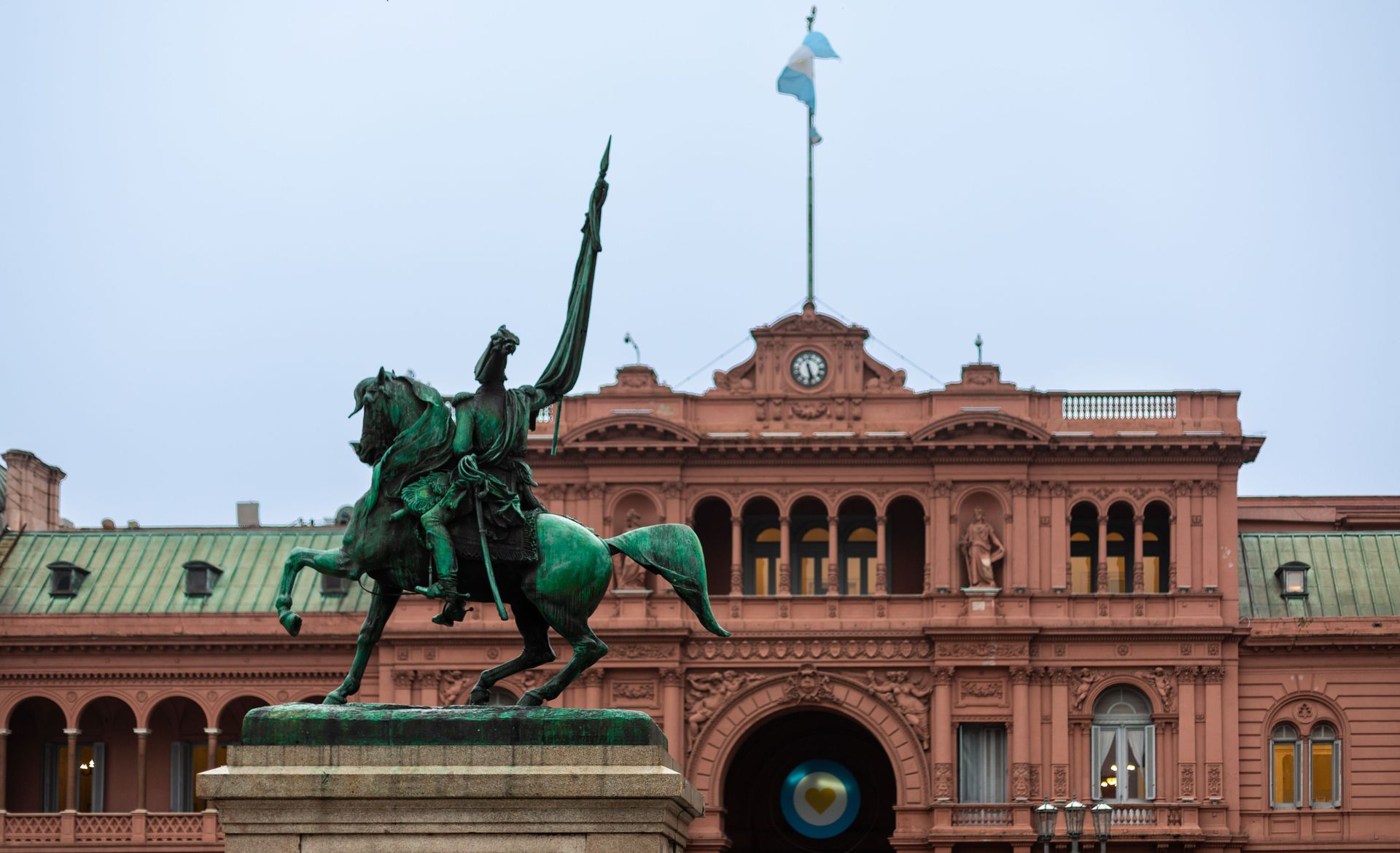
Few countries have argued about their intelligence service as long, or as publicly, as Argentina. The service ran a secret detention center during the last military dictatorship, paid a witness to steer the investigation of the deadliest terrorist attack in the country’s history, was drawn into the investigation of the death of the prosecutor pursuing that attack, and has been accused of spying on politicians, judges, journalists, and grieving families under governments of every stripe. Nearly every president since 1983 has reorganized it, and its name has changed with the governments: SIDE, then SI, then AFI, and since 2024 SIDE again.
This page is a working overview of Argentina’s intelligence services: where they came from, how they are organized today, and the cases that have put them in the news. It relies on published decrees, the texts of the intelligence laws, court rulings, and named reporting from across Argentina’s divided press. It treats Peronist and non-Peronist governments by the same standard, and it notes where a claim comes from a party with an interest in the outcome.
Argentine intelligence at a glance
- Main intelligence service: the Secretariat of State Intelligence (Secretaría de Inteligencia de Estado, SIDE), recreated by Decree of Necessity and Urgency (DNU) 614/2024, published on July 16, 2024, which dissolved the Federal Intelligence Agency (AFI) and named SIDE the senior body of the National Intelligence System (DNU 614/2024).
- Head: Cristian Auguadra, appointed by Decree 852/2025, published on December 3, 2025, replacing Sergio Neiffert, who had led SIDE since its recreation in July 2024 (Palabras del Derecho; Palabras del Derecho). Auguadra previously ran the service’s internal-affairs unit (Buenos Aires Times).
- Components under SIDE: the Argentine Intelligence Service (SIA), created in 2024; the National Counterintelligence Agency, formerly the National Security Agency; the Federal Cyber Intelligence Agency, formerly the Federal Cybersecurity Agency; and the General Intelligence Inspectorate, formerly the Internal Affairs Division, as reorganized by DNU 941/2025 (Marval O’Farrell Mairal).
- Legal basis: the National Intelligence Law, Law 25.520 of 2001, as amended, most recently by DNU 941/2025 (Argentina.gob.ar).
- Oversight: SIDE reports to the President. Congress oversees it through the Bicameral Commission for the Oversight of Intelligence Bodies and Activities, chaired since July 2026 by Deputy Sebastián Pareja of the governing La Libertad Avanza (Parlamentario).
- Relationship with the United States: close and growing. In March 2026, SIDE said Auguadra met CIA Director John Ratcliffe at Langley (El Intransigente), and in April 2026 Auguadra said the United States would provide technology and share sensitive information (Perfil).
History: from Perón’s CIDE to Milei’s SIDE
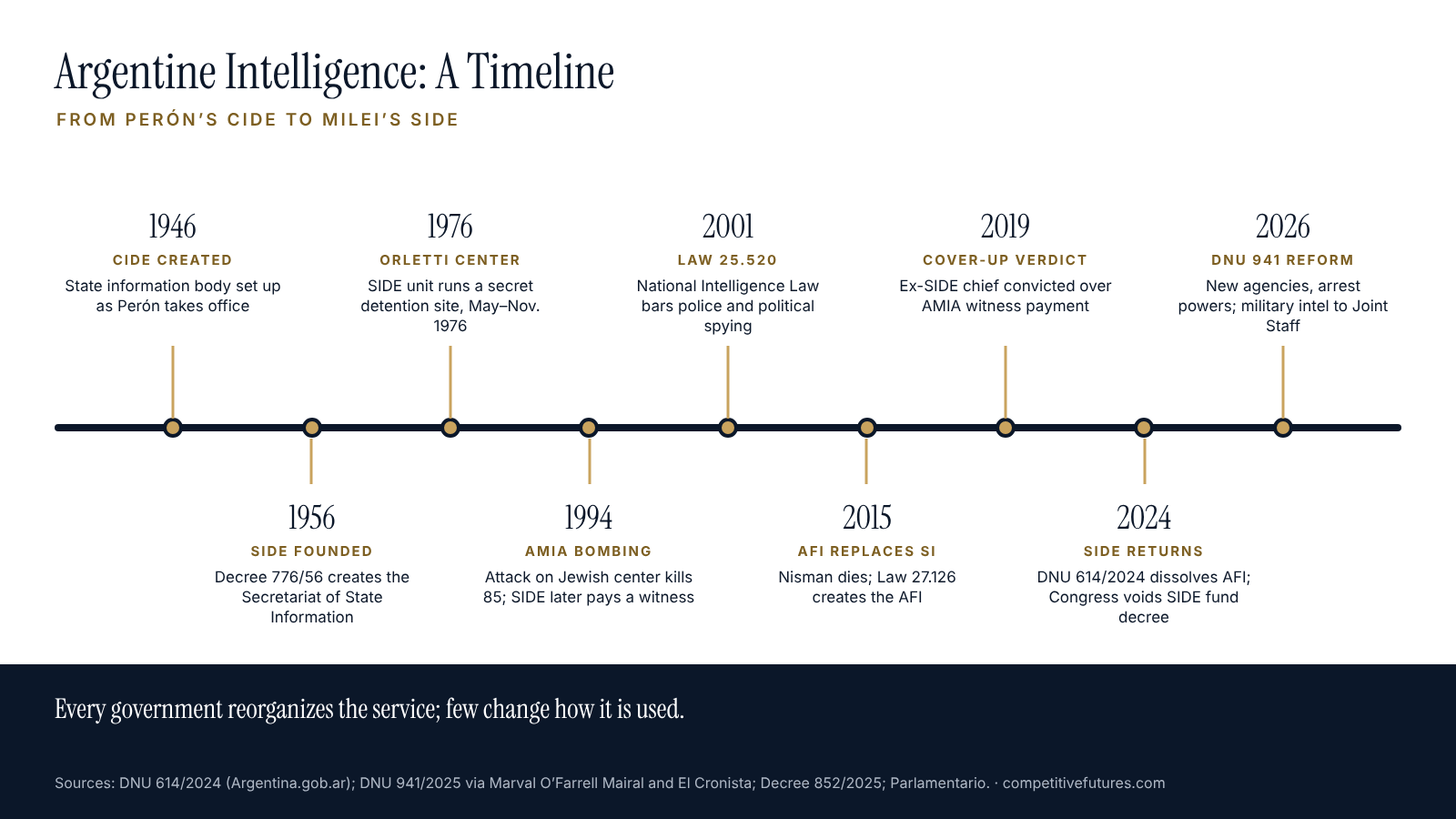
The service traces its origins to 1946, the year Juan Domingo Perón became president, when the State Information Coordination (Coordinación de Informaciones de Estado, CIDE) was created. A State Information Service followed in 1951, during Perón’s first presidency. The archive guide SIDE itself published in 2026 lists the decrees creating the body in 1946 and 1951 (Palabras del Derecho; Perfil). In January 1956, the military government that overthrew Perón issued Decree 776/56 creating the Secretariat of State Information, the first SIDE, to supply the government with the information it needed to run the state (Comisión Provincial por la Memoria).
Much of the service’s attention went to Argentines themselves. In 1973, under the elected Peronist governments of that year, laws placed SIDE inside a new National Intelligence Center and stated that it would not act as a repressive or police body, while a 1973 resolution created an advisory commission to vet people’s Marxist ideological background (Palabras del Derecho). After the March 1976 coup, the service became part of the dictatorship’s machinery of disappearance. The national government’s own memorial site for the Automotores Orletti detention center says the center operated from May to November 1976 as a unit known as OT18 under SIDE’s control, together with the Army’s Intelligence Battalion 601 (Argentina.gob.ar).
Democracy returned in 1983, but the intelligence service changed slowly. Under the Peronist government of Carlos Menem, SIDE money paid a key witness in the AMIA case, as courts later established. Congress passed the National Intelligence Law, Law 25.520, on November 27, 2001; it was published on December 6, 2001, and barred intelligence bodies from police functions, repressive tasks, and spying on people for their political opinions or lawful activities (Argentina.gob.ar).
The next break came in the last year of Cristina Fernández de Kirchner’s presidency. In mid-December 2014, she ordered the removal of the secretary and under-secretary of intelligence, and in January 2015 the prosecutor Alberto Nisman was found dead (Fundar). Congress passed Law 27.126 on February 25, 2015. It dissolved the Intelligence Secretariat, created the Federal Intelligence Agency (Agencia Federal de Inteligencia, AFI), and moved the office that carries out court-ordered wiretaps out of the intelligence service and into the Public Prosecutor’s Office (Microjuris).
Later governments kept the AFI and changed its rules. Mauricio Macri’s government restored secrecy over the agency’s structure, staff, and reserved funds by Decree 656/2016. Alberto Fernández’s government placed the AFI under an intervenor in December 2019; according to the think tank Fundar, more than 99 percent of the agency’s budget had been secret from 2016 to 2019. By DNU 214/2020 the Fernández government removed the legal exception that let intelligence bodies take part in criminal investigations, citing “spurious links” between intelligence and the courts (Fundar).
How Argentine intelligence is organized today
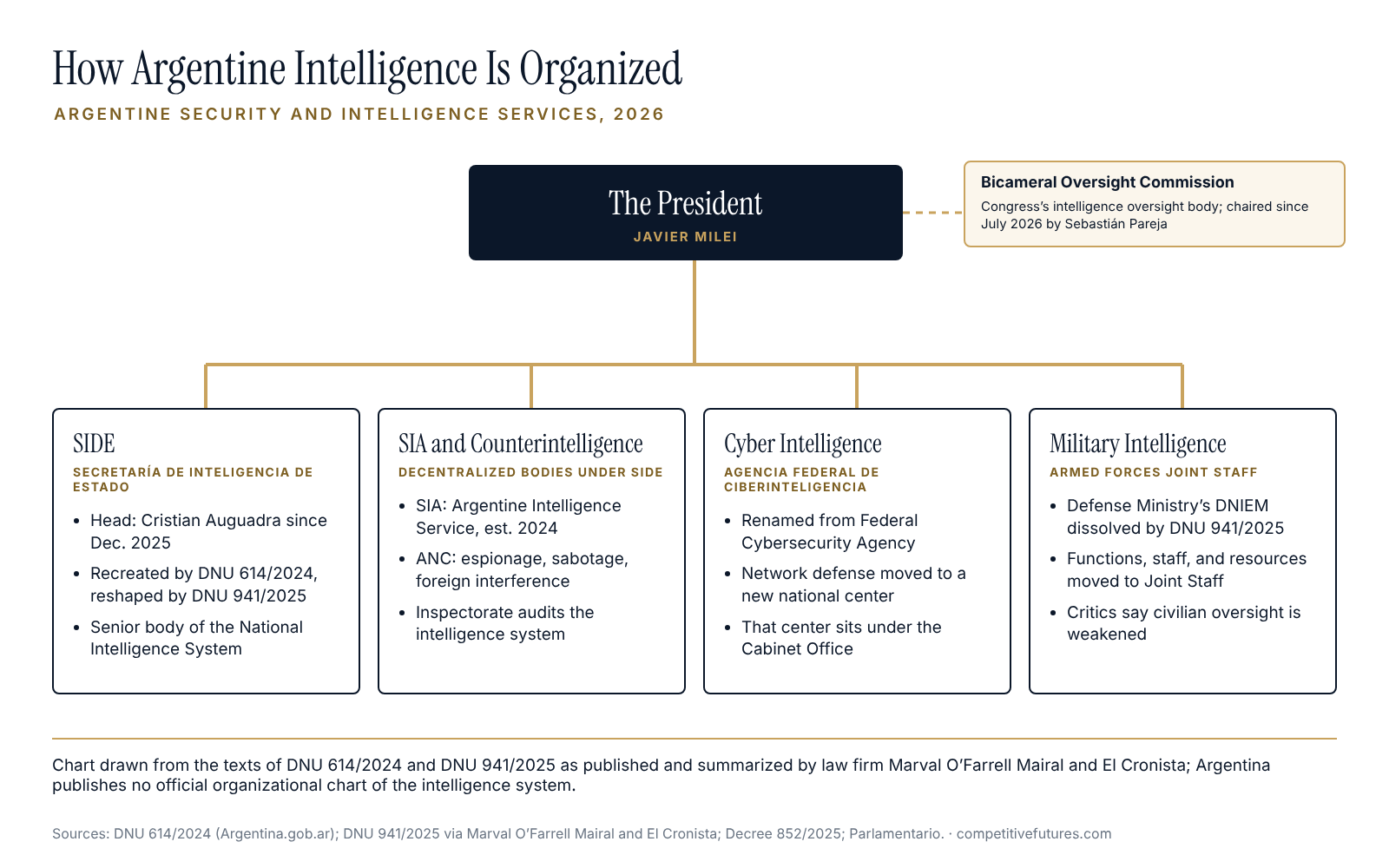
Argentina’s intelligence system has been redrawn twice in eighteen months, both times by decree. DNU 614/2024 created four bodies under SIDE (DNU 614/2024). DNU 941/2025, published in the Boletín Oficial on January 2, 2026, renamed and refocused them and added new coordination forums (Marval O’Farrell Mairal; El Cronista).
- SIDE is the senior body of the National Intelligence System. Its secretary, known in Argentine slang as “Señor 5,” appoints the heads of the other bodies and leads a new National Intelligence Community in which state intelligence bodies share information.
- The National Counterintelligence Agency, formerly the National Security Agency, now concentrates on detecting espionage, sabotage, and foreign interference or influence.
- The Federal Cyber Intelligence Agency works under SIDE, while a separate National Cybersecurity Center under the Cabinet Office protects government networks and systems.
- The General Intelligence Inspectorate, formerly the Internal Affairs Division, audits the system.
- Military intelligence changed most. DNU 941/2025 dissolved the Defense Ministry’s National Directorate of Strategic Military Intelligence (DNIEM) and moved its functions, staff, and resources to the intelligence directorate of the Armed Forces Joint Staff.
- The National Intelligence School (ENI) trains intelligence personnel. When SIDE was recreated in 2024, the government named Juan Bautista Yofre, who had headed SIDE under Menem, to lead it (iProfesional).
The 2026 decree also gave intelligence personnel limited power to apprehend people during intelligence activities, at the request of a court, or when they catch someone in the act, and declared all national intelligence activities covert (El Cronista). The government says the changes add controls. Critics, including Deputy Esteban Paulón, say the decree widens the definition of threats to cover activists, opponents, and journalists, and the Comisión Provincial por la Memoria, a Buenos Aires provincial human rights body, said it lets agents detain people without a court order (CPM). As of mid-2026, Congress had not rejected the decree, because the opposition lacked the votes (Parlamentario). In August 2026, SIDE officials told the oversight commission that no one had been apprehended under the new powers (Parlamentario).
Two things stand out. The architecture is set mostly by decree rather than statute, so it changes with each government; the government says a broader reform will go to Congress as a bill (El Cronista). And the money remains largely secret: SIDE’s 2025 budget reached about 107 billion pesos after a December increase, according to the magazine Noticias (Noticias).
Spies and judges
The most persistent theme in Argentine intelligence is its entanglement with the federal courts. For decades, judges and prosecutors relied on the intelligence service to carry out wiretaps and to investigate cases, and critics from several parties have argued that this gave the service leverage over the courts. The AMIA investigation shows the pattern at its worst: a judge, prosecutors, and the head of SIDE were all convicted over a payment to a witness, made with SIDE money. In a January 2024 judgment in Memoria Activa v. Argentina, the Inter-American Court of Human Rights found that informal intelligence involvement in the AMIA investigation, including undocumented searches, had damaged the integrity of the evidence, according to opposition deputies’ summary of the ruling (Chamber of Deputies).
Reformers have tried to cut the cord, and successors have retied it. The 2015 law moved court-ordered wiretaps to the Public Prosecutor’s Office. Macri’s government promoted the AFI as an auxiliary of the courts in cases ranging from kidnapping to money laundering, and Fernández’s 2020 decree removed that role again (Fundar). Milei’s 2026 decree now allows intelligence personnel to act at a court’s request once more (El Cronista).
Espionage cases against intelligence officers, meanwhile, rarely reach trial. In January 2026, the Comisión Provincial por la Memoria wrote that almost none of the cases arising from documents found at the AFI for 2015–2019 had produced indictments or trials after years of investigation (CPM). And the Nisman death investigation, more than a decade on, is still exploring whether the prosecutor died amid a feud between intelligence factions (La Nación).
Argentine intelligence in the news
Most public knowledge of Argentine intelligence comes from seven cases. Several are still before the courts, so the line between allegation and finding matters.
Automotores Orletti and Operation Condor (1976–2016)
Automotores Orletti, a former auto-repair shop in Buenos Aires, was the main Argentine hub of Operation Condor, the cross-border repression coordinated by South American military regimes. The human rights group CELS, a party to the trials, describes it as having been “under the control of the SIDE, in coordination with the Argentine and Uruguayan armies,” (CELS). On March 31, 2011, Federal Oral Court No. 1 in Buenos Aires sentenced former colonel Eduardo Cabanillas to life in prison and two former SIDE agents, Eduardo Ruffo and Honorio Martínez Ruiz, to 25 years each; a former Army intelligence agent received 20 years (Centro de Información Judicial). On May 27, 2016, the same court convicted 15 defendants in the joint Condor and Orletti trial, most for criminal association within the Condor plan, and acquitted two (Public Prosecutor’s Office). CELS called it the first ruling by any country’s courts that Condor was a criminal conspiracy (CELS).
The embassy and AMIA bombings (1992–present)
On March 17, 1992, a bomb destroyed the Israeli embassy in Buenos Aires. On July 18, 1994, a car bomb destroyed the AMIA Jewish community center, killing 85 people. On April 11, 2024, the Federal Court of Criminal Cassation found that both attacks were planned from Iran and carried out by Hezbollah, classified them as crimes against humanity so that they cannot lapse, and urged Argentina to pursue Iran before international tribunals (Los Andes). Iran’s Foreign Ministry spokesman called the ruling “politically motivated” and the allegations unfounded (MercoPress).
Because the accused remain outside Argentina, Congress passed Law 27.784 in February 2025 to allow trials in absentia. In June 2025, Judge Daniel Rafecas ordered such a trial for ten accused, including former Iranian intelligence minister Ali Fallahian, former foreign minister Ali Akbar Velayati, and former Revolutionary Guard commander Mohsen Rezai (Infobae). In September 2026, Chamber II of the Cassation court upheld the use of the procedure in the case; Rafecas had formally charged eight of the accused, the official defense could still appeal, and no trial date had been set (Canal 26).
The AMIA cover-up (1994–2024)
In its most damaging case, the service stood accused rather than investigating. On February 28, 2019, a federal court convicted the first AMIA judge, Juan José Galeano, and former SIDE head Hugo Anzorreguy, who received four and a half years, for a 1996 payment of 400,000 pesos-dollars, funded with SIDE money, to Carlos Telleldín, a former car dealer, in exchange for a false account of the attack’s preparations. Former president Carlos Menem was acquitted (BAE Negocios). In its April 2024 ruling, the Cassation court upheld the convictions of Galeano, Anzorreguy, Telleldín, and the two original prosecutors while reducing the sentences, Anzorreguy’s to two and a half years, and convicted former SIDE agent Patricio Finnen (Chequeado).
The Iran memorandum and the death of Alberto Nisman (2013–present)
In 2013, Fernández de Kirchner’s government signed a memorandum of understanding with Iran on the AMIA case, which Congress approved. Alberto Nisman, the prosecutor in charge of the AMIA investigation, accused the president of covering up for Iran through the agreement. Four days later, on the night of January 18, 2015, he was found dead in his apartment (La Nación). The complaint became a criminal case against the former president. After a Supreme Court decision of December 5, 2024, the case was awaiting oral trial before a three-judge federal court, with no date set as of January 2026 (El Litoral). Fernández de Kirchner denies wrongdoing, and her defenders, among them the documentary director Miguel Rodríguez Arias, argue that an agreement approved by Congress cannot be a crime (Tiempo Argentino).
The death remains under investigation. A multidisciplinary expert report by the Gendarmería, Argentina’s national border police, concluded that Nisman was murdered, and in 2018 the federal appeals chamber in Buenos Aires endorsed the homicide finding and ruled out suicide (Infobae). The only person formally charged in the main case is Diego Lagomarsino, the computer technician who owned the pistol, as an accessory; he maintains that Nisman shot himself (El Litoral). Prosecutor Eduardo Taiano is examining whether the death occurred amid a conflict between intelligence groups loyal to Fernández de Kirchner and to Antonio “Jaime” Stiuso, the longtime operations chief of SIDE. When Stiuso testified, he suggested that Kirchnerist groups were behind the killing (La Nación); no court has made such a finding. In April 2026, Taiano asked Judge Julián Ercolini to charge the first prosecutor on the case, Viviana Fein, with aggravated cover-up. Fein says the accusation rests on conjecture (Infobae).
AFI espionage under Macri (2016–present)
After Macri’s government ended, the AFI intervenors under Fernández found documents that led to about a dozen criminal complaints against former officials and agents. According to Fundar, from 2016 to 2019 parts of the AFI ran surveillance, tailing, and database searches on opposition politicians, union and social leaders, members of the government itself, journalists, and businesspeople, and two AFI stations in Buenos Aires were reported to have intercepted the phones of journalists, prosecutors, and politicians (Fundar). The best known concerns the alleged surveillance of relatives of the crew of the submarine ARA San Juan, which sank in 2017. No court has established who ordered the surveillance, and outcomes have been thin: the Comisión Provincial por la Memoria noted in January 2026 that almost none of these cases, the ARA San Juan case among them, had produced indictments or trials (CPM).
Milei’s decrees and the reserved funds (2024–2026)
Soon after recreating SIDE, the Milei government gave it 100 billion pesos in additional reserved funds by DNU 656/2024. The Chamber of Deputies voted 156 to 52 to reject it on August 21, 2024 (Sitio Andino), and the Senate followed, 49 to 11, in September, the first time both chambers rejected a decree of necessity and urgency, which repealed it (Chequeado). The 2026 decree has survived so far, and the commission has questioned Auguadra about the government’s national intelligence plan and reserved spending (Parlamentario). SIDE has also begun opening its archive, publishing 26 documents from 1973 to 1983 in March 2026; the human rights group Memoria Abierta called it a partial release of a small selection (Chequeado).
Russia’s “La Compañía” (2025–2026)
On June 18, 2025, presidential spokesman Manuel Adorni said SIDE had detected a group of Russian residents working for an entity linked to the Russian government called “La Compañía,” which he tied to Project Lakhta, the influence operation once run by Yevgeny Prigozhin. He said the group aimed to build a network of people loyal to Russian interests to run disinformation and influence campaigns, and he named Lev Konstantinovich Andriashvili and his wife, Irina Iakovenko (La Nación; The Moscow Times). Russia’s embassy dismissed the accusations as another wave of “spy mania” (Elonce). In May 2026, according to United24, a media platform run by Ukraine’s government, Argentine authorities detained a Russian citizen, Dmitry Novikov, alleged to lead a disinformation network, on the grounds that he gave false information on entry; SIDE confirmed the detention, and deportation was under review (United24).
How to read coverage of Argentine intelligence
In Argentina, intelligence material is itself a weapon in domestic politics. Wiretap transcripts and dossiers have leaked to the press for decades, and the national media are sharply divided along the same Peronist and anti-Peronist line as the country’s politics, so the same leak is often reported in opposite ways. Foreign governments add their own layers: Iran’s state media on the AMIA case, Russia’s embassy on espionage accusations, and Ukraine’s state outlets on Russian operations.
The discipline is the same one taught in our guides to trend analysis and evaluating forecasts: climb toward primary records. For Argentina, that means decrees and laws in the Boletín Oficial and the government’s legal database, rulings published by the judiciary’s Centro de Información Judicial, bills and session records of Congress, and the documents SIDE has begun to declassify. For lobbying in Washington by or against the Argentine government, the U.S. Justice Department’s public database of foreign agents (FARA eFile) is the place to start. When an intelligence story rests on a leaked transcript of unknown origin, treat it as a lead, not a finding, and ask who benefited from the leak.
Frequently asked questions
What is Argentina’s intelligence agency called?
Argentina’s main intelligence agency is the Secretariat of State Intelligence (Secretaría de Inteligencia de Estado, SIDE). It was recreated in July 2024, replacing the Federal Intelligence Agency (AFI), and oversees the Argentine Intelligence Service, the National Counterintelligence Agency, the Federal Cyber Intelligence Agency, and the General Intelligence Inspectorate.
Who is the head of Argentine intelligence?
Cristian Auguadra has headed SIDE since December 2025, when Decree 852/2025 appointed him to replace Sergio Neiffert, who had led the service since its recreation in July 2024.
Why did Argentina replace the AFI with the SIDE again?
The Milei government dissolved the AFI by decree in July 2024 and recreated SIDE with separate agencies for intelligence, counterintelligence, cyber, and internal affairs, presenting it as a restructuring of the national intelligence system; the AFI itself had been created in 2015, after the Nisman crisis, to replace the old intelligence secretariat.
Related reading
- Qatari Intelligence: History, Structure, and the Headlines
- Trend Analysis: How to Tell a Real Trend From Media Hype
- How to Evaluate a Forecast
- Cognitive Bias: A Field Guide for Leaders
Competitive Futures briefs companies and governments on intelligence services, foreign influence, and Latin America; details are on the services page.