Saudi Intelligence: History, Structure, and the Headlines
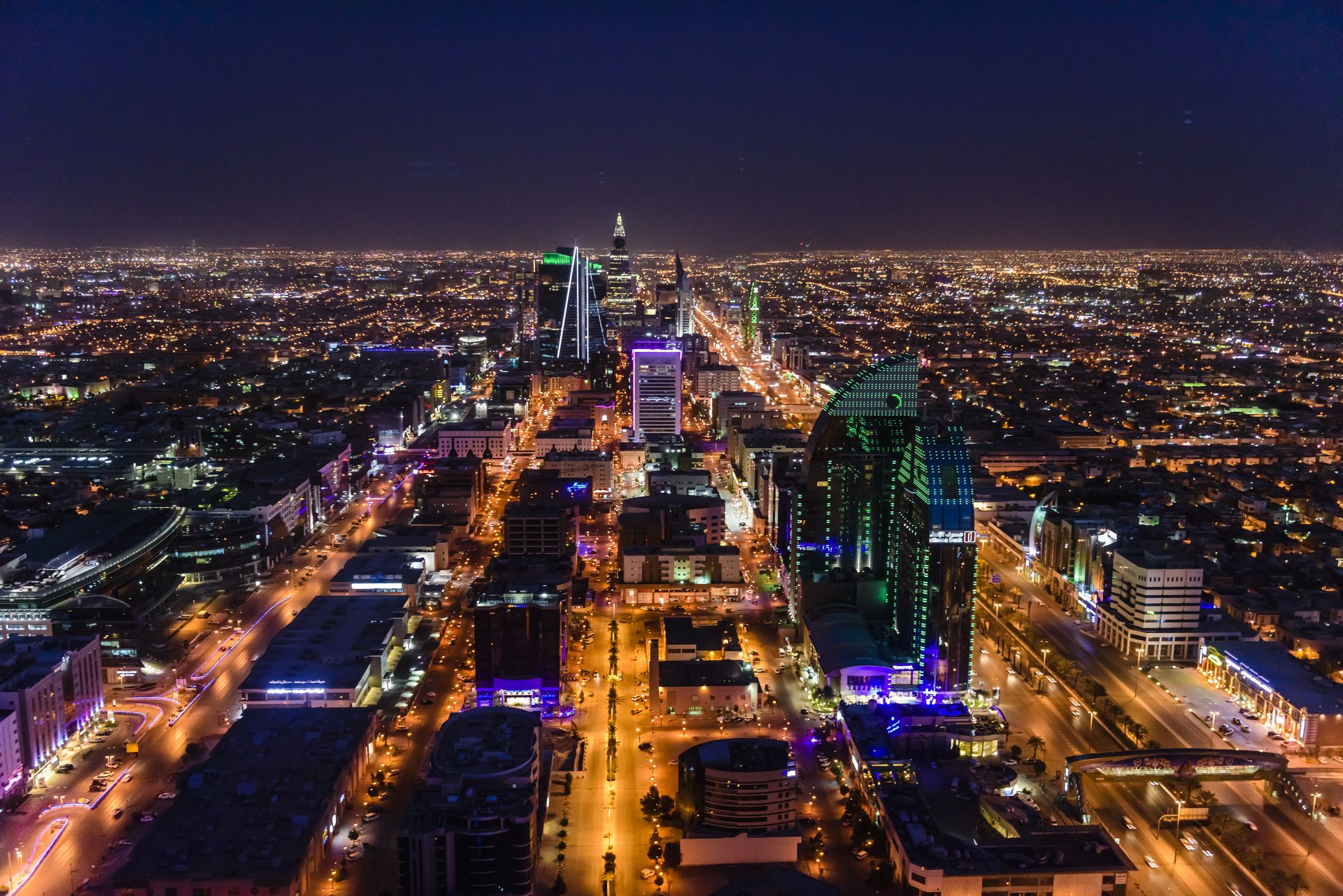
Saudi Arabia has been one of Washington’s most important intelligence partners for half a century, and one of its most uncomfortable. Saudi money and Saudi intelligence officers sat alongside the CIA in the Afghan war of the 1980s; the State Department has credited one Saudi counterterrorism official with helping save “countless American and Saudi lives”; and Saudi officials have also turned up, as subjects or suspects, in the 9/11 investigations, the killing of the journalist Jamal Khashoggi, and a federal prosecution over spying inside Twitter. Since 2017, the services that produce all of that have been rebuilt around one man, Crown Prince Mohammed bin Salman.
This page is a working overview of Saudi Arabia’s intelligence and security services: where they came from, how they are organized today, and the cases that have put them in the news. It relies on Saudi royal decrees as reported by Saudi media, U.S. government records, court rulings, and named reporting, and it notes where a claim comes from a party with an interest in the outcome.
Saudi intelligence at a glance
- Foreign intelligence service: the General Intelligence Presidency (Ri’asat al-Istikhbarat al-’Amah), established by royal order under King Saud in 1956 (Saudipedia).
- Head of General Intelligence: Khalid bin Ali Al-Humaidan, named intelligence chief with cabinet rank by King Salman in January 2015 (Gulf News) and still listed in that post on an official Saudi board roster in 2026 (National Cybersecurity Authority).
- Domestic security service: the Presidency of State Security (Ri’asat Amn al-Dawla), created by royal order on July 20, 2017, which took the domestic intelligence directorate, special forces, and counterterrorism functions out of the Interior Ministry (Arab News).
- Head of State Security: Abdulaziz bin Mohammed Al-Howairini, appointed with ministerial rank when the presidency was created in 2017 (Arab News) and still in post in 2026 (National Cybersecurity Authority).
- Reporting line: both presidencies answer to the king, and in practice to the crown prince, who chaired the 2018 committee that restructured General Intelligence (Asharq Al-Awsat).
- Relationship with the United States: close but turbulent. In November 2025, the United States and Saudi Arabia signed a Strategic Defense Agreement and the White House approved a defense package that includes future F-35 deliveries (White House).
History: from King Saud’s decree to the princes’ service
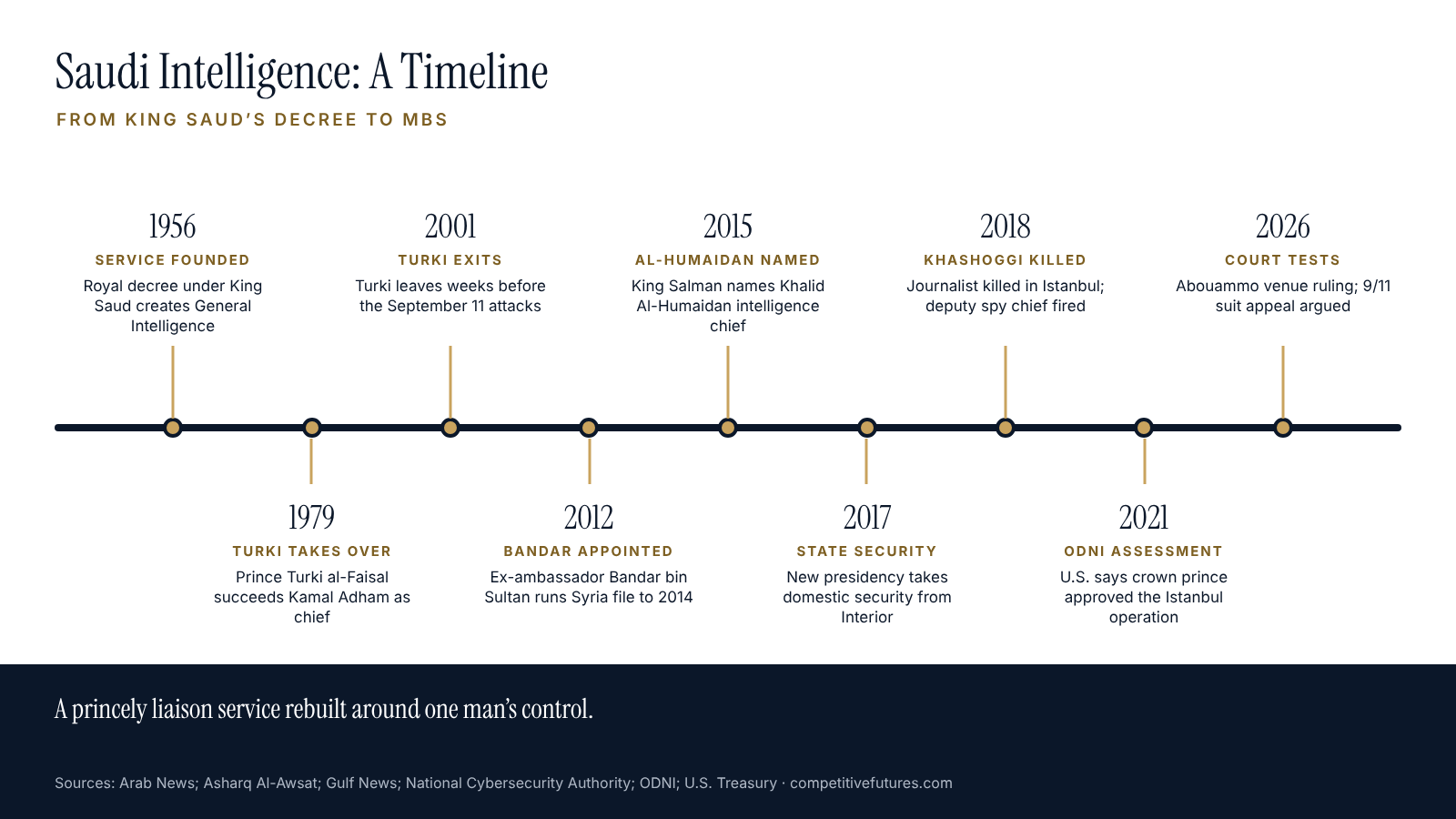
An intelligence office opened in 1955 under the name General Investigations, and Royal Decree No. 11 of 1956, issued under King Saud, made it an independent General Intelligence Department with branches in Jeddah and Dhahran. Under King Faisal it opened offices abroad, and in 1982 King Khalid issued Royal Decree M-5, its basic law, defining its responsibilities and limits (GlobalSecurity.org).
The man who built the modern service was Kamal Adham, the uncle of Prince Turki al-Faisal (GlobalSecurity.org), whom King Faisal put in charge of intelligence and who served until 1979. His later life was dominated by the BCCI banking scandal: accused of a central role in the secret takeover of a Washington bank, he pleaded guilty in the United States in 1992 under a plea agreement, paid a $105 million fine, and received a suspended sentence. He died in Cairo on October 29, 1999 (Gulf News).
Adham’s nephew, Prince Turki al-Faisal, took over in 1979 and ran the service until the end of August 2001 (Washington Institute). The 9/11 Commission records that Saudi Arabia and the United States provided “billions of dollars worth of secret assistance to rebel groups in Afghanistan fighting the Soviet occupation,” routed through Pakistan’s intelligence service (9/11 Commission Report, ch. 2). Turki held the kingdom’s “Afghan file,” which made him Riyadh’s main contact with the Taliban (Washington Institute). In the summer of 1998, according to the commission, he won a commitment from Taliban leaders to expel Osama bin Laden; when he pressed Mullah Omar on it that September, Omar refused, the meeting turned into a shouting match, and Saudi Arabia suspended diplomatic relations with the Taliban (9/11 Commission Report, ch. 4).
Turki’s successor, Prince Nawwaf bin Abdulaziz, took over shortly before the September 11 attacks and left at his own request in January 2005 (Al Jazeera). Prince Muqrin bin Abdulaziz later led the presidency (GlobalSecurity.org). In July 2012, King Abdullah gave the job to Prince Bandar bin Sultan, the long-serving former ambassador to Washington, who ran Saudi support for the Syrian rebels; he stepped down “upon his request” in April 2014 (CNN). The standard account, as the Middle East Institute’s Thomas Lippman put it, is that he fell from favor over Syria, though he had also been ill (Middle East Institute). Prince Khaled bin Bandar briefly followed him (Gulf News), and in January 2015 the new King Salman appointed General Khalid Al-Humaidan, ending a run of princes at the top of the service that began in 1979 (Gulf News).
At home, the decisive counterterrorism figure of the 2000s sat at the Interior Ministry: Prince Mohammed bin Nayef, credited with defeating al-Qaeda’s campaign inside Saudi Arabia in the mid-2000s and Washington’s favorite Saudi partner (Wilson Center). In 2017, Mohammed bin Salman displaced him as heir to the throne (Reuters via Dawn), and the security system he had run was taken apart and rebuilt.
How Saudi intelligence is organized today
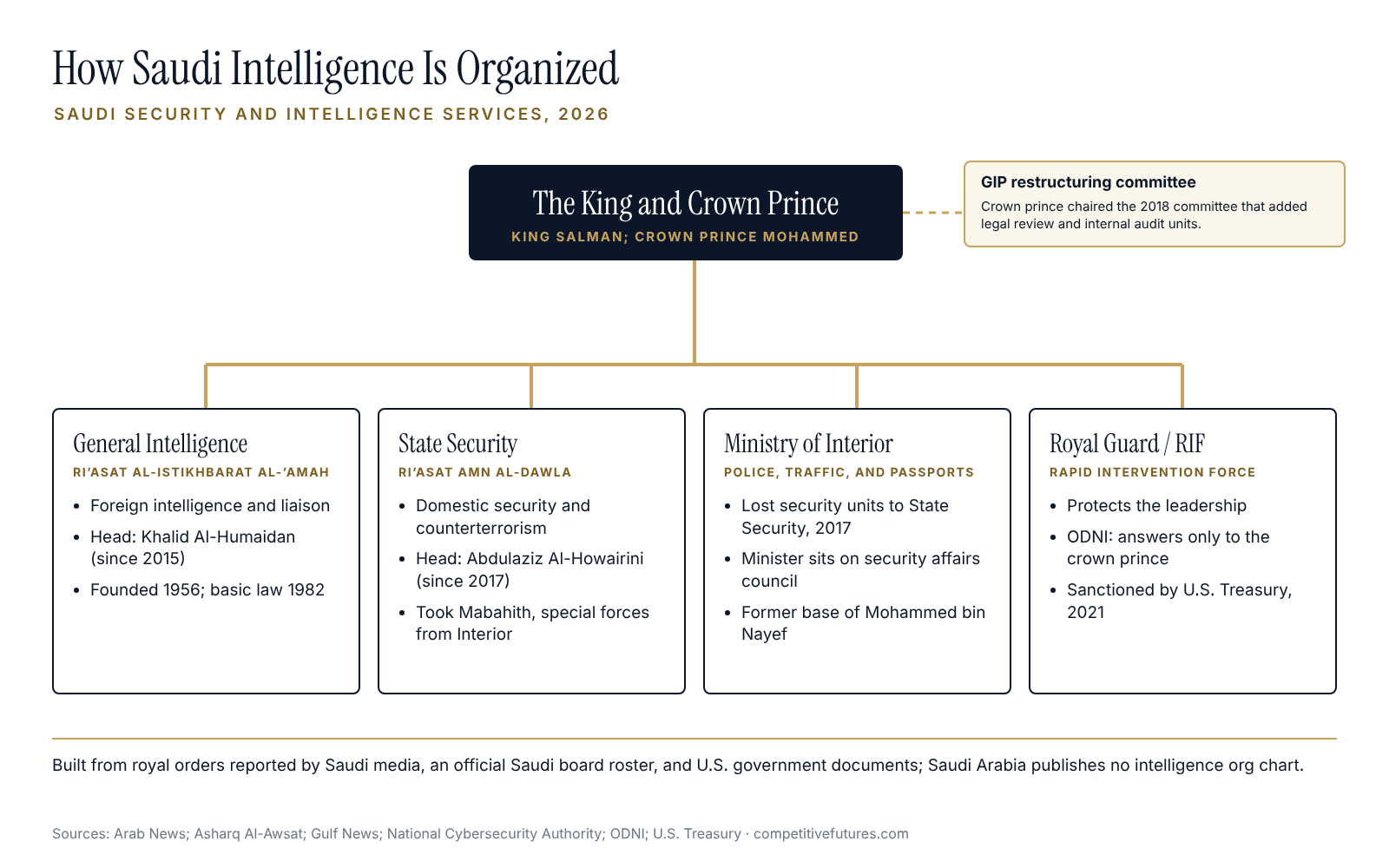
Saudi Arabia publishes no intelligence budget or organizational chart. Royal orders and official board listings show a system built around two presidencies and the Interior Ministry, all answering to the king and crown prince.
- The General Intelligence Presidency is the foreign intelligence service and the main channel for liaison with foreign services. After the Khashoggi killing, a ministerial committee chaired by the crown prince approved three new departments, including a “general department for legal review of intelligence operations” and an internal performance review office (Asharq Al-Awsat).
- The Presidency of State Security is the domestic security and counterterrorism service. The 2017 order moved into it the General Directorate of Investigation (the domestic intelligence service known as the Mabahith), the Special Security Forces, the Special Emergency Forces, the security aviation command, the technical affairs directorate, and the National Information Center, along with “all matters related to combatting terrorism and financial investigations” (Arab News).
- The Ministry of Interior kept the police, traffic, and passports, and its minister became a member of the Council for Political and Security Affairs (GlobalSecurity.org).
- The Royal Guard and the Rapid Intervention Force protect the leadership. U.S. intelligence describes the Rapid Intervention Force as a subset of the Royal Guard that “exists to defend the Crown Prince, answers only to him” (ODNI).
- The National Cybersecurity Authority leads national cyber defense; both security chiefs sit on its board (National Cybersecurity Authority).
The direction of travel is clear. Before 2017, power over intelligence and security was spread among senior princes, who ran General Intelligence and the Interior Ministry as personal domains. Today the same two professional officials, Al-Humaidan and Al-Howairini, have run the two presidencies for most of a decade, and the key decisions sit with the crown prince. Saudi officials present this as modernization and efficiency; human rights groups such as the Geneva-based MENA Rights Group argue that State Security has been given powers to “operate without any judicial oversight and with complete impunity” (MENA Rights Group).
From oil-era liaison to the crown prince’s security state
For most of its history, Saudi intelligence was a liaison service. Its value to Washington and London lay in money, access, and reach into the Muslim world, and its senior officers were princes who were also diplomats: Turki later became ambassador in Washington (Gulf News), and Bandar had spent more than two decades as ambassador in Washington before running intelligence (CNN). Cooperation was uneven. The 9/11 Commission found that in 1998 Saudi authorities quietly disrupted bin Laden-linked cells and made scores of arrests, but that on terrorist finance they gave the United States little access to key figures (9/11 Commission Report, ch. 4).
The question that has never gone away is whether parts of the Saudi state helped the 9/11 hijackers. The 9/11 Commission wrote: “We have found no evidence that the Saudi government as an institution” or senior Saudi officials individually funded al-Qaeda (9/11 Commission Report, ch. 5). The so-called 28 pages from the earlier congressional Joint Inquiry, released in July 2016, described contacts between some hijackers and people who may have had Saudi government ties, but stated that the inquiry “has made no final determination as to the reliability or sufficiency of the information.” Saudi Arabia welcomed the release and said investigators had found no Saudi government support for the attacks (AP via WGBH).
What changed after 2017 was the purpose. Critics say the consolidated services were turned toward the crown prince’s opponents abroad. The U.S. intelligence community’s 2021 assessment of the Khashoggi killing based its judgment on “the Crown Prince’s control of decisionmaking in the Kingdom” (PBS Frontline). Riyadh has also offered a different message: in March 2025, State Security chief Al-Howairini said on Saudi television that opposition figures abroad who face no charges of “homicide, theft or assault” would be welcomed home (Arab News).
Saudi intelligence in the news
Most public knowledge of how Saudi Arabia uses intelligence comes from six cases. In each, the allegations come from foreign governments, investigators, litigants, or researchers, and the Saudi government has denied them or not commented.
The 9/11 litigation (2001–2026)

Families of 9/11 victims, insurers, and businesses allege that Saudi government employees knowingly helped two hijackers in California. The investigative outlet Florida Bulldog, which has long covered the case, reports that a July 2021 FBI report, since declassified, described Omar al-Bayoumi as a Saudi spy who befriended the first two hijackers; the 9/11 Commission had found no evidence that a second man, the diplomat Fahad al-Thumairy, helped them (CBS News; Florida Bulldog). On August 28, 2025, U.S. District Judge George Daniels denied Saudi Arabia’s motion to dismiss, finding the plaintiffs had offered “reasonable evidence as to the roles played by Bayoumi, Thumairy, and KSA”; the ruling addressed jurisdiction, not the merits. The Saudi embassy said the kingdom “categorically denies” the allegations, “respectfully disagrees” with the decision, and would appeal (CBS News). A federal appeals panel in New York heard Saudi Arabia’s appeal on October 7, 2026, and had not ruled as of late October (AP via News4JAX).
The Twitter insiders (2015–2026)
In November 2019, federal prosecutors in San Francisco charged two former Twitter employees, Ahmad Abouammo and Ali Alzabarah, and a third man, Ahmed Almutairi, alleging that the employees passed nonpublic information about Twitter users to Saudi officials (U.S. Attorney’s Office, N.D. Cal.). Alzabarah reportedly fled to Saudi Arabia and has not been tried (Courthouse News). In August 2022, a jury convicted Abouammo on six counts, including acting as an agent of a foreign government, wire fraud, money laundering, and falsifying records, and acquitted him on five others (Axios). His lawyers argued his work had been part of his job; in December 2022, he was sentenced to three and a half years; the Saudi embassy did not respond to requests for comment (Reuters via Dawn). The Ninth Circuit wrote in December 2024, “We affirm Abouammo’s convictions but vacate his sentence and remand for resentencing,” and described the official who paid him as a close associate of the crown prince (United States v. Abouammo). On June 11, 2026, the Supreme Court ruled 9–0 that the falsification count had been tried in the wrong district. Justice Kagan wrote that the obstructive effects of the falsified invoice “were not elements of his crime” and that the trial had to take place in Seattle, where he made it; the Court’s opinion recounts that he gave a high-level Saudi official information about two dissidents and was wired $300,000 in return (Abouammo v. United States).
Saad Aljabri and the “Tiger Squad” (2017–present)
Saad Aljabri spent years as Mohammed bin Nayef’s closest aide at the Interior Ministry; the U.S. State Department called him “a valued partner in countering terrorism whose work helped save countless American and Saudi lives” (Reuters via Dawn). In August 2020, living in exile in Canada, he sued the crown prince and others in Washington, alleging that a hit squad was sent to kill him in Canada in October 2018 and was stopped at the border. The crown prince’s lawyers denied it, argued he was immune, and said Aljabri “can say whatever he wants to the newspapers. But this case does not belong in federal court” (Al Jazeera). Judge Timothy Kelly dismissed the claims against the crown prince for lack of personal jurisdiction in September 2022 (Transnational Litigation Blog); in July 2024 the D.C. Circuit affirmed that dismissal on head-of-state immunity grounds but allowed jurisdictional discovery against two other Saudi defendants (Transnational Litigation Blog). Saudi state-owned companies have sued Aljabri in Canada and the United States, alleging he embezzled billions while at the Interior Ministry, which he denies (Reuters via Dawn). In December 2021, a federal judge in Boston dismissed one of those suits after the Director of National Intelligence invoked the state secrets privilege (Middle East Eye).
Pegasus and the “KINGDOM” operator (2018)
In October 2018, researchers at the University of Toronto’s Citizen Lab reported: “We assess with high confidence that Abdulaziz’s phone was infected with NSO’s Pegasus spyware,” referring to Omar Abdulaziz, a Saudi dissident and Canadian permanent resident whose phone was infected while he was in Quebec. They attributed the infection to an operator they named KINGDOM, which they linked to the Saudi government and security services (Citizen Lab). The report does not include a Saudi government response. NSO Group has said its product is “licensed to government and law enforcement agencies for the sole purpose of investigating and preventing crime and terror,” and disputed Citizen Lab’s earlier mapping of its clients (Citizen Lab).
The killing of Jamal Khashoggi (2018–2022)
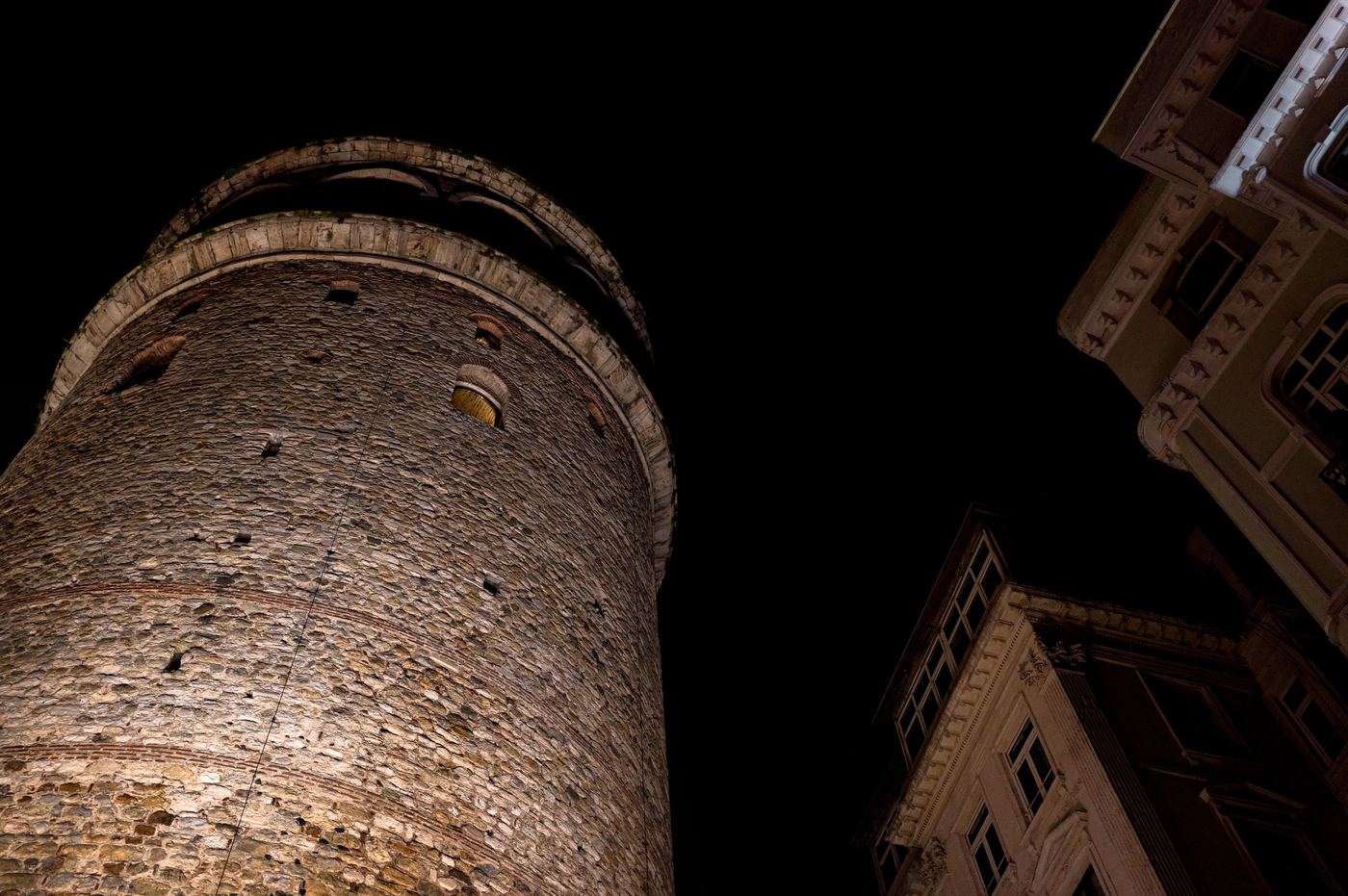
Jamal Khashoggi, a Saudi journalist and Washington Post columnist, was killed inside the Saudi consulate in Istanbul on October 2, 2018. In October 2018, Saudi Arabia’s public prosecutor said that discussions with him “led to a brawl and a fist fight” that caused his death; at the same time, royal decrees fired the deputy head of General Intelligence and other officials and put the crown prince in charge of restructuring the service (Argaam). In December 2019, a Riyadh court sentenced five people to death and three to prison, and the prosecutor said the trial found no prior intent to kill (Al Jazeera). After Khashoggi’s sons said they pardoned the killers, a final ruling in September 2020 replaced the death sentences with 20-year terms and gave three others 7 to 10 years. The UN special rapporteur Agnes Callamard called it “one more act today in this parody of justice” (AFP via Dawn).
On February 26, 2021, the Office of the Director of National Intelligence released an assessment that the crown prince “approved an operation in Istanbul, Turkey to capture or kill” Khashoggi, noting that seven members of his Rapid Intervention Force were on the team and that they “would not have participated in the operation against Khashoggi without Muhammad bin Salman’s approval” (ODNI). The Saudi foreign ministry said it “completely rejects the negative, false and unacceptable assessment in the report pertaining to the kingdom’s leadership” (The New Arab). The State Department imposed visa restrictions on 76 Saudis but took no action against the crown prince (PBS Frontline). In April 2022, a Turkish court halted its trial in absentia of 26 Saudi suspects and transferred the case to Saudi Arabia, a move Khashoggi’s fiancée, Hatice Cengiz, opposed (AP via PBS NewsHour).
Ahmad al-Asiri (2018–2021)
Major General Ahmad al-Asiri, deputy head of General Intelligence, was dismissed by royal decree in October 2018 (Argaam). Saudi prosecutors charged him over the Khashoggi killing, but in December 2019 the court acquitted him “due to insufficient evidence”; Saud al-Qahtani, a royal court adviser, was investigated but not indicted (Al Jazeera). Istanbul prosecutors indicted him, and in February 2021 the U.S. Treasury sanctioned him, calling him the “ringleader of the operation,” and also sanctioned the Rapid Intervention Force (U.S. Treasury). Under Saudi law, his acquittal stands.
How to read coverage of Saudi intelligence
Saudi intelligence is hard to research honestly because so many sources have a stake. Arab News, Asharq Al-Awsat, and Al Arabiya are Saudi-owned and generally reflect the official line. Al Jazeera is funded by Qatar, which was under a Saudi-led blockade during the Khashoggi crisis. Much of the early Khashoggi evidence reached the public through leaks from Turkish officials, whose government had its own quarrel with Riyadh until the two reconciled. Human rights groups and exiled dissidents supply much of what is known about State Security.
The discipline is the same one taught in our guides to trend analysis and evaluating forecasts: climb toward primary records. For Saudi Arabia, that means royal orders as published by the Saudi Press Agency, U.S. court opinions and dockets in the 9/11, Twitter, and Aljabri cases, Treasury sanctions notices, declassified U.S. intelligence assessments, and the U.S. Justice Department’s public database of foreign agents registered under the Foreign Agents Registration Act (FARA eFile), which lists the lobbyists and public relations firms working for the kingdom, and for its critics and rivals, in Washington. When a story rests on a single anonymous leak from a government at odds with Riyadh, treat it as a lead, not a finding.
Frequently asked questions
What is Saudi Arabia’s intelligence agency called?
Saudi Arabia’s foreign intelligence service is the General Intelligence Presidency (Ri’asat al-Istikhbarat al-’Amah), often shortened to GIP and founded under King Saud in 1956. Domestic security and counterterrorism belong to a separate body, the Presidency of State Security, created in 2017.
Who is the head of Saudi intelligence?
Khalid bin Ali Al-Humaidan has headed the General Intelligence Presidency since King Salman appointed him in January 2015, and Abdulaziz bin Mohammed Al-Howairini has headed the Presidency of State Security since it was created in July 2017. Both answer to the king and the crown prince.
Did Saudi intelligence have a role in 9/11?
The 9/11 Commission found no evidence that the Saudi government as an institution, or senior officials individually, funded al-Qaeda, but questions about contacts between Saudi officials and two hijackers are still being litigated. In August 2025, a federal judge let the families’ lawsuit against Saudi Arabia proceed; Saudi Arabia denies any involvement and has appealed.
Related reading
- Qatari Intelligence: History, Structure, and the Headlines
- Trend Analysis: How to Tell a Real Trend From Media Hype
- How to Evaluate a Forecast
- Cognitive Bias: A Field Guide for Leaders
Competitive Futures briefs companies and governments on intelligence services, foreign influence, and the Gulf; details are on the services page.