Qatari Intelligence: History, Structure, and the Headlines

Qatar is a country of about three million people, most of them foreign workers, and only a few hundred thousand citizens. It is also the host of the largest American air base in the Middle East, the home of the Hamas and Taliban political offices, the channel for most Gaza hostage negotiations since 2023, and a recurring name in corruption and espionage cases from Brussels to Jerusalem to New Delhi. Very little of that makes sense unless you understand the small, quiet, and well-connected intelligence service at the center of it.
This page is a working overview of Qatar’s intelligence and security services: where they came from, how they are organized today, and the cases that have put them in the news. It relies on official Qatari decrees, U.S. government records, court-reported facts, and named reporting, and it notes where a claim comes from a party with an interest in the outcome.
Qatari intelligence at a glance
- Main intelligence service: State Security (Jihaz Amn al-Dawla), formed when Qatar merged its services into a single agency in 2004.
- Head: Khalfan bin Ali bin Khalfan Al Bati Al Kaabi, appointed by Amiri Decision No. 74 of 2024 on November 12, 2024 (Qatar News Agency).
- Previous head: Abdullah bin Mohammed bin Mubarak Al Khulaifi, who was moved the same day to run the Amiri Diwan, the Emir’s court (The Peninsula).
- Internal Security Force (Lekhwiya): the elite security force under the Interior Ministry, placed under the command of the Emir’s brother and interior minister, Sheikh Khalifa bin Hamad Al Thani, in April 2023 (Gulf States Newsletter).
- National Cyber Security Agency: set up in 2021; its first chairman, Abdulrahman Ali Al Farahid Al Maliki, was appointed by Amiri Decision No. 9 of 2021 (The Peninsula).
- Relationship with the United States: close. Qatar hosts Al Udeid Air Base, was designated a Major Non-NATO Ally in March 2022 (White House), and in 2024 its intelligence chief received the CIA’s George Tenet medal.
History: from British protection to a single service
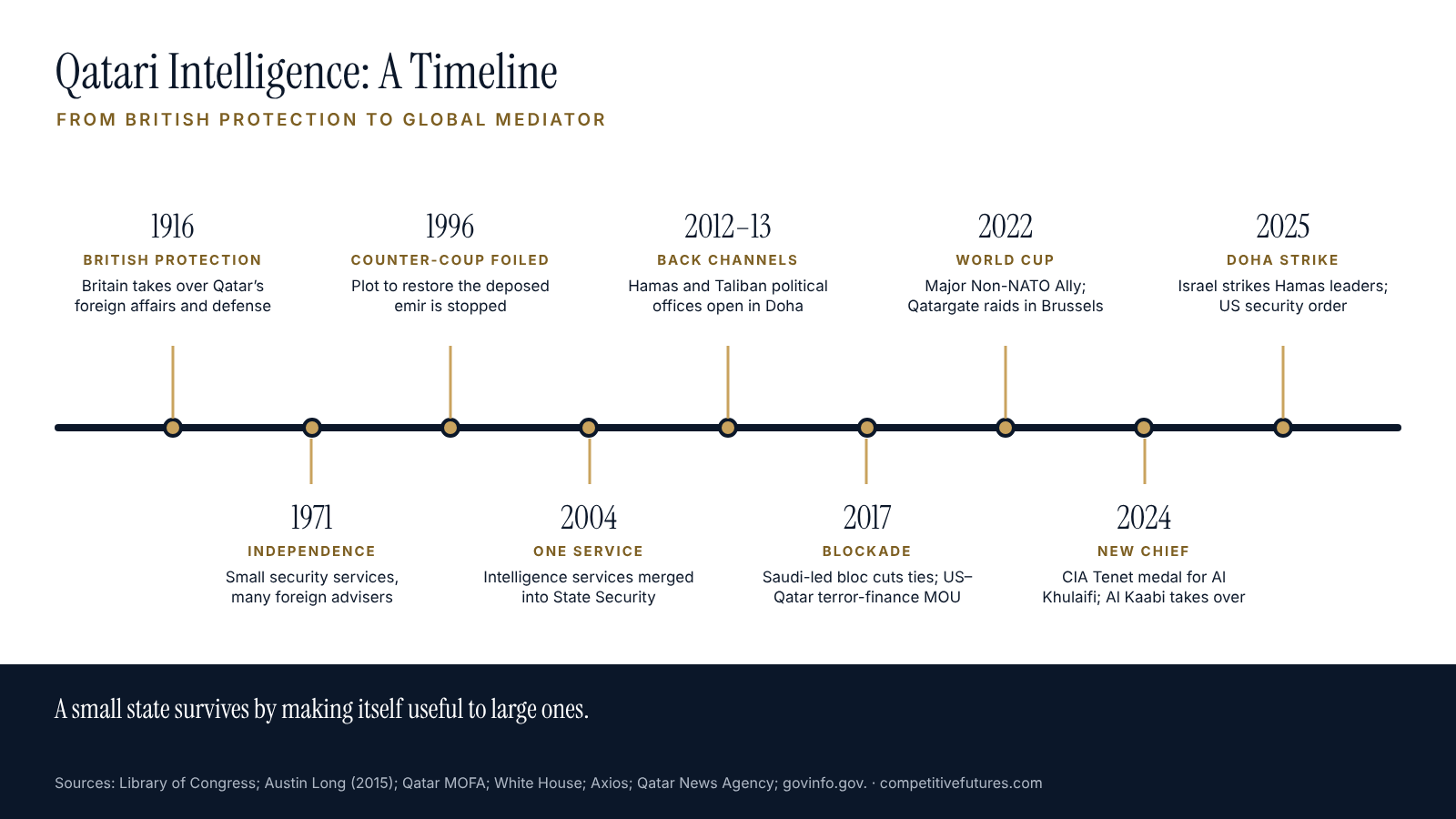
Britain ran Qatar’s foreign affairs and defense from 1916 until independence on September 3, 1971. The security services that grew up after independence were small and staffed heavily by foreigners. The Library of Congress country study of the Gulf states, written around 1992, describes two separate bodies: the Mubahathat, a “secret police office” that was “a nearly independent branch of the Ministry of Interior” handling sedition and espionage, and the Mukhabarat, an intelligence service “under armed forces jurisdiction” that tracked terrorists and political dissidents. Britons, French, Jordanians, and Pakistanis held advisory and technical posts (Library of Congress).
The formative crisis came early. Sheikh Hamad bin Khalifa Al Thani took power from his father in 1995, and in February 1996 a counter-coup plot to restore the old emir was discovered and stopped. Who stood behind it is still argued over. In 2018, at the height of the Gulf blockade, Al Jazeera, which is funded by the Qatari state, aired a documentary alleging that senior Saudi, Emirati, Bahraini, and Egyptian officials helped organize the plot (Al Jazeera). Whatever the full truth, the lesson Doha drew is plain in everything it has done since: the most immediate threats to the ruling family came from its neighbors, and a small state survives by making itself useful to large ones.
In 2004, Qatar merged its intelligence services into a single agency, Qatar State Security. Writing in 2015, the Columbia University scholar Austin Long described it as “increasingly professional” under its then head, Brigadier General Ghanem al-Kubaisi. He noted press reports that the service had organized arms and money for Syrian rebels and had helped free an American journalist held by Syrian militants (Austin Long, ISN Security Watch, via Eurasia Review).
The Arab Spring years made Qatar powerful friends and powerful enemies. In June 2017, Saudi Arabia, the UAE, Bahrain, and Egypt cut ties with Qatar and imposed a blockade, accusing it of supporting terrorist groups and political opponents across the region. Qatar denied the charges. Within weeks, on July 11, 2017, Qatar and the United States signed a memorandum of understanding on combating terrorist financing in Doha (Qatar Ministry of Foreign Affairs; CNBC). The blockade ended in January 2021, and Qatar came out of it more closely tied to Washington than before.
How Qatari intelligence is organized today
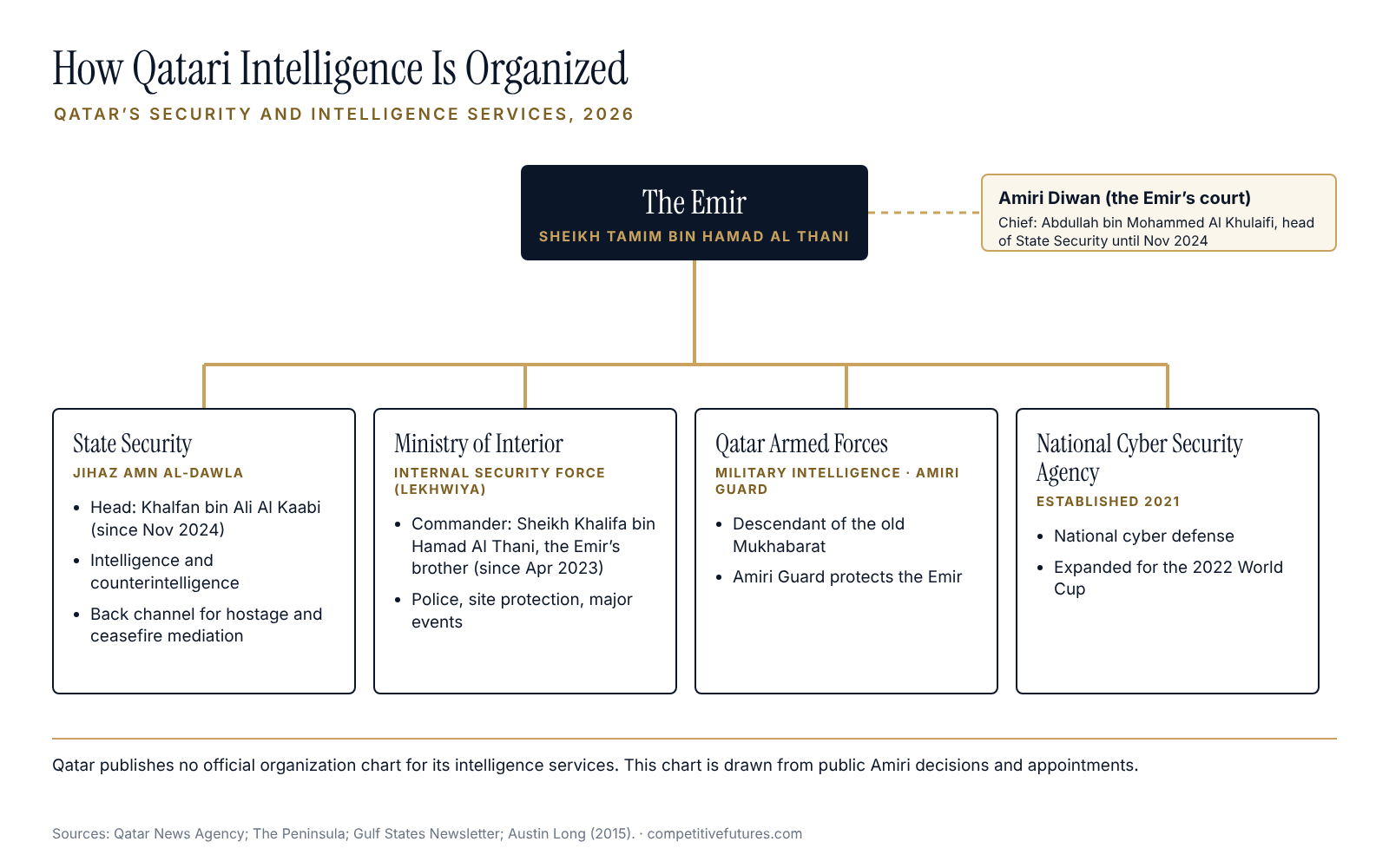
Qatar does not publish an organizational chart, a budget, or a founding law for its intelligence services in English, so the best public evidence is the trail of Amiri decisions that appoint their leaders. That trail shows a system built around a few bodies, all answering to the Emir.
- State Security is the main intelligence and counterintelligence service, and in recent years it has also been the working channel for Qatar’s most sensitive mediation. Its head reports to the Emir. The 2024 move of Abdullah Al Khulaifi from State Security to chief of the Amiri Diwan put the man who had run the country’s intelligence service, and its hostage diplomacy, at the center of the court.
- The Ministry of Interior runs the police and the Internal Security Force, Lekhwiya, which guards key sites, protects major events, and has a special-operations capability. Putting the Emir’s brother in command in 2023 kept that force close to the ruling family.
- The Qatar Armed Forces retain military intelligence, the descendant of the old Mukhabarat, and the Amiri Guard protects the Emir.
- The National Cyber Security Agency handles national cyber defense, a role that grew sharply with the 2022 World Cup.
Two things set this system apart from those of Qatar’s neighbors. First, the line between intelligence and diplomacy is thin by design: the same people who run security also run back channels. Second, much of Qatar’s capability has been bought rather than grown, through foreign advisers, contractors, and training, which is how several of the cases below began.
The mediation service
Qatar’s intelligence service is best known abroad for talking to people other governments will not talk to. In 2012, after Hamas’s leaders left Syria, Qatar allowed Hamas to open a political office in Doha, and in 2013 it hosted the Taliban’s political office. Qatari officials say both were set up at Washington’s request; in 2023 Qatar’s ambassador to the United States wrote that the United States wanted the Hamas office “to establish indirect lines of communication with Hamas” (Al Jazeera).
Those channels made Doha the venue for the Gaza hostage and ceasefire talks after October 7, 2023, with the CIA director and Israel’s Mossad chief traveling there to meet Qatari and Egyptian counterparts. In August 2024, CIA Director William Burns presented Al Khulaifi, then head of State Security, with the agency’s George Tenet medal for his support of U.S.–Qatari security cooperation; one of Axios’s sources said Qatar’s work to free hostages held by Hamas was a main reason for the award (Axios).
The same role made Qatar a target. On September 9, 2025, Israel struck residential compounds in Doha where members of Hamas’s political bureau were staying. Qatar’s Interior Ministry said a lieutenant colonel of the Internal Security Force, Badr Saad Mohammed Al Humaidi Al Dosari, was killed and several other security personnel were injured (Gulf News). On September 29, 2025, the White House issued Executive Order 14353, which states that the United States will regard any armed attack on Qatar’s territory, sovereignty, or critical infrastructure as a threat to U.S. peace and security (govinfo.gov).
Qatari intelligence in the news
Most public knowledge of how Qatar uses intelligence comes from seven cases. In each, the allegations come from investigators, litigants, or reporters, and Qatar has either denied them or declined to comment.
The World Cup and the former CIA officer (2010–2017)
In November 2021, the Associated Press reported, based on documents and former associates, that Qatar hired Kevin Chalker, a former CIA officer, and his firm Global Risk Advisors to spy on rival bid teams and soccer officials before the 2010 vote that awarded it the 2022 World Cup, and later to monitor critics inside FIFA. The AP also described proposals for surveillance of migrant workers and a 2017 plan to train Interior Ministry staff in spying and hacking. Chalker said he and his companies would not “ever engage in illegal surveillance” and called some documents forgeries; Qatar did not respond (AP via Dawn). Many of the same documents surfaced in a lawsuit against Chalker by the Republican fundraiser Elliott Broidy, described below; Chalker’s lawyers called that suit meritless.
The hunting party ransom (2015–2017)
In December 2015, a 25-member Qatari hunting party, including members of the royal family, was kidnapped in southern Iraq and held for 16 months. In 2018, the Washington Post reported, from intercepted calls and messages supplied by an unnamed foreign government, that Qatar paid at least $275 million to Iraqi militias and Iranian officials to win their release. Qatar has denied paying ransom (The National, summarizing the Post). The source of the intercepts matters here: they were leaked during the blockade, when several governments had every reason to embarrass Doha.
Elliott Broidy and the hacked emails (2017–2024)
During the blockade, Elliott Broidy, a Republican fundraiser, and his business partner George Nader pressed Washington to take a harder line on Qatar while seeking defense and intelligence business from the UAE and Saudi Arabia. According to an AP investigation, Broidy’s plans included a proposed budget of more than $12 million to “expose and penalize” Qatar, a May 2017 think-tank conference critical of Qatar, and support for sanctions legislation, and he pursued a UAE intelligence-gathering contract worth up to $600 million (AP via Al Jazeera). The AP’s reporting drew on Broidy emails that began arriving anonymously at news organizations in early 2018.
Broidy said a “nation state” had hacked him and sued Qatar, its lobbyists, and Chalker. Qatar rejected his account. The courts never decided whether Qatar did it. In December 2020, the U.S. Court of Appeals for the Ninth Circuit held that Qatar was immune from the suit under the Foreign Sovereign Immunities Act, describing clandestine espionage as conduct “that all national governments” claim the power to undertake, and stressing that its ruling was “neither an affirmation that the alleged conduct actually occurred nor an endorsement of any such conduct” (Broidy Capital Management v. State of Qatar). In April 2024, Broidy dropped his lawsuit against Chalker and Global Risk Advisors (Hughes Hubbard & Reed). In an unrelated case, Broidy pleaded guilty in October 2020 to conspiring to act as an unregistered foreign agent over lobbying tied to Malaysia’s 1MDB scandal and China (JURIST). The episode is a reminder that the Gulf rivalry was fought in Washington on both sides.
The Indian Navy veterans (2022–2024)
In August 2022, Qatar detained eight former Indian Navy personnel working for a Doha company, Dahra Global. Qatar never made the charges public, though they were widely reported to involve spying for Israel. A Qatari court sentenced them to death in October 2023; an appeals court commuted the sentences to prison terms in December 2023; and in February 2024 India’s Ministry of External Affairs announced that the Emir had decided to release them (JURIST). The case showed both sides of Qatari counterintelligence: severe on paper, and negotiable at the level of heads of state.
Qatargate in Brussels (2022–present)
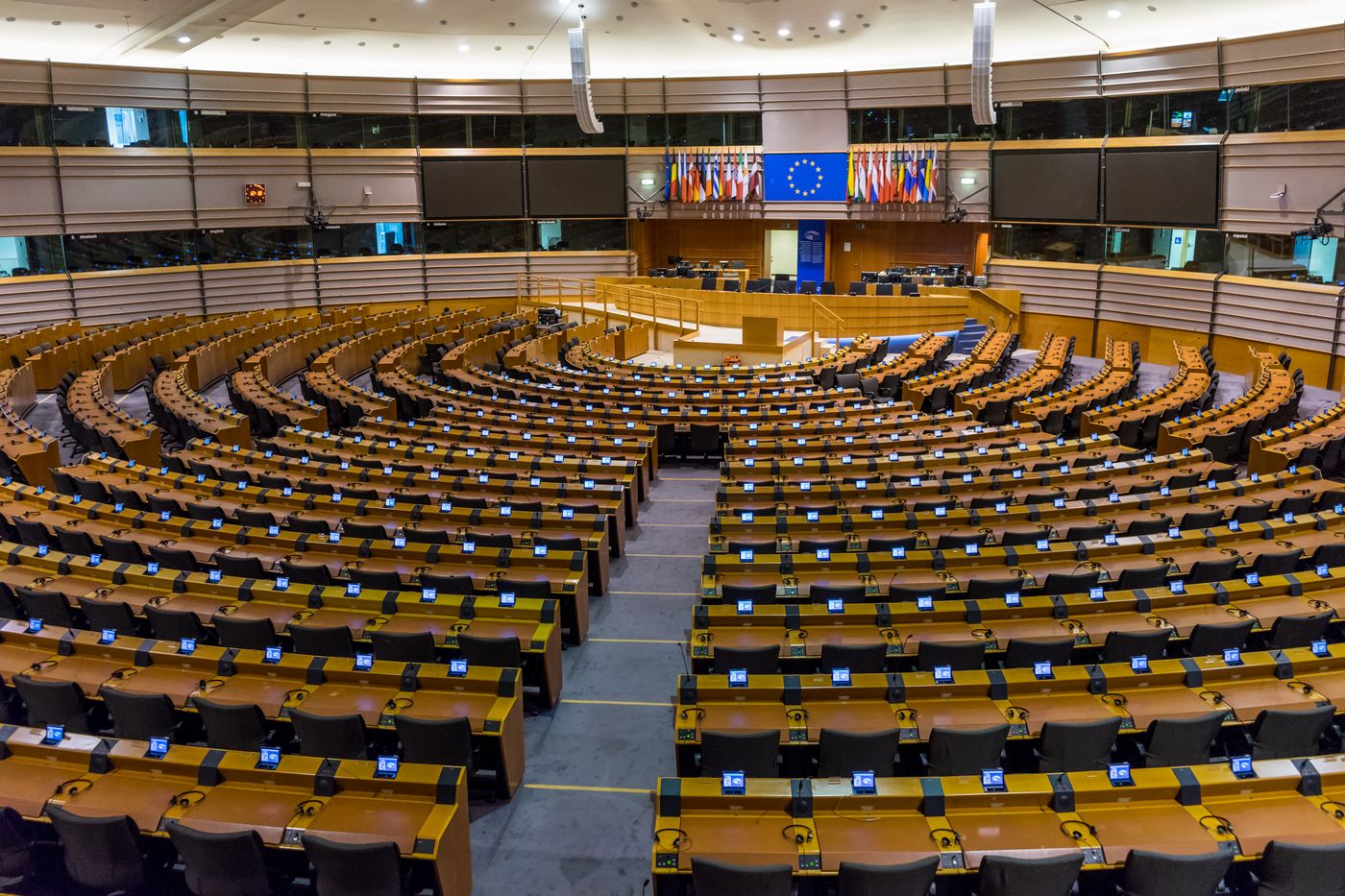
On December 9, 2022, Belgian police raided homes and offices in Brussels and found about €600,000 in cash, in a corruption investigation into suspected efforts by a Gulf state, which a source identified as Qatar, to influence the European Parliament (AFP via Dawn). Morocco was later named in the investigation as well. Qatar’s mission to the EU denied involvement and complained that Qatar had been “exclusively criticised and attacked” (The National). In February 2026, the Brussels Court of Appeal rejected most of the defendants’ challenges to the investigation and allowed it to continue; no trial had been held (LaPresse).
Senator Menendez and the Qatari investment (2021–2025)
In January 2024, federal prosecutors in New York added Qatar to the bribery case against Senator Bob Menendez of New Jersey. They alleged that Menendez helped the New Jersey developer Fred Daibes win investment from a Qatari fund by introducing Daibes to a member of the Qatari royal family who was a principal in the investment firm, meeting Qatari officials, and making public statements supportive of Qatar’s government that he passed to Daibes to share with the Qatari side. In August 2021, prosecutors said, Menendez sent Daibes a press release praising Qatar with the text, “You might want to send to them. I am just about to release.” The investment, worth tens of millions of dollars, was completed in 2023. Menendez’s lawyer called the allegations “a string of baseless assumptions and bizarre conjectures,” and no Qatari official was charged (AP via WHYY). A jury convicted Menendez on all counts in July 2024, including acting as an agent of Egypt, and in January 2025 he was sentenced to 11 years in prison; Daibes received seven years (PBS NewsHour). Menendez maintains his innocence and began serving his sentence in June 2025.
Qatargate in Israel (2025–present)
In February 2025, Israel’s attorney general opened a criminal investigation into allegations that aides to Prime Minister Benjamin Netanyahu, including his spokesman Jonatan Urich and former spokesman Eli Feldstein, were paid, through intermediaries, to promote Qatar’s image in Israel during the hostage negotiations. Reports tied the payments to Jay Footlik, a registered U.S. agent of Qatar. Netanyahu has called the investigation politically motivated (Jewish Insider). As of May 2026, no charges had been filed in the Qatar matter; prosecutors announced a planned indictment of Urich in a separate case over leaked classified documents (AP via Arab News).
How to read coverage of Qatari intelligence
Qatar is one of the hardest intelligence topics to research honestly, because nearly every source has a side. Al Jazeera is funded by the Qatari state. The UAE’s The National and the Saudi outlets Arab News and Al Arabiya spent the blockade years publishing every damaging story about Doha they could find. Leaked intercepts arrive from governments that do not identify themselves. Lobbying and image campaigns, on all sides, are large and well funded.
The discipline is the same one taught in our guides to trend analysis and evaluating forecasts: climb toward primary records. For Qatar, that means Amiri decisions published by the Qatar News Agency, court records in Belgium, Israel, India, and the United States, and the U.S. Justice Department’s public database of foreign agents registered under the Foreign Agents Registration Act (FARA eFile), which lists the lobbyists and consultants working for Qatar, and for its rivals, in Washington. When a story about Doha rests on a single anonymous leak from a hostile capital, treat it as a lead, not a finding.
Frequently asked questions
What is Qatar’s intelligence agency called?
Qatar’s main intelligence service is State Security (Jihaz Amn al-Dawla), sometimes called Qatar State Security or the State Security Service. It was formed when Qatar merged its intelligence services into a single agency in 2004.
Who is the head of Qatari intelligence?
Khalfan bin Ali bin Khalfan Al Bati Al Kaabi has headed State Security since November 2024. His predecessor, Abdullah bin Mohammed Al Khulaifi, became chief of the Amiri Diwan.
Does Qatari intelligence work with the United States?
Yes, closely. Qatar hosts Al Udeid Air Base, signed a counterterrorism financing agreement with the United States in 2017, was designated a Major Non-NATO Ally in 2022, and has served as a key intermediary in hostage negotiations. Its intelligence chief received the CIA’s George Tenet medal in 2024.
Related reading
- Trend Analysis: How to Tell a Real Trend From Media Hype
- How to Evaluate a Forecast
- Cognitive Bias: A Field Guide for Leaders
Competitive Futures briefs companies and governments on intelligence services, foreign influence, and the Gulf; details are on the services page.