Trump Remakes the Middle East—Despite What Most Analysts Predicted
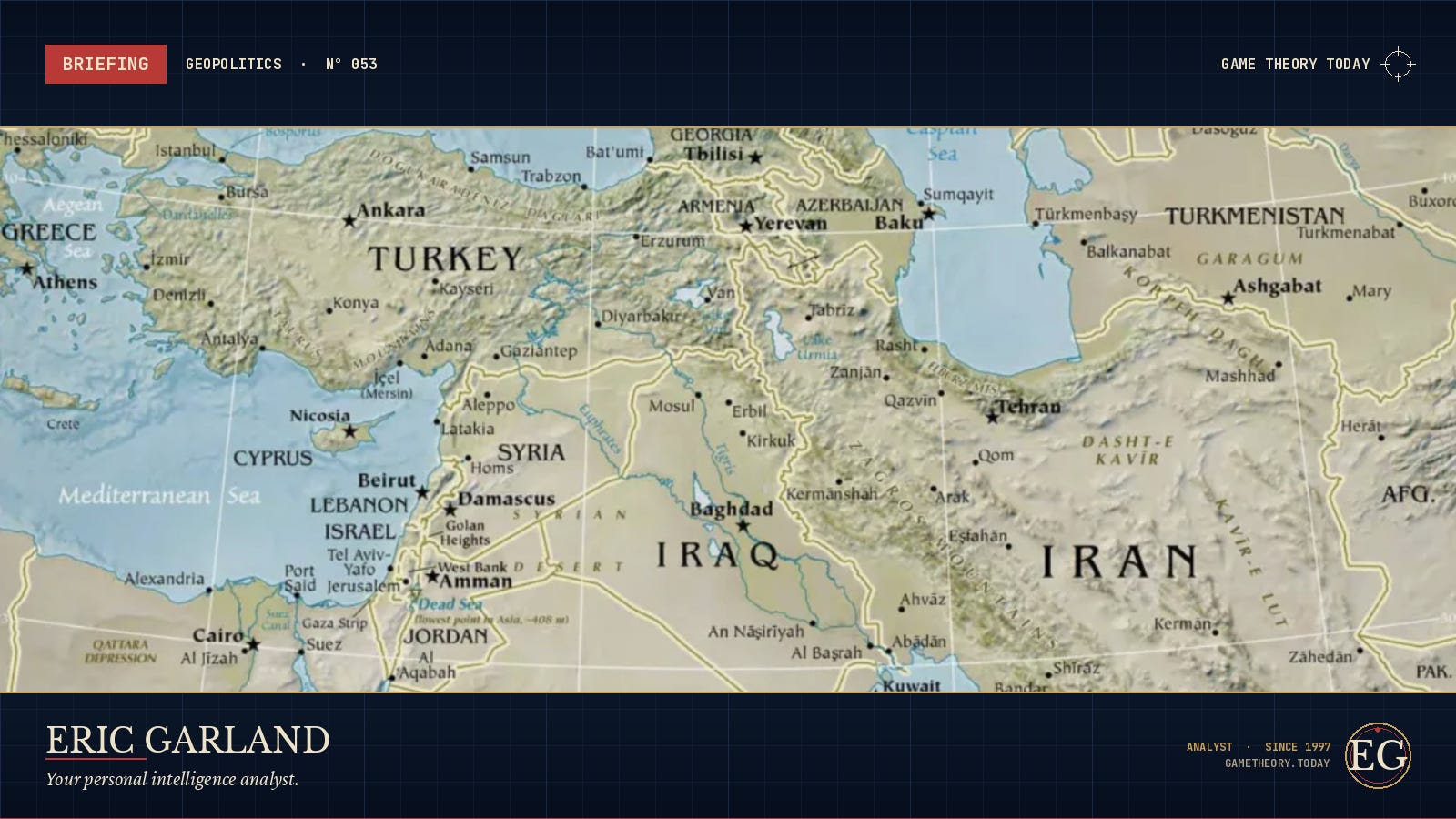
This week, four things happened that belong to the same story:
The United Arab Emirates announced its exit from OPEC and OPEC+, effective May 1.
Qatar — per Israeli reporting that has not yet been formally confirmed by Doha — ended its two-decade support for Hamas after Hamas failed to condemn Iranian missile strikes on Qatari territory.
The Iranian regime, decapitated by the US-Israel strike on Khamenei in February and unable to hold internal coherence on its single most important strategic asset, showed itself as publicly fractured: Foreign Minister Araghchi declared the Strait of Hormuz open for commercial shipping and was attacked by regime hardliners for handing Trump a victory. President Pezeshkian apologized to Arab neighbors for Iranian attacks.
And in Washington, the British monarch arrived to inspect American troops on the 250th anniversary of American independence — i.e., the anniversary of Britain losing North America — to deliver an explicitly above-politics address while the Pentagon publicly floated withdrawing US support for British Falklands sovereignty as punishment for British non-support on Iran.
Most analysts will write these up as four discrete stories. Energy. Counterterrorism. Iran. Diplomacy.
They are one story. And to understand it, we need to go back to the dewy slopes of 1992, when an academic international relations theorist named Alexander Wendt published a paper called “Anarchy Is What States Make of It.”
On Constructivism Over Realism or Liberalism
Wendt’s argument was deceptively simple. The dominant schools of international relations theory in the late twentieth century — Realism and Neoliberal Institutionalism — both treated the structure of the international system as fixed by material conditions. States exist in anarchy. Anarchy produces certain patterns: balancing, alliance formation, security dilemmas. The structure constrains behavior. The structure is the variable.
Wendt said nope. Anarchy is what states make of it. The international system is not fixed by the distribution of military and economic power. It is constituted by the choices states make, the identities they hold, and the expectations they share. Two states with identical material capabilities can produce radically different security relationships depending on whether they treat each other as friends or enemies. The “rules-based order” is not a feature of the universe. It’s a construction held in place by the actors that constitute it. Stop constituting it and it dissolves.
It’s very American, when you think about it: States, like human beings, have free will. They occasionally might take advantage of it—so you better watch out!
For thirty-four years, scholars argued about whether Wendt’s claim could actually be demonstrated empirically. To be honest, most ignored constructivism. After all, neoconservatism was much more relevant, what with its propensity for starting useless wars on immoral grounds. But if they did tussle with Constructivism, analysts observed that state behavior reproduced the inherited structure rather than restructuring it. Even leaders who talked about transforming the international order — Reagan, Bush 41, Clinton’s liberal-internationalism era, Bush 43’s freedom agenda — operated inside the constraints of the structure they inherited. As soaring as their discourse might have been, they tried to manage the old system, not constitute a new one. Not even the end of the Soviet Union was as revolutionary as one might expect.
Trump has broken the mold, and turned to an international relations theory which expects that, if you feel like it, you might break the mold. He inherited a structure and refused to treat any of it as given. And then things got weird very quickly—possibly in a very positive way for the United States.
Now For Something Different
The Middle Eastern order that ended this week was built in 1979 and lasted 47 years. It had four load-bearing pillars.
Pillar #1: Iranian revolutionary anti-Americanism as the regional centripetal force. The Islamic Republic positioned itself as the alternative center of gravity in the Middle East — opposed to American power, opposed to Saudi-led Sunni regional leadership, willing to project power through proxies and ideological reach. This was the order’s organizing antagonist. Every other regional state oriented itself in relation to it. It has been supported by Russia and China for decades, it was essential and well-funded.
Pillar #2: OPEC as petro-leverage. OPEC was never primarily an economic mechanism; it was the instrument that allowed Gulf petrostates to hedge between American security guarantees and Arab-world legitimacy without ever having to choose. Russia and China, again, loved this. Take that, democracy! Cartel discipline produced revenue. Revenue produced strategic optionality. Strategic optionality produced influence in Washington. The mechanism worked because no member ever broke ranks at a moment that mattered.
Pillar #3: Iranian-backed militant proxies. Hamas. Hezbollah. The Houthis. Iraqi militias. The proxy network was Tehran’s long arm — projecting Iranian power into theaters where Iran could not go directly, and absorbing diplomatic costs in proxy host states (Qatar, Lebanon, Iraq) that Tehran was happy to let others pay. Iran was able to project power far from home despite its status as a pariah in America’s eyes. Eventually, that power reached to the Americas through Venezuela and Cuba.
Pillar #4: Strategic optionality for the Gulf states. Take American security guarantees. Buy American weapons. Keep commercial and political distance from American positions. Hedge with Russia, China, Iran, and Europe simultaneously. Never have to choose. Heck, keep buying luxury real estate in Los Angeles while financing terrorists around the corner! The order was generous to its hedgers because the alternative — forcing them to choose — would have shattered the order itself.
This week, all four pillars showed structural cracks at once.
I Love It When a Plan Comes Together
In January, Trump decapitated the Maduro regime in Venezuela in a 2-hour, 28-minute military operation. The opposition is not in power; Vice President Delcy Rodríguez sits in Maduro’s chair on CIA advice. This is not democratic transition; it sure ain’t socialist transition. It is what specialists at War on the Rocks described as “regime co-optation” — leadership decapitation that converted a one-time adversary into something resembling a vassal state in a single afternoon. That’s quite a neat trick if you think about it. George W. Bush would have done anything to reach this kind of “mission accomplished” in such an abbreviated timeframe.
Right off Florida’s coast, Cuba is now under a US fuel blockade with explicit regime-change objectives by year-end. Executive Order 14380 authorized tariffs on countries supplying oil to Cuba. The lights stay on at America’s discretion. The Council on Foreign Relations notes that the Cuban political system is unlikely to collapse outright, but that misses the point — the demonstration effect for the Western Hemisphere has already been delivered. The idea that Cuba will continue operating as an intelligence base for Russia and China while its big brother Venezuela already bent the knee is fatuous.
Then, in February, the United States and Israel killed Iran’s Supreme Leader outright and degraded its military capability over weeks of follow-on strikes.. There are “peace talks” but they are more farce than diplomacy. Iranian negotiators failed to appear at the second round of scheduled talks in Pakistan. Trump’s aides attribute the silence to internal regime fractures, including uncertainty about whether new Supreme Leader Mojtaba Khamenei is giving subordinates clear directions, which is polite way to say we killed a lot of the guys who might have negotiated.
The clock is ticking for Iran in other ways—you can’t just shut off oil production. Black gold must keep flowing. Tanker-tracking firm Kpler estimates Iran has 12 to 22 days of crude oil storage capacity remaining; by mid-May, Iran may be forced to cut another 1.5 million barrels per day from production. Trump posted on Truth Social that Iran has informed the US they are in a “State of Collapse” and asking for the Strait of Hormuz to be reopened so they can manage exports while figuring out their leadership situation. (The specific quote is single-sourced through Truth Social. The underlying picture, though, is corroborated through multiple channels.)
Now, though, it’s getting really serious.
This week, the United Arab Emirates announced its exit from OPEC. The official statement makes exactly one oblique reference to the Iran war — citing near-term volatility in the Arabian Gulf and the Strait of Hormuz — and otherwise frames the decision in technocratic language about national interest and market responsiveness. The grievance is on the page if you know how to read it:
“During our time in the organization, we made significant contributions and even greater sacrifices for the benefit of all.”
The statement names no aligned power and pledges no alliance. The audience hierarchy gives the pivot away — UAE places investors at the top of its list of stated commitments, with Arab solidarity not mentioned at all. That’s quite an omission after the last 50 years.
On top of that, Qatar — per Israeli reporting that Doha has not yet confirmed but has not denied — ended its support for Hamas. This would be the third such move in eighteen months, but the first that appears permanent: Hamas leadership has reportedly already departed the country. The trigger, per the reporting, was Hamas’s failure to condemn Iranian strikes on Qatari soil. The host that absorbed twenty years of diplomatic cost on Tehran’s behalf has decided the cost is no longer worth paying.
Then, as if everything else were normal, the British monarch arrived in Washington under a state-visit framing that British officials described as designed to “transcend politics.”
Translation: the political relationship has cratered, and Britain is deploying the only soft-power asset it still has uncontested standing in. Charles’s address leaned on defense and intelligence ties — the Five Eyes relationship — because everything else in the bilateral relationship is contested. Maybe Britain’s politicians should have thought through the implications of calling our president a “crime boss.”
From Trump’s perspective, he’s offering the British people (and banks, and defense contractors, etc.) a way to reconcile after the diplomatic faux pas of their Parliament’s rude comments. If we cherish the King of England, all can’t really be lost, now can it?
After all the sharp elbows flying around the world, this last move with the U.K. is rather a graceful pirouette.
Now, where does it all go from here?
What Just Happened, and Where Are We Going?
Where is America right now, really? Despite my love of Constructivism, I’ll take it from more of a realist point of view.
The United States Government, led by Trump, made a calculation that our military works, and nobody else’s can counter us. So we began remaking the world order. After changing our diplomatic posture, we executed regime change in Venezuela with one on deck in Cuba, then struck at the heart of anti-Americanism in Iran.
The gamble paid off. America extended its hegemony throughout its own hemisphere, and it proved there is no near-peer adversary to counter our moves abroad. Russia and China did virtually nothing as we took out one of their most important proxies. The affairs to follow will be substantially different.
This is not a celebration of Trump’s foreign policy. It is an analytical observation about what just happened. The analysts who said this would never work were modeling a fixed system. Wendt told us thirty-four years ago the system is not fixed. Trump did not need to read Wendt to apply Wendt; he needed to refuse the constraint that academics had spent thirty-four years debating whether they could refuse.
The variable the analysts were modeling was rationality — what a rational actor would do given the costs of breaking the structure. The variable Trump was running was risk tolerance — what an actor willing to absorb costs nobody else would absorb could force. Different variable, different outcome. They missed the plan because they were watching the wrong dial.
The new order is also a construction. Constructions can be broken. Whether what we are building in its place will hold is the next analytical question. The strategic order built after 1979 is over. The order being built in its place is observable, but its durability is not yet decided.
That is the honest read. Not “Trump won.” Not “Trump is unhinged.” Trump constituted a new structure by refusing to honor the old one. The structure is responding.
We have real geopolitical events to watch. It’s a lot of fun, if you like that sort of thing.
Keep thinking.
Eric Garland is a strategic intelligence analyst with thirty years of practice advising Fortune-scale corporations and national governments. He is the author of Future, Inc. (AMACOM, 2007) and How to Predict the Future…and WIN! (Wallingford, 2011), and was personally sanctioned by the Russian Federation in 2022 for his open-source analysis of Russian intelligence operations. He is represented for speaking by Executive Speakers Bureau, Leading Authorities, and Chartwell Speakers (London).
First published on Game Theory Today (Substack), April 29, 2026.