Trump Did Not Walk Into Beijing Weak
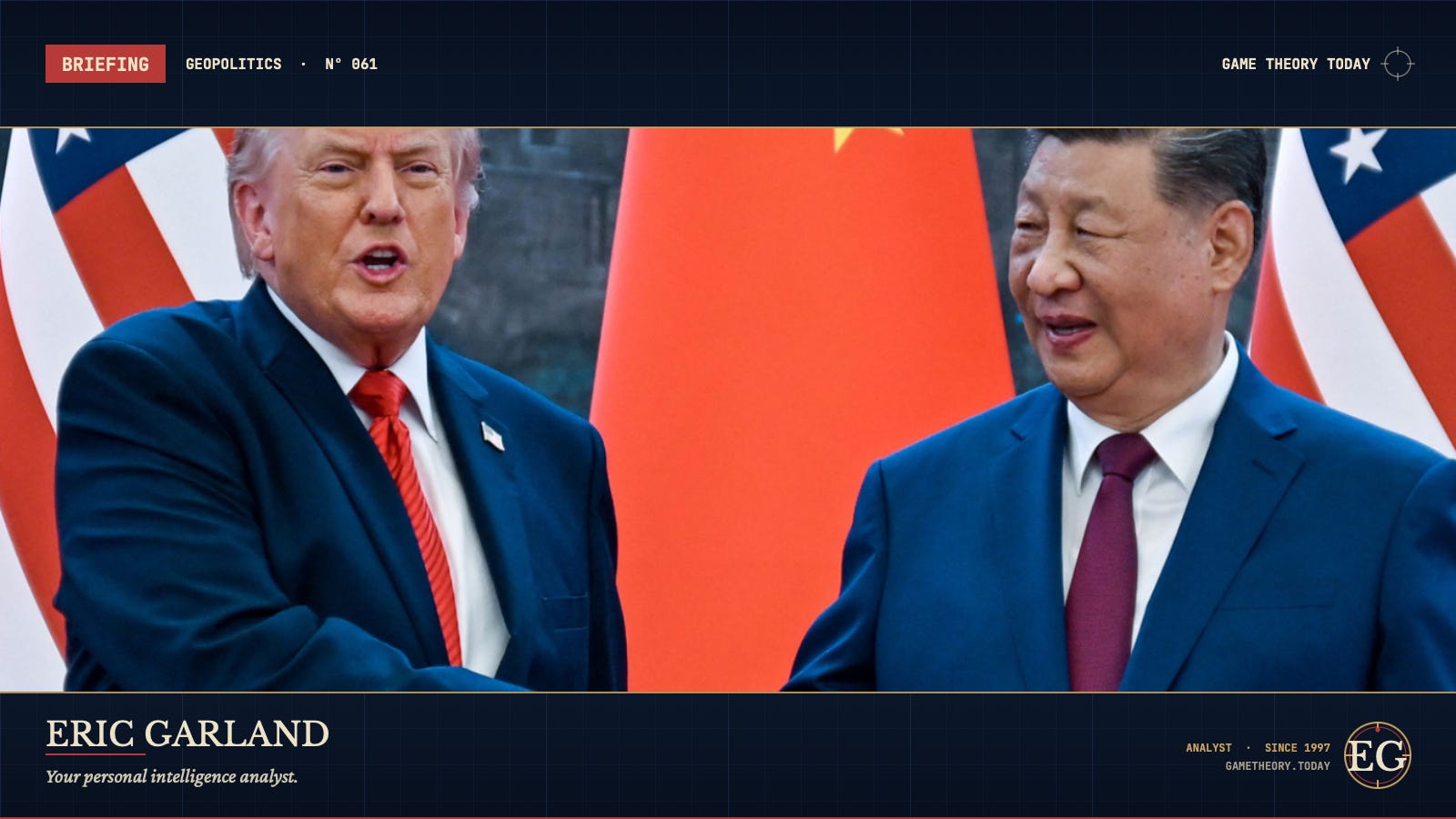
Every foreign affairs editor in America filed roughly the same column this week. Trump goes to Beijing with weak cards. Xi controls the room. The economy is fragile. Manufacturing is hollow. America will lose at the negotiating table.
Poppycock. And unsupported poppycock at that.
Ignore the cable talking head framing and count up Trump’s actions since early 2025, and a vastly different picture emerges. The Trump administration has spent sixteen months systematically dismantling the operational infrastructure the People’s Republic of China built inside the United States. By the time Air Force One lifted off for Beijing, the receipts were stacked to the ceiling, and they will inform the changes Trump makes to the very important U.S.-China relationship.
Let’s get counting.
Trump cut off Iran’s sanctioned oil to China
China built its strategic petroleum reserve on the oil output of a terrorist regime. The United States cut off that supply just prior to this trip to Beijing.
Iran was exporting, despite its sanctions, roughly 1.85 million barrels per day of crude in early 2024. The overwhelming majority of it went to China — refined through dark-fleet tankers and obscure terminals into the petrochemical complex that keeps Chinese industry cheap.
That number is now 567,000 barrels per day. A 70 percent collapse.
It did not happen because Iran ran out of oil. It happened because the Trump administration designated, sanctioned, seized, and threatened until the buyers stopped showing up. Oh, and it blockaded the blockade of the blockade in the Strait of Hormuz, or however that story actually went. In any event, China needed the oil coming through Hormuz, America didn’t, and the U.S. Navy drove the point home for everyone.
China’s planners now have to source replacement crude on the spot market — at premium prices, against a balance sheet already strained by a real estate crisis Beijing cannot admit to.
And the story isn’t done! Trump reserves the right to blow up Iran’s petroleum infrastructure for the next twenty five years—which will happen from one bomb on the right electrical transformer that will take 10+ years to source and install.
Trump arrives in Beijing as the man holding the spigot on Xi’s cheapest input, his finger lingering over the button that can change multiple countries’ economic reality instantly.
That’s all the leverage anybody needs, but there’s more.
Trump rolled up Beijing’s spy networks
Across sixteen months, the Department of Justice and the FBI have rolled up People’s Republic of China operations inside the United States at a tempo this country has not seen since ever. For the first time, America’s response to broad spectrum grey zone warfare has been equally broad spectrum—and we’re just getting warmed up.
A sitting Democratic mayor in Arcadia, California, Eileen Wang, pleaded guilty last week to acting as an agent of a foreign government under 18 U.S. Code § 951, which is the same statute used to prosecute the famous Russian Illegals in 2010. Her plea agreement showed that the Los Angeles Times got weaponized for CCP propaganda. It names the CEO of TP-Link—whose routers you may have bought for your home at BestBuy—which connects her operation to a full-blown People’s Liberation Army cyber assault on U.S. infrastructure. Her co-conspirator/ex-boyfriend is already facing four years in Federal penitentiary. More importantly, the prosecution suggests a much larger network, people who could be slowly prosecuted every few days by our DOJ, systematically humiliating Beijing and justifying all manner of punitive economic sanctions.
There are more Chinese spies around; some of the stories are downright embarrassing for all sides. Charles Lieber — the former chair of Harvard Chemistry, convicted in 2021 of concealing his Thousand Talents recruitment — has now formally defected to Beijing, where he is running a state-backed research program in advanced biotechnology for the People’s Liberation Army. Beijing is now recruiting our convicted felons.
Chinese nationals were arrested across the past year photographing the runway at Whiteman Air Force Base, the perimeter at Offutt, and dock infrastructure at a Pacific
Then there are the numerous cases of Chinese nationals at our universities doing everything from trafficking bioweapons to stealing research.
Federal prosecutors did not just publish indictments. They moved them through to plea, to conviction, to designation. Operation Take Back America has become the operational umbrella for a counterintelligence campaign that produces results on a weekly cadence—one that Trump can accelerate if negotiations don’t go to his liking.
Trump secured our farm land and military bases from China
Last summer, four cabinet secretaries — Agriculture, Defense, Homeland Security, and Justice — signed the National Farm Security Action Plan. The plan does what most observers assumed would never clear the lobbyists: it locks foreign adversaries, with the PRC named first, out of acquiring American farmland near military installations. It also opens the door to forced divestment of existing holdings.
Why does that matter? Because PLA collection doctrine treats agricultural land adjacent to bases as one of the highest-yield footholds available. Cheaper than satellites, better than embassies, legally protected the moment the deed clears. Plus, you can use them for safe houses! It’s espionage paradise—and we’ve been shutting it down.
Run that downstream. Every Chinese state-linked entity that bought acreage next to a U.S. base now sits on a divestment clock with the federal government holding the timer. Multiply that across every parcel in the country.
Quiet leverage. Structural leverage. Irreversible leverage.
Trump exposed China’s support of drug Cartels
Though started under Trump 1.0, and continued through Biden, Trump has been exposing the documented movement of fentanyl precursor money through Chinese underground banking networks on behalf of the Sinaloa and Jalisco cartels.
The Treasury Department’s Financial Crimes Enforcement Network has issued advisory after advisory naming the Chinese money-laundering organizations operating inside the United States. DEA indictments have followed. The State Department has designated specific Chinese chemical exporters under fentanyl trafficking authorities.
Beijing has spent two years insisting the precursor problem is “exaggerated.” The American docket says otherwise.
What the Consensus Misreads
Every consensus column makes the same analytical error. It scores Trump’s leverage on the macroeconomic indicators — GDP gap, trade deficit, dollar index, semiconductor wafer counts. Those numbers are real. They are also not what wins this kind of summit.
What wins this kind of summit is the inventory of operational facts the other side cannot deny.
Trump walks in carrying:
- A 70 percent collapse of his counterparty’s cheap energy import.
- A roll-up of his counterparty’s clandestine network on American soil that runs from mayors to scientists to property purchases.
- A statutory framework that lets him force-divest his counterparty out of agricultural positions adjacent to U.S. military bases.
- A documented record of his counterparty’s involvement in a fentanyl pipeline that has killed half a million Americans.
Xi cannot answer any of these with a press conference. He has to answer them with concessions — or absorb the receipts publicly.
That is what a strong negotiating position looks like in the actual practice of statecraft. Not vibes. Not the dollar index. Pressure on the adversary’s real operations, applied long enough that the adversary needs the meeting more than the host does.
The Wider Geometry
One more thing the consensus is missing. The pressure is not just on Beijing.
The same sixteen months have run a parallel campaign against the Caracas–Brussels–Tehran axis that backstops the Chinese sphere. Maduro’s regime is under maximum-pressure sanctions, with the U.S. Marines visibly active in the southern Caribbean. The Iranian oil revenue stream — the same one feeding China — has been throttled at source. The European port complexes that historically laundered sanctions-evading flows are now under designation regimes the Trump administration helped negotiate into place.
When Trump talks about leverage, he is not flexing at a single capital. He is showing Xi a board on which every one of the PRC’s proxy regimes is bleeding cash and operational reach at the same time. Trump’s flex on Caracas—regime change with zero casualties—was a flex on Beijing, a major one.
You do not have to like the president to see the pattern. The map shows pressure on every flank.
Listen to What Xi Is Asking For
Look at what Xi is asking for in this meeting. Not what Trump is asking for. That tells you who arrived in stronger shape.
Xi wants tariff relief. Xi wants a pause on the sanctions architecture. Xi wants the spy cases to slow down. Xi wants the agricultural divestment clock paused. Xi wants the European port designations rolled back. Xi wants the Treasury advisories softened.
Trump wants none of those things from Xi. Trump wants the precursors stopped, the IP theft prosecutions to be admitted, the political interference operations to be wound down, and Taiwan to be left alone.
One of these lists is asking for relief. The other is asking for behavior change.
You can tell which side is bringing leverage by reading the verbs.
The Bottom Line
Trump is not walking into Beijing weak. The consensus columns have it backwards.
The receipts say sixteen months of operational pressure, methodically applied. The receipts say a counterparty whose covert network has been visibly compromised, whose cheapest input has been visibly throttled, whose proxy regimes are visibly bleeding, and whose agricultural foothold is visibly on a divestment clock.
Read the dockets. Read the FinCEN advisories. Read the OFAC designations. Read the indictment unsealings. Read the National Farm Security Action Plan signed by four cabinet secretaries.
Then read the consensus column one more time. Notice which set of documents the column does not cite.
That is your tell.
— Eric
Eric Garland is the editor of Game Theory Today and runs Competitive Futures, an independent strategic intelligence practice. Subscribe for more analysis.
First published on Game Theory Today (Substack), May 14, 2026.