The Strait of Hormuz Is Showing Everybody’s Receipts — The Full Story
The Strait of Hormuz crisis is not an Iran story. It’s not an energy story. It’s not even a military story. It’s the moment when a network that has been operating against American interests for decades became visible to the entire world.
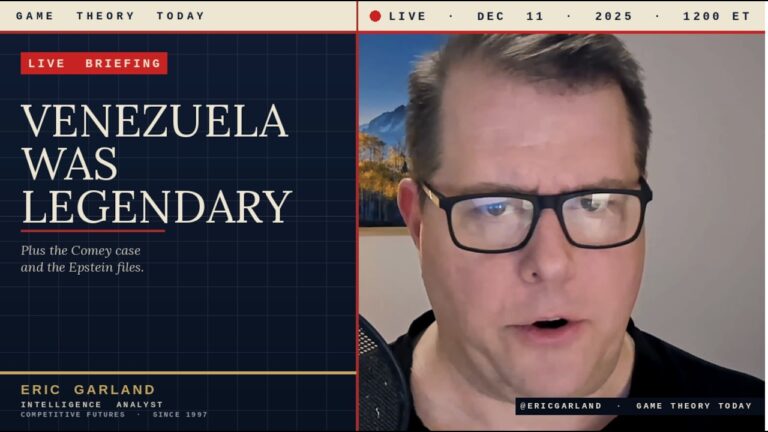
This video connects the full thread: Operation Absolute Resolve in Venezuela. Operation Epic Fury in Iran. The naval blockade of the Strait of Hormuz. The ghost fleet running oil to China. The fentanyl precursor pipeline from Chinese brokers to Mexican cartels. The IRGC’s crypto tolls. The MANPAD shipments. Moscow Narodny Bank. And the question nobody in media is asking: what if the target was never Iran?
Venezuela is gone. Iran’s leadership is shattered. The ghost fleet is tracked. The precursor pipeline is under pressure. And the artery that keeps China’s economy alive is now blockaded by the United States Navy.
What will China do?
This is the full synthesis of the four-part Strait of Hormuz series that generated over one million views in 48 hours on TikTok.
Keep Thinking.
🔔 Subscribe for professional intelligence analysis on geopolitics, cognitive bias, and strategic foresight.
Eric Garland is a career intelligence analyst sanctioned by Vladimir Putin in 2022 alongside three CIA directors. His 2016 Game Theory Thread was named by the New York Times as one of the 25 most important tweets in history. He is the author of Future, Inc. (AMACOM, 2007) and How to Predict the Future…and WIN!
Represented for speaking by Executive Speakers Bureau: https://executivespeakers.com/speaker/eric-garland
Substack: https://ericgarland.substack.com
TikTok: https://www.tiktok.com/@gametheorytoday
SOURCES:
— EIA crude oil production data (2025): U.S. Energy Information Administration
— Ghost fleet tracking: United Against Nuclear Iran (UANI) shipping updates
— China strategic petroleum reserve: House Select Committee on China report
— MANPAD intelligence: CNN, April 11, 2026
— Fentanyl precursor pipeline: Brookings Institution, Council on Foreign Relations, DEA
— Hezbollah-cartel nexus: DOJ testimony, Congressional hearings
— Operation Absolute Resolve: DOD briefing, January 3, 2026
— Strait of Hormuz shipping data: Lloyd’s List Intelligence, Kpler, S&P Global
— Trump blockade announcement: Truth Social, April 12, 2026
— Vance-Iran talks: CNBC, CNN, AP, April 11-12, 2026
Transcript
Auto-generated from the video audio; may contain transcription errors.
Read the full transcript
The straight of Hormuz crisis is not an Iran story. It’s not an energy story. It’s not even a military story. It’s the moment when a network that has been operating against American interests for decades becomes visible to the entire world. And once you see it, you can’t unsee it. Let’s recap the Iran war in a different way cuz it’s not about Iran at all. But you need another lens. Think about the map of the world in terms of crude oil production. The globe’s actual power map. The US is the world’s biggest oil producer at nearly 14 million barrels of crude per day, more than any country in history. Saudi and Russia are each around 10 million. Canada’s about 5 million, although they send most of it to America.
China’s around 4 million, but consumes far more than it produces. Then Brazil, Iraq, UAE, and Iran are all in the 4 million range. And those last three depend on the straight of Hormuz. That’s 20% of the world’s oil supply through a single choke point. That’s where our story begins with a state sponsor of terror, Iran, sitting on a choke point finally forced to defend itself militarily. And the world may never be the same. A few days ago, oil market analyst Rory Johnston flagged something remarkable on shipping data. A wave of empty super tankers, very large crude carriers, each capable of holding two million barrels, were converging on the US Gulf Coast because America was becoming the world center of energy like it was before 1970, not the Middle East.
Back up on the timeline, not all the way to bell bottoms, just to this winter. On January 3rd, 2026, the United States launched a major military operation in Venezuela cenamed Operation Absolute Resolve, which resulted in the capture of Venezuela’s Nicholas Maduro and forced a leadership change to Deli Rodriguez. It also put Venezuela’s almost 1 million barrels per day of crude production under de facto US control and more importantly stopped them from refining sanctioned Iranian oil. On February 28th, the United States and Israel launched Operation Epic Fury against Iran. They killed Supreme Leader Al Kame, blew up several layers of regime’s leadership, military, intelligence, internal security, and kablam, gone.
Then Trump says, “Oh, you crazy guys. Boy, you better not shut that straight to Hormuz that delivers all of China’s oil. We would be so mad, you guys.” Subsequently, the IRGC mined the waterway, attacked 21 merchant vessels, and issued warnings forbidding passage. Over 800 ships were stranded. Tanker traffic that had been over 100 ships a day dropped to single digits. And Trump said, “Hey NATO, you uh you want to help us unblock the Straight of Hormuz?” And they said, “No, not like they could really help anyhow.” And then Trump turned around and said, “Gotcha. Actually, we’re blockading your blockade. Everyone gets a blockade. You get a blockade. Your blockade gets a blockade. Take two. They’re small.
Now we’re playing a new game, one it looks like Trump prepared for. Gas prices in the US went up 40%, rent crude surged past $95. Countries across Asia began rationing fuel. Sri Lanka went to a 4-day work week. India’s cooking gas supplies disrupted. The global energy system is now in crisis. And then something happened that tells you everything about where the leverage actually sits. US crude began trading at a premium over Brent. The reverse of how oil markets normally work. the world couldn’t get Middle Eastern crude. So, it started coming to America, you know, to the Gulf of America, which is suddenly quite a bit more important than we thought when we expected that all was going to have to happen as travel agents update their style guides or whatever.
Empty super tankers racing across the ocean to load up at Texas ports. Trump called it the best and sweetest oil anywhere in the world. America can refine Canada’s oil. Here, take the best we’ve got. It’ll go super easy in your refineries. Take home take some home to the misses. She’ll love it. Now, for a guy who went broke selling steaks and booze, I think Trump finally found the perfect product and pitched it flawlessly. But the question an analyst asks is, who is this a sales pitch to? Who is it a sales pitch against? What what are we doing here? How do we end up doing the Coke and Pepsi challenge here with crude oil? Then this weekend, two things happen on the same day. First, JD Vance flew to Islamabad Pakistan for the highest level talks between the US and Iran since 1979.
He negotiated for 21 hours through the night in constant communication with Trump, Rubio, Hegsth, and the head of Sententcom, and he came home with nothing. Iran refused to commit to not developing a nuclear weapon. The talks collapsed. Hours later, Trump posted a statement on Truth Social that I want to walk through carefully because what it says and what it means are two different things. He opens by saying the meeting went well and most points were agreed to. Then in the same paragraph he announces that the US Navy will blockade the straight of Hormuz, not escort ships through it, [snorts] not pressure Iran to reopen it. Blockade it. No ships in, no ships out. He orders the interdiction of any vessel in international waters that paid a toll to Iran.
He announces mine clearing operations. And he closes with locked and loaded and a threat to finish off what’s left [snorts] of Iran. Now, the easy analysis is that this is incoherent. You need the straight open gas is up 40%. Your vice president just came home empty-handed. Blockading the thing that you need unblocked looks like a post-negotiation tantrum. But I don’t think it’s incoherent because I think the target isn’t Iran. Think about who paid Iran’s toll. Indian ships, Turkish ships, Pakistani ships. Yeah, Pakistan, the country that just hosted the talks, China was negotiating its own passage. When Trump says no one who pays an illegal toll will have safe passage on the high seas, he’s not threatening Iran.
Iran’s navy is touring the bottom of the sea. He’s threatening the rest of the world’s merchant fleet. The same countries he asked to join a naval coalition and who said no because they oppose the war. And here’s where it gets interesting. If the straight stays closed for any reason, whether Iranian mines or American blockade, the world has to buy American oil, and that’s already happening. The super tankers are already on route to Texas. US crude is already trading at a premium every week that the straight stays shut global energy infrastructure rewires around American production. Trump is returning America to the position of global energy leader that it lost around 1970 and which was immediately weaponized against us with the first7s oil crisis.
But there’s an even deeper logic. For six weeks, countries have been cutting side deals with the IRGC, paying $2 million a ship in crypto, negotiating bilateral safe passage, going around the United States entirely to do business with the people who mined an international waterway and attacked 21 merchant vessels. And this isn’t new behavior. Certain factions in the West have been declaring regimes apostate and then doing business with them on the side for decades. Moscow Nar Rodney Bank operated openly in the city of London for the entire Cold War. Soviet money, British address, everybody knew, nobody stopped it. JP Morgan gets fined for running Cuban and Iranian money. TD Bank runs cash for the cartels.
Facebook lets the Myanmar military regime use its platform for a genocide and somehow stays in business. The mechanism is always the same. Hostile [snorts] actors need access to legitimate systems and somebody in the legitimate system decides the money is worth more than the law. So Trump’s blockade announcement isn’t energy policy. It’s sanction enforcement doctrine. The message is the era of side deals is over. You don’t get to call yourself an ally of the United States and cut checks to the IRGC. You don’t get to condemn the war in public and finance the enemy in private. So if the target isn’t Iran, who is it? Well, follow the oil. While 800 ships sat stranded and the world scrambled for fuel, Iran’s ghost fleet was running crude to China without interruption.
United Against Nuclear Iran tracked 85 Iranian tankers at a single transfer point off the coast of Malaysia, doing shipto- ship handoffs bound for Chinese refineries. Since the war started, that operation has generated over $3 billion for the IRGC. You remember the same IRGC that mined the strait? The same IRGC charging 2 million a ship in cryptocurrency. This is how the Chinese do business through terrorist regimes. A congressional investigation by the House Select Committee on China found that Beijing spent years building a 1.2 2 billion barrel strategic petroleum reserve, enough for 109 days of supply by buying sanctioned oil from Iran, Russia, and Venezuela at below market prices through shadow fleets.
1if of China’s total oil imports were sanctioned crude assembled from the very barrels that Western sanctions were designed to strand. That’s not a country caught off guard by a crisis. That’s a country that prepared for one, and now the crisis is upon them. while the Gulf of America is open for business. And this is why Venezuela matters and likely why they went first at them in this whole military operation because Venezuela is where all three relationships converged in our own hemisphere. China was buying 75% of Venezuelan oil exports. Iran built refineries in Venezuela and shipped military equipment to Karacas. Russia armed the Maduro regime with fighter jets and surveillance technology. Hezbollah, Iran’s proxy, was running drug trafficking and moneyaundering operations through Venezuelan networks.
All three Asian adversaries, China, Russia, Iran, were propping up a narco dictatorship just 1500 miles from Miami, projecting malign influence against their main adversary. Trump took Venezuela off the board in January when US forces captured Maduro. Now Iran’s pieces off the board. Leadership shattered, navy destroyed. What’s left couldn’t close a deal in 21 hours. That leaves China. And the pattern doesn’t stop at oil. It gets worse. China is the world’s principal source of fentinyl precursor chemicals flowing to Mexican cartels. Not some of the supply, the principal source. Chinese brokers knowingly sold to the Sinaloa and Khalisco cartels. They shipped the chemicals disguised as dog food and cosmetics.
They provided recipes on how to turn their precursor into fentinil. Their Chinese moneyaundering networks became the go-to service for cartel cash around the world. And those same Mexican cartels have documented operational ties to Iran and Hezbollah going back over a decade. The DOJ has the cases. Congressional testimony established the connections. In 2011, Iran’s Kuds force tried to hire a Mexican cartel hit squad to assassinate the Saudi ambassador in Washington DC. The cartels have exterminated Americans through drugs and violence, but they aren’t simply Mexican. They are the violent frontface of a network that connects to Beijing through precursor chemicals and money laundering and to thyron through Hezbollah and the IRGC.
Now, layer on the manpad shipments. US intelligence reported this weekend that China is preparing to route shoulder fired anti-aircraft missiles to Iran through third countries while publicly claiming to have helped broker the ceasefire. Brokering peace with one hand, arming the enemy with the other. At what point do you stop treating these as separate policy problems and start seeing a pattern? The United States spent decades giving China the benefit of the doubt. American companies moved their supply chains there. Politicians on both sides courted Beijing as a partner. The theory was integrate them into the global economy and they’ll become a responsible stakeholder. Countless American executives and elected officials built careers on that assumption.
And for a long time, the patience was defensible. But there’s a limit. [sighs] When you’re brokering a ceasefire with one hand and shipping missiles with the other, when your shadow fleet is funding the IRGC while your precursor chemicals are killing tens of thousands of Americans a year. There’s a limit. There’s a point at which being patient is indistinguishable from being a sucker. And I think Trump has decided we’re there. The blockade isn’t just about Iran. The Venezuela operation wasn’t just about Maduro. The fentinel pressure isn’t just about drugs. When you line up the actions, not the rhetoric, the actions, the picture is an administration that no longer treats China as a competitor.
It’s treating China as an adversary, if not an enemy. And the Straight of Hormuz is where that shift became visible to the world. The Straight of Hormuz is a mirror. And right now, it’s showing everyone’s receipts. The oil receipts, the weapons receipts, the chemical receipts, the side deal receipts. Venezuela is gone. Iran’s leadership is shattered. The ghost fleet is tracked. The precursor pipeline is under pressure. And the artery that keeps China’s economy alive is now blockaded by the US Navy. What will China do? The pattern is there. The receipts are piling up and we’re just getting started. Keep thinking.
More from Eric Garland: the Competitive Futures Library, the Systemics Quarterly Brief, and Game Theory Today on YouTube.