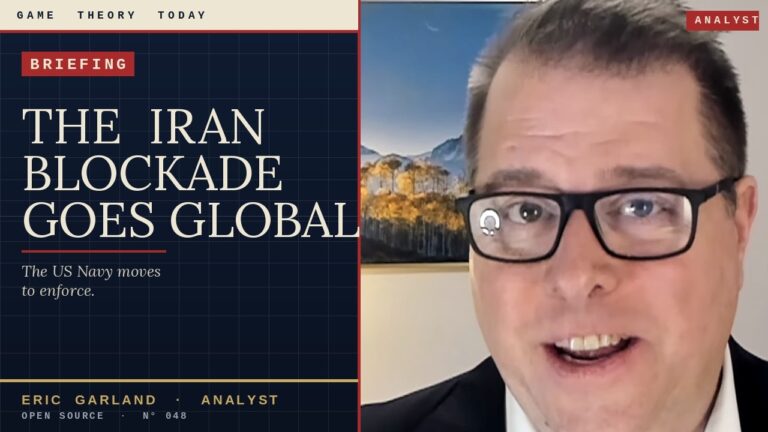
The Drawdown of 5000 Troops in Germany Is Because Putin Lost
The Pentagon announced today that 5,000 American troops will be withdrawn from Germany over the next six to twelve months. Most analysts are calling it a gift to Putin. They’re missing the actual story.
In this video I walk through what Russia looks like in 2026 across six independent indicators — Ukraine, Putin’s domestic political constraint, the intelligence services, the oligarchs, the energy sector, and the collapsed proxy network — and explain why the troop drawdown is the strategic content of the decision catching up to a reality the analytical class hasn’t absorbed yet.
I’m Eric Garland. Thirty years in strategic intelligence and foresight. Author of Future, Inc. (AMACOM, 2007) and How to Predict the Future…and WIN! (Wallingford, 2011). Sanctioned by the Russian Federation in May 2022 for open-source analysis of Russian intelligence operations.
Full analytical brief: ericgarland.substack.com
Daily commentary: x.com/ericgarland
Game Theory Today on TikTok: @gametheorytoday
— SOURCES —
Pentagon announcement and chronology
– CBS News, “Trump administration to cut 5,000 troops from Germany” (May 1, 2026)
– Politico — reporting on Pentagon learning of the decision via Truth Social before the formal announcement
Russian conventional military / Ukraine front
– Institute for the Study of War (ISW), daily Russia-Ukraine campaign assessments — understandingwar.org
– UK Ministry of Defence, Russia-Ukraine intelligence updates
– RUSI analytical briefs on Russian defense industrial base
Russian intelligence service degradation
– European Council on Foreign Relations (ECFR), tracking of post-2022 diplomatic expulsions
– CSIS reporting on Russian intelligence operations in Europe
Oligarch constraints and banking exclusion
– US Treasury OFAC Specially Designated Nationals list
– EU Council consolidated sanctions list
Russian energy export pressure
– International Energy Agency (IEA), monthly oil market reports
– KSE Institute (Kyiv School of Economics), Russian oil revenue tracker
Russian proxy network collapse
– Maduro capture: US Department of State, Congressional Research Service “U.S. Capture of Venezuela’s Nicolás Maduro: Considerations for Congress” (January 6, 2026)
– Hezbollah leadership decapitation (Nasrallah, September 2024, and successor losses): Reuters, AP, Foundation for Defense of Democracies
– Fall of the Assad regime (December 2024): standard wire service coverage
– US-Iran armed conflict: White House and DOD briefings, ongoing news cycle
Transcript
Auto-generated from the video audio; may contain transcription errors.
Read the full transcript
Tonight, the Pentagon just announced they’re pulling 5,000 troops out of Germany. I’m sure a ton of analysts in America will be calling it a gift to Putin, and they’ll be wrong. For those of you who don’t know me, I’m not big on gifts to Putin. My name’s Eric Garland. I’ve spent 30 years briefing Fortune 500 CEOs and national governments about Russia. Putin sanctioned me personally in 2022. So, when I tell you that the conventional take on this story is going to be missing the actual point, it’s not because I think Russia isn’t a threat, it’s because I think Russia is getting weaker by the day, and the troop drawdown is actually us making fun of him on May Day. Here’s the question nobody’s asking.
What is the garrison in Germany actually deterring against in 2026? Let me walk you through what Russia actually looks like right now. Six things fast. One, Ukraine. Russia has not moved the line in any operational meaningful way in over a year. The 2022 offensive is dead. The casualty math favors Ukraine. This would be like if America had trouble with a war with Ontario. Russia’s defense industrial base has now been hollowed out by sanctions and manpower losses, so the loss in Ukraine is basically baked in. Two, Putin can’t end the war. Bring those troops home empty-handed and you get overthrown. That’s not my opinion, that’s Russian history. Nicholas the second after the Russo-Japanese War, the Romanovs after World War I, the Soviet system after Afghanistan.
Putin knows this pattern better than everybody else, and he is trapped. Three, the intelligence services. There have been mass expulsions of officers from European diplomatic stations. Their illegals networks are vastly rolled up. The human tempo against the West is a fraction of what it was in 2014. Four, the oligarchs. The ones who are left are stuck at home and sanctioned and constrained. Prigozhin’s plane going down was the regime telling its elite what will happen if you get mouthy. They are shut out of world banking, so the oligarchs that used to be Putin’s dark wolves, now they’re tired old Dobermans hanging around the house, more likely to bite him. Again, it ain’t 2014. Five, energy.
The shadow fleet is under crushing pressure pressure. India and China are extracting steeper discounts, revenue flows are going, but margins have been crushed. And Ukrainian drones keep blowing up their stuff for their oil industry. That’s not good. Six, their proxies. Maduro’s in jail. Cuba’s in open collapse. Hezbollah’s gone. Assad’s regime’s gone. Iran’s leadership is in a in a tunnel somewhere missing internet. Not only is Russia unable to project power into Ukraine, which it used to own, its proxies are big zeros as well. So, the question, what are the 5,000 troops in Germany deterring against? A Russia that no longer exists. The post-2022 surge was sized for a threat profile that is materially attenuated on six independent indicators.
The drawdown is force posture catching up to a strategic reality that the analytical class hasn’t absorbed yet because absorbing it means retiring the framing that their careers have been built on. I’m not telling you Russia’s finished, I’m telling you that the indicators have shifted, the strategic content of this decision lines up with that shift, and the gift to Putin take is going to be very lazy, and I’m sure a lot of people are going to try it. So, the harder question, the one that’s actually worth your time, is this. Have we already won against Russia? Happy May Day, all. And keep thinking.
More from Eric Garland: the Competitive Futures Library, the Systemics Quarterly Brief, and Game Theory Today on YouTube.