Persistence of Impressions and the 25th Amendment
There is a moment in the life cycle of a failed analytical prediction when the analyst faces a choice. They can update their model — absorb the new information, revise the assessment, and continue tracking reality as it unfolds. Or they can increase the volume of the original prediction, hoping that urgency substitutes for accuracy.
We are watching the second option play out across an entire class of commentators right now, in real time, on this platform and others — and it is worth understanding why, because it reveals something far more important than any one person’s bad take.
The 25th Amendment Fantasy
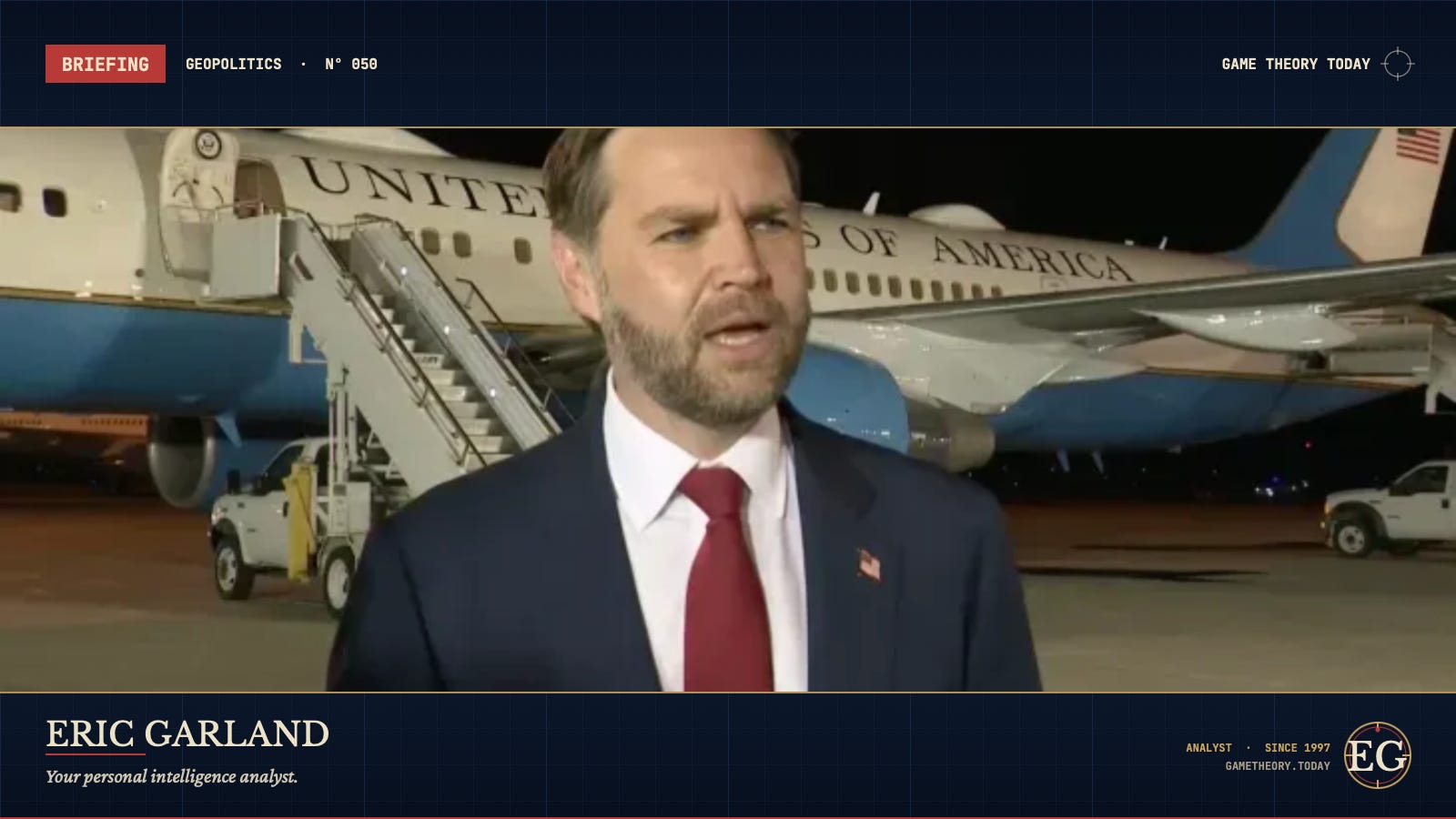
On April 7, 2026, the United States and Iran agreed to a two-week ceasefire after 40 days of war followed by a threat of overwhelming force from our President. Pakistan brokered the deal. Iran agreed in principle to reopen the Strait of Hormuz. The Vice President of the United States is leading a delegation to Islamabad for the highest-level US-Iran diplomatic meeting since the 1979 revolution.
Whatever you think of the war, whatever you think of the president who started it, whatever you think of the terms — this is a diplomatic development of historic magnitude. The military operation underway started with a decapitation strike against Venezuela, moved on to strategic assault against Iran, and will move on in a matter of days against Cuba. All three countries have been major Russian proxies, and they are all being rendered inert. The United States is not threatening a return to its assumed unipolar military status of the 1990s—it has demonstrated it through B-2 Spirit bombers, aircraft carrier groups, and A-10 Warthog tank killers. This is most important strategic maneuver of the United States since 1945.
And the response from a significant and vocal cohort of politicians, commentators, and authors is not to assess that development. It is to demand the immediate removal of the President through the 25th Amendment — a Constitutional mechanism instituted in 1967 to assure the smooth transition of power in the event that a President were shot dead, as in Dallas a few years prior, or comatose. It has since been used during cancer surgeries and colonoscopies for a limited duration. It has never once been used to remove a sitting president.
But the chorus of insistent voices across the sphere of digital influence is that the Amendment designed for smooth transition of power in case the President loses consciousness must now be used in place of U.S. elections. That these voices also assert that the President in question serves Russia is ironic, since it has been Russia’s eternal quest to portray American democracy as a farce no better than its Third World alternatives.
The Cognitive Layer: Richards Heuer
Richards Heuer spent his career at the CIA studying why intelligent, well-intentioned analysts get things wrong. His book Psychology of Intelligence Analysis — originally an internal CIA training manual, later declassified — catalogs the cognitive biases that cause trained professionals to misread the world even when they have access to good information.
One of the most dangerous biases Heuer identified is what he called persistence of impressions based on discredited evidence. The pattern works like this: an analyst forms an initial judgment based on the available evidence. Later, the evidence shifts — sometimes dramatically. But the judgment persists. It has become self-sustaining. It no longer needs the evidence that produced it, because it has been reinforced by repetition, by social consensus within the analyst’s community, and by the psychological cost of admitting the model was wrong. This is more than just being old-fashioned or stuck in your ways when we’re talking about predicting how nuclear weapons might be deployed against a billion people.
This is what we are watching. For nearly a decade, an entire category of commentators constructed their analytical framework around a single predicted outcome: the removal or imprisonment of Donald Trump. Books were published. Audiences were cultivated. Subscription revenue was generated. When Mueller did not deliver the predicted result, the prediction migrated to impeachment. When impeachment did not deliver it, the prediction migrated to criminal prosecution. When prosecution did not deliver it, the prediction migrated to electoral defeat. And now, with Trump in office, prosecuting a war, and negotiating a ceasefire with a nuclear-threshold state, the prediction has migrated to the 25th Amendment — the most structurally implausible removal mechanism available. The Trump-Russia Industrial Complex is in shambles, and its paragons are resisting the demands of reality to update their model of the world—to put it charitably.
Each migration of these influencers preserved their conclusion and discarded the new evidence arriving daily. That is persistence of impressions, operating exactly as Heuer described it, at scale.
The Strategic Layer: Yuri Bezmenov
But Heuer only explains the cognitive mechanism. To understand why this matters strategically, you need a different framework — one provided by a KGB officer named Yuri Bezmenov, who defected to the West in 1970 and spent the rest of his life trying to explain what the Soviet Union was actually doing to the United States.
Bezmenov described a process he called ideological subversion — a long-term operation designed not to steal secrets but to change an adversary’s perception of reality so thoroughly that, in his words, “despite the abundance of information, no one is able to come to sensible conclusions in the interests of defending themselves, their families, their community, and their country.”
The first and most critical stage of this operation, Bezmenov said, is demoralization. Not demoralization in the casual sense of feeling discouraged, but in the operational sense: the systematic destruction of a population’s ability to process reality accurately. A demoralized population, in Bezmenov’s framework, doesn’t lack information. It lacks the capacity to do anything useful with information. It is stuck.
And here is the line from Bezmenov that should stop you cold: “A person who is demoralized is unable to assess true information. The facts tell him nothing.”
Read that again. Not “the facts are hidden from him.” Not “he lacks access to information.” The facts tell him nothing. He has the information. He cannot use it. The analytical function is offline.
That is what hostile information operations are designed to produce. Not confusion — that’s a side effect. The target end state is stopped thinking. A population so locked into its prior commitments, so invested in its existing predictions, so psychologically entangled with its conclusions, that new information — even good information, even true information — cannot update the model.
The Convergence
Now put Heuer and Bezmenov together and look at what is happening on your screen.
A historical military operation is underway. It is tightly calendared and precisely executed across the entire Department of War around the globe, led by the President. A ceasefire is announced with one of the antagonists. Negotiations are underway. The Strait of Hormuz is being discussed. President Trump is meeting with the head of NATO to discuss that alliance’s role in helping the United States secure an outcome in the region. A diplomatic process is in motion that, whatever its outcome, represents a material change in the strategic landscape. Trump’s tweets are as over-the-top as they have been for years, but then again, this is not new information for the millions of Americans that voted him into the White House twice.
And yet—a large, vocal community of commentators — people with audiences, with platforms, with influence — is demanding that Trump be removed without an electoral outcome. They are telling their audience to demand a Constitutional maneuver that we employed to let Reagan get cancer surgery and let George W. Bush get a couple of colonscopies. These analysts, who have earned the trust of thousands of engaged readers, are escalating a prediction that was already failing, because their analytical model cannot accommodate what just happened—that Trump must end somewhere other than the ballot box.
They are not thinking about the ceasefire. They are not assessing the negotiations. They are not tracking the observable indicators that would tell them whether the diplomatic process is real or performative. They are doing what Heuer predicted they would do: persisting in an impression that the evidence has obliterated. And they are doing what Bezmenov predicted they would do: demonstrating that the facts tell them nothing.
This is not a criticism of anyone’s politics. I want to be precise about that. You can oppose this president, oppose this war, and oppose the terms of this ceasefire — and still update your analytical model when the facts change. Opposition and analytical function are not in conflict. Moreover the 25th Amendment is a constitutional mechanism that exists for a reason, and reasonable people can debate its applicability to any president. Some of my readers have already brought up the mental capacity of the last President, and I think there is some merit to these discussions when the median age of Presidential candidates hovers around 80.
But when the volume of a prediction increases at the exact moment the evidence for it decreases — that is not analysis. That is a diagnostic indicator. And the question it raises is not about the commentators. It is about you.
The Question That Matters
Bezmenov’s warning was never about the KGB. It was about what happens to a society that has been conditioned to mistake its commitments for its conclusions. The operation succeeds not when people believe false things, but when they lose the ability to update what they believe in response to what is actually happening.
So here is the question: when the facts change, does your model change?
Not your values. Not your political commitments. Not your assessment of who is good and who is bad. Your model. Your working theory of what is happening and what is likely to happen next. Does it track reality? Or does it track the prediction you made six years ago?
If your model updates, you are thinking.
If your model persists regardless of new information, you are not thinking. You are performing a commitment. And someone, somewhere, designed an operation that produces exactly that output.
The fix is not to agree with the ceasefire. The fix is not to trust the president. The fix is not to be optimistic. The fix is to stay in analytical motion — to keep tracking what is happening, keep identifying indicators, keep testing your predictions against observable reality.
The only way forward is to Keep Thinking.
Eric Garland is a career intelligence analyst, author of Future, Inc. (AMACOM, 2007), and the writer of the December 2016 Game Theory Thread, named by the New York Times as one of the 25 most important tweets in history. He was personally sanctioned by Vladimir Putin in May 2022 for his work exposing Russian intelligence operations in the United States.
For keynote speaking inquiries: Executive Speakers Bureau
Game Theory Today on TikTok | YouTube | Twitter/X
First published on Game Theory Today (Substack), April 9, 2026.