What a Former CIA Senior Operations Officer Told My Audience About Russia
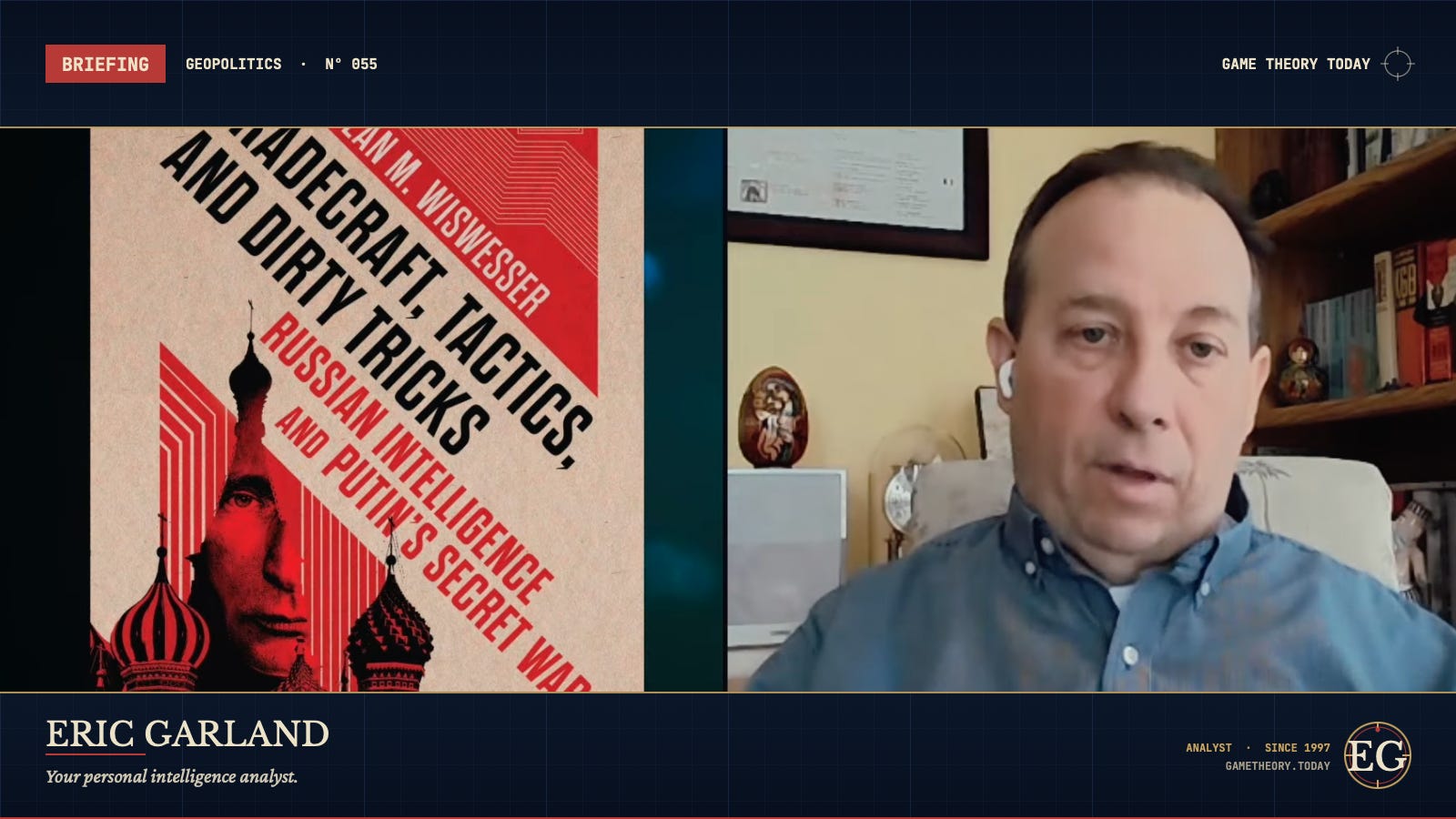
This weekend I sat down for forty minutes with Sean Wiswesser, a former CIA Senior Operations Officer who spent twenty-eight years inside the United States Intelligence Community. Twelve of those years were overseas, including…well, we don’t ask where. We just know his Russian accent is impeccable when he drops Russian intelligence terminology into conversations at full speed.
Wiswesser was a “denied area expert,” the specialist track that operates inside the hardest targets — Russia, China, Iran, North Korea. In spy terms, he’s the kind of guy who would import Kung Fu to China and fight the Shaolin monks on their own turf. He was a chief of base in a war zone. He worked the Ghost Stories case, the 2010 FBI counterintelligence operation that wrapped up the network of Russian illegals most Americans now associate with Anna Chapman or The Americans television show. Wiswesser recently retired and he has just published Tradecraft, Tactics, and Dirty Tricks: Russian Intelligence and Putin’s Secret War with Naval Institute Press.
The book is what its title says it is. Ten chapters on the operational specifics of how the Russian intelligence services attack the West. Not a memoir, not a single-case study, not a partisan polemic. A working professional’s account of the tradecraft—and it’s still a page-turner. For me, it was one of the most interesting, urgent, densest reads on the subject of the Russian intelligence services, and still easy to read because its jargon is handled with exceptional skill.
I want to walk through what Wiswesser told my audience, because the substance is too important to merely summarize and move on. And then I want to explain why I think the most important thing he said is something that did not generate a single news cycle when the interview went up — and why that silence is itself a piece of the problem he is describing.
What he told us
One of Sean’s anecdotes is particularly potent. Early in his career, after the September 11th attacks, with President Bush and President Putin having publicly agreed to cooperate against al-Qaeda, Wiswesser asked a Russian intelligence officer who was working with American services whether the cooperation was real. Whether the services on the ground were going to coordinate against the terrorist threat the way the principals had announced.
The Russian officer laughed at him.
“You were the main enemy all through the Cold War,” the officer said. “You still are the main enemy now. You will always be the main enemy of Russia and our security services. Under Putin, you all come first. Forget about terrorism. Forget about the Chechen war, any threats inside Russia. United States is going to come first and NATO and all of your allies will come second, third and fourth.”
This is not Cold War nostalgia. This is the Russian intelligence services’ actual operating doctrine, expressed by a working officer to a working American officer at the moment when the public narrative said the doctrine had changed. It had not changed. It has not changed since. The technical term for the United States in Russian intelligence parlance is главный противник — the main enemy, the main adversary. It predates the Cold War. It survived the Cold War. It is the assumption underneath every Russian operation against the West in the twenty-first century, and Americans who do not understand it cannot read the news correctly.
Wiswesser walked the audience through several specific operational areas his book documents.
He talked about active measures — what the Russian services now call “measures of support” because they have noticed that the older term carries American political baggage they would prefer to avoid. The 2016 election attack on the United States was not, in Wiswesser’s account (or in mine) an operation to elect a particular candidate. It was a textbook active-measures campaign aimed at undermining the legitimacy of the American democratic system as such.
The Senate Select Committee on Intelligence’s bipartisan report, the Director of National Intelligence’s investigation, and Facebook’s own internal review all reached the same finding: the Russian troll operation was arguing both sides of every emotionally charged American political question simultaneously. The operational goal was not to win an argument. The operational goal was to make Americans hate each other enough that they could not see the operation. They have continued. And it wasn’t just Americans. The Russians did it in Brexit. They have done it in Hungary. They are doing it now. They will keep doing it until we break the KGB successor agencies and bury them.
Wiswesser talked about “illegals” — Russian intelligence officers operating in the United States without the cover of the diplomatic community, often using stolen identities of Americans who died in infancy, often infiltrated through Canada, often building cover lives over decades. He confirmed something that everyone who actually worked the Ghost Stories case has known for fifteen years: when the FBI wrapped up the Anna Chapman network in 2010 and we deported the illegals back to Moscow, the order Putin almost assuredly gave his services the next day was to double down. To deploy twice as many illegals into the United States as fast as possible.
He talked about the renaming of the FSB Academy to the Felix Dzerzhinsky Academy. Dzerzhinsky was the founder of the Cheka, the original Bolshevik secret police, the institutional ancestor of every Russian security service that has existed since 1917. Lenin told Dzerzhinsky there could be no revolution without terror, and Dzerzhinsky took the instruction to heart. The Cheka killed hundreds of thousands of Russians. Its successors, the OGPU and NKVD and KGB, killed millions. The current FSB still operates out of the Lubyanka, the same building where in the early decades of Soviet rule prisoners were shot in the back of the head in the basement. There is no monument anywhere around the Lubyanka to the Russians who died there. Compare this to the Lithuanians, who turned the old KGB headquarters in Vilnius into a museum to the suffering inflicted in that building, with the names of the victims engraved in granite on the outside. Putin’s regime renamed its training academy after the man who started the killing.
This is the signal. The signal is unmistakable. The Russian state today is operationally proud of its institutional descent from the original Bolshevik terror apparatus, and its current leadership identifies with that lineage in a way Americans find difficult to take seriously because we cannot quite believe anyone would mean it.
They mean it.
If you ever knew Russian intelligence—much less faced them—you always knew they meant it. They not like us.
Wiswesser talked about cognitive warfare in the present tense. In a Midwestern American state — he believes Oklahoma — federal investigators looked into a flash mob protest in which hundreds of Americans had shown up to scream at each other on the street about gun rights. One side had been told the government was taking away their guns. The other side had been told the government was trying to hand out free guns to children. The crowd nearly came to violence. When law enforcement asked the participants who had organized the event, no one on either side could name an organizer. There was no organizer. There were no leaders. Ghost Stories, if you will! There were no real groups. The whole thing — both sides of it — appeared to have been engineered remotely by adversary services who wanted Americans on the street, in physical proximity, screaming at each other about an emotionally charged issue. The goal was not the issue. The goal was the screaming. The goal, ideally, was violence.
This is what active measures look like in 2026. This is what they will look like through the midterm elections and the 2028 cycle, and what they will look like every day in between when something in the news is hot enough to weaponize. The operations are no longer running through troll farms in St. Petersburg with quotas of two hundred Facebook posts per officer per day. They are running through artificial intelligence at industrial scale. The 2016 operation, Wiswesser estimates, has been magnified ten thousand times over. China is doing it too, and the Chinese services have substantially greater resources and substantially more patience than the Russian services do. Wiswesser is a Russia specialist, so he focused on Russia. He was clear that China is the larger threat in the long arc.
He closed with a piece of advice he gives when he speaks at universities, and which I want to repeat here. When you read a piece of news that makes you emotional — angry, afraid, ready to fight — pause before you react. Ask whether the news is a real event or a manufactured one. Ask whether the people involved are real people or fabricated personas. Ask why this particular story is hitting your feed at this particular moment. Stay in analytical motion. Refuse to arrive at the emotional destination the operation has constructed for you. Keep Thinking, if you will!
That is the entire defensive posture in one paragraph. It is also, more or less, the defensive posture I have spent the last decade trying to teach to civilian audiences. It was useful to hear it from a man with twenty-eight years inside the agency that runs the operations the rest of us are trying to understand from the outside.
Why it matters that you heard this
Here is what I want to say plainly.
Almost everything Sean Wiswesser told my audience this week has been said publicly, in some form, by credentialed professionals for the better part of a decade. The 2016 active-measures operation was documented in the bipartisan Senate Select Committee on Intelligence reports across five volumes between 2019 and 2020. The Mueller Report documented it. The DNI assessment documented it. Facebook’s own internal review documented it. The Active Measures Working Group at the State Department had been studying this exact category of Russian operation for thirty years before any of it.
The information has been available. The information continues to be available. The problem has never been the information. The problem has been an American information environment that systematically labels people who repeat the information in a professional way as conspiracy theorists, and that elevates partisan maximalists who overclaim the evidence in ways that discredit it. TV news has mainly been willing to cover the Russians as a partisan story, not as a shared threat from dangerous spy services.
This appears not to be an accident. This looks like the intended end state of the operation Wiswesser is describing. The operation is not just running through trolls and bots and flash mobs. It is running through the steady degradation of any American institution that might once have been able to identify and counter active measures in real time. The Active Measures Working Group was disbanded in 1992 because Washington concluded the Cold War was over and the operation had ended. The operation had not ended. It had only paused while the institutional capacity to recognize it was being dismantled. When Russian intelligence resumed full operational tempo against the West in the 2000s and especially after 2008, the American immune system that should have spotted the campaign no longer existed.
This discussion should lead the headlines. It shouldn’t merely be discussed among subject matter experts.
The reason every American should pay renewed attention to what Wiswesser is saying is not that the threat is new. The reason is that the threat is old, that we have been losing ground against it for thirty-five years, and that the operational sophistication of the adversary has grown by orders of magnitude while our institutional capacity to recognize the operation has continued to atrophy. The cognitive defense that used to be performed by the FBI’s counterintelligence division, the State Department’s active measures specialists, and a generation of working journalists who had cut their teeth on Cold War reporting is now substantially a citizen responsibility. It has been outsourced to you. The outsourcing was not announced and was not authorized. It happened because the institutional alternative was hollowed out, and you — the citizen reading the news, the voter walking into the polling place, the relative on the phone with someone whose Facebook feed has been quietly engineered for months — are the last analytical line of defense.
The Russian services know this. The Chinese services know this. They are operating against the assumption that the American citizen is the soft target and that American institutions can no longer be relied upon to identify what is being done. That assumption is correct as long as we do nothing about it. It becomes incorrect when enough citizens learn enough of the tradecraft to recognize the operation while it is happening to them.
Sean Wiswesser’s book is one of the texts I will continue to recommend to anyone who wants to do the work. Buy it. Read it. Lend it to someone who is not yet ready to buy it. Send it to the family member who keeps forwarding you flash-mob videos and asking what you think. The book is part of how a citizen rebuilds the analytical immune system that institutions used to maintain on our behalf and no longer do.
The link is here: Buy it now.
Thank you to Sean Wiswesser for the time, for the book, and for thirty-plus years of work most Americans will never know the details of and which has nevertheless kept them safer than they realize.
The full forty-minute interview is on Game Theory Today on YouTube.
The book, Tradecraft, Tactics, and Dirty Tricks: Russian Intelligence and Putin’s Secret War, is available at Amazon, Barnes & Noble, and your local independent bookstore.
Keep Thinking.
— Eric Garland
First published on Game Theory Today (Substack), May 4, 2026.