The Accidental Patriot: How Donald Trump Reengineered the Canadian Economy, One Stupid Comment At a Time
There is a saying in the U.S. Armed Forces: If it’s stupid but it works—it’s not stupid.
There is a wacktastic irony running through North American politics right now that deserves to be highlighted, because it simultaneously epitomizes this U.S. Army chestnut at the same time it illustrates how to analyze the secondary and tertiary implications of strategic trends.
Everyone thinks Donald Trump set out to bully Canada. What he has accomplished instead — perhaps inadvertently, through the blunt logic of economic coercion — is to solve one of the most intractable domestic political problems in Canadian history. And nobody has even bothered to thank him for it!
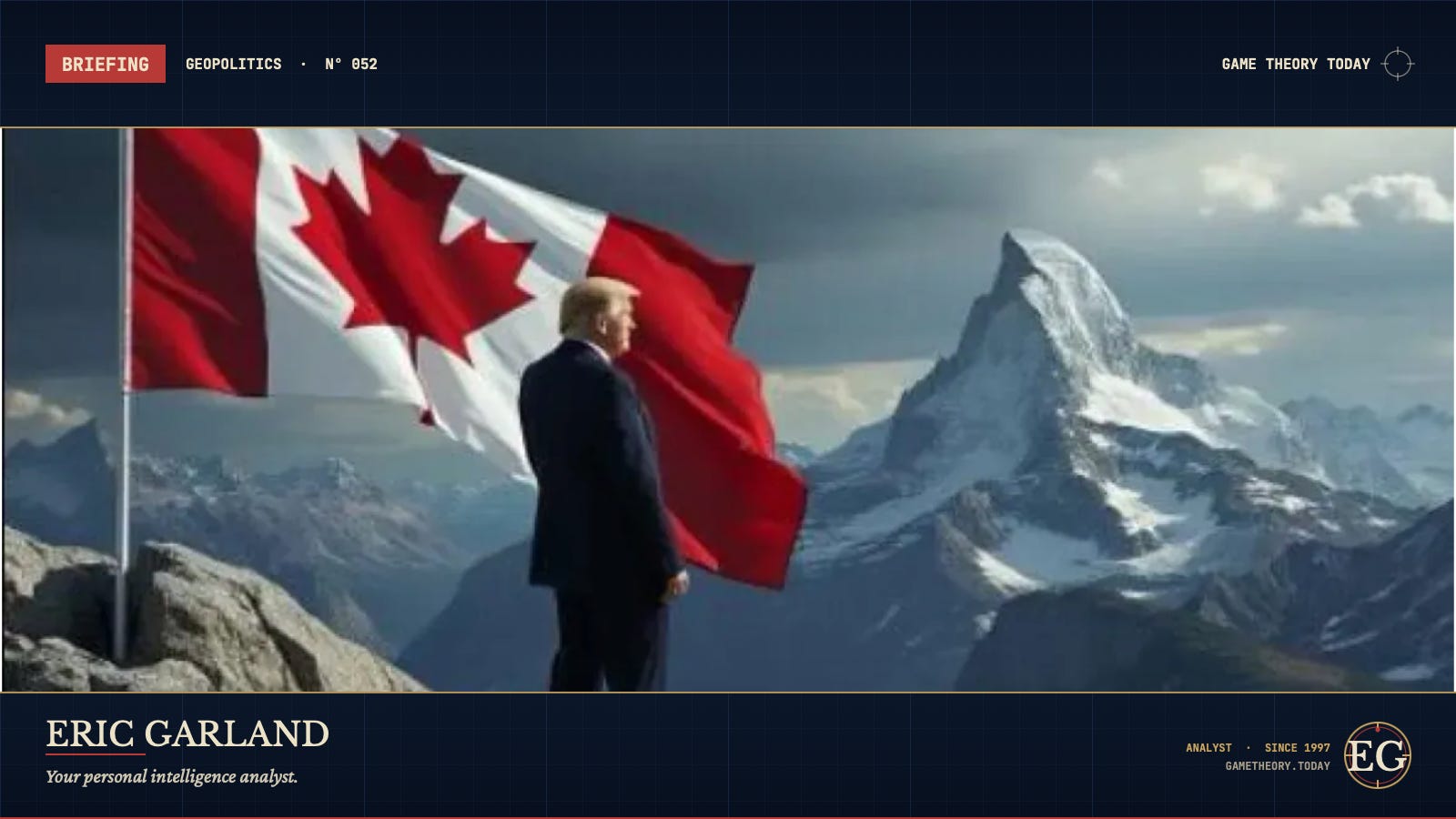
Trump got Alberta and Ottawa metaphorically talking to each other at Thanksgiving again. Canadian Thanksgiving. The one in October. It’s not a perfect relationship yet. But it’s a really fascinating start. And they have the same guy to thank who put a picture of Switzerland’s Matterhorn next to a red maple leaf and insinuated he was going to annex their country.
I think Trump’s Canadian political move fell undeniably in the category of: it was stupid, and it worked.
Unless you study separatist movements closely, you might not know that Canada has a sovereignty movement that seriously threatens unity—and it’s not the French one. The Alberta-Ottawa relationship has been the festering wound at the center of Canadian federalism for the better part of five decades. It produced the National Energy Program of 1980, which Albertans still invoke almost the same way Americans invoke Pearl Harbor. It produced the Kyoto Protocol fights, the pipeline cancellations, the equalization payment resentments, the periodic western separatist movements, and a political culture in which the word “Ottawa” functions in Calgary the way “Brussels” functions at pubs in the United Kingdom — as shorthand for an alien bureaucracy extracting wealth from productive people, some of whom have such bad taste they even speak French.
That wound may not be closed. But it is, for the first time in a generation, being addressed. And the doctor who finally lanced the boil was a man who probably can’t quote the Red Green Show, uses beaver as the punchline to very different jokes, and likely can’t detail the three elements of a Gordie Howe hat trick.
The Albertan Status Quo-disrupted
Alberta, in western Canada, sits on the largest proven oil reserves in the Western Hemisphere outside Venezuela — approximately 165 billion barrels of recoverable oil sands bitumen, with production capacity of over 4 million barrels per day and climbing.
For most of its history as a major producer, Alberta has had exactly one customer: the United States, reached through a network of pipelines so deeply integrated with American Midwest refining infrastructure that “energy independence” for either country is largely a fiction. Almost all of Canada’s crude oil exports — roughly 97% before 2024 — flowed south across the border.
This geographic captivity was the source of Alberta’s chronic economic anxiety. With only one buyer, you have no price-setting power. The Western Canadian Select crude that Alberta produces has historically traded at a discount of $15 to $40 per barrel below the American benchmark, West Texas Intermediate — a discount that exists precisely because Alberta oil is landlocked and its producers have nowhere else to go. For the oil patch, this discount represented billions of dollars in lost annual revenue, a permanent tax imposed by geography. Every pipeline proposal that would have connected Alberta to tidewater — Northern Gateway to the British Columbia coast, Energy East to New Brunswick — was blocked by environmental review processes, Indigenous rights litigation, and a federal political culture in Ottawa that was ambivalent about oil sands expansion.
The federal-provincial relationship became a proxy war. Alberta saw Ottawa as actively suppressing its economic development to appease Ontario and Quebec voters, and a left-leaning coastal environmental movement, at Alberta’s expense. Ottawa saw Alberta as a recalcitrant province demanding the right to externalize environmental costs onto the planet while expecting equalization transfers when oil prices fell. Both approaches threatened the harmony and prosperity of Canada’s energy policy without helping the country achieve economic independence from its southern neighbor.
Then Trans Mountain opened. The expanded pipeline, connecting Alberta’s oil sands to the Port of Vancouver, almost immediately began doing what every cancelled pipeline had promised to do: it gave Alberta producers somewhere else to sell. Within eighteen months, Canadian exports to non-US markets had grown nearly 300%, and the chronic discount on Alberta crude had started to narrow. The landlocked colony had its first tentative path to the sea.
But then, Trump started threatening tariffs. And then, perhaps without intending to, the most-important-Canadian-political-figure-who-isn’t-Canadian handed Alberta and Ottawa a common enemy, a common interest, and a common project — simultaneously.
Trump defeats Pierre Poilievre through stupid tweets
Pierre Poilievre was the leader of the Canadian Conservative Party, the heir to Stephen Harper’s political legacy, and one of the few national politicians in any country who refused to allow a background check so he could receive classified briefings. And yet, he still wanted to be Prime Minister of Canada. He might have made a challenging partner for any United States President.
That didn’t concern Canadian voters, though. Poilievre entered the final stretch of the Trudeau era in an apparently unassailable position. In December 2024, the Conservatives led by 22 points — 43% to 21% for the Liberals — with 69% of Canadians dissatisfied with the Trudeau government and only 15% believing it deserved re-election. Trudeau’s approval had fallen to 28%, tied for his lowest point in over nine years in office, while fewer than two in five Canadians viewed Poilievre favorably — but his negatives were still significantly better than Trudeau’s, and the desire for change was overwhelming.
Then, Trump began yammering about annexing Canada.
On January 6, 2025, Trudeau announced his resignation. Crucially, on the day of Trump’s inauguration two weeks later, Canada’s national polls had the Conservatives still 23 points ahead of the Liberals. The polls had hardly budged from Trudeau’s departure.
Then, Donald Trump talked about tariffs—big beautiful, crushing tariffs—which Canada could get around by selling their country to the United States.
On January 16, 2025, Mark Carney, the former Governor of both the Bank of Canada and the Bank of England, announced his intent to lead the Liberal Party. He was soon joined on the campaign trail by Canadian icon Mike Myers—who actually is my neighbor here in Vermont—because history sometimes requires Austin Powers and Wayne’s World to make sense. Canadians then rallied to cries of “Canada Is Not For Sale” and put their elbows up for some reason, and the polls shifted a tectonic twenty points overnight.
Mark Carney won, and he was willing to have his background checked so he could receive classified briefings.
And then, things got considerably less stupid, and Trump and Carney seemed to simply get back to being close geopolitical partners.
Carney’s professional formation—central banking, international finance, multilateral institution management—gave him the credibility to do what no recent Liberal leader had managed: engage with Alberta on its own terms, speak the language of energy economics rather than environmental symbolism, and make the case that national energy sovereignty was a progressive cause, not a conservative one. The Memorandum of Understanding with Alberta was the one of the most consequential acts of federal-provincial reconciliation since the Meech Lake era, and it was achieved not through constitutional negotiation but through a shared assessment of geopolitical risk.
Alberta Premier Danielle Smith, although not unwilling to start some political firestorms, brought to the table a pragmatism that her predecessors often lacked. The political incentive structure had shifted. The choice was no longer “fight Ottawa for pipeline approvals” versus “accept federal obstruction.” It was “work with Ottawa on a pipeline that Washington’s behavior has made obviously necessary” versus “watch Alberta’s market power remain permanently constrained.” Smith chose the former, and the result is the closest thing to genuine federal-provincial energy consensus that Canada has seen in living memory.
Canada and the U.S. in the tariff era
In March 2025, the Trump administration imposed tariffs on Canadian goods under the International Emergency Economic Powers Act — 25% on most imports, 10% on energy. The energy carve-out was carefully calibrated: American Midwest refineries run on Canadian heavy crude and cannot easily substitute for it, so destroying that supply relationship would damage American consumers and American refinery operators more than it would hurt Alberta. More than 70% of US refining capacity is configured to process heavier imported crude, and the Midwest refinery complex that depends on Canadian oil sands bitumen cannot be reconfigured overnight, or perhaps ever. The threat was real enough to generate genuine alarm, but the implementation preserved the physical oil flows that neither country could actually afford to disrupt.
This is the tell. The 51st state rhetoric was political theatre calibrated not to actually disrupt the infrastructure that American Midwest refineries — the industrial backbone of states like Ohio, Indiana, Wisconsin, and Minnesota — depend on for their daily operations. Canada was the demonstration that no relationship is sacred, no historical partnership provides immunity, no amount of goodwill substitutes for leverage. Every other American trading partner watching the spectacle recalibrated accordingly. But the energy flows? Those continued.
What the tariff threat accomplished was something no Canadian politician had managed to achieve in decades: it made Alberta’s energy security argument into a federal government priority. For years, Alberta Premier Smith had been demanding federal support for pipeline expansion to tidewater. For years, successive federal governments had offered varying degrees of rhetorical support combined with regulatory processes that produced no pipelines. The calculus changed fundamentally when the United States demonstrated that Canada’s near-total dependence on the American market was a vulnerability that an adversarial administration could weaponize. Suddenly the Alberta argument — that Canada needed energy export diversification for national security reasons — was not a provincial demand. It was a federal emergency.
The result was the November 2025 Canada-Alberta Memorandum of Understanding: a sweeping energy agreement that effectively ended the decade-long antagonism between Ottawa and Edmonton over pipeline approvals. The federal government committed to supporting a new oil pipeline from Alberta to the northern British Columbia coast, provisionally named the West Coast Oil Pipeline, with capacity of approximately 1 million barrels per day. The project is envisioned as Indigenous co-owned, with Alberta planning to submit a formal application to the federal Major Projects Office by July 2026, with Prince Rupert as the leading candidate for the terminal location.
For context: this is the pipeline that Ottawa killed when it cancelled Northern Gateway in 2016. The project that federal environmental policy deemed unacceptable a decade ago is now federal policy. The change was not driven by any ideological conversion in Ottawa. It was driven by Donald Trump making clear that Canada’s dependence on a single export market was a strategic liability that Washington was willing to exploit.
The paradox: still in Washington’s orbit, but on a path to true sovereignty
Here is where the story becomes genuinely interesting from a strategic standpoint: the West Coast Oil Pipeline project, if completed, would not remove Canada from the American oil market. It would change the terms on which Canada participates in it.
Canada currently sends approximately 3.9 million barrels per day to the United States — more than America imports from any other country on earth, and more than America imports from all other countries combined. Those flows are not going to stop. The pipeline infrastructure connecting Alberta to the American Midwest is too deeply integrated, the American refineries configured for Canadian heavy crude are too numerous, and the economics of proximity are too favorable. The United States will remain Canada’s largest oil customer for the foreseeable future.
What the new pipeline adds is not an exit from the American relationship. It is leverage within it. When Canada has 1 million barrels per day of additional capacity flowing to Asian markets, the WCS discount compresses further. When the discount compresses, the implicit subsidy that Canadian producers have been providing to American refineries for decades shrinks. Alberta gets a better price for its oil even when selling to American buyers, because those buyers now know that the alternative exists.
The Trans Mountain expansion already demonstrated this dynamic at smaller scale — the WCS discount narrowing from $15 to under $10 per barrel was not a regulatory achievement or a policy success. It was the market responding to the existence of genuine alternatives. A new pipeline moving a million barrels per day to Prince Rupert would deepen that effect substantially.
This is, paradoxically, exactly what Washington’s broader energy strategy needs from Canada. A Canada with genuine pricing power and diversified export markets is a Canada that participates in the American energy sphere by choice rather than by captivity. Partners who choose to stay are more reliable than partners who have no option to leave. And in the context of the broader restructuring of the Western Hemisphere oil market — with Venezuela now under American management, with Iran’s production disrupted, with the United States itself producing at record levels — Canada’s 4.9 million barrels per day of production is not merely a bilateral energy relationship. It is a cornerstone of American hemispheric oil dominance. Washington needs that cornerstone to be solid, politically stable, and in the hands of a government that can be trusted. The combination of Carney’s credibility and Alberta’s reconciled participation in the national project provides exactly that.
There is something almost elegantly perverse about the conclusion this leads to. Donald Trump, through tariffs he calibrated to threaten without fully disrupting, through annexation rhetoric he deployed to demonstrate dominance without intending to act on it, through the political chaos he created that elevated exactly the Canadian leader best suited to manage the relationship — achieved something that decades of conventional diplomacy had failed to produce. He made Canada stronger, more internally coherent, and more strategically valuable to the United States, all while appearing to do the opposite. Canadians should be reminded that our President is a member of the Screen Actors Guild and has literally played a wrestling heel on televisions, so it is not like there weren’t warning signs.
If it’s stupid but it works — it’s not stupid. And this actually wasn’t stupid.
Alberta and Ottawa are, for the first time in living memory, pulling in the same direction. As unusual as it felt, and as awkward as it is to recognize, Donald Trump accomplished that to zero applause.
You’re welcome, Canada. And sorry!
This analysis draws on Donald Trump’s stupid tweets, on Q1 2026 market data, EIA production and trade figures, the Canada Energy Regulator’s pipeline throughput reports, ATB Economics analysis of Trans Mountain revenues, and the Congressional Research Service’s March 2026 U.S.-Canada Trade Relations brief. The West Coast Oil Pipeline project remains in preliminary assessment; no final investment decision has been made.
First published on Game Theory Today (Substack), April 13, 2026.