How to Listen to TV News Experts
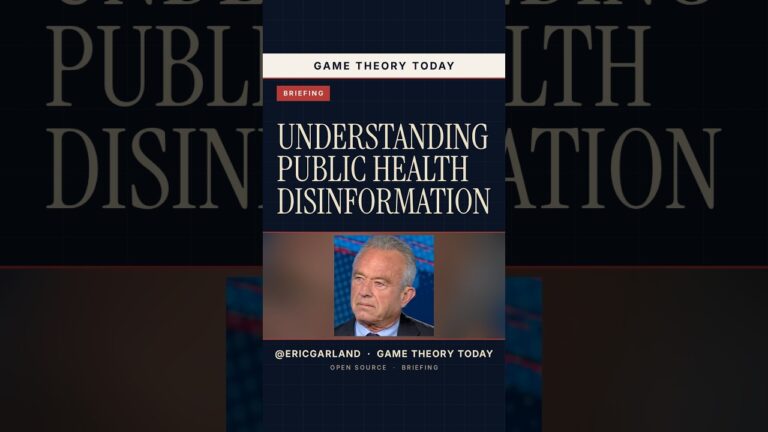
CNN put the Secretary of Health and Human Services in front of Dana Bash on August 2nd and it went off the rails. She pressed him on vaccines, cited the weight of the studies, and named the National Academy of Sciences and the American Academy of Pediatrics. He told her she was deferring to experts instead of reading the underlying research. Set aside who was right, because there’s a harder question underneath it that nobody in that studio was assigned to answer: how does a non-expert sort it out when the experts disagree?
Scientists have peer review, but you need to be an expert to follow the argument. Law reviews are the same. Television has nothing. The institution that has actually built a procedure for handing expert opinion to people who aren’t experts is the court system — because a jury is twelve non-specialists asked to decide something technical on a deadline. That’s the same problem the rest of us have every night, formalized, with three centuries of case law behind it.
Here are the three answers American courts have given. Before 1923 we ran on inherited English common law: a lawyer put a man on the stand, called him an expert, and the adversarial system was supposed to sort it out on cross-examination. Then in 1923 the D.C. Circuit decided Frye v. United States — not the Supreme Court, which is the most common mistake made about this case — and held that the thing from which the deduction is made must be “sufficiently established to have gained general acceptance in the particular field in which it belongs.” General acceptance. Not is it true — is it accepted. That test counts the room.
Then Daubert v. Merrell Dow Pharmaceuticals, Supreme Court, 1993. Daubert gave judges five questions to ask about the method itself: is the theory testable and falsifiable, has it been through peer review and publication, is there a known or potential rate of error, are there controls governing how the technique gets applied, and is it generally accepted in the field. Frye’s question survived — it just stopped being the only question. Consensus went from being the whole test to one factor among five, and the other four all ask whether the work holds up. Today most courts use Daubert, a few states still run on Frye, and some state courts — Missouri among them — let the judge decide who to hear regardless.
Which is what makes that interview worth watching twice. The case against Kennedy was a Frye case: a great many qualified people disagree with you. That’s a real argument, and it’s the 1923 one. His counter — go read the underlying studies — is Daubert-shaped, which is also the shape every crank uses, and that’s precisely why the courts never stopped at “go read it.” Daubert doesn’t ask you to trust the maverick. It asks him for his error rate. Nobody asked either of them those questions, because nobody in a television studio has that job.
I’m Eric Garland. I’ve spent 30 years in strategic intelligence practice, and I’m personally sanctioned by the Russian Federation for my work on Russian intelligence operations. On Game Theory Today I walk through the questions a professional analyst actually asks about the news, not the answers you’re handed.
🔔 Subscribe for daily geopolitical intelligence analysis. Follow on X @ericgarland. Full long-form analysis on Substack. 🎤 Book Eric to speak: · Leading Authorities — https://www.leadingauthorities.com/speakers/eric-garland · Executive Speakers Bureau — https://www.executivespeakers.com/speaker/eric-garland · Chartwell Speakers — https://www.chartwellspeakers.com/speaker/eric-garland/
SOURCES
Frye v. United States, 293 F. 1013 — Court of Appeals of the District of Columbia, December 3, 1923
Daubert v. Merrell Dow Pharmaceuticals, Inc., 509 U.S. 579 — U.S. Supreme Court, June 28, 1993
Federal Rule of Evidence 702 — as amended effective December 1, 2023
Missouri Rev. Stat. § 490.065 — amended effective August 28, 2017
CNN, “State of the Union” — August 2, 2026; CNN Politics fact-check, same day